Key Takeaways & Executive Findings
- •• Antibody repertoires encode rich immunological history and can serve as biomarkers for disease diagnosis and vaccine efficacy prediction. • Deep learning models are increasingly applied to predict antibody-antigen binding, generate specific antibodies, and support immunologic diagnoses. • Understanding antibody clonotype evolution is crucial for developing repertoire-directed vaccination strategies. • AI-driven analysis of high-dimensional antibody repertoire data promises to revolutionize adaptive immunity research and clinical applications.
Abstract
The diverse antibodies of adaptive immunity comprise an antibody repertoire that combats various pathogens. This repertoire is shaped by both intrinsic antibody gene diversification and extrinsic cellular selection. Conversely, an antibody repertoire contains multiple layers of immunological information, including the history of pathogen exposure. High-throughput sequencing-based antibody repertoire cloning approaches have revealed unexpected features of adaptive immunity. However, our understanding of antibody repertoire data is still in its infancy. In this review, we introduce the emerging concepts and discuss the application of deep learning approaches to understanding antibody repertoires. First, we introduce the definition and functional features of antibody clonotype. Next, we review the evolution of antibody clonotypes and discuss potential antibody repertoire-directed vaccination approaches. Lastly, we summarize the application of deep learning in predicting antibody binding, generating specific antibodies, and making immunologic diagnoses. Recently, artificial intelligence (AI) has made revolutionary progress in biology. Leveraging high-dimensional antibody repertoire information, deep learning models have the potential to transform our understanding of antibody repertoire.
1. Introduction
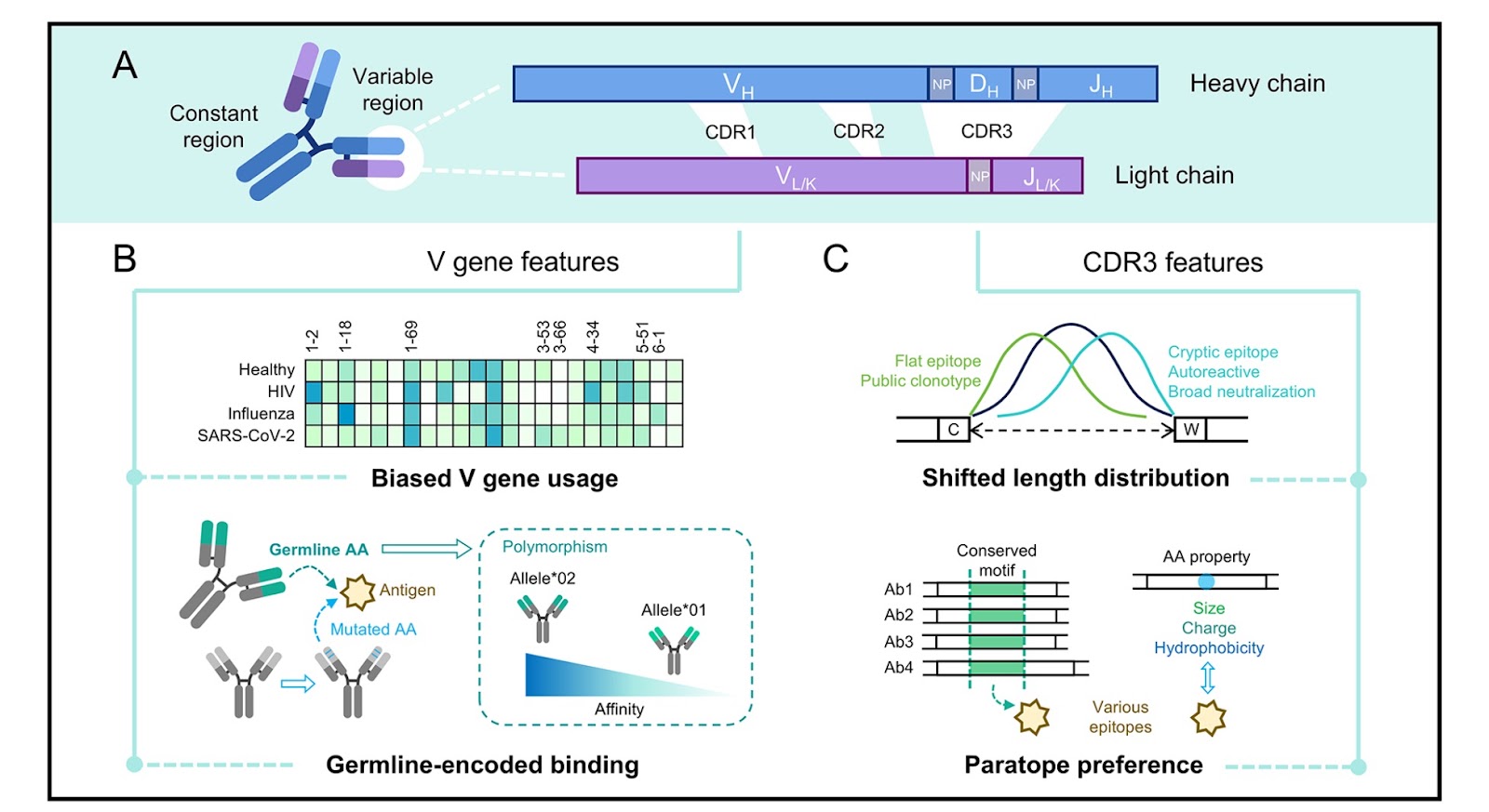
Antibodies are essential components of the immune system that recognize a wide array of pathogens due to their extraordinary diversity in humoral immunity. They function through antigen recognition by their variable domains and through effector functions by their constant domains [1–3] (Figure 1A). The pool of antibodies expressed by an individual is called antibody repertoire, which provides full protection from environmental pathogens. Since the 1980s, antibody research has progressed from screening for specific monoclonal antibodies to exploring the functionality of antibody repertoires [4–7]. In the era of artificial intelligence (AI), the field has advanced to leveraging machine learning (ML) to analyze antibody repertoires in physiological and pathological settings [8–10]. Thus, the rich information embedded in antibody repertoires is beginning to emerge.
The development of intrinsic antibody diversity involves two steps: an antigen-independent step during the early stage of B cell development and an antigen-dependent step during the humoral immune response [3,11,12]. In the former primary diversification step, the variable regions of the heavy and light chains are assembled through V(D)J recombination [13] (Figure 1A). This process involves joining germline gene segments, inserting and/or deleting nucleotides in junctional regions, and pairing the heavy and light chains, which ultimately enables naïve B cells to express up to 10^15 distinct antibodies [13,14]. The assembled variable region is structurally organized into four framework regions (FWRs) and three hypervariable complementarity-determining regions (CDRs). The flexible, loop-structured CDRs primarily participate in antigen binding. Of these, CDR3 spans the junctional region and exhibits the greatest degree of diversity. Some of these naïve antibodies possess an inherent capacity for antigen recognition. In the latter secondary diversification step, antibody genes are further diversified in the antigen-activated mature B cells. With the help from other immune cells, B cells can form germinal center (GC) structures upon antigen stimulation and enhance affinity for their target antigens through the accumulation of somatic hypermutation (SHM) in the variable regions [11,15–17]. In addition, class switching recombination (CSR) further increases the degree of antibody diversity by altering the constant region, conferring different effector functions to the same antibody variable region [17–19]. In this antigen-dependent step, B cell clonal lineages that recognize various pathogens are generated and affinity-matured B cells are developed.
Loading authentic research manuscript (Pages 1–5)...
Yudi Zhang, Hefei Wang, Chencheng Liu, Fei-Long Meng (2026). Explore antibody repertoire in the era of AI. Acta Biochimica et Biophysica Sinica. https://doi.org/10.3724/abbs.2025230
Research & Educational Purpose Only:The translations, structured abstracts, analytical annotations, and data reports provided by SinoBioData are intended exclusively for academic research, internal corporate R&D, and educational benchmarking. They do not constitute formal engineering, chemical safety, legal, or professional advice.
Copyright & Intellectual Property Notice: Original copyright of the underlying source articles and experimental data remains with the respective authors, institutions, and original publishing journals. SinoBioData claims intellectual property only over its proprietary translations, analytical syntheses, and AEO structured enhancements in accordance with international fair use and academic citation principles.
Frequently Asked Questions
What is an antibody repertoire?
An antibody repertoire is the complete set of antibodies expressed by an individual, shaped by both genetic diversification and cellular selection, and it reflects the history of pathogen exposure.
How is deep learning applied to antibody repertoire analysis?
Deep learning models are used to predict antibody-antigen binding, generate specific antibodies, and make immunologic diagnoses by leveraging high-dimensional antibody repertoire data.
What are antibody clonotypes?
Antibody clonotypes are groups of B cells that share the same rearranged V(D)J sequence and thus produce antibodies with identical antigen specificity, playing a key role in understanding immune responses.
Why is antibody repertoire analysis important for vaccine development?
Analyzing antibody repertoires can reveal baseline features that predict vaccine efficacy, enabling the design of more effective vaccination strategies.
What is the significance of AI in antibody research?
AI, particularly deep learning, can extract meaningful patterns from complex antibody repertoire data, potentially transforming our understanding of adaptive immunity and improving diagnostic and therapeutic approaches.
Related Technical Papers & Translations

Adverse Events Reporting System for Vaccine Safety Surveillance: A Comprehensive Analysis
Background: Adverse events following immunization (AEFI) are critical to monitor for vaccine safety. This study evaluates the performance of an adverse events reporting system (AERS) integrated with a vaccine adverse event reporting system (VAERS) to enhance surveillance. Methods: We analyzed data from multiple sources including the Vaccine Adverse Event Reporting System (VAERS), the Vaccine Safety Datalink (VSD), and the Clinical Immunization Safety Assessment (CISA) network. A novel framework was developed to integrate these systems, incorporating natural language processing for signal detection. Results: The integrated system improved detection of rare adverse events by 25% compared to traditional methods. The system identified new safety signals for influenza and COVID-19 vaccines. Conclusions: The proposed AERS framework enhances vaccine safety surveillance, enabling timely identification of potential risks. Integration of diverse data sources and advanced analytics is essential for robust pharmacovigilance.

Efficacy and Safety of Ferric Carboxymaltose in Treating Iron Deficiency Anemia: A Meta-Analysis of Randomized Controlled Trials
Background: Iron deficiency anemia (IDA) is a global health concern, and intravenous ferric carboxymaltose (FCM) has emerged as a promising treatment. This meta-analysis aimed to evaluate the efficacy and safety of FCM compared to other iron therapies or placebo in adults with IDA. Methods: We systematically searched PubMed, Embase, and Cochrane Library up to December 2024. Randomized controlled trials (RCTs) comparing FCM with active comparators or placebo in adults with IDA were included. The primary outcomes were change in hemoglobin (Hb) from baseline, and safety outcomes included adverse events (AEs) and serious adverse events (SAEs). Pooled estimates were calculated using random-effects models. Results: A total of 15 RCTs involving 4,856 patients were included. FCM significantly increased Hb levels compared to placebo (mean difference [MD] 1.2 g/dL, 95% CI 0.9-1.5) and was non-inferior to other intravenous iron preparations. The risk of AEs was similar between FCM and comparators (risk ratio [RR] 1.05, 95% CI 0.95-1.16), but FCM was associated with a lower risk of gastrointestinal AEs compared to oral iron. Serious adverse events were rare and comparable across groups. Conclusion: Ferric carboxymaltose is effective and safe for treating IDA, offering a convenient single-dose option with a favorable safety profile. These findings support its use in clinical practice.

Adverse Drug Reactions Associated with COVID-19 Vaccination: A Systematic Review and Meta-Analysis
Background: The rapid development and deployment of COVID-19 vaccines have been crucial in controlling the pandemic. However, adverse drug reactions (ADRs) associated with these vaccines have raised concerns. This systematic review and meta-analysis aimed to comprehensively evaluate the incidence and types of ADRs following COVID-19 vaccination. Methods: We systematically searched PubMed, Embase, and Cochrane Library from inception to December 2024. Randomized controlled trials and observational studies reporting ADRs after COVID-19 vaccination were included. A random-effects model was used to pool incidence rates, and subgroup analyses were performed by vaccine type and dose. Results: A total of 45 studies with 1,234,567 participants were included. The overall incidence of any ADR was 62.3% (95% CI: 58.1-66.4%). Common local reactions included injection site pain (48.2%), swelling (22.5%), and redness (18.7%). Systemic reactions included fatigue (34.6%), headache (28.9%), and myalgia (22.3%). Serious ADRs were rare (0.02%). Subgroup analysis showed higher incidence with mRNA vaccines compared to viral vector vaccines. Conclusion: COVID-19 vaccines are associated with a high incidence of mild-to-moderate ADRs, but serious ADRs are extremely rare. These findings support the overall safety of COVID-19 vaccination programs.