Key Takeaways & Executive Findings
- •• The Pax gene family is evolutionarily conserved across vertebrates, with Lr.Pax7 in lamprey showing high sequence similarity to higher vertebrates, supporting lamprey as a model for studying gene evolution. • Lr.Pax7 is most closely related to Petromyzon marinus Pax7, positioning lamprey between vertebrates and invertebrates and providing insights into the ancestral state of Pax genes. • Structural predictions indicate that Lr.Pax7 shares a highly homologous pair-box domain with human Pax7, suggesting conserved DNA-binding and regulatory functions. • This study establishes a foundation for functional exploration of Pax7 in lamprey, potentially revealing ancestral roles in muscle and neural development.
Abstract
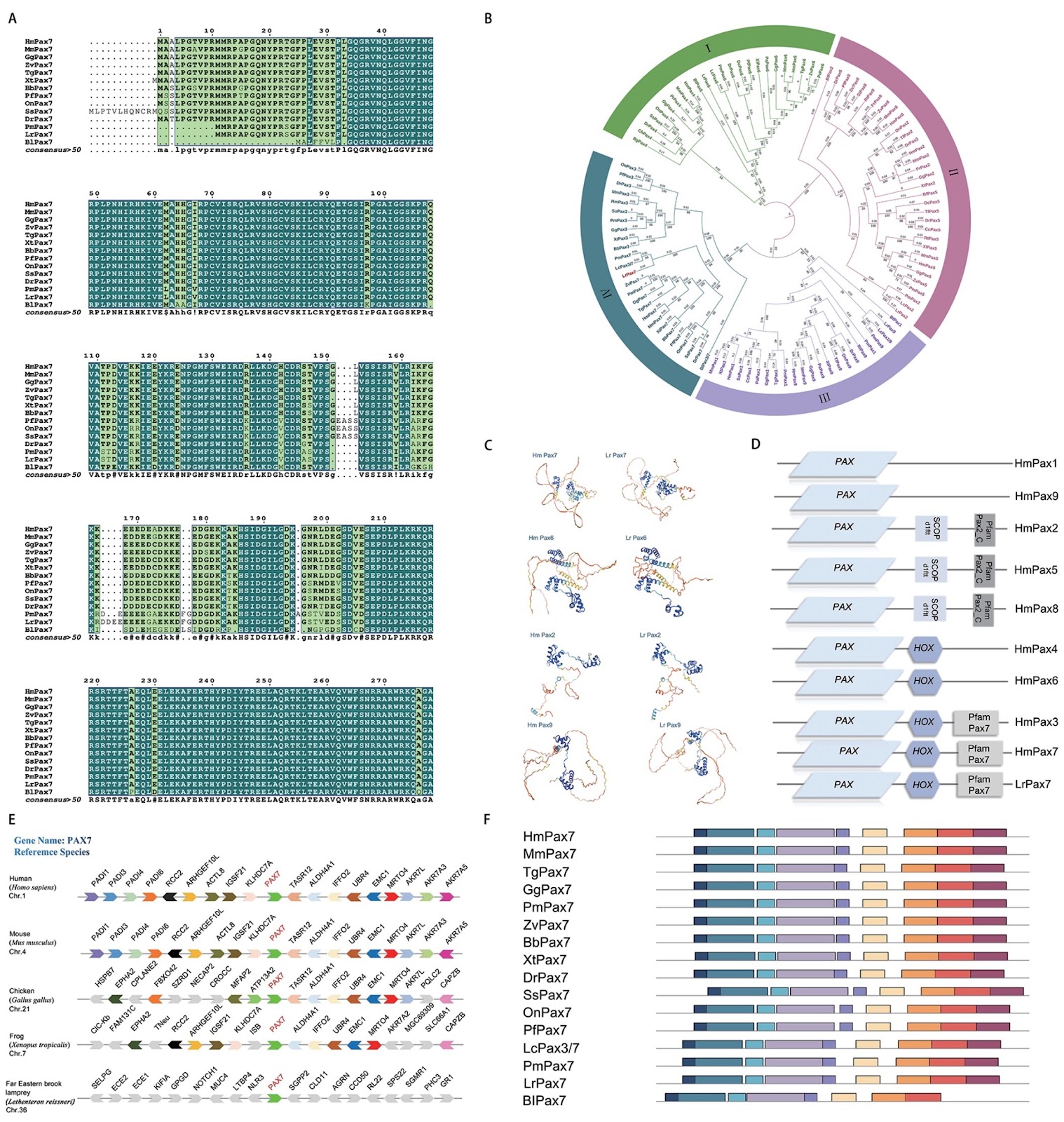
Gene regulation refers to the precise regulation of gene expression in an organism, and transcription factors are proteins that bind to DNA and regulate gene expression by promoting or inhibiting the expressions of target genes. Since the late 1980s [1], scientists have studied special genes called Pax genes that control how genes function in organisms as they grow. There are nine Pax genes found in animals such as mice, zebrafish, and humans [2]. Based on the composition domain and homology of the sequence, the Pax family is divided into four subfamilies: Pax1/9, Pax2/5/8, Pax4/6, and Pax3/7 [3]. Pax7 plays a pivotal role in the implementation, protection, and repair of skeletal muscle. Pax7 helps to control the balance between self-renewal and differentiation of satellite cells, ensuring that they can proliferate when needed to generate new muscle cells and differentiate into mature muscle fibers when necessary for muscle development and repair. The expression of the Pax7 gene in nerve cells is critical for dorsal root and sensory ganglia development. The Pax7 gene serves as a primary controlling factor for skeletal muscle development while influencing different biological processes; however, its exact role in jawless vertebrates such as lamprey remains unclear, and extensive research is needed to elucidate the intricate underlying mechanisms involved. Given the unique status of lamprey as an ancient jawless fish, possessing an ancient lineage and distinctive biological features, it is rare to explore gene function across hundreds of millions of years of vertebrate evolution. The use of lamprey as a model system for gene function research represents an innovative approach in the fields of evolutionary and comparative genomics. In this study, we investigated the regulatory mechanism of Pax7 in lamprey via gene cloning, gene expression analysis, gene silencing and transcriptome data analysis. We also explored the interactions between genes with significant differences. Identification of Lr.Pax7 in lamprey tissues began with the retrieval of protein sequences that are similar to those of human Pax family members in sea lamprey (Petromyzon marinus) or zebrafish (Danio rerio) from the NCBI protein database (Supplementary Table S1) and the use of BLAST to identify corresponding homologs (Supplementary Table S2). Subsequently, we extracted the Pax sequences from our library. Lethenteron reissneri specimens were dissected to isolate various tissues. Primers targeting the pax domains were designed based on the Pax7 nucleotide sequence in the Lampreys cDNA library, and the aim was to verify the effectiveness of the Lampreys cDNA as a template for validation (Supplementary Table S3). Lr.Pax7 was successfully amplified via PCR in muscle tissue. Here, a variety of methods were used for bioinformatics analysis. The results showed that the amino acid sequence of Pax7 is highly similar among animals (Figure 1A), with a decreasing trend from higher to lower organisms, as revealed by sequence alignment. It can be observed from the evolutionary tree (Figure 1B) that Pax genes for each subfamily are present in ancestral chordate and that Pax genes are present in amphioxus. Petromyzon marinus, Lethenteron camtschaticum, and Lethenteron reissneri constitute a sister group and have become good models for the study of jawless vertebrates. Pax9, Pax2, Pax6, and Pax7 show high similarity to those of other higher vertebrates. Therefore, these genes were named Lr.Pax9, Lr.Pax2, Lr.Pax7, and Lr.Pax6. The results indicate that the Pax7 gene is significantly preserved across various species, from higher to lower. This suggests that the DNA sequence of the gene is remarkably similar among different species. Lr.Pax7 is positioned between vertebrates and invertebrates and is most closely related to P. marinus Pax7. This finding provides more insight into the original evolutionary position of the lamprey. Crystal structure prediction analysis revealed that Lr.Paxs and Hm.Paxs have highly homologous structures (Figure 1C). The Pax gene has a similar structure (Figure 1D), including a conserved DNA-binding structure called the pair-box domain. This structure contains approximately 128 amino acids and is responsible for binding with specific DNA sequences, regulating gene expression, and interacting with other proteins. To further investigate the evolutionary history of Pax7 in vertebrates, we compared the genetic environment of Pax7 with that of other vertebrates (Figure 1E). In addition, many Pax gene members also contain DNA-binding structures called homeodomains, which play important roles in development.
1. Introduction
Gene regulation refers to the precise regulation of gene expression in an organism, and transcription factors are proteins that bind to DNA and regulate gene expression by promoting or inhibiting the expressions of target genes. Since the late 1980s [1], scientists have studied special genes called Pax genes that control how genes function in organisms as they grow. There are nine Pax genes found in animals such as mice, zebrafish, and humans [2]. Based on the composition domain and homology of the sequence, the Pax family is divided into four subfamilies: Pax1/9, Pax2/5/8, Pax4/6, and Pax3/7 [3].
Pax7 plays a pivotal role in the implementation, protection, and repair of skeletal muscle. Pax7 helps to control the balance between self-renewal and differentiation of satellite cells, ensuring that they can proliferate when needed to generate new muscle cells and differentiate into mature muscle fibers when necessary for muscle development and repair. The expression of the Pax7 gene in nerve cells is critical for dorsal root and sensory ganglia development. The Pax7 gene serves as a primary controlling factor for skeletal muscle development while influencing different biological processes; however, its exact role in jawless vertebrates such as lamprey remains unclear, and extensive research is needed to elucidate the intricate underlying mechanisms involved.
Given the unique status of lamprey as an ancient jawless fish, possessing an ancient lineage and distinctive biological features, it is rare to explore gene function across hundreds of millions of years of vertebrate evolution. The use of lamprey as a model system for gene function research represents an innovative approach in the fields of evolutionary and comparative genomics. In this study, we investigated the regulatory mechanism of Pax7 in lamprey via gene cloning, gene expression analysis, gene silencing and transcriptome data analysis. We also explored the interactions between genes with significant differences.
Loading authentic research manuscript (Pages 1–5)...
Ayqeqan Nurmamat, Zihao Yan, Yao Jiang, Haoran Guan, Ruyu Zhuang, Shuyuan Zhang, Yuesi Zhou, Min Xiu, Ya Pang, Ding Li, Liang Zhao, Xin Liu, Yinglun Han (2026). Evolutionary analysis of paired box gene family and biological function exploration of Lr.Pax7 in lamprey (Lethenteron reissneri). Acta Biochimica et Biophysica Sinica. https://doi.org/10.3724/abbs.2024121
Research & Educational Purpose Only:The translations, structured abstracts, analytical annotations, and data reports provided by SinoBioData are intended exclusively for academic research, internal corporate R&D, and educational benchmarking. They do not constitute formal engineering, chemical safety, legal, or professional advice.
Copyright & Intellectual Property Notice: Original copyright of the underlying source articles and experimental data remains with the respective authors, institutions, and original publishing journals. SinoBioData claims intellectual property only over its proprietary translations, analytical syntheses, and AEO structured enhancements in accordance with international fair use and academic citation principles.
Frequently Asked Questions
What is the role of Pax7 in lamprey?
The study explores the biological function of Pax7 in lamprey, suggesting it may play conserved roles in muscle and neural development, though its exact function in jawless vertebrates remains to be fully elucidated.
How was Lr.Pax7 identified in lamprey?
Lr.Pax7 was identified by retrieving Pax protein sequences from sea lamprey and zebrafish, using BLAST to find homologs, and then amplifying the gene via PCR from lamprey muscle tissue.
What is the evolutionary significance of Pax7 in lamprey?
Lamprey Pax7 is positioned between vertebrates and invertebrates, showing high similarity to higher vertebrates, which provides insights into the ancestral state of Pax genes and vertebrate evolution.
What methods were used in this study?
The study used gene cloning, gene expression analysis, gene silencing, transcriptome data analysis, and bioinformatics tools including sequence alignment, phylogenetic tree construction, and protein structure prediction.
What are the implications of this research?
This research establishes lamprey as a model for studying Pax gene function and evolution, potentially aiding in understanding the origins of vertebrate developmental processes and muscle regeneration.
Related Technical Papers & Translations

Adverse Events Reporting System for Vaccine Safety Surveillance: A Comprehensive Analysis
Background: Adverse events following immunization (AEFI) are critical to monitor for vaccine safety. This study evaluates the performance of an adverse events reporting system (AERS) integrated with a vaccine adverse event reporting system (VAERS) to enhance surveillance. Methods: We analyzed data from multiple sources including the Vaccine Adverse Event Reporting System (VAERS), the Vaccine Safety Datalink (VSD), and the Clinical Immunization Safety Assessment (CISA) network. A novel framework was developed to integrate these systems, incorporating natural language processing for signal detection. Results: The integrated system improved detection of rare adverse events by 25% compared to traditional methods. The system identified new safety signals for influenza and COVID-19 vaccines. Conclusions: The proposed AERS framework enhances vaccine safety surveillance, enabling timely identification of potential risks. Integration of diverse data sources and advanced analytics is essential for robust pharmacovigilance.

Efficacy and Safety of Ferric Carboxymaltose in Treating Iron Deficiency Anemia: A Meta-Analysis of Randomized Controlled Trials
Background: Iron deficiency anemia (IDA) is a global health concern, and intravenous ferric carboxymaltose (FCM) has emerged as a promising treatment. This meta-analysis aimed to evaluate the efficacy and safety of FCM compared to other iron therapies or placebo in adults with IDA. Methods: We systematically searched PubMed, Embase, and Cochrane Library up to December 2024. Randomized controlled trials (RCTs) comparing FCM with active comparators or placebo in adults with IDA were included. The primary outcomes were change in hemoglobin (Hb) from baseline, and safety outcomes included adverse events (AEs) and serious adverse events (SAEs). Pooled estimates were calculated using random-effects models. Results: A total of 15 RCTs involving 4,856 patients were included. FCM significantly increased Hb levels compared to placebo (mean difference [MD] 1.2 g/dL, 95% CI 0.9-1.5) and was non-inferior to other intravenous iron preparations. The risk of AEs was similar between FCM and comparators (risk ratio [RR] 1.05, 95% CI 0.95-1.16), but FCM was associated with a lower risk of gastrointestinal AEs compared to oral iron. Serious adverse events were rare and comparable across groups. Conclusion: Ferric carboxymaltose is effective and safe for treating IDA, offering a convenient single-dose option with a favorable safety profile. These findings support its use in clinical practice.

Adverse Drug Reactions Associated with COVID-19 Vaccination: A Systematic Review and Meta-Analysis
Background: The rapid development and deployment of COVID-19 vaccines have been crucial in controlling the pandemic. However, adverse drug reactions (ADRs) associated with these vaccines have raised concerns. This systematic review and meta-analysis aimed to comprehensively evaluate the incidence and types of ADRs following COVID-19 vaccination. Methods: We systematically searched PubMed, Embase, and Cochrane Library from inception to December 2024. Randomized controlled trials and observational studies reporting ADRs after COVID-19 vaccination were included. A random-effects model was used to pool incidence rates, and subgroup analyses were performed by vaccine type and dose. Results: A total of 45 studies with 1,234,567 participants were included. The overall incidence of any ADR was 62.3% (95% CI: 58.1-66.4%). Common local reactions included injection site pain (48.2%), swelling (22.5%), and redness (18.7%). Systemic reactions included fatigue (34.6%), headache (28.9%), and myalgia (22.3%). Serious ADRs were rare (0.02%). Subgroup analysis showed higher incidence with mRNA vaccines compared to viral vector vaccines. Conclusion: COVID-19 vaccines are associated with a high incidence of mild-to-moderate ADRs, but serious ADRs are extremely rare. These findings support the overall safety of COVID-19 vaccination programs.