Key Takeaways & Executive Findings
- •• α-Ketoglutarate (α-KG) is a critical metabolic intermediate that regulates bone metabolism by promoting osteogenesis, inhibiting osteoclast differentiation, and enhancing chondrocyte proliferation. • α-KG maintains the dynamic balance between bone formation and resorption, offering therapeutic potential for osteoporosis, osteoarthritis, rheumatoid arthritis, and bone tumors. • α-KG alleviates bone loss and inflammation in bone tissue, suggesting its role as a promising target for bone-related disease treatment. • The review clarifies the regulatory effects of α-KG on various bone and joint cells, providing a foundation for future clinical applications.
Abstract
Bone metabolism in bone tissue is constantly maintained in a state of dynamic equilibrium. The mass of bone and joint tissues is determined by both bone formation and bone resorption. It is hypothesized that disrupted metabolic balance leads to osteoporosis, osteoarthritis, rheumatoid arthritis, and bone tumors. Such disruptions often manifest as either a reduction or abnormality in bone mass and are frequently accompanied by pathological changes such as inflammation, fractures, and pain. α-Ketoglutarate (α-KG) serves as a pivotal intermediate in various metabolic pathways in mammals, significantly contributing to cellular energy metabolism, amino acid metabolism, and other physiological processes. α-KG may be a therapeutic target for a variety of bone-related diseases, such as osteoporosis, osteoarthritis, and rheumatoid arthritis, because of its role in maintaining the metabolic balance of bone. After the application of α-KG, bone loss and inflammation in bone tissue are alleviated. This review focuses on the regulatory effects of α-KG on various cells in bone and joint tissues. Owing to the regulatory effect of α-KG on the balance of bone metabolism, the application of α-KG in the treatment of osteoporosis, osteoarthritis, rheumatoid arthritis, bone tumors, and other bone tissue diseases has been clarified.
1. Introduction
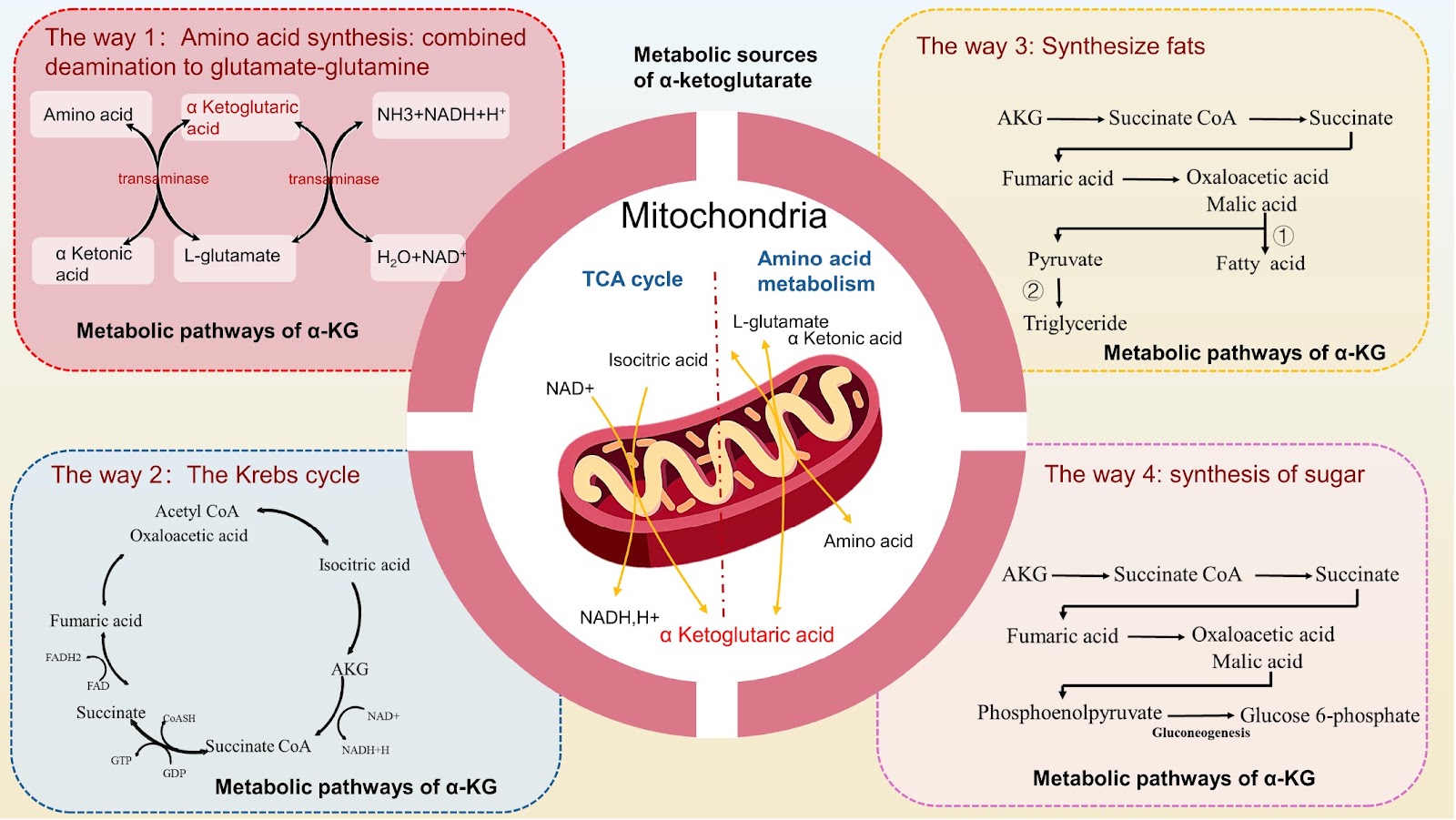
As an intermediate in a variety of metabolic processes, α-ketoglutarate (α-KG) is also known as 2-oxoglutarate and is closely involved in the energy metabolism process represented by carbohydrate metabolism in the body [1]. Carbohydrate metabolism depends on the energy supply of the tricarboxylic acid cycle (TCA), which is the main pathway for acetyl-CoA to completely decompose into water and carbon dioxide and generate energy, and it is also the precursor source of much biosynthesis [2]. α-KG, as a rate-determining intermediate, is crucial in cell energy metabolism because it connects intracellular carbon and nitrogen metabolism between isocitrate and succinyl coenzyme A. Additionally, α-KG is closely involved in the amino acid cycle [3]. As a precursor of amino acids such as glutamine and glutamic acid, α-KG plays a direct role in energy production and a wide range of cellular chemical reactions. α-KG provides an energy source, stimulating protein synthesis, inhibiting protein degradation in muscle, and serving as a significant metabolic fuel for gastrointestinal cells [2]. In the intestine, proline, leucine, and other amino acids are formed by α-KG in the intestinal epithelium [4]. Moreover, studies have shown that the synthesis of ketoglutarate reductive amination around blood vessels is also an important source of glutamic acid in bone tissue [5].
The dynamic balance between mature osteoblast activity and osteoclast activity involves complex processes affecting bone metabolism [6,7]. Various bone-related diseases are often accompanied by a loss of balance between osteoblast and osteoclast activity, as well as inflammatory lesions in cartilage and synovial tissue. Furthermore, the proliferation, differentiation and apoptosis of various cells in bone tissue are closely related to energy metabolism [8]. The activation of mitochondrial physiological activities and the metabolic transition to oxidative phosphorylation are involved in the differentiation, proliferation, and maturation of mesenchymal stem cells (MSCs) [9]. In one recent study, the levels of mitochondrial biogenesis-related proteins were found to be elevated, along with increased levels of tricarboxylate cyclase and respiratory chain complex subunits. This resulted in an increase in oxygen consumption, the mitochondrial membrane potential, and the intracellular ATP content, indicating that the oxidative metabolism of mitochondria is enhanced during bone metabolism [10]. The effect of α-KG on bone tissue is affected by a variety of mechanisms. The production and utilization of α-KG not only changes the bone metabolism balance but also affects bone mass. α-KG also affects the proliferation and differentiation of various cells in bone tissue by promoting osteogenesis, inhibiting osteoclast differentiation, and enhancing the proliferation of chondrocytes.
Loading authentic research manuscript (Pages 1–5)...
Zuping Wu, Yuzhe Guan, Qian Chen, Ruifeng Song, Jing Xie, Xin Zhang, Yan Wang, Qianming Chen, Xiaoyan Chen (2026). Essential role of the metabolite α-ketoglutarate in bone tissue and bone-related diseases. Acta Biochimica et Biophysica Sinica. https://doi.org/10.3724/abbs.2025020
Research & Educational Purpose Only:The translations, structured abstracts, analytical annotations, and data reports provided by SinoBioData are intended exclusively for academic research, internal corporate R&D, and educational benchmarking. They do not constitute formal engineering, chemical safety, legal, or professional advice.
Copyright & Intellectual Property Notice: Original copyright of the underlying source articles and experimental data remains with the respective authors, institutions, and original publishing journals. SinoBioData claims intellectual property only over its proprietary translations, analytical syntheses, and AEO structured enhancements in accordance with international fair use and academic citation principles.
Frequently Asked Questions
What is α-ketoglutarate and why is it important for bone health?
α-Ketoglutarate (α-KG) is a key intermediate in the tricarboxylic acid cycle and amino acid metabolism. It plays a crucial role in cellular energy metabolism and is involved in maintaining the dynamic balance between bone formation and resorption, thereby influencing bone mass and health.
How does α-ketoglutarate affect bone cells?
α-KG promotes osteogenesis (bone formation), inhibits osteoclast differentiation (bone resorption), and enhances chondrocyte proliferation, thereby supporting bone tissue integrity and function.
Which bone-related diseases could be treated with α-ketoglutarate?
α-KG shows therapeutic potential for osteoporosis, osteoarthritis, rheumatoid arthritis, bone tumors, and periodontitis, as it helps alleviate bone loss and inflammation.
What is the mechanism of α-ketoglutarate in bone metabolism?
α-KG influences bone metabolism by modulating energy metabolism, amino acid synthesis, and mitochondrial function, which in turn affects the differentiation and activity of osteoblasts, osteoclasts, and chondrocytes.
Is α-ketoglutarate a potential therapeutic target for bone diseases?
Yes, due to its regulatory effects on bone metabolism and its ability to reduce bone loss and inflammation, α-KG is considered a promising therapeutic target for various bone-related diseases.
Related Technical Papers & Translations

Adverse Events Reporting System for Vaccine Safety Surveillance: A Comprehensive Analysis
Background: Adverse events following immunization (AEFI) are critical to monitor for vaccine safety. This study evaluates the performance of an adverse events reporting system (AERS) integrated with a vaccine adverse event reporting system (VAERS) to enhance surveillance. Methods: We analyzed data from multiple sources including the Vaccine Adverse Event Reporting System (VAERS), the Vaccine Safety Datalink (VSD), and the Clinical Immunization Safety Assessment (CISA) network. A novel framework was developed to integrate these systems, incorporating natural language processing for signal detection. Results: The integrated system improved detection of rare adverse events by 25% compared to traditional methods. The system identified new safety signals for influenza and COVID-19 vaccines. Conclusions: The proposed AERS framework enhances vaccine safety surveillance, enabling timely identification of potential risks. Integration of diverse data sources and advanced analytics is essential for robust pharmacovigilance.

Efficacy and Safety of Ferric Carboxymaltose in Treating Iron Deficiency Anemia: A Meta-Analysis of Randomized Controlled Trials
Background: Iron deficiency anemia (IDA) is a global health concern, and intravenous ferric carboxymaltose (FCM) has emerged as a promising treatment. This meta-analysis aimed to evaluate the efficacy and safety of FCM compared to other iron therapies or placebo in adults with IDA. Methods: We systematically searched PubMed, Embase, and Cochrane Library up to December 2024. Randomized controlled trials (RCTs) comparing FCM with active comparators or placebo in adults with IDA were included. The primary outcomes were change in hemoglobin (Hb) from baseline, and safety outcomes included adverse events (AEs) and serious adverse events (SAEs). Pooled estimates were calculated using random-effects models. Results: A total of 15 RCTs involving 4,856 patients were included. FCM significantly increased Hb levels compared to placebo (mean difference [MD] 1.2 g/dL, 95% CI 0.9-1.5) and was non-inferior to other intravenous iron preparations. The risk of AEs was similar between FCM and comparators (risk ratio [RR] 1.05, 95% CI 0.95-1.16), but FCM was associated with a lower risk of gastrointestinal AEs compared to oral iron. Serious adverse events were rare and comparable across groups. Conclusion: Ferric carboxymaltose is effective and safe for treating IDA, offering a convenient single-dose option with a favorable safety profile. These findings support its use in clinical practice.

Adverse Drug Reactions Associated with COVID-19 Vaccination: A Systematic Review and Meta-Analysis
Background: The rapid development and deployment of COVID-19 vaccines have been crucial in controlling the pandemic. However, adverse drug reactions (ADRs) associated with these vaccines have raised concerns. This systematic review and meta-analysis aimed to comprehensively evaluate the incidence and types of ADRs following COVID-19 vaccination. Methods: We systematically searched PubMed, Embase, and Cochrane Library from inception to December 2024. Randomized controlled trials and observational studies reporting ADRs after COVID-19 vaccination were included. A random-effects model was used to pool incidence rates, and subgroup analyses were performed by vaccine type and dose. Results: A total of 45 studies with 1,234,567 participants were included. The overall incidence of any ADR was 62.3% (95% CI: 58.1-66.4%). Common local reactions included injection site pain (48.2%), swelling (22.5%), and redness (18.7%). Systemic reactions included fatigue (34.6%), headache (28.9%), and myalgia (22.3%). Serious ADRs were rare (0.02%). Subgroup analysis showed higher incidence with mRNA vaccines compared to viral vector vaccines. Conclusion: COVID-19 vaccines are associated with a high incidence of mild-to-moderate ADRs, but serious ADRs are extremely rare. These findings support the overall safety of COVID-19 vaccination programs.