Key Takeaways & Executive Findings
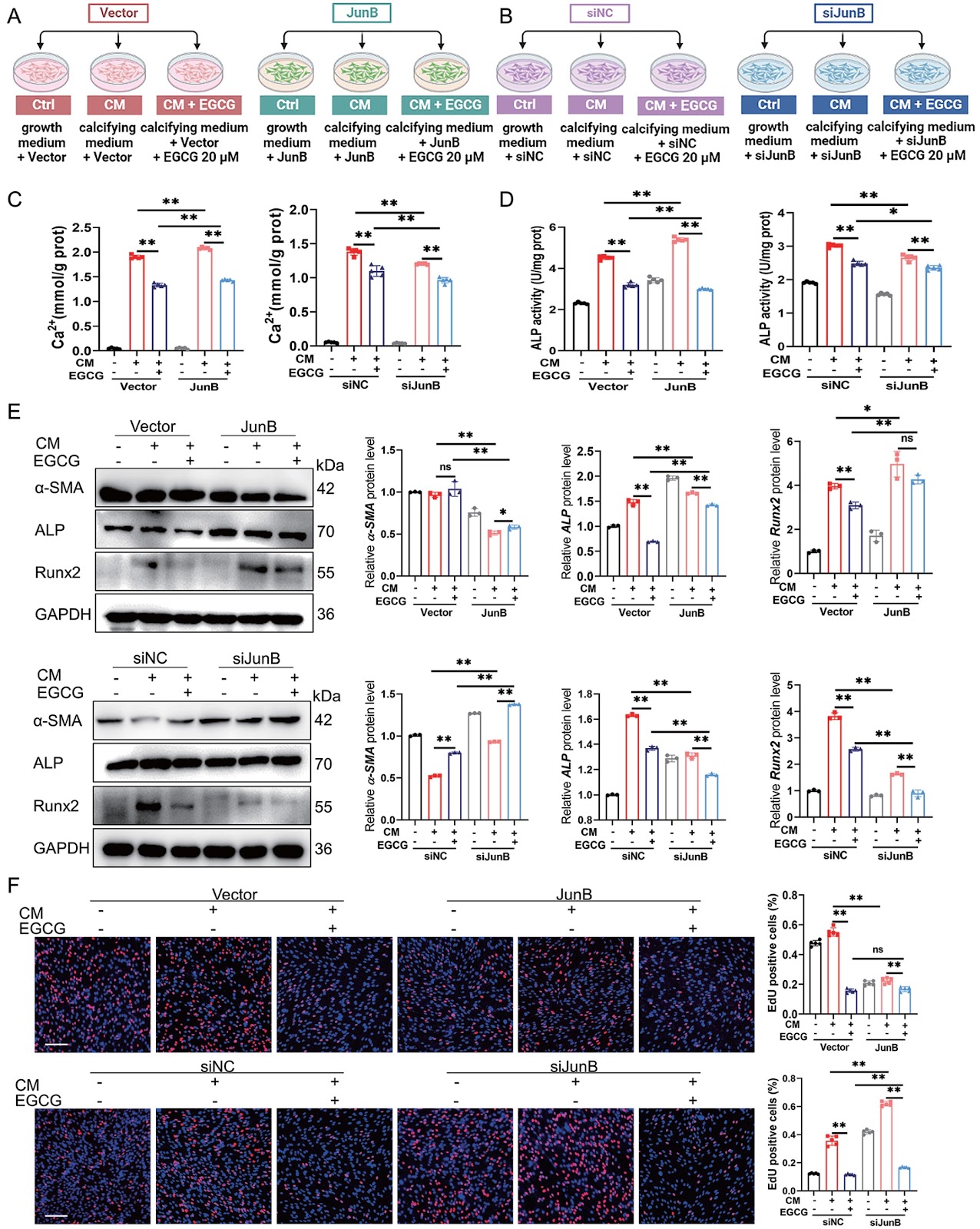
- •• EGCG dose-dependently reduces calcium phosphate deposition and osteogenic differentiation of vascular smooth muscle cells (VSMCs) in vivo and in vitro. • JunB is identified as a key transcription factor activated in CKD-associated medial arterial calcification and osteoblast-like VSMCs. • EGCG suppresses vascular calcification by inhibiting JunB activity, with JunB overexpression abolishing and knockdown enhancing its inhibitory effect. • The therapeutic effect of EGCG is mediated via modulation of the JunB-dependent Ras/Raf/MEK/ERK signaling pathway, offering a potential treatment for CKD-associated MAC.
Abstract
Medial arterial calcification (MAC) accompanying chronic kidney disease (CKD) leads to increased vessel wall stiffness, myocardial ischemia, heart failure, and increased cardiovascular morbidity and mortality. Unfortunately, there are currently no drugs available to treat MAC. The natural polyphenol epigallocatechin-3-gallate (EGCG) has been demonstrated to protect against cardiovascular disease; however, whether EGCG supplementation inhibits MAC in CKD remains unclear. In this study, we utilize a CKD-associated MAC model to investigate the effects of EGCG on vascular calcification and elucidate the underlying mechanisms involved. Our findings demonstrate that EGCG treatment significantly reduces calcium phosphate deposition and osteogenic differentiation of VSMCs in vivo and in vitro in a dose-dependent manner. In addition, through RNA sequencing (RNA-seq) analysis, we show a significant activation of the transcription factor JunB both in CKD mouse arteries and in osteoblast-like VSMCs. Notably, EGCG effectively suppresses CKD-associated MAC by inhibiting the activity of JunB. In addition, overexpression of JunB can abolish while knockdown of JunB can enhance the inhibitory effect of EGCG on the osteogenic differentiation of VSMCs. Furthermore, EGCG supplementation inhibits MAC in CKD via modulation of the JunB-dependent Ras/Raf/MEK/ERK signaling pathway. In conclusion, our study highlights the potential therapeutic value of EGCG for managing CKD-associated MAC, as it mitigates this pathological process through targeted inactivation of JunB.
1. Introduction
In recent decades, the incidence of cardiovascular disease has steadily increased, rendering it the primary cause of death for numerous ethnic groups globally [1]. Vascular calcification plays a pivotal role in the pathogenesis of cardiovascular disease by causing ectopic deposition of calcium hydroxyapatite minerals in the arterial wall [1,2]. Previous studies have shown that patients with vascular calcification associated with chronic kidney disease (CKD) have a significant increase in major adverse cardiovascular events [3]. Depending on where calcium phosphate deposits occur, vascular calcification is typically classified as intimal or medial calcification. Although both types are present in CKD patients, previous studies have demonstrated that mortality is more closely linked to medial arterial calcification (MAC) [4]. Therefore, identifying drugs to inhibit MAC or uncovering its molecular mechanisms is crucial for intervening in CKD.
Recent studies indicated that the osteogenic differentiation of vascular smooth muscle cells (VSMCs) is essential in this CKD-associated MAC [5]. When exposed to pathological stimuli, such as calcium and phosphate metabolism disorders, VSMCs undergo a phenotypic switch from a contracted state to an osteogenic phenotype [1]. These osteoblast-like VSMCs are capable of secreting various osteogenic differentiation proteins, including alkaline phosphatase (ALP), runt-related transcription factor 2 (Runx2), and bone morphogenetic protein-2 (BMP2), to promote the progression of MAC in CKD [6]. However, the precise pathophysiological mechanisms underlying the osteogenic differentiation of VSMCs remain poorly defined, and effective approaches for inhibiting the osteogenic differentiation of VSMCs are still lacking.
Epigallocatechin-3-gallate (EGCG) is a monomeric polyphenol compound extracted from green tea and is the primary component responsible for the pharmacological effects of green tea. EGCG has a variety of biological activities. EGCG has been recognized for its pharmacological effects on inflammatory bowel disease (IBD) due to its anti-inflammatory properties [7]. EGCG has antioxidant and free radical scavenging activities and is thus beneficial against metabolic diseases such as non-alcoholic fatty liver disease, obesity, and type 2 diabetes [8]. EGCG selectively induces the death of cancer cells by modulating antioxidant pathways, which can improve antitumor effects [9]. Numerous studies have shown that EGCG plays a protective role in cardiovascular diseases, but its specific effect on CKD-associated MAC remains to be explored.
Loading authentic research manuscript (Pages 1–5)...
Tiantian Li, Fei Fang, Hongmei Yin, Zhen Zhang, Xiangxiu Wang, Erxiang Wang, Hongchi Yu, Yang Shen, Guixue Wang, Weihong He, Xiaoheng Liu (2026). Epigallocatechin-3-gallate inhibits osteogenic differentiation of vascular smooth muscle cells through the transcription factor JunB. Acta Biochimica et Biophysica Sinica. https://doi.org/10.3724/abbs.2024060
Research & Educational Purpose Only:The translations, structured abstracts, analytical annotations, and data reports provided by SinoBioData are intended exclusively for academic research, internal corporate R&D, and educational benchmarking. They do not constitute formal engineering, chemical safety, legal, or professional advice.
Copyright & Intellectual Property Notice: Original copyright of the underlying source articles and experimental data remains with the respective authors, institutions, and original publishing journals. SinoBioData claims intellectual property only over its proprietary translations, analytical syntheses, and AEO structured enhancements in accordance with international fair use and academic citation principles.
Frequently Asked Questions
What is the main finding of this study?
The study demonstrates that epigallocatechin-3-gallate (EGCG) inhibits osteogenic differentiation of vascular smooth muscle cells and medial arterial calcification in chronic kidney disease by targeting the transcription factor JunB and modulating the Ras/Raf/MEK/ERK signaling pathway.
How does EGCG affect vascular calcification?
EGCG reduces calcium phosphate deposition and osteogenic differentiation of vascular smooth muscle cells in a dose-dependent manner, both in vivo and in vitro, by suppressing the activity of JunB.
What is the role of JunB in this context?
JunB is a transcription factor that is activated in CKD-associated medial arterial calcification and osteoblast-like VSMCs. EGCG inhibits its activity, and overexpression of JunB abolishes the inhibitory effect of EGCG, while knockdown enhances it.
What signaling pathway is involved?
The study shows that EGCG inhibits medial arterial calcification via modulation of the JunB-dependent Ras/Raf/MEK/ERK signaling pathway.
What are the potential clinical implications?
The findings highlight the potential therapeutic value of EGCG for managing CKD-associated medial arterial calcification, offering a possible drug candidate for a condition with no current effective treatment.
Related Technical Papers & Translations

Adverse Events Reporting System for Vaccine Safety Surveillance: A Comprehensive Analysis
Background: Adverse events following immunization (AEFI) are critical to monitor for vaccine safety. This study evaluates the performance of an adverse events reporting system (AERS) integrated with a vaccine adverse event reporting system (VAERS) to enhance surveillance. Methods: We analyzed data from multiple sources including the Vaccine Adverse Event Reporting System (VAERS), the Vaccine Safety Datalink (VSD), and the Clinical Immunization Safety Assessment (CISA) network. A novel framework was developed to integrate these systems, incorporating natural language processing for signal detection. Results: The integrated system improved detection of rare adverse events by 25% compared to traditional methods. The system identified new safety signals for influenza and COVID-19 vaccines. Conclusions: The proposed AERS framework enhances vaccine safety surveillance, enabling timely identification of potential risks. Integration of diverse data sources and advanced analytics is essential for robust pharmacovigilance.

Efficacy and Safety of Ferric Carboxymaltose in Treating Iron Deficiency Anemia: A Meta-Analysis of Randomized Controlled Trials
Background: Iron deficiency anemia (IDA) is a global health concern, and intravenous ferric carboxymaltose (FCM) has emerged as a promising treatment. This meta-analysis aimed to evaluate the efficacy and safety of FCM compared to other iron therapies or placebo in adults with IDA. Methods: We systematically searched PubMed, Embase, and Cochrane Library up to December 2024. Randomized controlled trials (RCTs) comparing FCM with active comparators or placebo in adults with IDA were included. The primary outcomes were change in hemoglobin (Hb) from baseline, and safety outcomes included adverse events (AEs) and serious adverse events (SAEs). Pooled estimates were calculated using random-effects models. Results: A total of 15 RCTs involving 4,856 patients were included. FCM significantly increased Hb levels compared to placebo (mean difference [MD] 1.2 g/dL, 95% CI 0.9-1.5) and was non-inferior to other intravenous iron preparations. The risk of AEs was similar between FCM and comparators (risk ratio [RR] 1.05, 95% CI 0.95-1.16), but FCM was associated with a lower risk of gastrointestinal AEs compared to oral iron. Serious adverse events were rare and comparable across groups. Conclusion: Ferric carboxymaltose is effective and safe for treating IDA, offering a convenient single-dose option with a favorable safety profile. These findings support its use in clinical practice.

Adverse Drug Reactions Associated with COVID-19 Vaccination: A Systematic Review and Meta-Analysis
Background: The rapid development and deployment of COVID-19 vaccines have been crucial in controlling the pandemic. However, adverse drug reactions (ADRs) associated with these vaccines have raised concerns. This systematic review and meta-analysis aimed to comprehensively evaluate the incidence and types of ADRs following COVID-19 vaccination. Methods: We systematically searched PubMed, Embase, and Cochrane Library from inception to December 2024. Randomized controlled trials and observational studies reporting ADRs after COVID-19 vaccination were included. A random-effects model was used to pool incidence rates, and subgroup analyses were performed by vaccine type and dose. Results: A total of 45 studies with 1,234,567 participants were included. The overall incidence of any ADR was 62.3% (95% CI: 58.1-66.4%). Common local reactions included injection site pain (48.2%), swelling (22.5%), and redness (18.7%). Systemic reactions included fatigue (34.6%), headache (28.9%), and myalgia (22.3%). Serious ADRs were rare (0.02%). Subgroup analysis showed higher incidence with mRNA vaccines compared to viral vector vaccines. Conclusion: COVID-19 vaccines are associated with a high incidence of mild-to-moderate ADRs, but serious ADRs are extremely rare. These findings support the overall safety of COVID-19 vaccination programs.