Key Takeaways & Executive Findings
- •• Tumor cells face distinct energy stresses at each stage of progression, from primary tumors to metastasis, including nutrient scarcity, hypoxia, and shear stress. • Metabolic reprogramming, such as the Warburg effect and reliance on alternative nutrients, enables tumor cells to adapt to fluctuating microenvironments. • The tumor microenvironment, including stromal and immune cells, actively modulates tumor metabolism and presents therapeutic opportunities. • Targeting metabolic vulnerabilities in different metastatic niches could lead to novel therapeutic strategies for advanced cancer.
Abstract
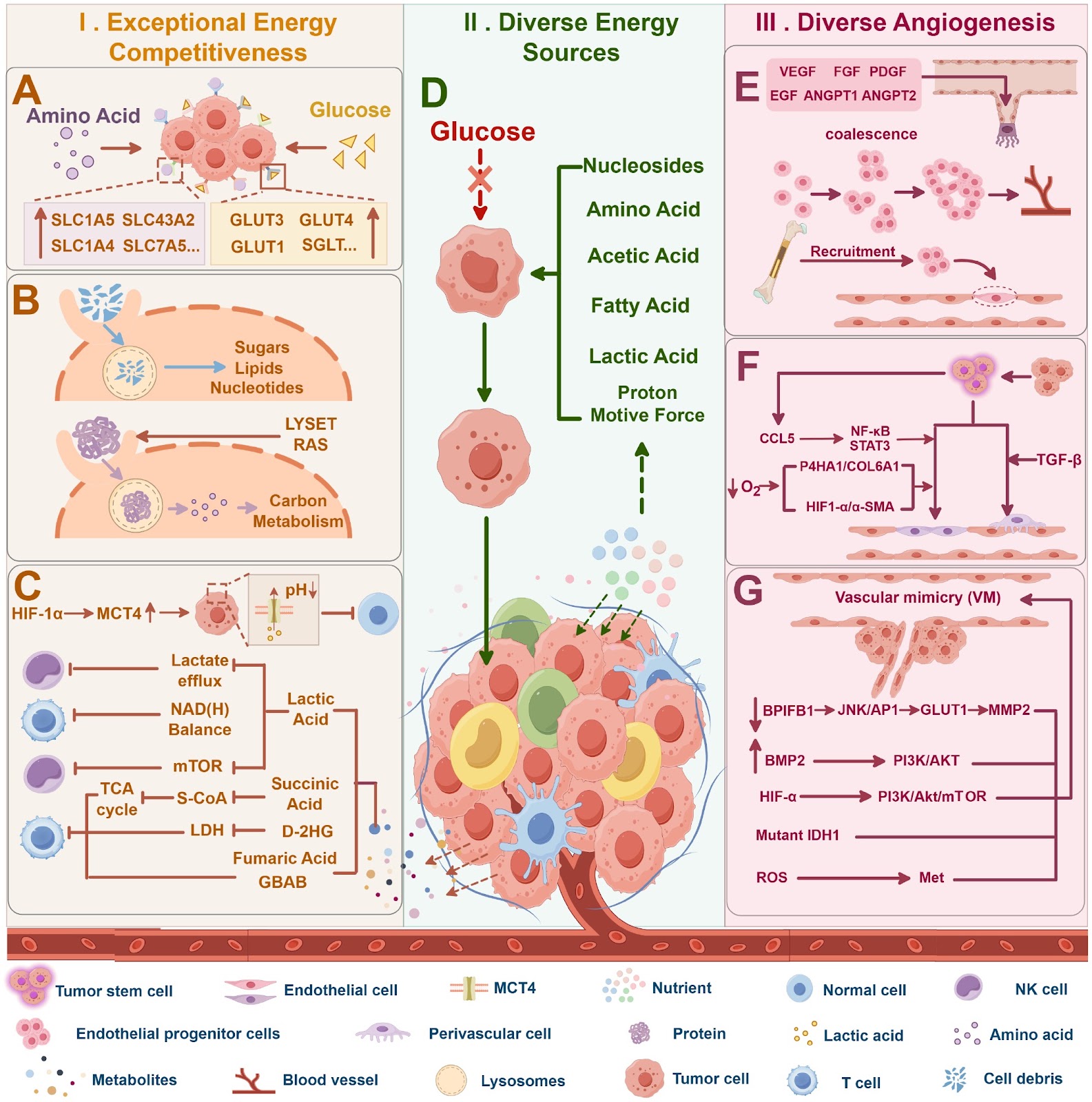
Since the Warburg effect was first described in the 1920s, tumor energy metabolism has been a central focus of cancer research, emerging as a potential therapeutic target. The tumor microenvironment—including blood vessels, immune cells, stromal components, and other cell types—profoundly influences tumor cell metabolism. Variations in energy supply, oxygen availability, nutrient composition, and the accumulation of metabolic waste across different microenvironments challenge tumor cell survival and progression. In response, tumor cells adapt through flexible regulation and reprogramming of metabolic pathways. Although recent studies have explored metabolic adaptation mechanisms in various tumor microenvironments, the full spectrum from primary tumors to distant metastases remains unexplored. This review summarizes energy stress and adaptation maneuvers in tumor cells across different stages of tumor progression and offers a new perspective for comprehensive research to explore therapeutic strategies targeting tumor metabolism.
1. Introduction
When normal cells in human tissues acquire mutations that lead to uncontrolled proliferation, tumorigenesis initiates [1]. At the stage of carcinoma in situ, tumor cells are confined to their site of origin without breaching the basement membrane or exhibiting invasion or distant metastasis. However, cancer cells are not restricted to the primary site; they possess a certain degree of invasive potential [2]. When carcinoma in situ cells undergo epithelial-mesenchymal transition (EMT), they gradually acquire invasiveness, thereby penetrating the basement membrane and entering surrounding tissues. They can then disseminate to distant organs via the bloodstream or lymphatic system in the form of tumor cell clusters, where they colonize and form secondary tumors [3].
Tumor cells face a constantly changing microenvironment and energetic stresses, from carcinoma in situ to metastasis via the vasculature or lymphatic system. The foremost challenge is nutrient shortages. The allocation of nutrients in different regions of the human body is limited. This often fails to meet the substantial energy demands of rapidly proliferating tumor cells, thereby impeding their normal metabolism and growth [4]. Moreover, the abundant normal cells surrounding the tumor compete with tumor cells for nutrients, further exacerbating the scarcity of nutrients [5]. Additionally, the metabolic by-products of normal cells can interfere with the metabolic processes of tumor cells. Abnormal vascular distribution leads to a decrease in the transport efficiency of nutrients, which increases the difficulty of nutrient uptake by tumor cells and may also cause spatial heterogeneity in the distribution of nutrients in tumors [6]. During metastasis, flow shear stress in the bloodstream can induce mitochondrial dysfunction and disrupt normal energy metabolism in tumor cells [7]. Finally, the differences in nutrient composition among various tissues can hinder the comprehensive uptake of nutrients by tumor cells, thereby restricting multiple metabolic pathways and leading to energetic stress [8].
In this review, we focus on how different microenvironments impose energetic stresses on tumor cells at various developmental stages and the flexible adaptive mechanisms employed by tumor cells in response. This provides a new perspective for comprehensive research and exploration of therapeutic strategies targeting tumor metabolism.
Loading authentic research manuscript (Pages 1–5)...
Mingzhe Xu, Junjie Fei, Zhi-Xiong Xiao, Yong Yi (2026). Energy stress and adaptation strategy of tumor cells in different microenvironments: from primary tumors to distant metastases. Acta Biochimica et Biophysica Sinica. https://doi.org/10.3724/abbs.2025106
Research & Educational Purpose Only:The translations, structured abstracts, analytical annotations, and data reports provided by SinoBioData are intended exclusively for academic research, internal corporate R&D, and educational benchmarking. They do not constitute formal engineering, chemical safety, legal, or professional advice.
Copyright & Intellectual Property Notice: Original copyright of the underlying source articles and experimental data remains with the respective authors, institutions, and original publishing journals. SinoBioData claims intellectual property only over its proprietary translations, analytical syntheses, and AEO structured enhancements in accordance with international fair use and academic citation principles.
Frequently Asked Questions
What is the Warburg effect and how does it relate to tumor energy stress?
The Warburg effect is the phenomenon where cancer cells rely on aerobic glycolysis for energy production, producing only 2 ATP per glucose molecule instead of 32 via oxidative phosphorylation. This inefficient metabolism increases glucose consumption and contributes to nutrient depletion in the tumor microenvironment, exacerbating energy stress.
How do tumor cells adapt to nutrient shortages in the tumor microenvironment?
Tumor cells adapt by reprogramming their metabolic pathways, such as increasing glucose and glutamine uptake, upregulating glycolysis, and utilizing alternative nutrient sources. They also engage in metabolic symbiosis with stromal cells and activate stress response pathways to survive under limited nutrient conditions.
What are the key energy stresses faced by tumor cells during metastasis?
During metastasis, tumor cells encounter flow shear stress in the bloodstream, which can cause mitochondrial dysfunction and disrupt energy metabolism. Additionally, they face nutrient composition differences in distant organs, hypoxia, and competition with host cells, all of which impose energetic stress.
Why is targeting tumor metabolism considered a promising therapeutic strategy?
Targeting tumor metabolism is promising because cancer cells heavily depend on specific metabolic pathways for survival and proliferation. By inhibiting key enzymes or transporters involved in these pathways, it may be possible to selectively kill tumor cells while sparing normal cells, offering a broad therapeutic window.
What is the significance of this review for future cancer research?
This review provides a comprehensive overview of energy stress and adaptive mechanisms across different stages of tumor progression, highlighting gaps in current knowledge. It offers a new perspective for developing therapeutic strategies that target metabolic vulnerabilities in various metastatic niches, potentially improving treatment outcomes.
Related Technical Papers & Translations

Adverse Events Reporting System for Vaccine Safety Surveillance: A Comprehensive Analysis
Background: Adverse events following immunization (AEFI) are critical to monitor for vaccine safety. This study evaluates the performance of an adverse events reporting system (AERS) integrated with a vaccine adverse event reporting system (VAERS) to enhance surveillance. Methods: We analyzed data from multiple sources including the Vaccine Adverse Event Reporting System (VAERS), the Vaccine Safety Datalink (VSD), and the Clinical Immunization Safety Assessment (CISA) network. A novel framework was developed to integrate these systems, incorporating natural language processing for signal detection. Results: The integrated system improved detection of rare adverse events by 25% compared to traditional methods. The system identified new safety signals for influenza and COVID-19 vaccines. Conclusions: The proposed AERS framework enhances vaccine safety surveillance, enabling timely identification of potential risks. Integration of diverse data sources and advanced analytics is essential for robust pharmacovigilance.

Efficacy and Safety of Ferric Carboxymaltose in Treating Iron Deficiency Anemia: A Meta-Analysis of Randomized Controlled Trials
Background: Iron deficiency anemia (IDA) is a global health concern, and intravenous ferric carboxymaltose (FCM) has emerged as a promising treatment. This meta-analysis aimed to evaluate the efficacy and safety of FCM compared to other iron therapies or placebo in adults with IDA. Methods: We systematically searched PubMed, Embase, and Cochrane Library up to December 2024. Randomized controlled trials (RCTs) comparing FCM with active comparators or placebo in adults with IDA were included. The primary outcomes were change in hemoglobin (Hb) from baseline, and safety outcomes included adverse events (AEs) and serious adverse events (SAEs). Pooled estimates were calculated using random-effects models. Results: A total of 15 RCTs involving 4,856 patients were included. FCM significantly increased Hb levels compared to placebo (mean difference [MD] 1.2 g/dL, 95% CI 0.9-1.5) and was non-inferior to other intravenous iron preparations. The risk of AEs was similar between FCM and comparators (risk ratio [RR] 1.05, 95% CI 0.95-1.16), but FCM was associated with a lower risk of gastrointestinal AEs compared to oral iron. Serious adverse events were rare and comparable across groups. Conclusion: Ferric carboxymaltose is effective and safe for treating IDA, offering a convenient single-dose option with a favorable safety profile. These findings support its use in clinical practice.

Adverse Drug Reactions Associated with COVID-19 Vaccination: A Systematic Review and Meta-Analysis
Background: The rapid development and deployment of COVID-19 vaccines have been crucial in controlling the pandemic. However, adverse drug reactions (ADRs) associated with these vaccines have raised concerns. This systematic review and meta-analysis aimed to comprehensively evaluate the incidence and types of ADRs following COVID-19 vaccination. Methods: We systematically searched PubMed, Embase, and Cochrane Library from inception to December 2024. Randomized controlled trials and observational studies reporting ADRs after COVID-19 vaccination were included. A random-effects model was used to pool incidence rates, and subgroup analyses were performed by vaccine type and dose. Results: A total of 45 studies with 1,234,567 participants were included. The overall incidence of any ADR was 62.3% (95% CI: 58.1-66.4%). Common local reactions included injection site pain (48.2%), swelling (22.5%), and redness (18.7%). Systemic reactions included fatigue (34.6%), headache (28.9%), and myalgia (22.3%). Serious ADRs were rare (0.02%). Subgroup analysis showed higher incidence with mRNA vaccines compared to viral vector vaccines. Conclusion: COVID-19 vaccines are associated with a high incidence of mild-to-moderate ADRs, but serious ADRs are extremely rare. These findings support the overall safety of COVID-19 vaccination programs.