Key Takeaways & Executive Findings
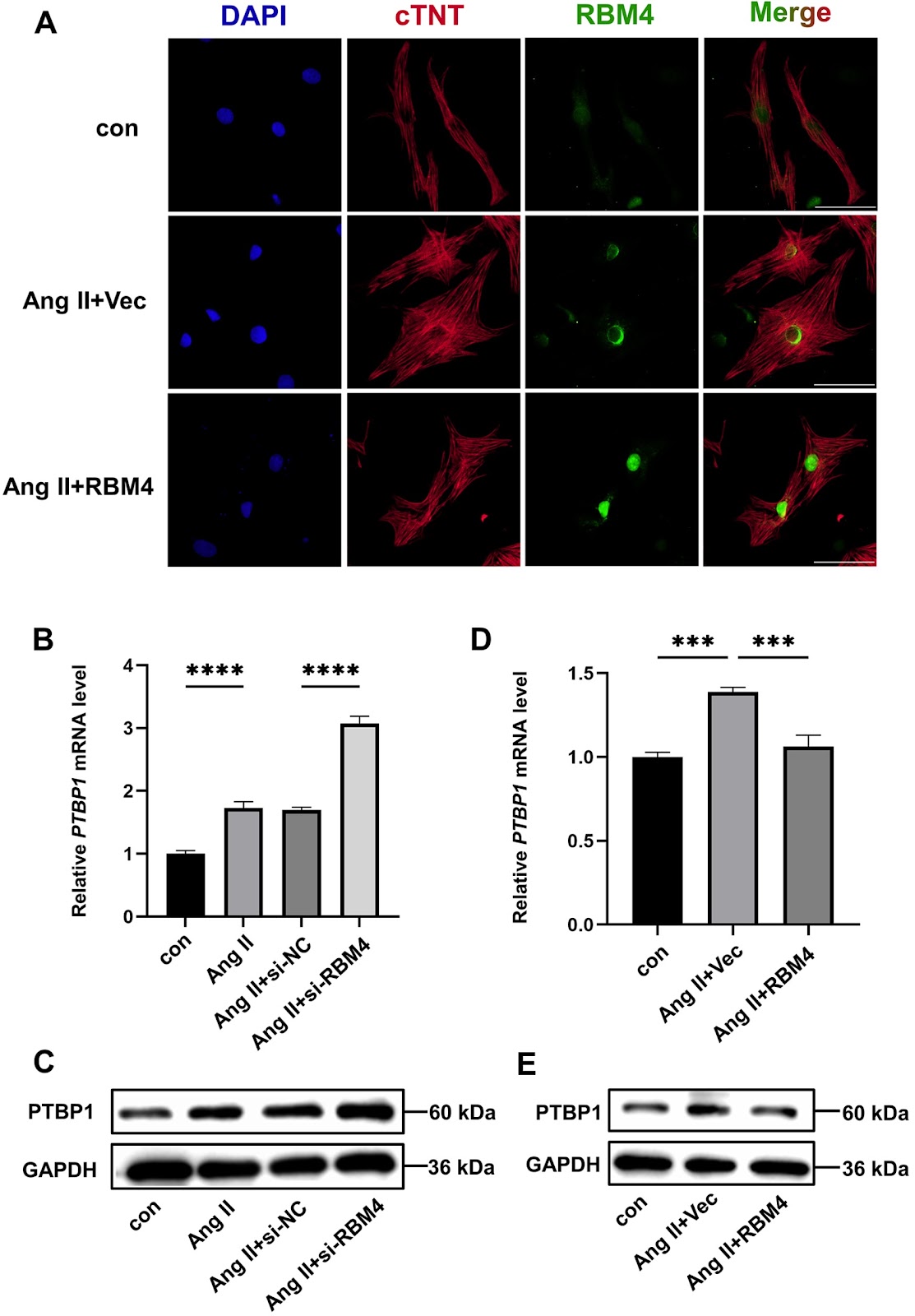
- •• RBM4 acts as an endogenous protective factor against Ang II-induced cardiomyocyte hypertrophy, with its knockdown aggravating and overexpression suppressing hypertrophy. • Mechanistically, RBM4 localizes in the nucleus and downregulates the pro-hypertrophic gene PTBP1, revealing a novel m6A-RBM4-PTBP1 axis. • Ang II stimulation increases m6A methylation of RBM4 mRNA, enhancing YTHDF1-mediated translation of RBM4, which explains its upregulation during hypertrophy. • These findings provide new insights into post-transcriptional regulation in cardiac hypertrophy and potential therapeutic targets for heart failure.
Abstract
Aberrant gene expression in cardiomyocyte has been revealed to be the fundamental essence of pathological cardiac hypertrophy. However, the detailed mechanisms are not fully understood. The underlying regulators of gene expression involved in cardiac hypertrophy remain to be further identified. Here, we report that the RNA-binding protein RNA-binding motif protein 4 (RBM4) functions as an endogenic protector that is able to fight against cardiomyocyte hypertrophy in vitro. Under pro-hypertrophic stimulation of angiotensin II (Ang II), the protein level of RBM4 in cardiomyocyte and myocardium is elevated. Knockdown of RBM4 can further aggravate cardiomyocyte hypertrophy, while over-expression of RBM4 represses cardiomyocyte hypertrophy. Mechanistically, RBM4 is localized in the nucleus and down-regulates the expression of polypyrimidine tract-binding protein 1 (PTBP1), which has been shown to aggravate cardiomyocyte hypertrophy. In addition, we suggest that the up-regulation of RBM4 in cardiomyocyte hypertrophy is caused by N6-methyladenosine (m6A). Ang II induces m6A methylation of RBM4 mRNA, which further enhances the YTH domain-containing family protein 1 (YTHDF1)-mediated translation of RBM4. Thus, our results reveal a novel pathway consisting of m6A, RBM4 and PTBP1, which is involved in cardiomyocyte hypertrophy.
1. Introduction
Pathological cardiac hypertrophy is the compensatory response of the heart to hemodynamic overload caused by hypertension or valvulopathy, or myocardium loss-induced ventricular volume overload. Sustained pro-hypertrophic stimulation often leads to cardiac dysfunction, irreversible heart failure, and even sudden death. The cardiomyocyte in cardiac hypertrophy is characterized by increased size and aberrantly activated fetal gene (e.g., atrial natriuretic peptide, ANF, and brain natriuretic peptide, BNP) expression, which has been reported to be mediated by several signaling pathways (e.g., calmodulin-dependent kinase II, CaMKII and mTOR signaling), histone modification regulators (e.g., histone acetyltransferase p300 and histone deacetylases, HDACs) as well as transcription factors (e.g., nuclear factor of activated T cells, NFAT, GATA-binding factor 4, GATA4 and myocyte-specific enhancer factor 2, MEF2) [1,2]. In the recent decade, post-transcriptional regulatory mechanisms, such as non-coding RNAs (ncRNAs), alternative splicing and N6-methyladenosine (m6A) are gradually revealed to be closely involved in the cardiomyocyte hypertrophy. Nevertheless, the underlying post-transcriptional mechanisms and related critical regulatory factors still need to be further explored.
RNA-binding motif (RBM) protein is a subfamily of RNA-binding protein (RBP). They usually have at least one RNA-recognition motif (RRM), which is supposed to bind to single-stranded RNA. RBM proteins are generally involved in pre-mRNA splicing, and are also reported to regulate translation and mRNA degradation [3,4]. Notably, some RBM proteins play fundamental roles in the heart. Deficiency or dysregulation of these RBM proteins can cause heart disease. For instance, cardiac-specific RBM20 mediates the splicing of Titin pre-mRNA. Mutation of the RBM20 gene is a critical cause of dilated cardiomyopathy [5,6]. RBM24 is essential for cardiac sarcomere assembly and heart development by mediating alternative splicing and translation initiation in cardiomyocyte [7‒9]. Deletion of RBM24 also leads to dilated cardiomyopathy [10]. Elevated RBM25 aggravates abnormal SCN5A pre-mRNA splicing and heart failure [11]. RBM38 has been reported to rescue cardiac hypertrophy through inhibiting LXR-α expression [12]. RBM4 is a member of RBM protein family that has a regulatory function in alternative splicing, as well as translation [13]. RBM4 has been shown to function in muscle cell differentiation [14] and tumorigenesis [15]. Intriguingly, RBM4 mRNA is highly expressed in heart tissue [16]. Moreover, it has been found to mediate the splicing of various cardiomyocyte hypertrophy-related genes [17]. However, it is still unclear whether RBM4 is involved in cardiomyocyte hypertrophy.
Loading authentic research manuscript (Pages 1–5)...
Weihan Sun, Xinyu Fang, Heng Zhang, Yijian Lu, Peiyan Wang, Jiaxin Li, Mengyang Li (2026). Endogenous RBM4 prevents Ang II-induced cardiomyocyte hypertrophy via downregulating the expression of PTBP1. Acta Biochimica et Biophysica Sinica. https://doi.org/10.3724/abbs.2024103
Research & Educational Purpose Only:The translations, structured abstracts, analytical annotations, and data reports provided by SinoBioData are intended exclusively for academic research, internal corporate R&D, and educational benchmarking. They do not constitute formal engineering, chemical safety, legal, or professional advice.
Copyright & Intellectual Property Notice: Original copyright of the underlying source articles and experimental data remains with the respective authors, institutions, and original publishing journals. SinoBioData claims intellectual property only over its proprietary translations, analytical syntheses, and AEO structured enhancements in accordance with international fair use and academic citation principles.
Frequently Asked Questions
What is the role of RBM4 in cardiomyocyte hypertrophy?
RBM4 acts as an endogenous protective factor against Ang II-induced cardiomyocyte hypertrophy. Its knockdown aggravates hypertrophy, while overexpression suppresses it, indicating an anti-hypertrophic function.
How does RBM4 regulate PTBP1 expression?
RBM4 localizes in the nucleus and downregulates the expression of PTBP1, a pro-hypertrophic gene, thereby inhibiting cardiomyocyte hypertrophy.
What is the mechanism of RBM4 upregulation during hypertrophy?
Ang II stimulation increases m6A methylation of RBM4 mRNA, which enhances YTHDF1-mediated translation of RBM4, leading to its upregulation.
What is the significance of the m6A-RBM4-PTBP1 pathway?
This pathway represents a novel post-transcriptional regulatory mechanism in cardiac hypertrophy, offering potential therapeutic targets for heart failure.
What experimental model was used in this study?
The study used neonatal rat cardiomyocytes isolated from 1- to 2-day-old SD rats, treated with Ang II to induce hypertrophy in vitro.
Related Technical Papers & Translations

Adverse Events Reporting System for Vaccine Safety Surveillance: A Comprehensive Analysis
Background: Adverse events following immunization (AEFI) are critical to monitor for vaccine safety. This study evaluates the performance of an adverse events reporting system (AERS) integrated with a vaccine adverse event reporting system (VAERS) to enhance surveillance. Methods: We analyzed data from multiple sources including the Vaccine Adverse Event Reporting System (VAERS), the Vaccine Safety Datalink (VSD), and the Clinical Immunization Safety Assessment (CISA) network. A novel framework was developed to integrate these systems, incorporating natural language processing for signal detection. Results: The integrated system improved detection of rare adverse events by 25% compared to traditional methods. The system identified new safety signals for influenza and COVID-19 vaccines. Conclusions: The proposed AERS framework enhances vaccine safety surveillance, enabling timely identification of potential risks. Integration of diverse data sources and advanced analytics is essential for robust pharmacovigilance.

Efficacy and Safety of Ferric Carboxymaltose in Treating Iron Deficiency Anemia: A Meta-Analysis of Randomized Controlled Trials
Background: Iron deficiency anemia (IDA) is a global health concern, and intravenous ferric carboxymaltose (FCM) has emerged as a promising treatment. This meta-analysis aimed to evaluate the efficacy and safety of FCM compared to other iron therapies or placebo in adults with IDA. Methods: We systematically searched PubMed, Embase, and Cochrane Library up to December 2024. Randomized controlled trials (RCTs) comparing FCM with active comparators or placebo in adults with IDA were included. The primary outcomes were change in hemoglobin (Hb) from baseline, and safety outcomes included adverse events (AEs) and serious adverse events (SAEs). Pooled estimates were calculated using random-effects models. Results: A total of 15 RCTs involving 4,856 patients were included. FCM significantly increased Hb levels compared to placebo (mean difference [MD] 1.2 g/dL, 95% CI 0.9-1.5) and was non-inferior to other intravenous iron preparations. The risk of AEs was similar between FCM and comparators (risk ratio [RR] 1.05, 95% CI 0.95-1.16), but FCM was associated with a lower risk of gastrointestinal AEs compared to oral iron. Serious adverse events were rare and comparable across groups. Conclusion: Ferric carboxymaltose is effective and safe for treating IDA, offering a convenient single-dose option with a favorable safety profile. These findings support its use in clinical practice.

Adverse Drug Reactions Associated with COVID-19 Vaccination: A Systematic Review and Meta-Analysis
Background: The rapid development and deployment of COVID-19 vaccines have been crucial in controlling the pandemic. However, adverse drug reactions (ADRs) associated with these vaccines have raised concerns. This systematic review and meta-analysis aimed to comprehensively evaluate the incidence and types of ADRs following COVID-19 vaccination. Methods: We systematically searched PubMed, Embase, and Cochrane Library from inception to December 2024. Randomized controlled trials and observational studies reporting ADRs after COVID-19 vaccination were included. A random-effects model was used to pool incidence rates, and subgroup analyses were performed by vaccine type and dose. Results: A total of 45 studies with 1,234,567 participants were included. The overall incidence of any ADR was 62.3% (95% CI: 58.1-66.4%). Common local reactions included injection site pain (48.2%), swelling (22.5%), and redness (18.7%). Systemic reactions included fatigue (34.6%), headache (28.9%), and myalgia (22.3%). Serious ADRs were rare (0.02%). Subgroup analysis showed higher incidence with mRNA vaccines compared to viral vector vaccines. Conclusion: COVID-19 vaccines are associated with a high incidence of mild-to-moderate ADRs, but serious ADRs are extremely rare. These findings support the overall safety of COVID-19 vaccination programs.