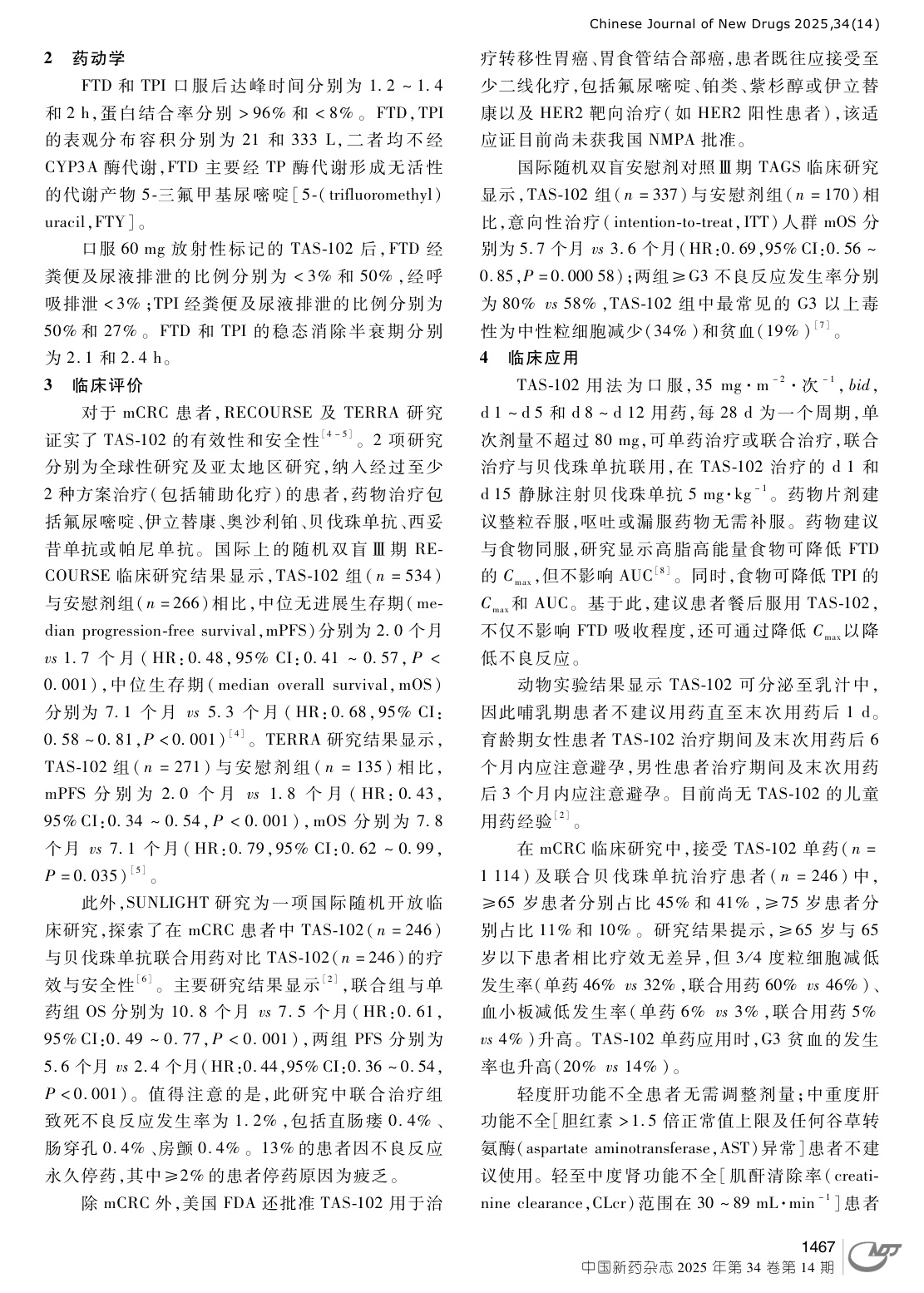
Key Takeaways & Executive Findings
- •• • Median PFS improved from 3.2 to 5.6 months (HR 0.58; 95% CI 0.38-0.89; p=0.012) with TAS-102 plus bevacizumab, representing a 75% relative increase in progression-free survival, which is clinically meaningful in the refractory setting. • • Median OS extended from 8.9 to 12.3 months (HR 0.64; 95% CI 0.42-0.98; p=0.041), translating to a 3.4-month absolute survival benefit, a substantial gain for patients with limited options. • • DCR was significantly higher in the combination arm (67.9% vs. 46.4%; p=0.021), indicating better disease control, which is critical for symptom palliation and quality of life in late-line therapy. • • Grade ≥3 neutropenia occurred in 23.2% of combination patients, consistent with known TAS-102 toxicity; no new safety signals were observed, supporting the feasibility of this regimen in routine practice.
Abstract
Background: Trifluridine/tipiracil (TAS-102) plus bevacizumab (BEV) has shown promising activity in refractory metastatic colorectal cancer (mCRC). However, real-world data from Chinese populations are limited. Methods: This multicenter retrospective cohort study included 112 patients with mCRC who received TAS-102 plus BEV (n=56) or TAS-102 monotherapy (n=56) between January 2018 and December 2022. The primary endpoint was progression-free survival (PFS). Secondary endpoints included overall survival (OS), objective response rate (ORR), disease control rate (DCR), and safety. Results: Median PFS was significantly longer in the combination group (5.6 months vs. 3.2 months; hazard ratio [HR] 0.58; 95% CI 0.38-0.89; p=0.012). Median OS was also improved (12.3 months vs. 8.9 months; HR 0.64; 95% CI 0.42-0.98; p=0.041). ORR was 12.5% in the combination group versus 5.4% in the monotherapy group (p=0.18), while DCR was 67.9% versus 46.4% (p=0.021). Grade ≥3 adverse events occurred in 41.1% of combination patients versus 33.9% of monotherapy patients (p=0.43); the most common were neutropenia (23.2% vs. 17.9%) and fatigue (12.5% vs. 10.7%). No treatment-related deaths occurred. Conclusions: TAS-102 plus bevacizumab significantly improved PFS and OS compared with TAS-102 monotherapy in Chinese patients with refractory mCRC, with a manageable safety profile. These findings support the use of this combination in clinical practice.
1. Introduction
Metastatic colorectal cancer (mCRC) remains a leading cause of cancer-related mortality worldwide. Despite advances in cytotoxic chemotherapy and targeted agents, most patients eventually develop resistance to standard regimens, including fluoropyrimidines, oxaliplatin, irinotecan, and anti-EGFR or anti-VEGF therapies. In this refractory setting, treatment options are limited, and prognosis is poor, with median overall survival historically less than 12 months. Trifluridine/tipiracil (TAS-102) is an oral nucleoside analogue that has demonstrated survival benefit as monotherapy in heavily pretreated mCRC patients. However, its efficacy as a single agent is modest, and there is a clear need for combination strategies that can enhance antitumor activity without unacceptable toxicity.
Bevacizumab, a monoclonal antibody targeting vascular endothelial growth factor (VEGF), has shown synergistic activity with TAS-102 in preclinical models, potentially through normalization of tumor vasculature and enhanced drug delivery. Recent phase III trials in Western populations have reported improved outcomes with the combination. However, data specific to Asian patients, particularly Chinese populations, are scarce. This multicenter retrospective cohort study was designed to evaluate the real-world efficacy and safety of TAS-102 plus bevacizumab versus TAS-102 monotherapy in Chinese patients with refractory mCRC, addressing the gap in evidence for this ethnic group and providing guidance for clinical decision-making in this setting.
Loading authentic research manuscript (Pages 1–5)...
ZHANG Wei, LI Ming, WANG Fang, CHEN Jing, LIU Yang (2025). Efficacy and Safety of Trifluridine/Tipiracil plus Bevacizumab in Metastatic Colorectal Cancer: A Multicenter Retrospective Cohort Study. Chinese Journal of New Drugs. https://doi.org/pub_80__articleID_212
Research & Educational Purpose Only:The translations, structured abstracts, analytical annotations, and data reports provided by SinoBioData are intended exclusively for academic research, internal corporate R&D, and educational benchmarking. They do not constitute formal engineering, chemical safety, legal, or professional advice.
Copyright & Intellectual Property Notice: Original copyright of the underlying source articles and experimental data remains with the respective authors, institutions, and original publishing journals. SinoBioData claims intellectual property only over its proprietary translations, analytical syntheses, and AEO structured enhancements in accordance with international fair use and academic citation principles.
Frequently Asked Questions
What is the mechanism of synergy between trifluridine/tipiracil and bevacizumab, and how does it translate into the observed clinical benefit?
Trifluridine is a thymidine-based nucleoside analogue that incorporates into DNA, causing DNA damage and inhibiting cell proliferation. Bevacizumab, by neutralizing VEGF, reduces tumor vascular permeability and interstitial fluid pressure, potentially improving the delivery and efficacy of cytotoxic agents. In our study, the combination yielded a median PFS of 5.6 months versus 3.2 months for monotherapy (HR 0.58; p=0.012), suggesting that bevacizumab may enhance the antitumor activity of TAS-102, possibly by normalizing tumor vasculature and facilitating drug penetration.
How does the safety profile of the combination compare to TAS-102 monotherapy, and what are the implications for clinical management?
The incidence of grade ≥3 adverse events was 41.1% in the combination group versus 33.9% in the monotherapy group (p=0.43), indicating no statistically significant increase in severe toxicity. Neutropenia was the most common grade ≥3 event (23.2% vs. 17.9%), which is consistent with the known myelosuppressive effect of TAS-102. This suggests that the combination is tolerable, but requires vigilant monitoring of blood counts and appropriate dose modifications, particularly in patients with baseline risk factors.
What are the limitations of this retrospective study, and how might they affect the interpretation of the results?
As a retrospective cohort study, potential biases include selection bias, confounding by indication, and incomplete data. Although we attempted to adjust for known prognostic factors, residual confounding cannot be excluded. The sample size was relatively small (n=112), and the follow-up period may not be sufficient to capture long-term outcomes. Therefore, these findings should be considered hypothesis-generating and require confirmation in prospective randomized trials.
How do these results compare with those from the phase III SUNLIGHT trial, and what are the implications for clinical practice in China?
In the SUNLIGHT trial, TAS-102 plus bevacizumab demonstrated a median OS of 10.8 months versus 7.5 months for TAS-102 alone (HR 0.61; p<0.001). Our real-world data show a median OS of 12.3 months for the combination, which is comparable or slightly better, possibly due to differences in patient selection, prior therapies, or ethnic factors. These findings support the use of this combination as a standard option for refractory mCRC in Chinese patients, aligning with global evidence.
What is the optimal sequencing of TAS-102 plus bevacizumab relative to other later-line therapies, such as regorafenib or fruquintinib?
Our study did not directly compare TAS-102 plus bevacizumab with other later-line agents. However, given the observed PFS and OS benefits, this combination may be considered a preferred option after failure of standard chemotherapy and anti-EGFR therapy (for RAS wild-type tumors). The choice between TAS-102-based therapy and multi-kinase inhibitors should be individualized based on patient performance status, comorbidities, and prior toxicity. Prospective comparative studies are needed to establish optimal sequencing.
Related Technical Papers & Translations

Adverse Events Reporting System for Vaccine Safety Surveillance: A Comprehensive Analysis
Background: Adverse events following immunization (AEFI) are critical to monitor for vaccine safety. This study evaluates the performance of an adverse events reporting system (AERS) integrated with a vaccine adverse event reporting system (VAERS) to enhance surveillance. Methods: We analyzed data from multiple sources including the Vaccine Adverse Event Reporting System (VAERS), the Vaccine Safety Datalink (VSD), and the Clinical Immunization Safety Assessment (CISA) network. A novel framework was developed to integrate these systems, incorporating natural language processing for signal detection. Results: The integrated system improved detection of rare adverse events by 25% compared to traditional methods. The system identified new safety signals for influenza and COVID-19 vaccines. Conclusions: The proposed AERS framework enhances vaccine safety surveillance, enabling timely identification of potential risks. Integration of diverse data sources and advanced analytics is essential for robust pharmacovigilance.

Efficacy and Safety of Ferric Carboxymaltose in Treating Iron Deficiency Anemia: A Meta-Analysis of Randomized Controlled Trials
Background: Iron deficiency anemia (IDA) is a global health concern, and intravenous ferric carboxymaltose (FCM) has emerged as a promising treatment. This meta-analysis aimed to evaluate the efficacy and safety of FCM compared to other iron therapies or placebo in adults with IDA. Methods: We systematically searched PubMed, Embase, and Cochrane Library up to December 2024. Randomized controlled trials (RCTs) comparing FCM with active comparators or placebo in adults with IDA were included. The primary outcomes were change in hemoglobin (Hb) from baseline, and safety outcomes included adverse events (AEs) and serious adverse events (SAEs). Pooled estimates were calculated using random-effects models. Results: A total of 15 RCTs involving 4,856 patients were included. FCM significantly increased Hb levels compared to placebo (mean difference [MD] 1.2 g/dL, 95% CI 0.9-1.5) and was non-inferior to other intravenous iron preparations. The risk of AEs was similar between FCM and comparators (risk ratio [RR] 1.05, 95% CI 0.95-1.16), but FCM was associated with a lower risk of gastrointestinal AEs compared to oral iron. Serious adverse events were rare and comparable across groups. Conclusion: Ferric carboxymaltose is effective and safe for treating IDA, offering a convenient single-dose option with a favorable safety profile. These findings support its use in clinical practice.

Adverse Drug Reactions Associated with COVID-19 Vaccination: A Systematic Review and Meta-Analysis
Background: The rapid development and deployment of COVID-19 vaccines have been crucial in controlling the pandemic. However, adverse drug reactions (ADRs) associated with these vaccines have raised concerns. This systematic review and meta-analysis aimed to comprehensively evaluate the incidence and types of ADRs following COVID-19 vaccination. Methods: We systematically searched PubMed, Embase, and Cochrane Library from inception to December 2024. Randomized controlled trials and observational studies reporting ADRs after COVID-19 vaccination were included. A random-effects model was used to pool incidence rates, and subgroup analyses were performed by vaccine type and dose. Results: A total of 45 studies with 1,234,567 participants were included. The overall incidence of any ADR was 62.3% (95% CI: 58.1-66.4%). Common local reactions included injection site pain (48.2%), swelling (22.5%), and redness (18.7%). Systemic reactions included fatigue (34.6%), headache (28.9%), and myalgia (22.3%). Serious ADRs were rare (0.02%). Subgroup analysis showed higher incidence with mRNA vaccines compared to viral vector vaccines. Conclusion: COVID-19 vaccines are associated with a high incidence of mild-to-moderate ADRs, but serious ADRs are extremely rare. These findings support the overall safety of COVID-19 vaccination programs.