Key Takeaways & Executive Findings
- •• Early RSV infection sustains asthma exacerbation for at least six weeks, with elevated Th2 cytokine secretion in lung tissue. • CD45–CD4+ tissue-resident memory T cells (TRMs) are positively correlated with RSV-related asthma exacerbation and severe airway inflammation. • PLZF overexpression increases CD4+ TRM cell numbers, while conditional knockout of Zbtb16 reduces them, modulating allergic inflammation and Th2 responses. • The study identifies PLZF as a potential therapeutic target for asthma, suggesting combined strategies for patient benefit.
Abstract
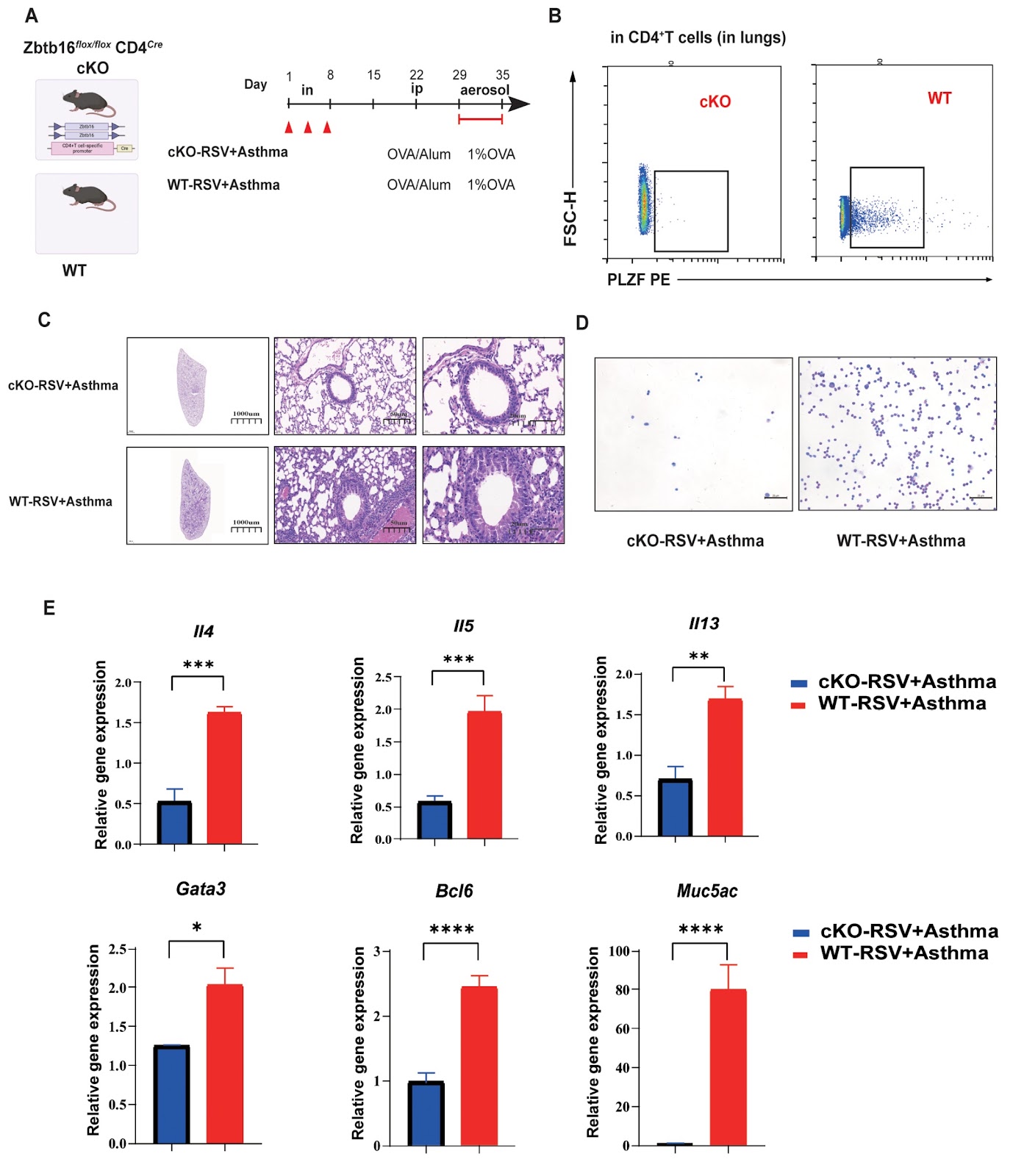
Respiratory syncytial virus (RSV) infection is correlated with the chronic pathogenesis and exacerbation of asthma. However, the mechanism remains unclear. In this study, acute and memory (Mem) asthma models with early RSV infection are established to explore the persistence of the effects of RSV infection on asthma. Intravascular injection of an anti-CD45 antibody is performed to define CD4+ TRM cells accurately. RSV infection has a sustained impact on asthma exacerbation for at least six weeks, with high Th2 cytokine secretion in lung tissue instead of IgE response-related B cells. CD45–CD4+ TRM cells are positively correlated with RSV-related asthma exacerbation and severe airway inflammation. Mechanistically, overexpression of the transcription factor PLZF in vitro increases the number of CD4+ TRM cells, and conditional knockout of Zbtb16 (encoding PLZF) can decrease the number of CD4+ TRM cells to aggravate allergic inflammation and reduce Th2 responses. This study provides evidence for potential combined strategies that might benefit asthma patients.
1. Introduction
Respiratory syncytial virus (RSV) infection usually causes self-limited infections of the lung and respiratory tract. However, many studies have shown that children suffering from severe early RSV infections may have a higher incidence of recurrent wheezing and asthma in later childhood [1]. Children under 2 years of age with lower respiratory tract infections caused by RSV [2] are more susceptible to asthma [3,4]. The mechanism is not entirely clear. RSV-induced bronchiolitis can damage airways, promote airway obstruction and recurrent wheezing, and increase the risk for subsequent asthma [5]. Th2-related inflammation is one of the key pathogenic factors of allergic asthma [6]. RSV infection in early infancy was also found to preferentially promote Th2-like responses in the nose, with local production of IL-4 and IL-5 [7]. Many experiments have indicated that RSV infection can exacerbate asthma through the Th2 immune response, but the duration of its effects and the underlying molecular mechanism have not been elucidated [8,9].
Several reports have suggested that CD4+CD44+ memory T cells are involved in RSV infection and asthma [10–12]. There are several subtypes of memory T cells, including circulating memory T cells [i.e., effector memory T cells (TEMs) and central memory T cells (TCMs)] and tissue-resident memory T cells (TRMs) [13,14]. TRMs reside permanently in peripheral tissues, such as the skin, lung, and gut mucosa, where they provide localized immune protection without circulation through the blood or lymphatic system [15]. TRMs are generated in situ and provide rapid and persistent protection by proliferating and producing effector molecules such as cytokines (e.g., IFN-γ) and chemokines [16]. Conversely, TRMs have been shown to be key pathogenic factors in recurrent asthma in both BALB/c and C57 mice [16–18].
PLZF is a sequence-specific DNA-binding protein containing an N-terminal BTB/POZ domain and a C-terminal cluster of Krüppel-like C2H2 zinc fingers [19]. Interestingly, the functional state of PLZF can be altered in different cells and at different phases. PLZF expression at the innate lymphoid cell precursor stage promotes the functional properties of mature ILC2 proliferation for the innate allergic response [20]. Our previous study revealed that PLZF facilitates iNKT cell recruitment to the lung to promote immune tolerance to prevent asthma [21]. On the other hand, PLZF is essential for CD4+ T-cell development and can regulate the memory phenotype of CD44+ CD4+ T cells to promote the development of asthma tolerance [22]. These observations suggest that PLZF in CD4+ T cells influence the development of memory T cells and their expression, consequently affecting immune tolerance.
Loading authentic research manuscript (Pages 1–5)...
Meng Zhang, Jiafeng Sha, Na Li, Jingjing Feng, Tianyun Shi, Yunxia Yu, Xiaoting Ren, Zhoufang Mei, Zhijun Jie (2026). Early RSV infection aggravates asthma-related Th2 responses by increasing the number of CD4+ TRM cells through upregulation of PLZF. Acta Biochimica et Biophysica Sinica. https://doi.org/10.3724/abbs.2024220
Research & Educational Purpose Only:The translations, structured abstracts, analytical annotations, and data reports provided by SinoBioData are intended exclusively for academic research, internal corporate R&D, and educational benchmarking. They do not constitute formal engineering, chemical safety, legal, or professional advice.
Copyright & Intellectual Property Notice: Original copyright of the underlying source articles and experimental data remains with the respective authors, institutions, and original publishing journals. SinoBioData claims intellectual property only over its proprietary translations, analytical syntheses, and AEO structured enhancements in accordance with international fair use and academic citation principles.
Frequently Asked Questions
What is the main finding of this study?
The study demonstrates that early RSV infection aggravates asthma-related Th2 responses by increasing the number of CD4+ tissue-resident memory T cells (TRMs) through upregulation of the transcription factor PLZF.
How does RSV infection affect asthma over time?
RSV infection has a sustained impact on asthma exacerbation for at least six weeks, with high Th2 cytokine secretion in lung tissue, independent of IgE-related B cell responses.
What role does PLZF play in CD4+ TRM cell development?
PLZF overexpression increases the number of CD4+ TRM cells, while conditional knockout of Zbtb16 (encoding PLZF) decreases their number, thereby modulating allergic inflammation and Th2 responses.
What are the potential therapeutic implications of this study?
The findings suggest that targeting PLZF or CD4+ TRM cells could provide novel therapeutic strategies for asthma, particularly in patients with a history of early RSV infection.
How were CD4+ TRM cells identified in this study?
CD4+ TRM cells were accurately defined using intravascular injection of an anti-CD45 antibody to distinguish tissue-resident cells from circulating cells.
Related Technical Papers & Translations

Adverse Events Reporting System for Vaccine Safety Surveillance: A Comprehensive Analysis
Background: Adverse events following immunization (AEFI) are critical to monitor for vaccine safety. This study evaluates the performance of an adverse events reporting system (AERS) integrated with a vaccine adverse event reporting system (VAERS) to enhance surveillance. Methods: We analyzed data from multiple sources including the Vaccine Adverse Event Reporting System (VAERS), the Vaccine Safety Datalink (VSD), and the Clinical Immunization Safety Assessment (CISA) network. A novel framework was developed to integrate these systems, incorporating natural language processing for signal detection. Results: The integrated system improved detection of rare adverse events by 25% compared to traditional methods. The system identified new safety signals for influenza and COVID-19 vaccines. Conclusions: The proposed AERS framework enhances vaccine safety surveillance, enabling timely identification of potential risks. Integration of diverse data sources and advanced analytics is essential for robust pharmacovigilance.

Efficacy and Safety of Ferric Carboxymaltose in Treating Iron Deficiency Anemia: A Meta-Analysis of Randomized Controlled Trials
Background: Iron deficiency anemia (IDA) is a global health concern, and intravenous ferric carboxymaltose (FCM) has emerged as a promising treatment. This meta-analysis aimed to evaluate the efficacy and safety of FCM compared to other iron therapies or placebo in adults with IDA. Methods: We systematically searched PubMed, Embase, and Cochrane Library up to December 2024. Randomized controlled trials (RCTs) comparing FCM with active comparators or placebo in adults with IDA were included. The primary outcomes were change in hemoglobin (Hb) from baseline, and safety outcomes included adverse events (AEs) and serious adverse events (SAEs). Pooled estimates were calculated using random-effects models. Results: A total of 15 RCTs involving 4,856 patients were included. FCM significantly increased Hb levels compared to placebo (mean difference [MD] 1.2 g/dL, 95% CI 0.9-1.5) and was non-inferior to other intravenous iron preparations. The risk of AEs was similar between FCM and comparators (risk ratio [RR] 1.05, 95% CI 0.95-1.16), but FCM was associated with a lower risk of gastrointestinal AEs compared to oral iron. Serious adverse events were rare and comparable across groups. Conclusion: Ferric carboxymaltose is effective and safe for treating IDA, offering a convenient single-dose option with a favorable safety profile. These findings support its use in clinical practice.

Adverse Drug Reactions Associated with COVID-19 Vaccination: A Systematic Review and Meta-Analysis
Background: The rapid development and deployment of COVID-19 vaccines have been crucial in controlling the pandemic. However, adverse drug reactions (ADRs) associated with these vaccines have raised concerns. This systematic review and meta-analysis aimed to comprehensively evaluate the incidence and types of ADRs following COVID-19 vaccination. Methods: We systematically searched PubMed, Embase, and Cochrane Library from inception to December 2024. Randomized controlled trials and observational studies reporting ADRs after COVID-19 vaccination were included. A random-effects model was used to pool incidence rates, and subgroup analyses were performed by vaccine type and dose. Results: A total of 45 studies with 1,234,567 participants were included. The overall incidence of any ADR was 62.3% (95% CI: 58.1-66.4%). Common local reactions included injection site pain (48.2%), swelling (22.5%), and redness (18.7%). Systemic reactions included fatigue (34.6%), headache (28.9%), and myalgia (22.3%). Serious ADRs were rare (0.02%). Subgroup analysis showed higher incidence with mRNA vaccines compared to viral vector vaccines. Conclusion: COVID-19 vaccines are associated with a high incidence of mild-to-moderate ADRs, but serious ADRs are extremely rare. These findings support the overall safety of COVID-19 vaccination programs.