Key Takeaways & Executive Findings
- •• DLPC, the main component of phosphatidylcholine, induces ferroptosis in cancer cells, offering a novel therapeutic avenue. • The specific acyl chain length and unsaturation pattern of DLPC are critical for its anti-cancer activity, as structurally similar PCs lack this effect. • PC exhibits dose-dependent inhibition of MC38 colon cancer cell viability, with DLPC being the most potent component. • This study underscores the need to investigate individual lipid species rather than treating PC as a whole, revealing distinct biological functions.
Abstract
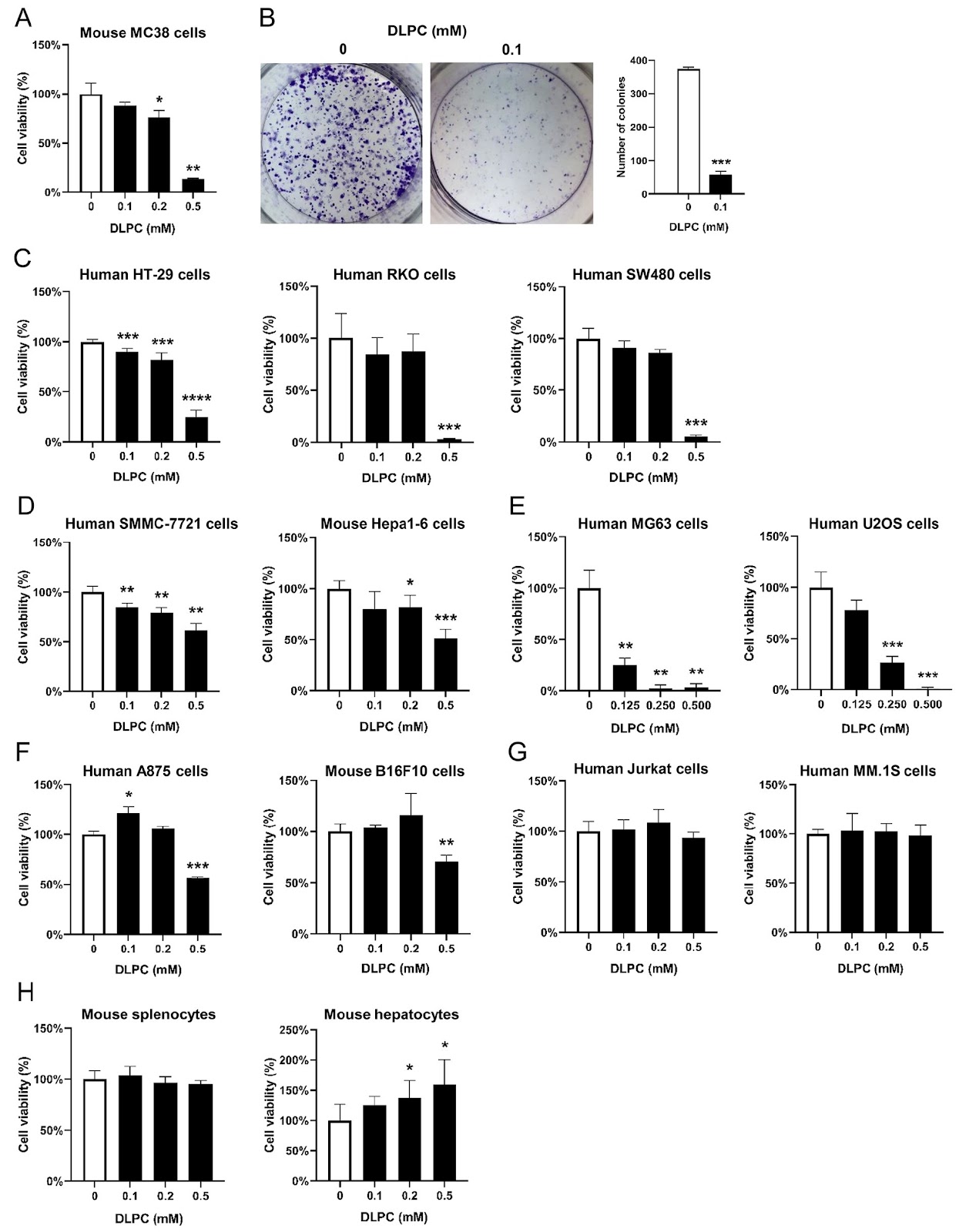
Phosphatidylcholine (PC) is the most abundant phospholipid in mammalian cells, accounting for approximately 50% of all phospholipids and serving as a main component of cellular and subcellular membranes. PC is a mixture of many species with distinct functions, and its levels are altered in cancer. Previous studies have shown contradictory roles of PC in cancer development. Here, we investigated the effects of PC and its main component, 1,2-dilinoleoyl-sn-glycero-3-phosphocholine (DLPC), on mouse colon cancer MC38 cells. PC dose-dependently decreased cell viability, and DLPC was identified as the active component. DLPC inhibited MC38 cell growth more effectively than PC, while structurally similar PCs with different acyl chain lengths or unsaturation degrees did not. This suggests that the specific structure of DLPC is crucial for its activity. Further mechanistic studies revealed that DLPC induces ferroptosis, a form of regulated cell death, in cancer cells. These findings highlight DLPC as a potential therapeutic agent for cancer treatment and underscore the importance of studying individual PC species.
1. Introduction
Phosphatidylcholine (PC) is the most abundant phospholipid in mammalian cells, accounting for approximately 50% of all phospholipids and serving as the main component of cellular and subcellular membranes. It is also found as a metabolite in serum. PC contributes to regulating cellular functions, and its level may be altered under certain physiological and pathological conditions; thus, it may serve as a marker for disease progression. PC is generally studied as a whole, but it is a mixture of many species that may have distinct functions. Therefore, it is worthwhile to study the individual species of PC.
Previous studies revealed that PC is involved in cancer development. The levels of fatty acids and complex lipids, including PC, are elevated in cancer cells, and increased PC biosynthesis contributes to the malignant transformation of intestinal epithelial cells. Ingram et al. found that drug-resistant prostate cancer cell lines have higher levels of PC than parental control cells. These findings suggest that PC promotes cancer development, but other groups have reported opposite effects. For example, Yu et al. reported that PCYT1A (the rate-limiting enzyme for PC synthesis) suppresses cancer cell proliferation and migration by inhibiting the mTORC1 pathway in lung adenocarcinoma. Moreover, the expression of PCYT1A is associated with better survival in patients with urothelial cancer of the bladder. Given these contradictory findings, further work is needed to clarify the roles of PC and individual PC species in cancer cells.
Loading authentic research manuscript (Pages 1–5)...
Chunmiao Han, Yingying Gu, Renling Miao, Wanhong Han, Qianying Zhang, Xiaodi Hu, Hu Li, Yong Zhang, Meihong Chen (2026). DLPC induces ferroptosis in cancer cells. Acta Biochimica et Biophysica Sinica. https://doi.org/10.3724/abbs.2024097
Research & Educational Purpose Only:The translations, structured abstracts, analytical annotations, and data reports provided by SinoBioData are intended exclusively for academic research, internal corporate R&D, and educational benchmarking. They do not constitute formal engineering, chemical safety, legal, or professional advice.
Copyright & Intellectual Property Notice: Original copyright of the underlying source articles and experimental data remains with the respective authors, institutions, and original publishing journals. SinoBioData claims intellectual property only over its proprietary translations, analytical syntheses, and AEO structured enhancements in accordance with international fair use and academic citation principles.
Frequently Asked Questions
What is DLPC and how does it relate to phosphatidylcholine?
DLPC (1,2-dilinoleoyl-sn-glycero-3-phosphocholine) is the main component of phosphatidylcholine (PC), comprising 40-52% of PC derived from soybean. It is an 18:2/18:2 PC with two 18-carbon acyl chains each containing two unsaturated bonds.
What is ferroptosis and why is it important in cancer therapy?
Ferroptosis is a regulated form of cell death characterized by iron-dependent lipid peroxidation. It is important in cancer therapy because it can bypass apoptosis resistance, offering a potential strategy to eliminate cancer cells that are resistant to conventional treatments.
How does DLPC induce ferroptosis in cancer cells?
The exact mechanism is not fully detailed in the provided text, but the study indicates that DLPC induces ferroptosis in cancer cells. This likely involves the accumulation of lipid peroxides and disruption of redox homeostasis, leading to cell death.
Why is studying individual PC species important?
PC is a mixture of many species with distinct functions. Studying individual species like DLPC allows researchers to identify specific bioactive lipids that may have therapeutic potential, as demonstrated by DLPC's unique ability to inhibit cancer cell growth compared to other PC species.
What are the potential clinical implications of this finding?
DLPC could be developed as a novel anti-cancer agent, particularly for colon cancer, by inducing ferroptosis. This may provide a new therapeutic option for patients who do not respond to existing treatments.
Related Technical Papers & Translations

Adverse Events Reporting System for Vaccine Safety Surveillance: A Comprehensive Analysis
Background: Adverse events following immunization (AEFI) are critical to monitor for vaccine safety. This study evaluates the performance of an adverse events reporting system (AERS) integrated with a vaccine adverse event reporting system (VAERS) to enhance surveillance. Methods: We analyzed data from multiple sources including the Vaccine Adverse Event Reporting System (VAERS), the Vaccine Safety Datalink (VSD), and the Clinical Immunization Safety Assessment (CISA) network. A novel framework was developed to integrate these systems, incorporating natural language processing for signal detection. Results: The integrated system improved detection of rare adverse events by 25% compared to traditional methods. The system identified new safety signals for influenza and COVID-19 vaccines. Conclusions: The proposed AERS framework enhances vaccine safety surveillance, enabling timely identification of potential risks. Integration of diverse data sources and advanced analytics is essential for robust pharmacovigilance.

Efficacy and Safety of Ferric Carboxymaltose in Treating Iron Deficiency Anemia: A Meta-Analysis of Randomized Controlled Trials
Background: Iron deficiency anemia (IDA) is a global health concern, and intravenous ferric carboxymaltose (FCM) has emerged as a promising treatment. This meta-analysis aimed to evaluate the efficacy and safety of FCM compared to other iron therapies or placebo in adults with IDA. Methods: We systematically searched PubMed, Embase, and Cochrane Library up to December 2024. Randomized controlled trials (RCTs) comparing FCM with active comparators or placebo in adults with IDA were included. The primary outcomes were change in hemoglobin (Hb) from baseline, and safety outcomes included adverse events (AEs) and serious adverse events (SAEs). Pooled estimates were calculated using random-effects models. Results: A total of 15 RCTs involving 4,856 patients were included. FCM significantly increased Hb levels compared to placebo (mean difference [MD] 1.2 g/dL, 95% CI 0.9-1.5) and was non-inferior to other intravenous iron preparations. The risk of AEs was similar between FCM and comparators (risk ratio [RR] 1.05, 95% CI 0.95-1.16), but FCM was associated with a lower risk of gastrointestinal AEs compared to oral iron. Serious adverse events were rare and comparable across groups. Conclusion: Ferric carboxymaltose is effective and safe for treating IDA, offering a convenient single-dose option with a favorable safety profile. These findings support its use in clinical practice.

Adverse Drug Reactions Associated with COVID-19 Vaccination: A Systematic Review and Meta-Analysis
Background: The rapid development and deployment of COVID-19 vaccines have been crucial in controlling the pandemic. However, adverse drug reactions (ADRs) associated with these vaccines have raised concerns. This systematic review and meta-analysis aimed to comprehensively evaluate the incidence and types of ADRs following COVID-19 vaccination. Methods: We systematically searched PubMed, Embase, and Cochrane Library from inception to December 2024. Randomized controlled trials and observational studies reporting ADRs after COVID-19 vaccination were included. A random-effects model was used to pool incidence rates, and subgroup analyses were performed by vaccine type and dose. Results: A total of 45 studies with 1,234,567 participants were included. The overall incidence of any ADR was 62.3% (95% CI: 58.1-66.4%). Common local reactions included injection site pain (48.2%), swelling (22.5%), and redness (18.7%). Systemic reactions included fatigue (34.6%), headache (28.9%), and myalgia (22.3%). Serious ADRs were rare (0.02%). Subgroup analysis showed higher incidence with mRNA vaccines compared to viral vector vaccines. Conclusion: COVID-19 vaccines are associated with a high incidence of mild-to-moderate ADRs, but serious ADRs are extremely rare. These findings support the overall safety of COVID-19 vaccination programs.