Key Takeaways & Executive Findings
- •• Identified 673 miRNAs from Persicaria chinensis, including 422 novel and 251 conserved, with pch-miR319a as the most abundant conserved miRNA. • Demonstrated that pch-miR319a targets ITGA3, a gene associated with cervical cancer progression, via dual-luciferase reporter assay. • Overexpression of pch-miR319a reduced viability, migration, and induced apoptosis in HeLa cervical cancer cells in vitro. • In a syngeneic mouse model, pch-miR319a treatment inhibited tumor growth and downregulated ITGA3 and Ki-67, suggesting therapeutic potential.
Abstract
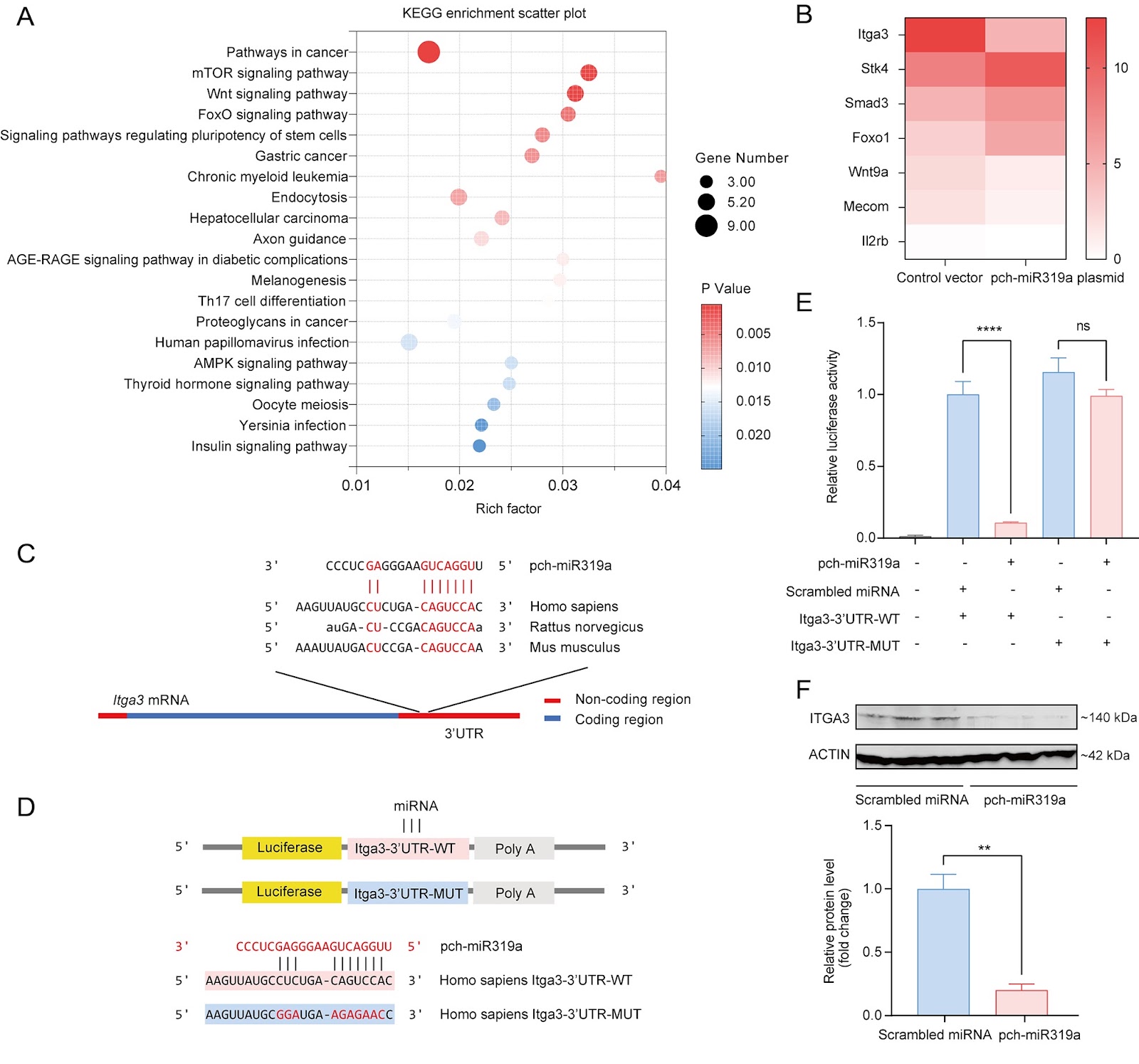
Persicaria chinensis, a well-known traditional Chinese medicinal herb that is both edible and medicinal, has been widely acknowledged for its therapeutic effects, such as anti-inflammatory, antioxidant, and antitumor activities. However, the role of miRNAs from this plant in the cross-kingdom regulation of human diseases has not been investigated. In this study, we analyze the miRNA expression profile of P. chinensis using high-throughput sequencing and identify a total of 673 miRNAs, including 422 novel miRNAs that are unique to this plant and 251 conserved miRNAs. Among the conserved miRNAs, pch-miR319a is found to be the most abundant. Moreover, food-oriented pch-miR319a accumulates in the uterus and tumors and exhibits a rich repertoire of target genes within cancer-related pathways, demonstrating significant cross-kingdom regulatory potential. Utilizing the dual-luciferase reporter gene assay, we demonstrate that pch-miR319a from P. chinensis targets the Itga3 gene, which is associated with cervical cancer progression. Overexpression of pch-miR319a significantly decreases the viability, migration, and induces apoptosis of HeLa cervical cancer cells in vitro. Moreover, in a syngeneic mouse tumor model of cervical cancer, treatment with pch-miR319a effectively inhibits tumor growth and downregulates the expressions of ITGA3 and the proliferation marker Ki-67. Our study highlights the potential of pch-miR319a from P. chinensis as a novel therapeutic agent for cervical cancer by targeting ITGA3 and provides new insights into the cross-kingdom regulatory mechanisms of plant miRNAs in human diseases.
1. Introduction
Cervical cancer is the second most common cancer among women in low- and lower-middle-income countries, posing a significant threat to public health [1,2]. The management of cervical cancer is confronted with several formidable challenges, including drug resistance, metastasis, and recurrence [3]. Consequently, the development of novel therapeutic strategies, particularly those based on natural products, has become a focal point of current research. Natural products, especially traditional Chinese medicinal herbs, are recognized for their potential to modulate critical molecular pathways involved in tumor proliferation inhibition, attributable to their complex chemical constituents and diverse biological activities [4,5]. Notwithstanding the demonstration of promising antitumor properties in preclinical studies, traditional Chinese medicinal herbs remain underutilized in the clinical treatment of cervical cancer, and their underlying mechanisms of action have yet to be fully elucidated.
Persicaria chinensis (L.) H. Gross, also known as Polygonum chinense, has versatile culinary and medicinal uses. It can be brewed into herbal tea with a slightly sour flavor, offering benefits for dampness removal and summer heat relief [6]. As a perennial herb widely distributed in southern China, it has also been used in traditional medicine to treat inflammatory disorders and tumors for centuries. Modern pharmacological studies have revealed that P. chinensis is rich in flavonoids, coumarins, and phenolic acids, exhibiting anti-inflammatory, antioxidant, and antitumor activities [6–10]. For instance, phenolic substances, such as ellagic acid and corilagin, significantly inhibit the proliferation of cervical cancer SiHa cells and induce apoptosis by upregulating the protein expression levels of p53, Bcl-2, and caspase-3/9 while concurrently downregulating the protein expression level of Bax [11]. However, the short half-life of small molecules in P. chinensis significantly restricts their efficacy and durability in the treatment of chronic diseases.
In comparison to traditional plant extracts, plant-derived microRNAs (miRNAs) are relatively resistant to degradation and exhibit a longer half-life [12]. Characterized by 3′-terminal 2′-O-methylation and high GC content sequences, miRNAs are endowed with the capacity to withstand nuclease-mediated degradation [13]. Notably, they can preserve structural integrity for over 75 minutes when subjected to extreme conditions, such as boiling water treatment and gastric acid environments [14]. In addition, plant miRNAs are typically enclosed within extracellular vesicles or protein complexes, which markedly prolongs their half-life in the bloodstream [15].
Loading authentic research manuscript (Pages 1–5)...
Yueyue Yan, Dan Bai, Lei Li, Leimei Xu, Hua Yang, Yuhui Wang, Han Feng, Lan Zhu (2026). Distinct miR319a identified from Persicaria chinensis mediates cross-kingdom suppression of cervical cancer by targeting ITGA3. Acta Biochimica et Biophysica Sinica. https://doi.org/10.3724/abbs.2026010
Research & Educational Purpose Only:The translations, structured abstracts, analytical annotations, and data reports provided by SinoBioData are intended exclusively for academic research, internal corporate R&D, and educational benchmarking. They do not constitute formal engineering, chemical safety, legal, or professional advice.
Copyright & Intellectual Property Notice: Original copyright of the underlying source articles and experimental data remains with the respective authors, institutions, and original publishing journals. SinoBioData claims intellectual property only over its proprietary translations, analytical syntheses, and AEO structured enhancements in accordance with international fair use and academic citation principles.
Frequently Asked Questions
What is the main finding of this study?
The study identifies a novel plant miRNA, pch-miR319a from Persicaria chinensis, that can cross-kingdom regulate cervical cancer by targeting the ITGA3 gene, inhibiting tumor growth in vitro and in vivo.
How does pch-miR319a suppress cervical cancer?
pch-miR319a targets the ITGA3 gene, which is associated with cervical cancer progression. Overexpression of pch-miR319a reduces cell viability, migration, and induces apoptosis in HeLa cells, and in a mouse model it inhibits tumor growth and downregulates ITGA3 and Ki-67.
What is the significance of plant miRNAs in human diseases?
Plant miRNAs are relatively stable and can survive harsh conditions, and they can be absorbed through diet and regulate human genes, offering a novel therapeutic approach for diseases like cancer.
What methods were used in this study?
The study used high-throughput sequencing to profile miRNAs, dual-luciferase reporter assay to confirm target binding, and in vitro and in vivo experiments including cell viability, migration, apoptosis assays, and a syngeneic mouse tumor model.
What are the potential clinical implications?
pch-miR319a could be developed as a novel therapeutic agent for cervical cancer, providing a natural product-based strategy that may overcome drug resistance and improve treatment outcomes.
Related Technical Papers & Translations

Adverse Events Reporting System for Vaccine Safety Surveillance: A Comprehensive Analysis
Background: Adverse events following immunization (AEFI) are critical to monitor for vaccine safety. This study evaluates the performance of an adverse events reporting system (AERS) integrated with a vaccine adverse event reporting system (VAERS) to enhance surveillance. Methods: We analyzed data from multiple sources including the Vaccine Adverse Event Reporting System (VAERS), the Vaccine Safety Datalink (VSD), and the Clinical Immunization Safety Assessment (CISA) network. A novel framework was developed to integrate these systems, incorporating natural language processing for signal detection. Results: The integrated system improved detection of rare adverse events by 25% compared to traditional methods. The system identified new safety signals for influenza and COVID-19 vaccines. Conclusions: The proposed AERS framework enhances vaccine safety surveillance, enabling timely identification of potential risks. Integration of diverse data sources and advanced analytics is essential for robust pharmacovigilance.

Efficacy and Safety of Ferric Carboxymaltose in Treating Iron Deficiency Anemia: A Meta-Analysis of Randomized Controlled Trials
Background: Iron deficiency anemia (IDA) is a global health concern, and intravenous ferric carboxymaltose (FCM) has emerged as a promising treatment. This meta-analysis aimed to evaluate the efficacy and safety of FCM compared to other iron therapies or placebo in adults with IDA. Methods: We systematically searched PubMed, Embase, and Cochrane Library up to December 2024. Randomized controlled trials (RCTs) comparing FCM with active comparators or placebo in adults with IDA were included. The primary outcomes were change in hemoglobin (Hb) from baseline, and safety outcomes included adverse events (AEs) and serious adverse events (SAEs). Pooled estimates were calculated using random-effects models. Results: A total of 15 RCTs involving 4,856 patients were included. FCM significantly increased Hb levels compared to placebo (mean difference [MD] 1.2 g/dL, 95% CI 0.9-1.5) and was non-inferior to other intravenous iron preparations. The risk of AEs was similar between FCM and comparators (risk ratio [RR] 1.05, 95% CI 0.95-1.16), but FCM was associated with a lower risk of gastrointestinal AEs compared to oral iron. Serious adverse events were rare and comparable across groups. Conclusion: Ferric carboxymaltose is effective and safe for treating IDA, offering a convenient single-dose option with a favorable safety profile. These findings support its use in clinical practice.

Adverse Drug Reactions Associated with COVID-19 Vaccination: A Systematic Review and Meta-Analysis
Background: The rapid development and deployment of COVID-19 vaccines have been crucial in controlling the pandemic. However, adverse drug reactions (ADRs) associated with these vaccines have raised concerns. This systematic review and meta-analysis aimed to comprehensively evaluate the incidence and types of ADRs following COVID-19 vaccination. Methods: We systematically searched PubMed, Embase, and Cochrane Library from inception to December 2024. Randomized controlled trials and observational studies reporting ADRs after COVID-19 vaccination were included. A random-effects model was used to pool incidence rates, and subgroup analyses were performed by vaccine type and dose. Results: A total of 45 studies with 1,234,567 participants were included. The overall incidence of any ADR was 62.3% (95% CI: 58.1-66.4%). Common local reactions included injection site pain (48.2%), swelling (22.5%), and redness (18.7%). Systemic reactions included fatigue (34.6%), headache (28.9%), and myalgia (22.3%). Serious ADRs were rare (0.02%). Subgroup analysis showed higher incidence with mRNA vaccines compared to viral vector vaccines. Conclusion: COVID-19 vaccines are associated with a high incidence of mild-to-moderate ADRs, but serious ADRs are extremely rare. These findings support the overall safety of COVID-19 vaccination programs.