Key Takeaways & Executive Findings
- •• A functional EBV proteome microarray covering 72 viral proteins was developed and applied to profile antibody responses in gastric cancer patients, revealing an IgG-skewed humoral signature specific to EBVaGC. • A five-analyte panel (LF2_IgG, BBLF2_IgG, BLRF2_IgG, BPLF1-2_IgA, and BGLF4_IgA) was identified and validated, achieving an AUC of 0.93 in an independent validation set (n=316). • In a community-based screening cohort (n=474), the panel achieved 87.3% sensitivity and 88.3% specificity for distinguishing EBVaGC from non-malignant gastric conditions, with an AUC of 0.94. • The study establishes a serological framework for EBVaGC diagnosis, offering a scalable strategy for population-level screening that could improve clinical management of this virus-driven malignancy.
Abstract
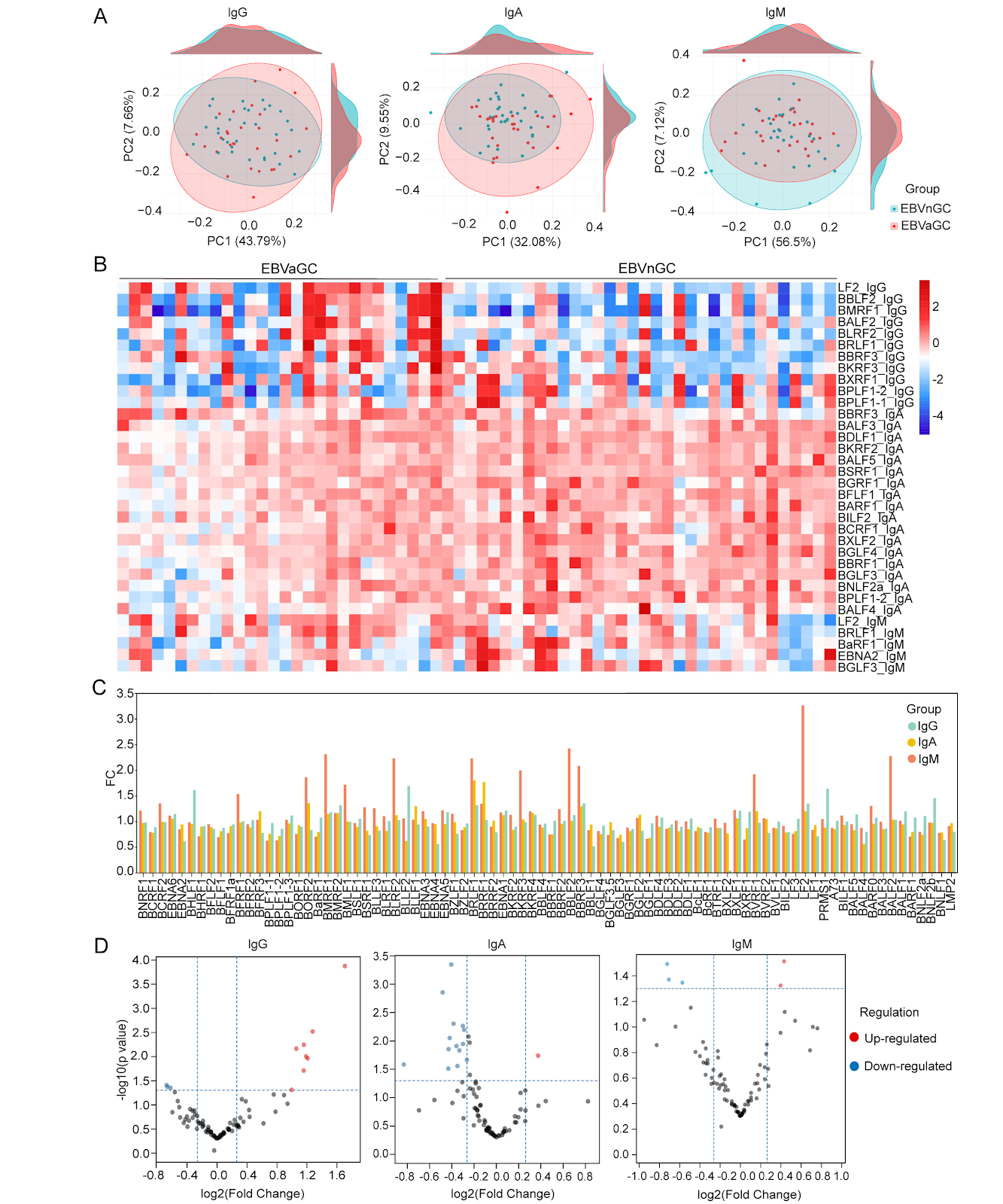
Epstein-Barr virus-associated gastric cancer (EBVaGC) displays unique clinicopathological hallmarks, yet serology-based tools for its detection are still limited. Here, we develop a functional EBV proteome microarray covering 72 viral proteins and apply it to profile antibody responses in 62 gastric cancer patients. The resulting landscape reveals an IgG-skewed humoral signature specific to EBVaGC and identifies 34 EBV antigens exhibiting differential reactivities. Multivariable logistic regression integrates complementary markers into an optimal five-analyte panel (LF2_IgG, BBLF2_IgG, BLRF2_IgG, BPLF1-2_IgA, and BGLF4_IgA) that achieves outstanding discrimination performance (AUC = 0.93) in an independent validation set (n = 316). The panel’s performance is further validated in a community-based screening cohort (n = 474), where it achieves 87.3% sensitivity and 88.3% specificity for distinguishing EBVaGC from non-malignant gastric conditions spanning gastritis to dysplasia (AUC = 0.94). Together, these results establish a serological framework for EBVaGC diagnosis and provide a scalable strategy for population-level screening that could materially improve the management of this virus-driven malignancy.
1. Introduction
Epstein-Barr virus-associated gastric cancer (EBVaGC) is a distinct molecular subtype that accounts for 5%–10% of gastric carcinomas worldwide [1]. It is characterized by pervasive genome-wide DNA hypermethylation, which drives unique tumor biology and pronounced immunogenic profile [2]. This distinct biology underlies the subtype’s exceptional sensitivity to immune checkpoint inhibitors, making EBV status a valuable predictive biomarker in clinical practice [3,4]. Therefore, the precise and timely differentiation of EBVaGC from other subtypes of gastric cancer is of significant implications for treatment selection.
Currently, the diagnostic gold standard of EBVaGC relies on in situ hybridization for Epstein-Barr virus-encoded RNA (EBER) in tumor tissue [5]. However, neoadjuvant treatments administered before surgery often disrupt tumor architecture and reduce the sensitivity of EBER detection [6,7]. In addition, EBV status is typically evaluated in pre-operative biopsy specimens, where limited sampling and intratumoral heterogeneity can lead to false-negative results and consequently low detection rates [8,9]. These challenges underscore the urgent need for rapid, tissue-independent diagnostic assays to reliably identify EBVaGC, thereby improving patient stratification and targeted treatment.
Loading authentic research manuscript (Pages 1–5)...
Pincang Xia, Yingying Yu, Xiaoting Xu, Jiajun Lin, Jiayi Shen, Xinyi Lin, Tao Zhang, Zhaowei Xu, Xian-E Peng, Xu Lin (2026). Discovery and Validation of Biomarkers for Epstein-Barr Virus Associated Gastric Cancer. Acta Biochimica et Biophysica Sinica. https://doi.org/10.3724/abbs.2026046
Research & Educational Purpose Only:The translations, structured abstracts, analytical annotations, and data reports provided by SinoBioData are intended exclusively for academic research, internal corporate R&D, and educational benchmarking. They do not constitute formal engineering, chemical safety, legal, or professional advice.
Copyright & Intellectual Property Notice: Original copyright of the underlying source articles and experimental data remains with the respective authors, institutions, and original publishing journals. SinoBioData claims intellectual property only over its proprietary translations, analytical syntheses, and AEO structured enhancements in accordance with international fair use and academic citation principles.
Frequently Asked Questions
What is the significance of this study?
This study identifies and validates a five-biomarker panel for the serological detection of Epstein-Barr virus-associated gastric cancer (EBVaGC), offering a non-invasive diagnostic tool that could improve patient stratification and enable population-level screening.
How was the biomarker panel developed?
The panel was developed using a functional EBV proteome microarray covering 72 viral proteins to profile antibody responses in gastric cancer patients. Multivariable logistic regression integrated complementary markers into an optimal five-analyte panel.
What are the key biomarkers in the panel?
The panel includes antibodies against LF2 (IgG), BBLF2 (IgG), BLRF2 (IgG), BPLF1-2 (IgA), and BGLF4 (IgA).
How well does the panel perform?
The panel achieved an AUC of 0.93 in an independent validation set (n=316) and an AUC of 0.94 in a community-based screening cohort (n=474), with 87.3% sensitivity and 88.3% specificity.
What are the potential clinical applications?
The panel could be used for non-invasive diagnosis of EBVaGC, aiding in treatment selection and enabling large-scale screening programs to detect this subtype early.
Related Technical Papers & Translations

Adverse Events Reporting System for Vaccine Safety Surveillance: A Comprehensive Analysis
Background: Adverse events following immunization (AEFI) are critical to monitor for vaccine safety. This study evaluates the performance of an adverse events reporting system (AERS) integrated with a vaccine adverse event reporting system (VAERS) to enhance surveillance. Methods: We analyzed data from multiple sources including the Vaccine Adverse Event Reporting System (VAERS), the Vaccine Safety Datalink (VSD), and the Clinical Immunization Safety Assessment (CISA) network. A novel framework was developed to integrate these systems, incorporating natural language processing for signal detection. Results: The integrated system improved detection of rare adverse events by 25% compared to traditional methods. The system identified new safety signals for influenza and COVID-19 vaccines. Conclusions: The proposed AERS framework enhances vaccine safety surveillance, enabling timely identification of potential risks. Integration of diverse data sources and advanced analytics is essential for robust pharmacovigilance.

Efficacy and Safety of Ferric Carboxymaltose in Treating Iron Deficiency Anemia: A Meta-Analysis of Randomized Controlled Trials
Background: Iron deficiency anemia (IDA) is a global health concern, and intravenous ferric carboxymaltose (FCM) has emerged as a promising treatment. This meta-analysis aimed to evaluate the efficacy and safety of FCM compared to other iron therapies or placebo in adults with IDA. Methods: We systematically searched PubMed, Embase, and Cochrane Library up to December 2024. Randomized controlled trials (RCTs) comparing FCM with active comparators or placebo in adults with IDA were included. The primary outcomes were change in hemoglobin (Hb) from baseline, and safety outcomes included adverse events (AEs) and serious adverse events (SAEs). Pooled estimates were calculated using random-effects models. Results: A total of 15 RCTs involving 4,856 patients were included. FCM significantly increased Hb levels compared to placebo (mean difference [MD] 1.2 g/dL, 95% CI 0.9-1.5) and was non-inferior to other intravenous iron preparations. The risk of AEs was similar between FCM and comparators (risk ratio [RR] 1.05, 95% CI 0.95-1.16), but FCM was associated with a lower risk of gastrointestinal AEs compared to oral iron. Serious adverse events were rare and comparable across groups. Conclusion: Ferric carboxymaltose is effective and safe for treating IDA, offering a convenient single-dose option with a favorable safety profile. These findings support its use in clinical practice.

Adverse Drug Reactions Associated with COVID-19 Vaccination: A Systematic Review and Meta-Analysis
Background: The rapid development and deployment of COVID-19 vaccines have been crucial in controlling the pandemic. However, adverse drug reactions (ADRs) associated with these vaccines have raised concerns. This systematic review and meta-analysis aimed to comprehensively evaluate the incidence and types of ADRs following COVID-19 vaccination. Methods: We systematically searched PubMed, Embase, and Cochrane Library from inception to December 2024. Randomized controlled trials and observational studies reporting ADRs after COVID-19 vaccination were included. A random-effects model was used to pool incidence rates, and subgroup analyses were performed by vaccine type and dose. Results: A total of 45 studies with 1,234,567 participants were included. The overall incidence of any ADR was 62.3% (95% CI: 58.1-66.4%). Common local reactions included injection site pain (48.2%), swelling (22.5%), and redness (18.7%). Systemic reactions included fatigue (34.6%), headache (28.9%), and myalgia (22.3%). Serious ADRs were rare (0.02%). Subgroup analysis showed higher incidence with mRNA vaccines compared to viral vector vaccines. Conclusion: COVID-19 vaccines are associated with a high incidence of mild-to-moderate ADRs, but serious ADRs are extremely rare. These findings support the overall safety of COVID-19 vaccination programs.