Key Takeaways & Executive Findings
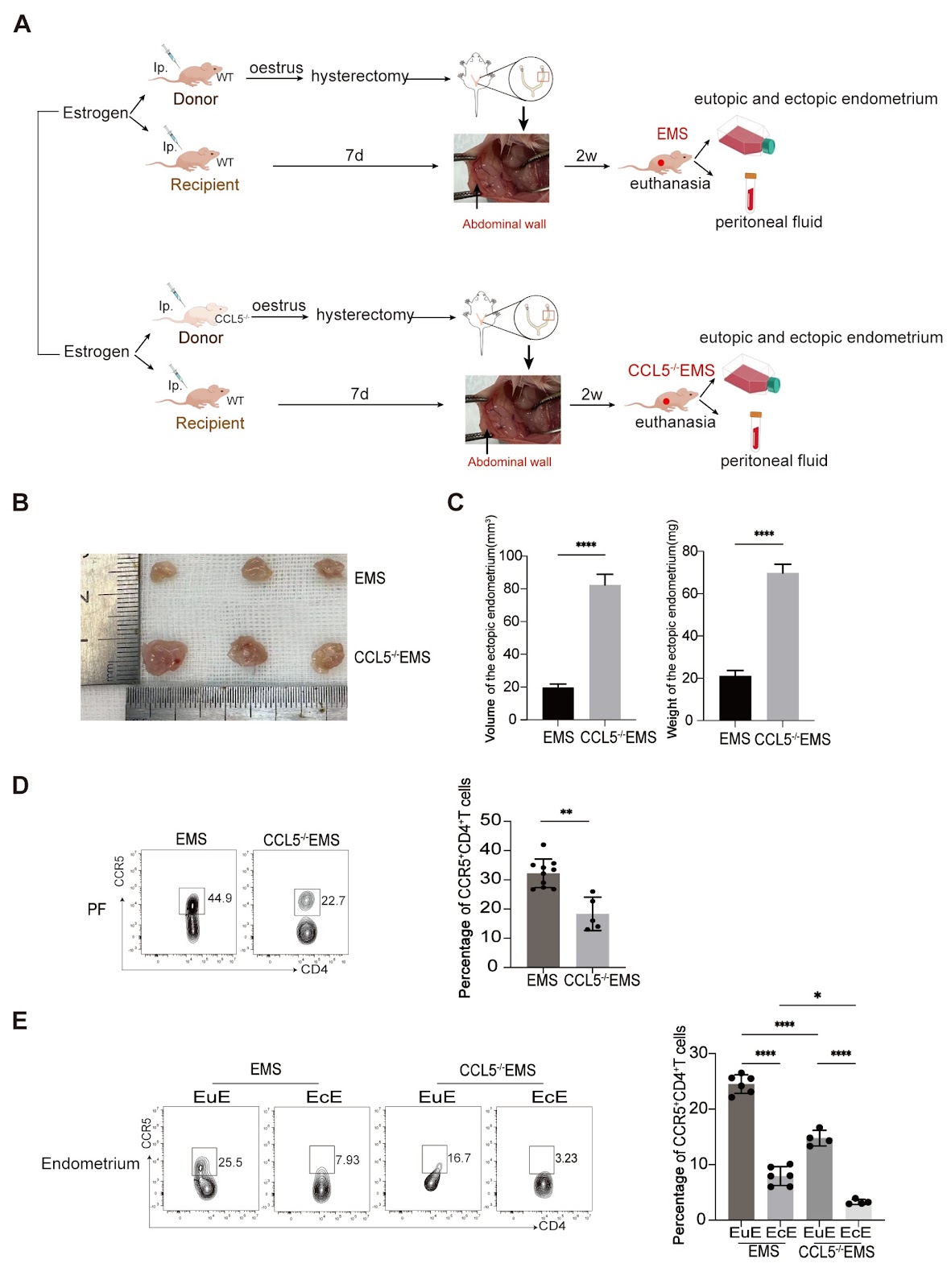
- •• CCR5+CD4+ T cells exhibit a more activated and cytotoxic phenotype compared to CCR5‒CD4+ T cells, with diminished numbers and impaired IFN-γ production in endometriosis lesions. • Ectopic endometrial stromal cells (ecESCs) show impaired production of CCL5, leading to reduced recruitment of CCR5+CD4+ T cells. • CCL5 knockout mice develop larger ectopic lesions, confirming the protective role of CCL5-CCR5 axis in endometriosis progression. • The study suggests that enhancing CCL5 expression or CCR5+CD4+ T cell recruitment could be a potential therapeutic strategy for endometriosis.
Abstract
Endometriosis (EMS) is a benign gynecological disease characterized by the growth of endometrial tissue outside the uterine cavity. Evidence shows that the survival of patients with ectopic endometrial implants is associated with a dysregulated immune microenvironment. CD4+ T cells can regulate EMS through diverse cytokines, the inflammatory response, and angiogenesis. CCR5+CD4+ T cells exhibit increased cellular immunogenicity and play a role in infectious diseases, host defense, and cancer progression. However, the specific mechanisms of CCR5+CD4+ T cells in EMS remain unknown. In the present study, flow cytometry and RNA-seq are utilized to assess the proportions and features of CCR5+CD4+ T cells in EMS patients, RT-PCR and ELISA are used to assess the production of CCL5 by ectopic endometrial stromal cells (ecESCs). Two EMS models are established through C57B6 wild-type and CCL5‒/‒ mice and utilized to explore the in vivo effects of CCR5+CD4+ T cells on ectopic lesions. Compared with CCR5‒CD4+ T cells, CCR5+CD4+ T cells display a more activated and cytotoxic phenotype. Diminished CCR5+CD4+ T cells and their impaired ability to produce IFN-γ are observed in the ectopic lesions of EMS patients and in murine EMS models. Impaired production of CCL5 has been detected in human ecESCs. Moreover, endometria stripped from CCL5‒/‒ mice are more likely to generate ectopic lesions in the peritoneum of recipient mice. These findings demonstrate that the attenuated recruitment of CCR5+CD4+ T cells in ectopic lesions caused by decreased production of CCL5 in ecESCs may facilitate the progression of EMS.
1. Introduction
Endometriosis (EMS) is a prevalent, chronic, and painful gynecological disease in which active endometrial tissue grows outside the uterine cavity. It affects approximately 15% of women and negatively impacts their quality of life (such as dysmenorrhea, dyspareunia, and chronic pelvic pain) [1‒3]. Available treatment options for EMS are limited, and the recurrence rate is alarmingly high [4]. Therefore, it is necessary to investigate the pathogenesis of EMS. Menstrual reflux is the most accepted theory used to explain the development of EMS. However, this hypothesis cannot fully explain the cause of EMS [5]. Other factors, such as stem cells, immunological factors, and epigenetics, might play a part in EMS development.
A disorganized local immune microenvironment is a pivotal promoter of EMS. The abnormal activation of T cells [6], weakened phagocytic ability of macrophages [7,8], and decreased cytotoxicity of NK cells [9] contribute to the growth of ectopic endometrial implants. Accumulating evidence has shown that systemic and local variations in CD4+ T cells are closely related to the pathogenesis and development of EMS [10‒12].
Some studies have shown that there is no significant difference in the proportion of CD4+ T cells in the peritoneal fluid between healthy women and EMS patients [13], whereas other studies have reported increased numbers of peritoneal CD4+ T cells among EMS patients [14,15]. Increased numbers of peritoneal Tregs, which can promote the growth and invasion of ectopic lesions via the induction of macrophage polarization and the production of profibrotic cytokines, are found in EMS patients [16,17]. Increased numbers of peritoneal Th17 cells in EMS patients secrete IL-17A, which promotes the inflammatory response and proliferation of ectopic endometrial stromal cells [18]. Peritoneal CD4+ T cells in EMS patients show Th2 predominance, and Th2 cells secrete IL-4 and IL-13 to promote fibrosis by mediating the differentiation of fibroblasts into myofibroblasts in ectopic lesions [19].
CCR5+CD4+ T cells are abundant in the endometrium, and CD38+HLA-DR+ CCR5+CD4+ T cells exhibit an immune-activating phenotype [20]. CCR5+CD4+ T cells can increase CD40L/CD40-mediated APC maturation and promote the activation of DCs and CD8+ T cells, thus playing an anti-tumor role [21]. However, whether CCR5+CD4+ T cells play a role in the development of EMS has not been studied.
Loading authentic research manuscript (Pages 1–5)...
Yue Li, Yunyun Li, Yewei Lu, Yikong Lin, Xiaolin Wang, Yizhun Zhu, Qiongjing Zeng, Meirong Du (2026). Decreased CCL5 expression in endometrial stromal cells induces deficient CCR5+CD4+ T cells in endometriosis. Acta Biochimica et Biophysica Sinica. https://doi.org/10.3724/abbs.2024178
Research & Educational Purpose Only:The translations, structured abstracts, analytical annotations, and data reports provided by SinoBioData are intended exclusively for academic research, internal corporate R&D, and educational benchmarking. They do not constitute formal engineering, chemical safety, legal, or professional advice.
Copyright & Intellectual Property Notice: Original copyright of the underlying source articles and experimental data remains with the respective authors, institutions, and original publishing journals. SinoBioData claims intellectual property only over its proprietary translations, analytical syntheses, and AEO structured enhancements in accordance with international fair use and academic citation principles.
Frequently Asked Questions
What is the role of CCR5+CD4+ T cells in endometriosis?
CCR5+CD4+ T cells are a subset of CD4+ T cells that exhibit an activated and cytotoxic phenotype. In endometriosis, their numbers are diminished and their ability to produce IFN-γ is impaired, which may contribute to disease progression due to reduced immune surveillance.
How does CCL5 affect endometriosis progression?
CCL5 is a chemokine produced by ectopic endometrial stromal cells that recruits CCR5+CD4+ T cells to the ectopic lesions. Decreased CCL5 expression leads to deficient recruitment of these T cells, thereby facilitating the progression of endometriosis.
What are the key findings of this study?
The study found that CCR5+CD4+ T cells are reduced in endometriosis lesions and have impaired IFN-γ production. Additionally, ectopic endometrial stromal cells show decreased CCL5 production, and CCL5 knockout mice develop larger ectopic lesions, confirming the importance of the CCL5-CCR5 axis in controlling endometriosis.
What is the clinical significance of this research?
This research suggests that enhancing CCL5 expression or CCR5+CD4+ T cell recruitment could be a potential therapeutic strategy for endometriosis. It also provides new insights into the immune microenvironment of endometriosis, which may lead to novel biomarkers or treatment targets.
How was the study conducted?
The study used flow cytometry and RNA-seq to assess CCR5+CD4+ T cell proportions and features in endometriosis patients, RT-PCR and ELISA to measure CCL5 production in ectopic endometrial stromal cells, and mouse models (wild-type and CCL5 knockout) to evaluate in vivo effects on ectopic lesions.
Related Technical Papers & Translations

Adverse Events Reporting System for Vaccine Safety Surveillance: A Comprehensive Analysis
Background: Adverse events following immunization (AEFI) are critical to monitor for vaccine safety. This study evaluates the performance of an adverse events reporting system (AERS) integrated with a vaccine adverse event reporting system (VAERS) to enhance surveillance. Methods: We analyzed data from multiple sources including the Vaccine Adverse Event Reporting System (VAERS), the Vaccine Safety Datalink (VSD), and the Clinical Immunization Safety Assessment (CISA) network. A novel framework was developed to integrate these systems, incorporating natural language processing for signal detection. Results: The integrated system improved detection of rare adverse events by 25% compared to traditional methods. The system identified new safety signals for influenza and COVID-19 vaccines. Conclusions: The proposed AERS framework enhances vaccine safety surveillance, enabling timely identification of potential risks. Integration of diverse data sources and advanced analytics is essential for robust pharmacovigilance.

Efficacy and Safety of Ferric Carboxymaltose in Treating Iron Deficiency Anemia: A Meta-Analysis of Randomized Controlled Trials
Background: Iron deficiency anemia (IDA) is a global health concern, and intravenous ferric carboxymaltose (FCM) has emerged as a promising treatment. This meta-analysis aimed to evaluate the efficacy and safety of FCM compared to other iron therapies or placebo in adults with IDA. Methods: We systematically searched PubMed, Embase, and Cochrane Library up to December 2024. Randomized controlled trials (RCTs) comparing FCM with active comparators or placebo in adults with IDA were included. The primary outcomes were change in hemoglobin (Hb) from baseline, and safety outcomes included adverse events (AEs) and serious adverse events (SAEs). Pooled estimates were calculated using random-effects models. Results: A total of 15 RCTs involving 4,856 patients were included. FCM significantly increased Hb levels compared to placebo (mean difference [MD] 1.2 g/dL, 95% CI 0.9-1.5) and was non-inferior to other intravenous iron preparations. The risk of AEs was similar between FCM and comparators (risk ratio [RR] 1.05, 95% CI 0.95-1.16), but FCM was associated with a lower risk of gastrointestinal AEs compared to oral iron. Serious adverse events were rare and comparable across groups. Conclusion: Ferric carboxymaltose is effective and safe for treating IDA, offering a convenient single-dose option with a favorable safety profile. These findings support its use in clinical practice.

Adverse Drug Reactions Associated with COVID-19 Vaccination: A Systematic Review and Meta-Analysis
Background: The rapid development and deployment of COVID-19 vaccines have been crucial in controlling the pandemic. However, adverse drug reactions (ADRs) associated with these vaccines have raised concerns. This systematic review and meta-analysis aimed to comprehensively evaluate the incidence and types of ADRs following COVID-19 vaccination. Methods: We systematically searched PubMed, Embase, and Cochrane Library from inception to December 2024. Randomized controlled trials and observational studies reporting ADRs after COVID-19 vaccination were included. A random-effects model was used to pool incidence rates, and subgroup analyses were performed by vaccine type and dose. Results: A total of 45 studies with 1,234,567 participants were included. The overall incidence of any ADR was 62.3% (95% CI: 58.1-66.4%). Common local reactions included injection site pain (48.2%), swelling (22.5%), and redness (18.7%). Systemic reactions included fatigue (34.6%), headache (28.9%), and myalgia (22.3%). Serious ADRs were rare (0.02%). Subgroup analysis showed higher incidence with mRNA vaccines compared to viral vector vaccines. Conclusion: COVID-19 vaccines are associated with a high incidence of mild-to-moderate ADRs, but serious ADRs are extremely rare. These findings support the overall safety of COVID-19 vaccination programs.