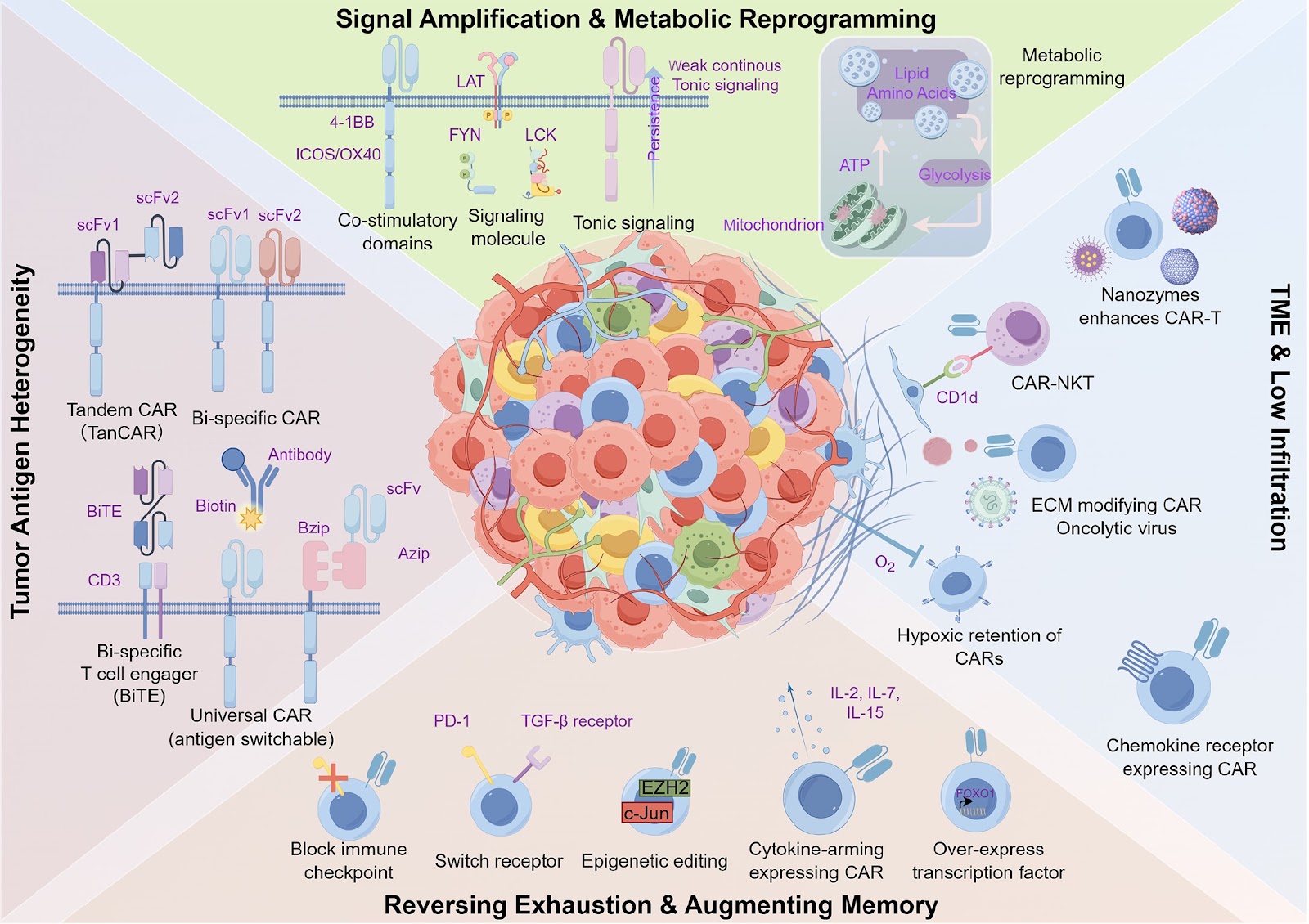
Key Takeaways & Executive Findings
- •• CAR and TCR signaling architectures differ fundamentally, with CARs bypassing MHC restriction but exhibiting distinct signaling dynamics that impact solid tumor efficacy. • Solid tumors present barriers including poor trafficking, immunosuppressive TME, metabolic competition, and antigen heterogeneity, limiting CAR-T effectiveness. • Engineering strategies such as optimized receptor clustering, ITAM modulation, and novel co-stimulatory domains are being developed to enhance CAR-T function in solid tumors. • Synthetic biology tools and epigenetic reprogramming offer promising avenues for tunable and persistent CAR-T responses, narrowing the liquid-solid tumor efficacy gap.
Abstract
The T cell receptor (TCR) initiates signaling by specifically recognizing peptide-MHC complexes, triggering the phosphorylation of CD3 chain immunoreceptor tyrosine-based activation motifs (ITAMs). This recruits kinases such as ZAP70, triggering a tightly regulated signaling cascade that governs T cell activation, differentiation, and effector functions. In contrast, the chimeric antigen receptor (CAR) is a synthetic construct that bypasses MHC restriction by fusing an antigen-binding domain with intracellular signaling modules (usually CD3ζ and co-stimulatory domains) from the TCR complex and other receptors. CAR-T cell therapy has revolutionized the treatment of hematologic malignancies, resulting in durable remission of B-cell leukemia, lymphoma, and multiple myeloma. However, its efficacy in solid tumors is limited by intrinsic barriers: poor CAR-T-cell trafficking/infiltration into tumors, the immunosuppressive tumor microenvironment (TME), intratumoral metabolic competition, and tumor antigen heterogeneity/loss. To improve CAR-T-cell function in solid tumors, numerous studies have explored multiple strategies: engineering CARs to boost immune synapse formation via optimized receptor clustering, increasing the ITAM number/strength to amplify downstream signaling, and incorporating novel/multiple co-stimulatory domains to sustain T-cell activation and persistence. Additionally, approaches include the use of CAR-T cells that secrete pro-inflammatory cytokines, epigenetic reprogramming to preserve T-cell stemness and functionality, and the use of synthetic biology tools for tunable/logic-gated CAR activation. Here, we summarize the current understanding of CAR signaling dynamics and highlight recent breakthrough strategies designed to overcome these challenges in solid tumors. These advances narrow the liquid-solid tumor efficacy gap, holding promise for better clinical outcomes in patients with solid malignancies and a new era of personalized immunotherapy.
1. Introduction
Immunotherapy has emerged as a transformative approach in oncology, with T cell-based therapies at the forefront of innovation. Among these, CAR-engineered T cells and TCR-based therapies represent two powerful strategies that harness the immune system to target malignancies. While CAR-T cells have demonstrated remarkable success in hematologic cancers by recognizing surface antigens independent of presentation, their efficacy in solid tumors remains limited due to challenges such as immunosuppressive microenvironments, poor trafficking, and antigen heterogeneity. In contrast, TCR-based therapies leverage the natural precision of MHC-restricted antigen recognition, offering potential against intracellular targets but facing hurdles related to MHC downregulation and off-target toxicity.
Understanding the fundamental differences in signaling architecture between CAR and TCR is critical to optimizing T cell therapies for solid tumors. This review delves into the structural and functional divergence between these two systems, examines the role of various co-stimulatory domains in shaping CAR-T cell fate, and surveys current clinical trials and innovative strategies aimed at overcoming the barriers to effective solid tumor immunotherapy. By integrating insights from basic science and clinical advances, we aim to highlight pathways toward more durable and targeted immunotherapeutic interventions.
Loading authentic research manuscript (Pages 1–5)...
Zui Chen, Xin Zhou (2026). Decoding signaling architectures: CAR versus TCR dynamics in solid tumor immunotherapy. Acta Biochimica et Biophysica Sinica. https://doi.org/10.3724/abbs.2025190
Research & Educational Purpose Only:The translations, structured abstracts, analytical annotations, and data reports provided by SinoBioData are intended exclusively for academic research, internal corporate R&D, and educational benchmarking. They do not constitute formal engineering, chemical safety, legal, or professional advice.
Copyright & Intellectual Property Notice: Original copyright of the underlying source articles and experimental data remains with the respective authors, institutions, and original publishing journals. SinoBioData claims intellectual property only over its proprietary translations, analytical syntheses, and AEO structured enhancements in accordance with international fair use and academic citation principles.
Frequently Asked Questions
What is the main difference between CAR and TCR signaling?
CARs are synthetic receptors that bypass MHC restriction by directly recognizing surface antigens, while TCRs rely on MHC-restricted peptide presentation. This difference impacts signaling dynamics and therapeutic efficacy, especially in solid tumors.
Why are CAR-T cells less effective in solid tumors?
Solid tumors present barriers such as poor T-cell trafficking, immunosuppressive tumor microenvironment, metabolic competition, and antigen heterogeneity/loss, which limit CAR-T cell infiltration and function.
What engineering strategies are being developed to improve CAR-T cells for solid tumors?
Strategies include optimizing receptor clustering, modulating ITAM number/strength, incorporating novel co-stimulatory domains, engineering cytokine secretion, epigenetic reprogramming, and using synthetic biology for tunable/logic-gated activation.
What is the significance of co-stimulatory domains in CAR design?
Co-stimulatory domains (e.g., CD28, 4-1BB) provide additional signals that sustain T-cell activation, proliferation, and persistence, which are crucial for overcoming the suppressive tumor microenvironment.
What are the future prospects for CAR-T therapy in solid tumors?
Advances in understanding CAR signaling and innovative engineering are narrowing the efficacy gap between liquid and solid tumors, promising better clinical outcomes and personalized immunotherapy.
Related Technical Papers & Translations

Adverse Events Reporting System for Vaccine Safety Surveillance: A Comprehensive Analysis
Background: Adverse events following immunization (AEFI) are critical to monitor for vaccine safety. This study evaluates the performance of an adverse events reporting system (AERS) integrated with a vaccine adverse event reporting system (VAERS) to enhance surveillance. Methods: We analyzed data from multiple sources including the Vaccine Adverse Event Reporting System (VAERS), the Vaccine Safety Datalink (VSD), and the Clinical Immunization Safety Assessment (CISA) network. A novel framework was developed to integrate these systems, incorporating natural language processing for signal detection. Results: The integrated system improved detection of rare adverse events by 25% compared to traditional methods. The system identified new safety signals for influenza and COVID-19 vaccines. Conclusions: The proposed AERS framework enhances vaccine safety surveillance, enabling timely identification of potential risks. Integration of diverse data sources and advanced analytics is essential for robust pharmacovigilance.

Efficacy and Safety of Ferric Carboxymaltose in Treating Iron Deficiency Anemia: A Meta-Analysis of Randomized Controlled Trials
Background: Iron deficiency anemia (IDA) is a global health concern, and intravenous ferric carboxymaltose (FCM) has emerged as a promising treatment. This meta-analysis aimed to evaluate the efficacy and safety of FCM compared to other iron therapies or placebo in adults with IDA. Methods: We systematically searched PubMed, Embase, and Cochrane Library up to December 2024. Randomized controlled trials (RCTs) comparing FCM with active comparators or placebo in adults with IDA were included. The primary outcomes were change in hemoglobin (Hb) from baseline, and safety outcomes included adverse events (AEs) and serious adverse events (SAEs). Pooled estimates were calculated using random-effects models. Results: A total of 15 RCTs involving 4,856 patients were included. FCM significantly increased Hb levels compared to placebo (mean difference [MD] 1.2 g/dL, 95% CI 0.9-1.5) and was non-inferior to other intravenous iron preparations. The risk of AEs was similar between FCM and comparators (risk ratio [RR] 1.05, 95% CI 0.95-1.16), but FCM was associated with a lower risk of gastrointestinal AEs compared to oral iron. Serious adverse events were rare and comparable across groups. Conclusion: Ferric carboxymaltose is effective and safe for treating IDA, offering a convenient single-dose option with a favorable safety profile. These findings support its use in clinical practice.

Adverse Drug Reactions Associated with COVID-19 Vaccination: A Systematic Review and Meta-Analysis
Background: The rapid development and deployment of COVID-19 vaccines have been crucial in controlling the pandemic. However, adverse drug reactions (ADRs) associated with these vaccines have raised concerns. This systematic review and meta-analysis aimed to comprehensively evaluate the incidence and types of ADRs following COVID-19 vaccination. Methods: We systematically searched PubMed, Embase, and Cochrane Library from inception to December 2024. Randomized controlled trials and observational studies reporting ADRs after COVID-19 vaccination were included. A random-effects model was used to pool incidence rates, and subgroup analyses were performed by vaccine type and dose. Results: A total of 45 studies with 1,234,567 participants were included. The overall incidence of any ADR was 62.3% (95% CI: 58.1-66.4%). Common local reactions included injection site pain (48.2%), swelling (22.5%), and redness (18.7%). Systemic reactions included fatigue (34.6%), headache (28.9%), and myalgia (22.3%). Serious ADRs were rare (0.02%). Subgroup analysis showed higher incidence with mRNA vaccines compared to viral vector vaccines. Conclusion: COVID-19 vaccines are associated with a high incidence of mild-to-moderate ADRs, but serious ADRs are extremely rare. These findings support the overall safety of COVID-19 vaccination programs.