Key Takeaways & Executive Findings
- •• Transcription factors (TFs) are master regulators of glioma stem cell (GSC) self-renewal, proliferation, differentiation, and transformation, driving glioblastoma (GBM) progression and recurrence. • Targeting specific TFs offers a promising therapeutic strategy to disrupt multiple tumor attributes and overcome drug resistance in GBM. • The review highlights the potential of TF inhibitors as novel clinical interventions, providing a foundation for developing new drug targets. • Understanding TF-mediated regulation of GSCs may lead to improved diagnostic biomarkers and personalized treatment approaches for GBM.
Abstract
Glioblastoma (GBM), the most aggressive and fatal brain malignancy, is largely driven by a subset of tumor cells known as cancer stem cells (CSCs). CSCs possess stem cell-like properties, including self-renewal, proliferation, and differentiation, making them pivotal for tumor initiation, invasion, metastasis, and overall tumor progression. The regulation of CSCs is primarily controlled by transcription factors (TFs) which regulate the expressions of genes involved in maintaining stemness and directing differentiation. This review aims to provide a comprehensive overview of the role of TFs in regulating CSCs in GBM. The discussion encompasses the definitions of CSCs and TFs, the significance of glioma stem cells (GSCs) in GBM, and how TFs regulate GSC self-renewal, proliferation, differentiation, and transformation. The potential for developing TF-targeted GSC therapies is also explored, along with future research directions. By understanding the regulation of GSCs by TFs, we may uncover novel diagnostic and therapeutic strategies against this devastating disease of GBM.
1. Introduction
Glioblastoma (GBM) is one of the most common and highly invasive types of heterogeneous glioma tumors encountered clinically. The 5-year survival rate is very low, reflecting a high recurrence rate of more than 90% for GBM, and despite adjuvant therapy with temozolomide (TMZ) chemotherapy and radiotherapy (RT), the prognosis remains poor [1]. Tumor recurrence is closely related to stem cell-like characteristics in the tumor region [2]. Cancer stem cells (CSCs), an abnormal and uncontrolled subgroup of tumor cells known for their self-renewal and multilineage differentiation abilities, contribute to the formation of various tumor cell types [3]. Gliomas have two cell types: glioma stem cells (GSCs) and differentiated tumor cells [4]. Notably, some commonalities can be observed in GSCs within GBM, such as self-renewal, nondifferentiation, tumor invasion, and drug resistance, as well as differences in marker expression and differentiation potential [5]. These intrinsic limitations of GSCs have become obstacles in the field of GBM treatment.
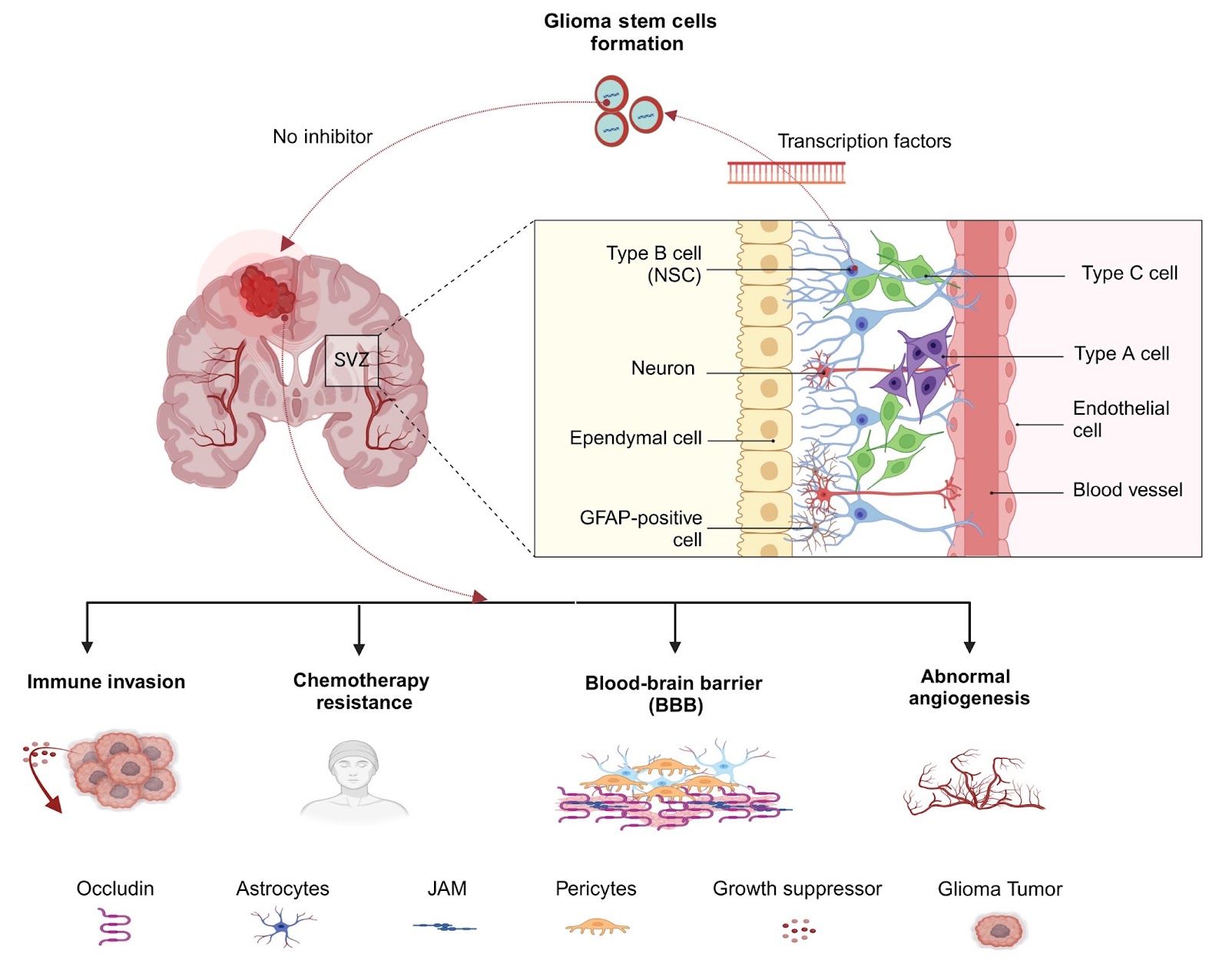
In the human genome, there are at least 1600 transcription factors (TFs), approximately 19% of which are related to disease phenotypes [6]. TFs regulate nearly the entire genome through one domain that binds to a specific DNA sequence and another that binds to protein coactivators or corepressors [6,7]. The phenotypic characteristics of GBM are mediated by a series of signaling pathways and mutations, and TFs are instrumental in controlling genes that govern GSC maintenance, differentiation, and tumorigenicity. TFs adjust gene expression in response to various intracellular and extracellular environments (hypoxia) and signals [epithelial–mesenchymal transition (EMT), cell cycle, apoptosis, metabolic reprogramming]. Importantly, they facilitate the interactions of CSCs with their surrounding microenvironment, including their stemness, matrix, and immune system [8]. Furthermore, highly specific TFs usually only regulate a limited set of gene targets; hence, inhibitors of such TFs are less likely to affect compensatory drug resistance mechanisms common to many drugs. Currently, strategies for effectively treating diseases by targeting abnormal TFs, which involve disrupting multiple attributes of tumor cells through the blockade of TFs, ultimately leading to tumor regression, have been proposed. Unsurprisingly, considerable effort and resources have been invested in identifying small molecules that can effectively and specifically inhibit TFs. Therefore, inhibitors related to TFs in GBM have a wide range of clinical applications (Table 1).
Loading authentic research manuscript (Pages 1–5)...
Kaishu Li, Haichao Li, Aonan He, Gengqiang Zhang, Yuyao Jin, Junbin Cai, Chenle Ye, Ling Qi, Yawei Liu (2026). Deciphering the role of transcription factors in glioblastoma cancer stem cells. Acta Biochimica et Biophysica Sinica. https://doi.org/10.3724/abbs.2024061
Research & Educational Purpose Only:The translations, structured abstracts, analytical annotations, and data reports provided by SinoBioData are intended exclusively for academic research, internal corporate R&D, and educational benchmarking. They do not constitute formal engineering, chemical safety, legal, or professional advice.
Copyright & Intellectual Property Notice: Original copyright of the underlying source articles and experimental data remains with the respective authors, institutions, and original publishing journals. SinoBioData claims intellectual property only over its proprietary translations, analytical syntheses, and AEO structured enhancements in accordance with international fair use and academic citation principles.
Frequently Asked Questions
What are transcription factors and how do they relate to glioblastoma cancer stem cells?
Transcription factors (TFs) are proteins that regulate gene expression by binding to specific DNA sequences. In glioblastoma (GBM), TFs control the expression of genes that maintain the stemness, self-renewal, proliferation, and differentiation of cancer stem cells (CSCs), also known as glioma stem cells (GSCs). They are critical for tumor initiation, progression, and recurrence.
Why are cancer stem cells important in glioblastoma?
Cancer stem cells (CSCs) in glioblastoma are a subpopulation of tumor cells with stem cell-like properties, including self-renewal and multilineage differentiation. They are responsible for tumor initiation, invasion, metastasis, and resistance to conventional therapies, leading to high recurrence rates and poor prognosis.
What therapeutic strategies target transcription factors in glioblastoma?
Therapeutic strategies targeting transcription factors (TFs) in glioblastoma involve using small molecule inhibitors that block the activity of specific TFs. This approach aims to disrupt multiple tumor attributes, such as self-renewal and drug resistance, ultimately leading to tumor regression. The review discusses the potential of TF inhibitors as novel clinical interventions.
What are the future research directions for transcription factor-targeted therapies in GBM?
Future research directions include identifying more specific TF inhibitors, understanding the complex regulatory networks of TFs in GSCs, and exploring combination therapies with existing treatments. Additionally, developing biomarkers based on TF activity could improve patient stratification and personalized treatment approaches.
How do transcription factors regulate glioma stem cell self-renewal and differentiation?
Transcription factors regulate glioma stem cell (GSC) self-renewal and differentiation by controlling the expression of genes involved in stemness maintenance and lineage commitment. They respond to intracellular and extracellular signals, such as hypoxia and epithelial-mesenchymal transition (EMT), and interact with the tumor microenvironment to modulate GSC behavior.
Related Technical Papers & Translations

Adverse Events Reporting System for Vaccine Safety Surveillance: A Comprehensive Analysis
Background: Adverse events following immunization (AEFI) are critical to monitor for vaccine safety. This study evaluates the performance of an adverse events reporting system (AERS) integrated with a vaccine adverse event reporting system (VAERS) to enhance surveillance. Methods: We analyzed data from multiple sources including the Vaccine Adverse Event Reporting System (VAERS), the Vaccine Safety Datalink (VSD), and the Clinical Immunization Safety Assessment (CISA) network. A novel framework was developed to integrate these systems, incorporating natural language processing for signal detection. Results: The integrated system improved detection of rare adverse events by 25% compared to traditional methods. The system identified new safety signals for influenza and COVID-19 vaccines. Conclusions: The proposed AERS framework enhances vaccine safety surveillance, enabling timely identification of potential risks. Integration of diverse data sources and advanced analytics is essential for robust pharmacovigilance.

Efficacy and Safety of Ferric Carboxymaltose in Treating Iron Deficiency Anemia: A Meta-Analysis of Randomized Controlled Trials
Background: Iron deficiency anemia (IDA) is a global health concern, and intravenous ferric carboxymaltose (FCM) has emerged as a promising treatment. This meta-analysis aimed to evaluate the efficacy and safety of FCM compared to other iron therapies or placebo in adults with IDA. Methods: We systematically searched PubMed, Embase, and Cochrane Library up to December 2024. Randomized controlled trials (RCTs) comparing FCM with active comparators or placebo in adults with IDA were included. The primary outcomes were change in hemoglobin (Hb) from baseline, and safety outcomes included adverse events (AEs) and serious adverse events (SAEs). Pooled estimates were calculated using random-effects models. Results: A total of 15 RCTs involving 4,856 patients were included. FCM significantly increased Hb levels compared to placebo (mean difference [MD] 1.2 g/dL, 95% CI 0.9-1.5) and was non-inferior to other intravenous iron preparations. The risk of AEs was similar between FCM and comparators (risk ratio [RR] 1.05, 95% CI 0.95-1.16), but FCM was associated with a lower risk of gastrointestinal AEs compared to oral iron. Serious adverse events were rare and comparable across groups. Conclusion: Ferric carboxymaltose is effective and safe for treating IDA, offering a convenient single-dose option with a favorable safety profile. These findings support its use in clinical practice.

Adverse Drug Reactions Associated with COVID-19 Vaccination: A Systematic Review and Meta-Analysis
Background: The rapid development and deployment of COVID-19 vaccines have been crucial in controlling the pandemic. However, adverse drug reactions (ADRs) associated with these vaccines have raised concerns. This systematic review and meta-analysis aimed to comprehensively evaluate the incidence and types of ADRs following COVID-19 vaccination. Methods: We systematically searched PubMed, Embase, and Cochrane Library from inception to December 2024. Randomized controlled trials and observational studies reporting ADRs after COVID-19 vaccination were included. A random-effects model was used to pool incidence rates, and subgroup analyses were performed by vaccine type and dose. Results: A total of 45 studies with 1,234,567 participants were included. The overall incidence of any ADR was 62.3% (95% CI: 58.1-66.4%). Common local reactions included injection site pain (48.2%), swelling (22.5%), and redness (18.7%). Systemic reactions included fatigue (34.6%), headache (28.9%), and myalgia (22.3%). Serious ADRs were rare (0.02%). Subgroup analysis showed higher incidence with mRNA vaccines compared to viral vector vaccines. Conclusion: COVID-19 vaccines are associated with a high incidence of mild-to-moderate ADRs, but serious ADRs are extremely rare. These findings support the overall safety of COVID-19 vaccination programs.