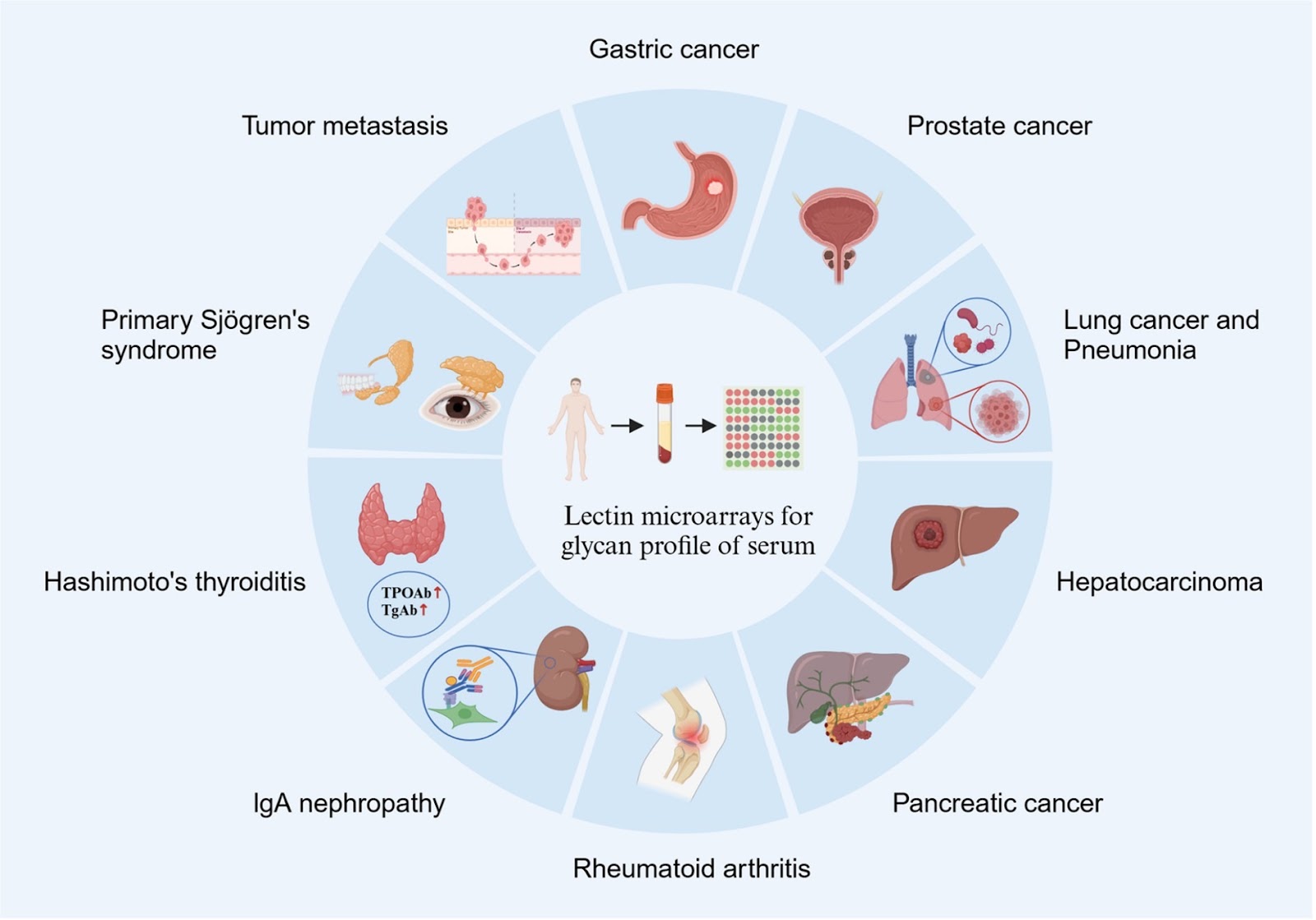
Key Takeaways & Executive Findings
- •• Lectin microarrays enable high-throughput, sensitive profiling of glycan patterns in diverse clinical samples, offering advantages over traditional methods like mass spectrometry. • The technology has evolved since 2005 and now shows potential for clinical applications, particularly in diagnosing tumors, autoimmune diseases, and chronic inflammation. • Glycosylation changes are more pronounced than other biological parameters in certain pathological conditions, making glycan biomarkers valuable for early disease diagnosis. • The review highlights the need for standardized protocols and further validation to translate lectin microarray findings into routine clinical practice.
Abstract
Glycosylation, a crucial posttranslational modification, plays a significant role in numerous physiological and pathological processes. Lectin microarrays, which leverage the high specificity of lectins for sugar binding, are ideally suited for profiling the glycan spectra of diverse and complex biological samples. In this review, we explore the evolution of lectin detection technologies, as well as the applications and challenges of lectin microarrays in analyzing the glycome profiles of various clinical samples, including serum, saliva, tissues, sperm, and urine. This review not only emphasizes significant advancements in the high-throughput analysis of polysaccharides but also provides insight into the potential of lectin microarrays for diagnosing and managing diseases such as tumors, autoimmune diseases, and chronic inflammation. We aim to provide a clear, concise, and comprehensive overview of the use of lectin microarrays in clinical settings, thereby assisting researchers in conducting clinical studies in glycobiology.
1. Introduction
Glycosylation, a prevalent type of modification occurring during both cotranslational and posttranslational processes, plays a pivotal role in various cellular functions, including adhesion, recognition, molecular transport, clearance, and signal transduction [1]. Glycans exhibit remarkable structural diversity, encompassing variances in monosaccharide subunit linkages and branching, complex compositions of glycoconjugates resulted from interactions with polysaccharides, proteins, lipids, and other sugar moieties, as well as diverse glycosylation sites [2]. Changes in physiological states can lead to modifications in specific glycans, with the glycan chains of some IgG molecules undergoing significant alterations with advancing age [3]. Similarly, disease states significantly impact glycan biosynthesis, with changes in glycosylation patterns being more pronounced than alterations in other biological parameters under specific pathological conditions [4]. Therefore, the field of human glycomics is critical for advancing clinical research on diseases, with the precise identification of disease-specific glycoforms, holding the potential to greatly improve early disease diagnosis.
Over the past twenty years, techniques for examining glycosylation have primarily included capillary electrophoresis (CE) [5,6], high-performance liquid chromatography (HPLC) [7,8], mass spectrometry (MS) [9], and lectin assays [10,11]. Capillary electrophoresis, powered by high-voltage direct current, offers benefits such as superior separation efficiency, minimal sample utilization, and partial structural insights. HPLC, known for its efficient and stable separation capabilities, coupled with high-sensitivity fluorescence detection, enables quantitative analysis of N-glycans. Mass spectrometry, a commonly employed detection method in glycan analysis, boasts high sensitivity, particularly for derivatized glycans, and enables complete elucidation of glycan composition through multistage MS data. However, prior to these analyses, enzymatic or chemical methods are typically used to detach glycans from glycoproteins, facilitating separate analysis and detection of glycan expression and alterations within samples. Lectins, naturally occurring substances initially discovered in plants but found across various organisms, are glycan-binding proteins capable of selectively interacting with specific sugar moieties of soluble sugars, glycoproteins, or glycolipids [12].
Loading authentic research manuscript (Pages 1–5)...
Hangzhou Yang, Zihan Lin, Bo Wu, Jun Xu, Sheng-Ce Tao, Shumin Zhou (2026). Deciphering disease through glycan codes: leveraging lectin microarrays for clinical insights. Acta Biochimica et Biophysica Sinica. https://doi.org/10.3724/abbs.2024123
Research & Educational Purpose Only:The translations, structured abstracts, analytical annotations, and data reports provided by SinoBioData are intended exclusively for academic research, internal corporate R&D, and educational benchmarking. They do not constitute formal engineering, chemical safety, legal, or professional advice.
Copyright & Intellectual Property Notice: Original copyright of the underlying source articles and experimental data remains with the respective authors, institutions, and original publishing journals. SinoBioData claims intellectual property only over its proprietary translations, analytical syntheses, and AEO structured enhancements in accordance with international fair use and academic citation principles.
Frequently Asked Questions
What are lectin microarrays and how do they work?
Lectin microarrays are platforms that immobilize a panel of lectins—proteins that specifically bind to carbohydrate structures—on a solid surface. When a biological sample is applied, the lectins capture glycans present in the sample, allowing for the simultaneous profiling of multiple glycan structures. This enables high-throughput analysis of glycosylation patterns in complex samples.
What clinical samples can be analyzed using lectin microarrays?
Lectin microarrays can analyze a variety of clinical samples, including serum, saliva, tissues, sperm, and urine. This versatility makes them useful for studying disease-related glycosylation changes across different bodily fluids and tissues.
What are the advantages of lectin microarrays over traditional glycan analysis methods?
Compared to methods like mass spectrometry, lectin microarrays offer simplicity, speed, high throughput, and high sensitivity. They do not require the detachment of glycans from proteins, which can alter their structure, thus preserving native glycan conformations.
How can lectin microarrays contribute to disease diagnosis?
By detecting disease-specific glycan alterations, lectin microarrays can identify potential biomarkers for various conditions, including tumors, autoimmune diseases, and chronic inflammation. This can aid in early diagnosis, prognosis, and monitoring of disease progression.
What are the current challenges in using lectin microarrays in clinical settings?
Challenges include the need for standardization of protocols, validation of results across large patient cohorts, and integration with existing diagnostic workflows. Additionally, the specificity and cross-reactivity of lectins require careful interpretation of data.
Related Technical Papers & Translations

Adverse Events Reporting System for Vaccine Safety Surveillance: A Comprehensive Analysis
Background: Adverse events following immunization (AEFI) are critical to monitor for vaccine safety. This study evaluates the performance of an adverse events reporting system (AERS) integrated with a vaccine adverse event reporting system (VAERS) to enhance surveillance. Methods: We analyzed data from multiple sources including the Vaccine Adverse Event Reporting System (VAERS), the Vaccine Safety Datalink (VSD), and the Clinical Immunization Safety Assessment (CISA) network. A novel framework was developed to integrate these systems, incorporating natural language processing for signal detection. Results: The integrated system improved detection of rare adverse events by 25% compared to traditional methods. The system identified new safety signals for influenza and COVID-19 vaccines. Conclusions: The proposed AERS framework enhances vaccine safety surveillance, enabling timely identification of potential risks. Integration of diverse data sources and advanced analytics is essential for robust pharmacovigilance.

Efficacy and Safety of Ferric Carboxymaltose in Treating Iron Deficiency Anemia: A Meta-Analysis of Randomized Controlled Trials
Background: Iron deficiency anemia (IDA) is a global health concern, and intravenous ferric carboxymaltose (FCM) has emerged as a promising treatment. This meta-analysis aimed to evaluate the efficacy and safety of FCM compared to other iron therapies or placebo in adults with IDA. Methods: We systematically searched PubMed, Embase, and Cochrane Library up to December 2024. Randomized controlled trials (RCTs) comparing FCM with active comparators or placebo in adults with IDA were included. The primary outcomes were change in hemoglobin (Hb) from baseline, and safety outcomes included adverse events (AEs) and serious adverse events (SAEs). Pooled estimates were calculated using random-effects models. Results: A total of 15 RCTs involving 4,856 patients were included. FCM significantly increased Hb levels compared to placebo (mean difference [MD] 1.2 g/dL, 95% CI 0.9-1.5) and was non-inferior to other intravenous iron preparations. The risk of AEs was similar between FCM and comparators (risk ratio [RR] 1.05, 95% CI 0.95-1.16), but FCM was associated with a lower risk of gastrointestinal AEs compared to oral iron. Serious adverse events were rare and comparable across groups. Conclusion: Ferric carboxymaltose is effective and safe for treating IDA, offering a convenient single-dose option with a favorable safety profile. These findings support its use in clinical practice.

Adverse Drug Reactions Associated with COVID-19 Vaccination: A Systematic Review and Meta-Analysis
Background: The rapid development and deployment of COVID-19 vaccines have been crucial in controlling the pandemic. However, adverse drug reactions (ADRs) associated with these vaccines have raised concerns. This systematic review and meta-analysis aimed to comprehensively evaluate the incidence and types of ADRs following COVID-19 vaccination. Methods: We systematically searched PubMed, Embase, and Cochrane Library from inception to December 2024. Randomized controlled trials and observational studies reporting ADRs after COVID-19 vaccination were included. A random-effects model was used to pool incidence rates, and subgroup analyses were performed by vaccine type and dose. Results: A total of 45 studies with 1,234,567 participants were included. The overall incidence of any ADR was 62.3% (95% CI: 58.1-66.4%). Common local reactions included injection site pain (48.2%), swelling (22.5%), and redness (18.7%). Systemic reactions included fatigue (34.6%), headache (28.9%), and myalgia (22.3%). Serious ADRs were rare (0.02%). Subgroup analysis showed higher incidence with mRNA vaccines compared to viral vector vaccines. Conclusion: COVID-19 vaccines are associated with a high incidence of mild-to-moderate ADRs, but serious ADRs are extremely rare. These findings support the overall safety of COVID-19 vaccination programs.