Key Takeaways & Executive Findings
- •• D-CAPS, a double-site CRISPR-Cas9 system, provides complete resistance against T7 phage in E. coli, with no plaques even at high MOI. • D-CAPS maintains normal growth and protein expression in E. coli, comparable to wild-type strains, even under phage challenge. • The system is versatile, effective across different E. coli strains including MG1655 and BL21(DE3), highlighting its industrial applicability. • D-CAPS offers a robust solution to phage contamination in fermentation, potentially reducing economic losses and improving product quality.
Abstract
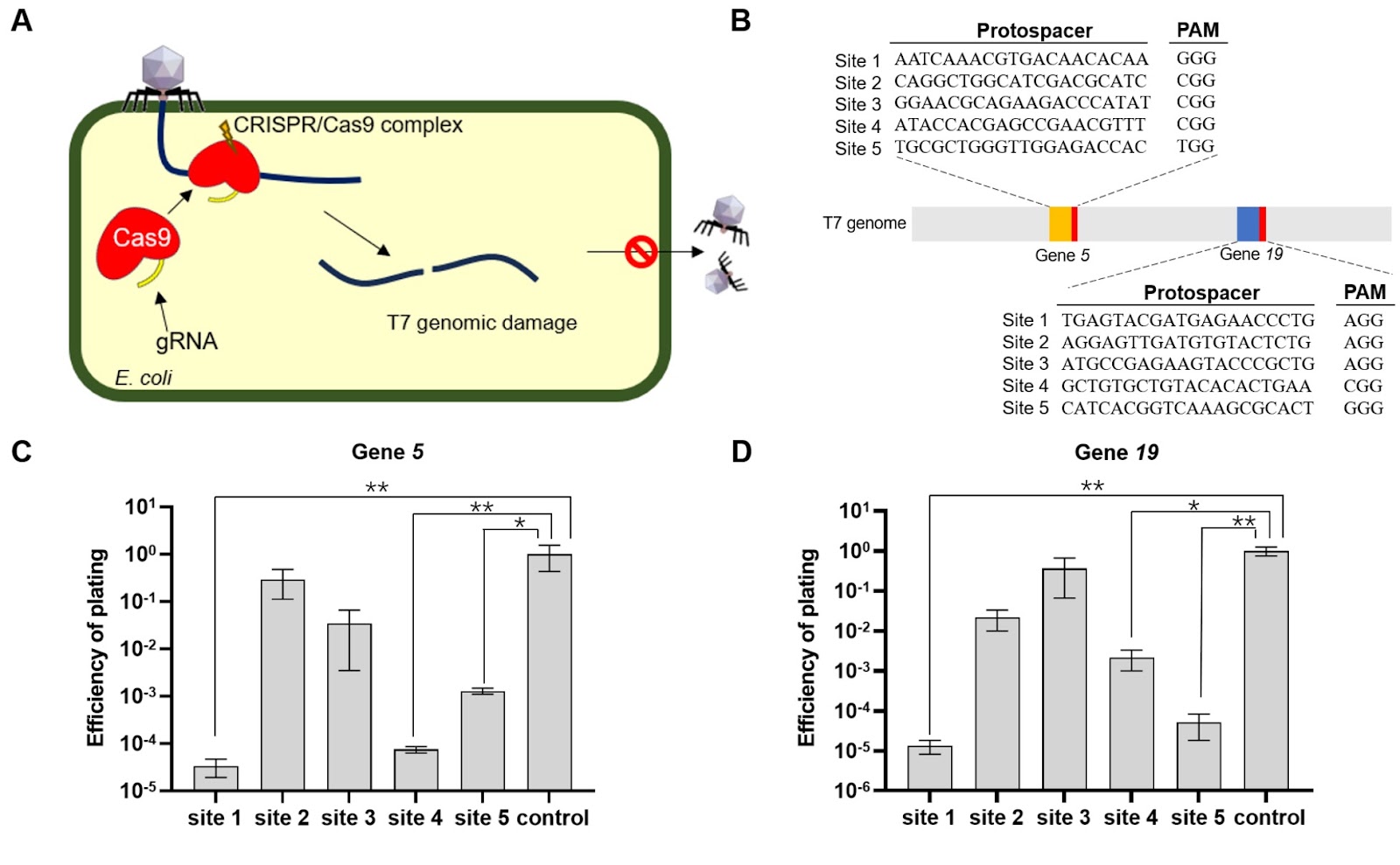
Escherichia coli is widely used in industrial chemical synthesis but faces significant challenges due to bacteriophage contamination, which reduces product quality and yield. Therefore, developing an efficient antiphage system is essential. In this study, we develop a CRISPR-Cas9-based antiphage system (CAPS) targeting essential genes of the T7 phage (gene 5 and gene 19) with single gRNAs transformed into MG1655 strains expressing Cas9. While CAPS provides limited resistance, with plating efficiencies ranging from 10–5 to 10–1, further optimization is needed. To enhance efficacy, we design a double-site-targeting CRISPR-Cas9-based antiphage system (D-CAPS). D-CAPS demonstrates complete resistance, with no plaques observed even at a high multiplicity of infection (MOI of 2), and growth curve analysis reveals that antiphage E. coli strains grow normally, similar to the wild-type strain, even at a high multiplicity of infection. Furthermore, D-CAPS is effective against BL21(DE3) strains, showing strong resistance and demonstrating its versatility across different E. coli strains. Protein expression analysis via green fluorescent protein confirms that E. coli carrying D-CAPS could maintain normal protein expression levels even in the presence of phages, comparable to wild-type strains. Overall, D-CAPS offers a robust and versatile approach to enhancing E. coli resistance to phages, providing a practical solution for protecting industrial E. coli strains and improving fermentation processes.
1. Introduction
Escherichia coli strains are the most commonly used hosts in industrial production and are widely utilized in the synthesis of various chemicals, including organic acids, alcohols, amino acids, fatty acids, alkanes, etc. Notably, E. coli strains such as MG1655 from the K-12 series and BL21 (DE3) from the B series have become important chassis strains in synthetic biology. However, in actual industrial production, E. coli faces the risk of contamination by bacteriophages. Phages can rapidly kill host bacteria, accumulate at very high concentrations, and spread throughout production facilities. This contamination can lead to a decline in fermentation product quality, reduced production capacity, and economic losses. Therefore, addressing the issue of phage contamination in fermentation processes is urgent.
Various industries have implemented methods to reduce contamination by bacteriophages during fermentation, such as raw material treatment, strain rotation, process changes, plant design adjustments, and extensive cleaning and hygiene practices. However, these measures undoubtedly increase the operating costs of facilities. E. coli possesses several endogenous mechanisms to resist phage infection, including surface receptor mutation, the restriction-modification (R-M) system, the clustered regularly interspaced short palindromic repeats (CRISPR)-CRISPR-associated protein (Cas) system, the abortive infection system, and the Thoeris system. These mechanisms help E. coli survive phage infection or prevent phage contamination from spreading in the environment. Although E. coli has evolved a wide variety of antiphage strategies through its long-term arms race with bacteriophages, bacteriophages have concurrently evolved various countermeasures to evade these defense systems. Consequently, the endogenous defense mechanisms of E. coli offer limited protection during actual phage infections. Thus, it is necessary to develop more effective measures to defend against bacteriophage infection.
Loading authentic research manuscript (Pages 1–5)...
Mingjun Sun, Jie Gao, Hongjie Tang, Hengyi Wang, Liyan Zhou, Chuan Song, Yongqiang Tian, Qi Li (2026). D-CAPS: an efficient CRISPR-Cas9-based phage defense system for E. coli. Acta Biochimica et Biophysica Sinica. https://doi.org/10.3724/abbs.2024208
Research & Educational Purpose Only:The translations, structured abstracts, analytical annotations, and data reports provided by SinoBioData are intended exclusively for academic research, internal corporate R&D, and educational benchmarking. They do not constitute formal engineering, chemical safety, legal, or professional advice.
Copyright & Intellectual Property Notice: Original copyright of the underlying source articles and experimental data remains with the respective authors, institutions, and original publishing journals. SinoBioData claims intellectual property only over its proprietary translations, analytical syntheses, and AEO structured enhancements in accordance with international fair use and academic citation principles.
Frequently Asked Questions
What is D-CAPS?
D-CAPS is a double-site-targeting CRISPR-Cas9-based antiphage system designed to protect E. coli from bacteriophage infection, specifically targeting essential genes of T7 phage.
How does D-CAPS improve upon single-site CAPS?
While single-site CAPS provides limited resistance (plating efficiencies 10-5 to 10-1), D-CAPS achieves complete resistance with no plaques even at high multiplicity of infection (MOI of 2), ensuring normal growth and protein expression.
Is D-CAPS effective in different E. coli strains?
Yes, D-CAPS demonstrates strong resistance in both MG1655 and BL21(DE3) strains, showing versatility across different E. coli strains used in industrial applications.
What are the practical applications of D-CAPS?
D-CAPS provides a robust solution to protect industrial E. coli strains from phage contamination, improving fermentation processes and reducing economic losses.
Does D-CAPS affect normal protein expression?
No, protein expression analysis using green fluorescent protein confirmed that E. coli carrying D-CAPS maintains normal protein expression levels even in the presence of phages, comparable to wild-type strains.
Related Technical Papers & Translations

Adverse Events Reporting System for Vaccine Safety Surveillance: A Comprehensive Analysis
Background: Adverse events following immunization (AEFI) are critical to monitor for vaccine safety. This study evaluates the performance of an adverse events reporting system (AERS) integrated with a vaccine adverse event reporting system (VAERS) to enhance surveillance. Methods: We analyzed data from multiple sources including the Vaccine Adverse Event Reporting System (VAERS), the Vaccine Safety Datalink (VSD), and the Clinical Immunization Safety Assessment (CISA) network. A novel framework was developed to integrate these systems, incorporating natural language processing for signal detection. Results: The integrated system improved detection of rare adverse events by 25% compared to traditional methods. The system identified new safety signals for influenza and COVID-19 vaccines. Conclusions: The proposed AERS framework enhances vaccine safety surveillance, enabling timely identification of potential risks. Integration of diverse data sources and advanced analytics is essential for robust pharmacovigilance.

Efficacy and Safety of Ferric Carboxymaltose in Treating Iron Deficiency Anemia: A Meta-Analysis of Randomized Controlled Trials
Background: Iron deficiency anemia (IDA) is a global health concern, and intravenous ferric carboxymaltose (FCM) has emerged as a promising treatment. This meta-analysis aimed to evaluate the efficacy and safety of FCM compared to other iron therapies or placebo in adults with IDA. Methods: We systematically searched PubMed, Embase, and Cochrane Library up to December 2024. Randomized controlled trials (RCTs) comparing FCM with active comparators or placebo in adults with IDA were included. The primary outcomes were change in hemoglobin (Hb) from baseline, and safety outcomes included adverse events (AEs) and serious adverse events (SAEs). Pooled estimates were calculated using random-effects models. Results: A total of 15 RCTs involving 4,856 patients were included. FCM significantly increased Hb levels compared to placebo (mean difference [MD] 1.2 g/dL, 95% CI 0.9-1.5) and was non-inferior to other intravenous iron preparations. The risk of AEs was similar between FCM and comparators (risk ratio [RR] 1.05, 95% CI 0.95-1.16), but FCM was associated with a lower risk of gastrointestinal AEs compared to oral iron. Serious adverse events were rare and comparable across groups. Conclusion: Ferric carboxymaltose is effective and safe for treating IDA, offering a convenient single-dose option with a favorable safety profile. These findings support its use in clinical practice.

Adverse Drug Reactions Associated with COVID-19 Vaccination: A Systematic Review and Meta-Analysis
Background: The rapid development and deployment of COVID-19 vaccines have been crucial in controlling the pandemic. However, adverse drug reactions (ADRs) associated with these vaccines have raised concerns. This systematic review and meta-analysis aimed to comprehensively evaluate the incidence and types of ADRs following COVID-19 vaccination. Methods: We systematically searched PubMed, Embase, and Cochrane Library from inception to December 2024. Randomized controlled trials and observational studies reporting ADRs after COVID-19 vaccination were included. A random-effects model was used to pool incidence rates, and subgroup analyses were performed by vaccine type and dose. Results: A total of 45 studies with 1,234,567 participants were included. The overall incidence of any ADR was 62.3% (95% CI: 58.1-66.4%). Common local reactions included injection site pain (48.2%), swelling (22.5%), and redness (18.7%). Systemic reactions included fatigue (34.6%), headache (28.9%), and myalgia (22.3%). Serious ADRs were rare (0.02%). Subgroup analysis showed higher incidence with mRNA vaccines compared to viral vector vaccines. Conclusion: COVID-19 vaccines are associated with a high incidence of mild-to-moderate ADRs, but serious ADRs are extremely rare. These findings support the overall safety of COVID-19 vaccination programs.