Key Takeaways & Executive Findings
- •• First crystal structures of WDR5 bound to Kif2A-derived peptides reveal a dual engagement of both WIN and S7 sites, with Arg117 and Ser121 as key anchors. • Ser121 induces a conformational change in Tyr191, opening the S7 pocket, which is critical for high-affinity binding and inhibitor mimicry. • Mutagenesis and ITC confirm the functional importance of Arg117 and Ser121, providing a molecular basis for the non-canonical mitotic role of WDR5. • The WIN-S7 site plasticity offers a promising therapeutic target for cancers linked to chromosomal instability, guiding dual-site inhibitor design.
Abstract
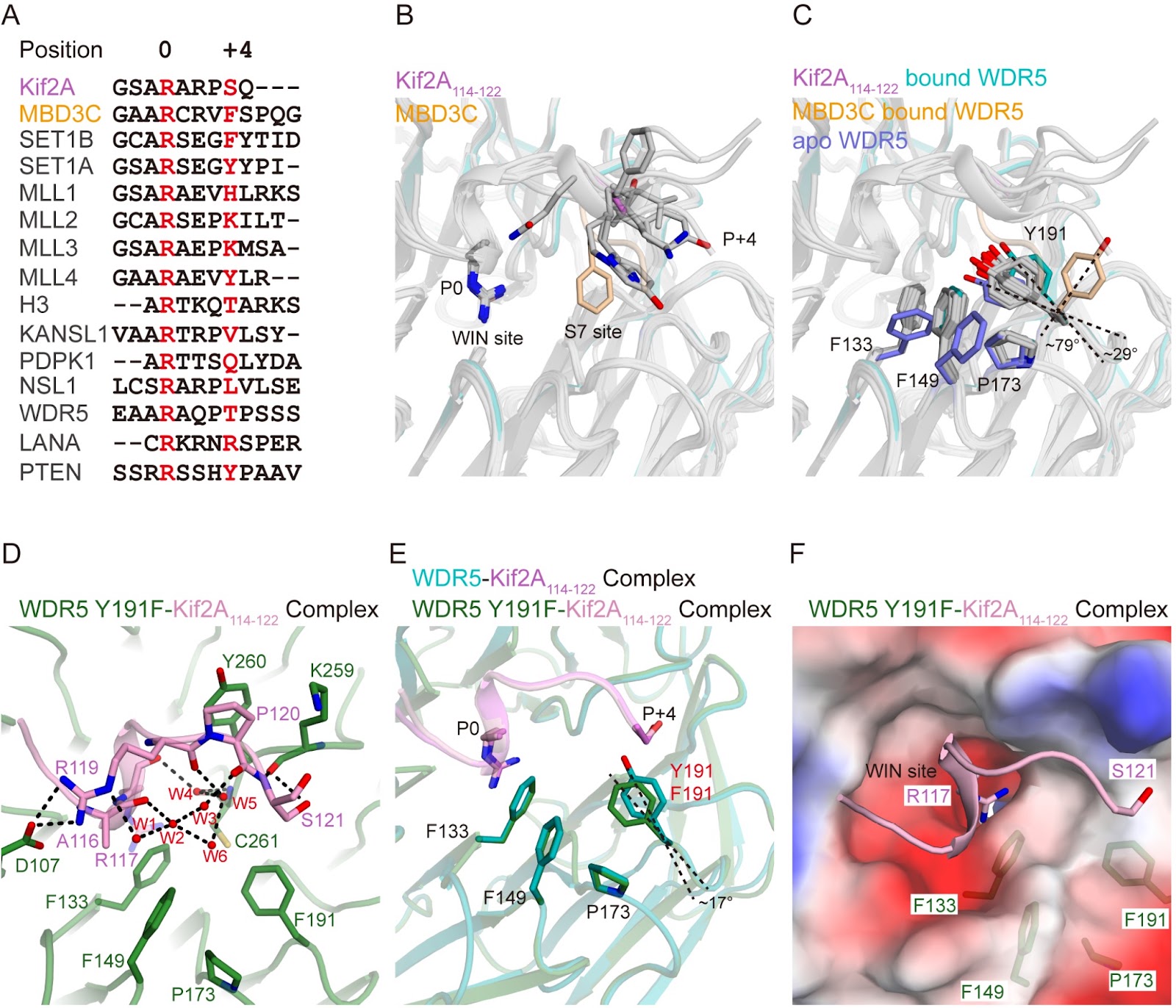
Chromosome congression and spindle assembly are essential for genomic stability and proper cell division, with deficiencies in these processes linked to tumorigenesis. WD repeat-containing protein 5 (WDR5), a core component of the mixed lineage leukemia (MLL) methyltransferase complex, directly binds to kinesin family member 2A (Kif2A) to regulate these mitotic events. Despite the importance of this interaction, its structural basis for Kif2A recognition by WDR5 remains unclear. Here, we determine the crystal structure of WDR5 in complex with a Kif2A-derived peptide (residues 114–122) at a resolution of 1.85 Å. Structural analysis reveals that Kif2A engages both the WIN and S7 sites of WDR5 via Arg117 and Ser121, with Ser121 forming hydrogen bonds with WDR5 Tyr191 and Lys259, driving Tyr191 rotation and opening the S7 pocket. Additional structures of WDR5 complexed with truncated or mutated Kif2A peptides and a WDR5 Y191F variant highlight the dynamic nature of Tyr191. Notably, anti-WDR5 compounds exhibit a similar binding mode at the WDR5 WIN-S7 site. The results of mutagenesis combined with isothermal titration calorimetry (ITC) assays underscore the critical roles of Arg117 and Ser121 in mediating the binding of Kif2A to WDR5. In summary, our findings provide atomic-level insights into the molecular mechanisms underlying the non-canonical mitotic function of the MLL/WDR5 complex and highlight WIN-S7 sites as promising therapeutic targets for diseases associated with chromosomal instability, such as cancers.
1. Introduction
Accurate chromosome segregation during mitosis is essential for maintaining genomic stability and preventing aneuploidy [1], a hallmark of many cancers [2,3]. Central to this process is the coordination of chromosome congression and spindle assembly, which are regulated by a network of protein interactions and posttranslational modifications [1,4]. Key players in this regulatory network include MLL complexes and kinesin motor proteins [5–7], both of which are essential for mitotic fidelity.
WDR5 is a highly conserved core component of MLL/SET1 methyltransferase complexes and is known for mediating histone H3 lysine 4 (H3K4) methylation, an epigenetic marker associated with active transcription [8–10]. This modification is critical for regulating gene expression during development and in response to cellular signals [11]. In addition to transcriptional regulation, WDR5 also functions as a scaffold protein, facilitating the assembly of diverse protein complexes through its WD40 repeat domain, which forms a β-propeller structure [6]. WDR5 has two distinct binding pockets: the WDR5-interacting (WIN) site and the WDR5-binding motif (WBM) site [6]. The WIN site accommodates various binding partners, including H3 [12–15], MLL proteins [16,17], MBD3C [18], KANSL1 [19], PDPK1 [20], LANA [21] and PTEN [22], whereas the WBM site interacts with proteins such as MYC [23], RBBP5 [24], and KANSL2 [19]. WDR5 is involved in diverse cellular processes, such as promoting cellular differentiation and bone formation [25] and maintaining stem cell pluripotency and self-renewal [26,27]. Given its multifaceted roles, particularly in cancer biology, where it is frequently overexpressed and linked to oncogenesis [28–30], WDR5 has emerged as an attractive drug target. Although the WIN site has been the primary focus of small-molecule inhibitor development [31,32], recent studies have identified the S7 pocket as an additional binding site that enhances inhibitor binding affinity [20,33–37]. This structural pocket was initially identified through studies with OICR-9429 [31,32], a small-molecule inhibitor that occupies a binding site formed by Phe133, Phe149, Pro173 and Tyr191, which is spatially distinct from the WIN site. Subsequent structural characterization by the Fesik group [34] led to the formal designation of this region as the S7 pocket, emphasizing its importance in structure-based inhibitor optimization. For example, dual-site inhibitors, such as compound 10, which targets both the WIN and S7 sites, have demonstrated potent on-target effects and preclinical efficacy in cancer models.
Emerging evidence suggests that the non-canonical role of WDR5 in mitosis is mediated by its interaction with Kif2A [7], a kinesin-13 family member that specializes in microtubule depolymerization. Kif2A plays a pivotal role in mitotic spindle assembly and chromosome segregation by regulating microtubule dynamics at plus ends, distinguishing it from cargo-transporting kinesins [38–40]. Structu...
Loading authentic research manuscript (Pages 1–5)...
Yang Yang, Shuting Zhang, Zhangyu Wu, Wenwen Li, Xuefang Sun, Yumi Xuan, Tianrong Hang, Li Xu, Xuemin Chen (2026). Crystal structures of Kif2A complexed with WDR5 reveal the structural plasticity of WIN-S7 sites. Acta Biochimica et Biophysica Sinica. https://doi.org/10.3724/abbs.2025066
Research & Educational Purpose Only:The translations, structured abstracts, analytical annotations, and data reports provided by SinoBioData are intended exclusively for academic research, internal corporate R&D, and educational benchmarking. They do not constitute formal engineering, chemical safety, legal, or professional advice.
Copyright & Intellectual Property Notice: Original copyright of the underlying source articles and experimental data remains with the respective authors, institutions, and original publishing journals. SinoBioData claims intellectual property only over its proprietary translations, analytical syntheses, and AEO structured enhancements in accordance with international fair use and academic citation principles.
Frequently Asked Questions
What is the significance of the WDR5-Kif2A interaction in mitosis?
The interaction is crucial for chromosome congression and spindle assembly, ensuring accurate chromosome segregation. Dysregulation can lead to aneuploidy and cancer.
How does Kif2A bind to WDR5 at the molecular level?
Kif2A engages both the WIN and S7 sites of WDR5 via Arg117 and Ser121. Ser121 forms hydrogen bonds with Tyr191 and Lys259, inducing a conformational change that opens the S7 pocket.
What is the structural plasticity of the WIN-S7 sites?
The WIN-S7 sites exhibit conformational flexibility, particularly Tyr191, which can rotate to accommodate different ligands. This plasticity is exploited by dual-site inhibitors.
Why are WIN-S7 sites considered promising therapeutic targets?
Targeting both WIN and S7 sites can enhance binding affinity and specificity, potentially leading to more effective inhibitors for cancers associated with chromosomal instability.
What methods were used to validate the binding mode?
The study used X-ray crystallography, site-directed mutagenesis, and isothermal titration calorimetry (ITC) to confirm the critical roles of Arg117 and Ser121 in binding.
Related Technical Papers & Translations

Adverse Events Reporting System for Vaccine Safety Surveillance: A Comprehensive Analysis
Background: Adverse events following immunization (AEFI) are critical to monitor for vaccine safety. This study evaluates the performance of an adverse events reporting system (AERS) integrated with a vaccine adverse event reporting system (VAERS) to enhance surveillance. Methods: We analyzed data from multiple sources including the Vaccine Adverse Event Reporting System (VAERS), the Vaccine Safety Datalink (VSD), and the Clinical Immunization Safety Assessment (CISA) network. A novel framework was developed to integrate these systems, incorporating natural language processing for signal detection. Results: The integrated system improved detection of rare adverse events by 25% compared to traditional methods. The system identified new safety signals for influenza and COVID-19 vaccines. Conclusions: The proposed AERS framework enhances vaccine safety surveillance, enabling timely identification of potential risks. Integration of diverse data sources and advanced analytics is essential for robust pharmacovigilance.

Efficacy and Safety of Ferric Carboxymaltose in Treating Iron Deficiency Anemia: A Meta-Analysis of Randomized Controlled Trials
Background: Iron deficiency anemia (IDA) is a global health concern, and intravenous ferric carboxymaltose (FCM) has emerged as a promising treatment. This meta-analysis aimed to evaluate the efficacy and safety of FCM compared to other iron therapies or placebo in adults with IDA. Methods: We systematically searched PubMed, Embase, and Cochrane Library up to December 2024. Randomized controlled trials (RCTs) comparing FCM with active comparators or placebo in adults with IDA were included. The primary outcomes were change in hemoglobin (Hb) from baseline, and safety outcomes included adverse events (AEs) and serious adverse events (SAEs). Pooled estimates were calculated using random-effects models. Results: A total of 15 RCTs involving 4,856 patients were included. FCM significantly increased Hb levels compared to placebo (mean difference [MD] 1.2 g/dL, 95% CI 0.9-1.5) and was non-inferior to other intravenous iron preparations. The risk of AEs was similar between FCM and comparators (risk ratio [RR] 1.05, 95% CI 0.95-1.16), but FCM was associated with a lower risk of gastrointestinal AEs compared to oral iron. Serious adverse events were rare and comparable across groups. Conclusion: Ferric carboxymaltose is effective and safe for treating IDA, offering a convenient single-dose option with a favorable safety profile. These findings support its use in clinical practice.

Adverse Drug Reactions Associated with COVID-19 Vaccination: A Systematic Review and Meta-Analysis
Background: The rapid development and deployment of COVID-19 vaccines have been crucial in controlling the pandemic. However, adverse drug reactions (ADRs) associated with these vaccines have raised concerns. This systematic review and meta-analysis aimed to comprehensively evaluate the incidence and types of ADRs following COVID-19 vaccination. Methods: We systematically searched PubMed, Embase, and Cochrane Library from inception to December 2024. Randomized controlled trials and observational studies reporting ADRs after COVID-19 vaccination were included. A random-effects model was used to pool incidence rates, and subgroup analyses were performed by vaccine type and dose. Results: A total of 45 studies with 1,234,567 participants were included. The overall incidence of any ADR was 62.3% (95% CI: 58.1-66.4%). Common local reactions included injection site pain (48.2%), swelling (22.5%), and redness (18.7%). Systemic reactions included fatigue (34.6%), headache (28.9%), and myalgia (22.3%). Serious ADRs were rare (0.02%). Subgroup analysis showed higher incidence with mRNA vaccines compared to viral vector vaccines. Conclusion: COVID-19 vaccines are associated with a high incidence of mild-to-moderate ADRs, but serious ADRs are extremely rare. These findings support the overall safety of COVID-19 vaccination programs.