Key Takeaways & Executive Findings
- •• YAP/TAZ and ERα exhibit synergistic cooperation and pathway antagonism, with context-dependent dynamics shaping skeletal adaptation. • Mechanical potentiation of ERα transcriptional activity requires YAP/TAZ co-activation in bone mesenchymal stem cells. • Estrogen signaling modulates YAP mechanosensitivity through cytoskeletal remodeling, linking hormonal and mechanical pathways. • The YAP/TAZ-ERα axis is a promising therapeutic target for osteoporotic bone loss, especially in alveolar bone preservation.
Abstract
Bone remodeling represents a dynamic equilibrium orchestrated by mechanobiological and endocrine signals, with YAP/TAZ and ERα emerging as pivotal regulators of skeletal adaptation. YAP/TAZ functions as the central mechanotransduction hub of the Hippo pathway, converting biomechanical cues, including microenvironment matrix stiffness and shear stress, into osteogenic transcriptional programs. Concurrently, ERα integrates both mechanical stimuli and estradiol (E2) signaling to coordinate osteoblast-osteoclast coupling through the transcriptional regulation of RUNX2 activity and RANKL suppression. Although increasing evidence suggests that these two systems might engage in functional crosstalk, there is still no consensus on this issue. This review synthesizes the current understanding of YAP/TAZ-ERα interactions across three dimensions: (1) mechanohormonal integration in skeletal remodeling, (2) context-dependent reciprocity in breast carcinogenesis, and (3) tissue-specific regulatory paradigms in extra-skeletal systems. Key findings reveal that YAP/TAZ and ERα exhibit both synergistic cooperation (enhanced osteogenic differentiation via promoter co-occupancy) and pathway antagonism (competitive TEAD binding), with their interaction dynamics being critically shaped by the cellular microenvironmental context. Notably, mechanical potentiation of ERα transcriptional activity requires YAP/TAZ co-activation in bone mesenchymal stem cells, whereas estrogen signaling modulates YAP mechanosensitivity through cytoskeletal remodeling. These mechanistic insights indicate that the YAP/TAZ-ERα axis is a promising therapeutic target for osteoporotic bone loss, particularly in alveolar bone preservation. By bridging endocrine and mechanobiological perspectives, this work provides a conceptual framework for developing combinatorial therapies that simultaneously address hormonal imbalance and mechanical insufficiency in skeletal pathologies.
1. Introduction
Bone remodeling represents a lifelong physiological process essential for skeletal maintenance and renewal [1,2]. This dynamic equilibrium relies on the coordinated activities of osteoblasts and osteoclasts, which are meticulously regulated by biophysical signals, biochemical signals and their interactions. Mechanical signal transduction converges on the Hippo pathway effectors Yes-associated protein (YAP) and transcriptional co-activator with PDZ-binding motif (TAZ) molecular rheostats that translate biomechanical cues (e.g., cell density, cell area, tissue stretch, shear forces, and matrix stiffness) into transcriptional programs that govern cell behaviors, including proliferation and differentiation [3,4]. Physiological mechanical loading promotes bone anabolism through YAP/TAZ activation, whereas disuse-induced unloading precipitates rapid bone loss, underscoring their mechanosensitive regulation of skeletal integrity [5].
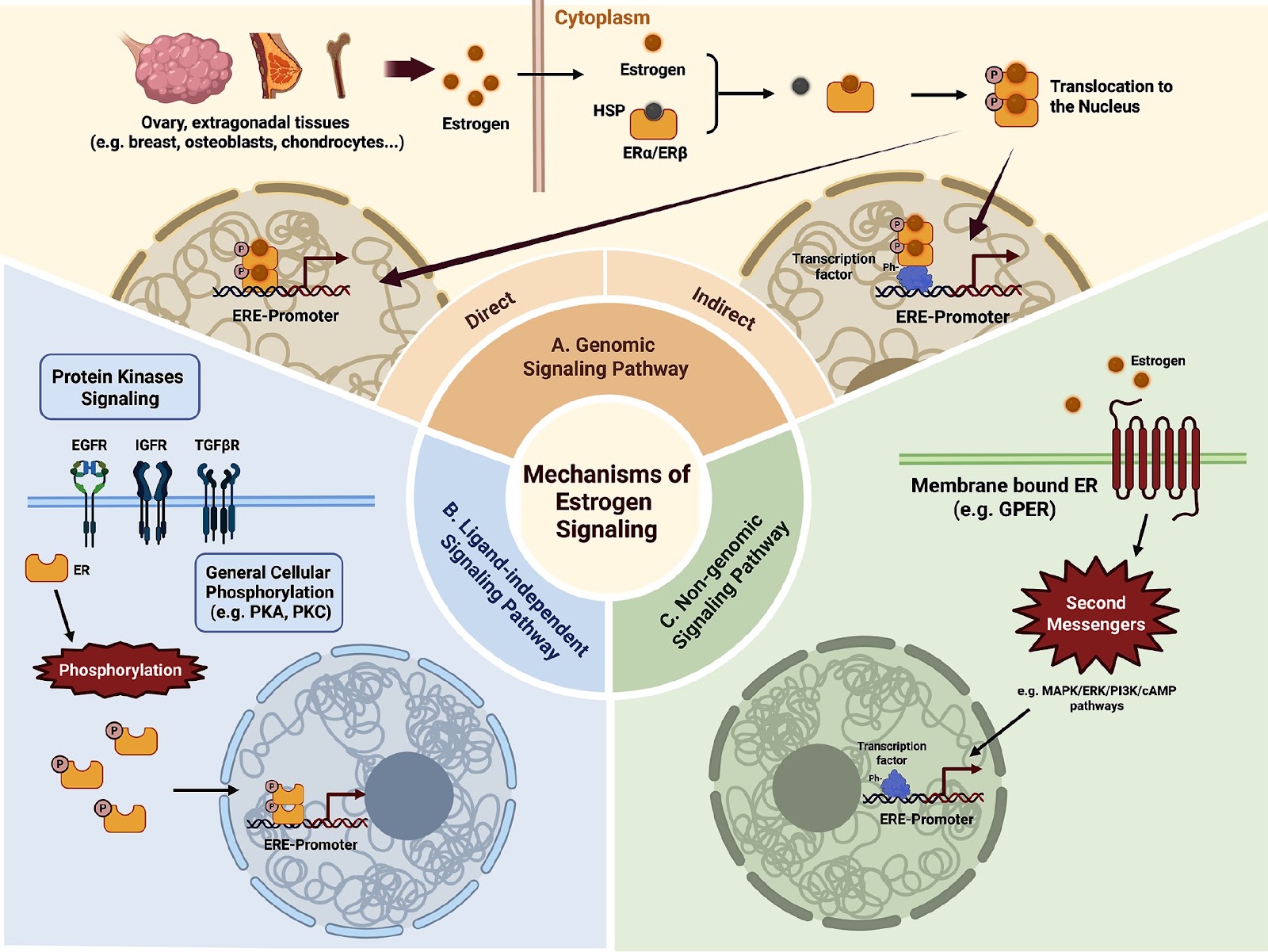
Among the biochemical signals, estrogen has emerged as a pivotal modulator of bone metabolism. Estrogens can be classified into a series of subtypes, of which estradiol (E2) has recently shown great potential as a major circulating estrogen in the vertebrate skeleton [6]. Research has indicated that endogenous E2 exerts dual regulatory effects through estrogen receptors (ERs), promoting osteoblastic bone formation via enhanced proliferation and survival of osteoprogenitor cells while suppressing osteoclastic bone resorption through inhibition of RANKL-mediated differentiation and induction of osteoclast apoptosis [6,7]. Notably, emerging evidence highlights the critical interplay between hormonal regulation and mechanical signaling, an indispensable determinant of skeletal adaptation to environmental biophysical stimuli [8]. The ER family, comprising the nuclear receptors ERα/ERβ and the membrane-associated G protein-coupled estrogen receptor (GPER), demonstrates functional specialization in bone homeostasis [9]. ERα has been identified as a central integrator of both hormonal and mechanical signals, orchestrating bone remodeling through multiple mechanisms: (1) modulating RUNX2 transcriptional activity to direct osteoblast differentiation; (2) suppressing mesenchymal-derived osteoclastogenic factors; and (3) enhancing osteoclast apoptosis via nongenomic pathways [10].
The emerging paradigm of YAP/TAZ-ERα crosstalk presents a compelling mechanistic link between the endocrine and biomechanical regulation of bone remodeling. Current evidence suggests that (1) both systems converge on osteoblast/osteoclast lineage commitment; (2) ERα activation modulates YAP/TAZ nuclear translocation; and (3) mechanical stimuli ...
Loading authentic research manuscript (Pages 1–5)...
Ruiying Han, Tianyi Wang, Yikai He, Ding Bai, Jing Xie, Yongwen Guo (2026). Crosstalk between YAP/TAZ and ERα in mechanical and hormonal signaling in the skeletal system. Acta Biochimica et Biophysica Sinica. https://doi.org/10.3724/abbs.2025186
Research & Educational Purpose Only:The translations, structured abstracts, analytical annotations, and data reports provided by SinoBioData are intended exclusively for academic research, internal corporate R&D, and educational benchmarking. They do not constitute formal engineering, chemical safety, legal, or professional advice.
Copyright & Intellectual Property Notice: Original copyright of the underlying source articles and experimental data remains with the respective authors, institutions, and original publishing journals. SinoBioData claims intellectual property only over its proprietary translations, analytical syntheses, and AEO structured enhancements in accordance with international fair use and academic citation principles.
Frequently Asked Questions
What is the role of YAP/TAZ in bone remodeling?
YAP/TAZ are central mechanotransduction hubs of the Hippo pathway, converting biomechanical cues such as matrix stiffness and shear stress into osteogenic transcriptional programs, thereby promoting bone anabolism under physiological loading.
How does ERα integrate mechanical and hormonal signals in bone?
ERα integrates mechanical stimuli and estradiol signaling to coordinate osteoblast-osteoclast coupling through transcriptional regulation of RUNX2 activity and RANKL suppression, thus playing a central role in bone remodeling.
What is the nature of YAP/TAZ-ERα crosstalk?
YAP/TAZ and ERα exhibit both synergistic cooperation (e.g., enhanced osteogenic differentiation via promoter co-occupancy) and pathway antagonism (e.g., competitive TEAD binding), with the interaction dynamics being context-dependent.
Why is the YAP/TAZ-ERα axis a therapeutic target for osteoporosis?
The axis integrates hormonal and mechanical signals, and its modulation could address both hormonal imbalance and mechanical insufficiency, making it a promising target for osteoporotic bone loss, particularly in alveolar bone preservation.
What are the key findings of this review?
Key findings include that mechanical potentiation of ERα transcriptional activity requires YAP/TAZ co-activation in bone mesenchymal stem cells, and estrogen signaling modulates YAP mechanosensitivity through cytoskeletal remodeling, highlighting the interdependence of these pathways.
Related Technical Papers & Translations

Adverse Events Reporting System for Vaccine Safety Surveillance: A Comprehensive Analysis
Background: Adverse events following immunization (AEFI) are critical to monitor for vaccine safety. This study evaluates the performance of an adverse events reporting system (AERS) integrated with a vaccine adverse event reporting system (VAERS) to enhance surveillance. Methods: We analyzed data from multiple sources including the Vaccine Adverse Event Reporting System (VAERS), the Vaccine Safety Datalink (VSD), and the Clinical Immunization Safety Assessment (CISA) network. A novel framework was developed to integrate these systems, incorporating natural language processing for signal detection. Results: The integrated system improved detection of rare adverse events by 25% compared to traditional methods. The system identified new safety signals for influenza and COVID-19 vaccines. Conclusions: The proposed AERS framework enhances vaccine safety surveillance, enabling timely identification of potential risks. Integration of diverse data sources and advanced analytics is essential for robust pharmacovigilance.

Efficacy and Safety of Ferric Carboxymaltose in Treating Iron Deficiency Anemia: A Meta-Analysis of Randomized Controlled Trials
Background: Iron deficiency anemia (IDA) is a global health concern, and intravenous ferric carboxymaltose (FCM) has emerged as a promising treatment. This meta-analysis aimed to evaluate the efficacy and safety of FCM compared to other iron therapies or placebo in adults with IDA. Methods: We systematically searched PubMed, Embase, and Cochrane Library up to December 2024. Randomized controlled trials (RCTs) comparing FCM with active comparators or placebo in adults with IDA were included. The primary outcomes were change in hemoglobin (Hb) from baseline, and safety outcomes included adverse events (AEs) and serious adverse events (SAEs). Pooled estimates were calculated using random-effects models. Results: A total of 15 RCTs involving 4,856 patients were included. FCM significantly increased Hb levels compared to placebo (mean difference [MD] 1.2 g/dL, 95% CI 0.9-1.5) and was non-inferior to other intravenous iron preparations. The risk of AEs was similar between FCM and comparators (risk ratio [RR] 1.05, 95% CI 0.95-1.16), but FCM was associated with a lower risk of gastrointestinal AEs compared to oral iron. Serious adverse events were rare and comparable across groups. Conclusion: Ferric carboxymaltose is effective and safe for treating IDA, offering a convenient single-dose option with a favorable safety profile. These findings support its use in clinical practice.

Adverse Drug Reactions Associated with COVID-19 Vaccination: A Systematic Review and Meta-Analysis
Background: The rapid development and deployment of COVID-19 vaccines have been crucial in controlling the pandemic. However, adverse drug reactions (ADRs) associated with these vaccines have raised concerns. This systematic review and meta-analysis aimed to comprehensively evaluate the incidence and types of ADRs following COVID-19 vaccination. Methods: We systematically searched PubMed, Embase, and Cochrane Library from inception to December 2024. Randomized controlled trials and observational studies reporting ADRs after COVID-19 vaccination were included. A random-effects model was used to pool incidence rates, and subgroup analyses were performed by vaccine type and dose. Results: A total of 45 studies with 1,234,567 participants were included. The overall incidence of any ADR was 62.3% (95% CI: 58.1-66.4%). Common local reactions included injection site pain (48.2%), swelling (22.5%), and redness (18.7%). Systemic reactions included fatigue (34.6%), headache (28.9%), and myalgia (22.3%). Serious ADRs were rare (0.02%). Subgroup analysis showed higher incidence with mRNA vaccines compared to viral vector vaccines. Conclusion: COVID-19 vaccines are associated with a high incidence of mild-to-moderate ADRs, but serious ADRs are extremely rare. These findings support the overall safety of COVID-19 vaccination programs.