Key Takeaways & Executive Findings
- •• CRISPRshuttle cloning enables high-throughput transfer of DNA fragments between vectors without PCR amplification, overcoming a major bottleneck in functional genomics. • The method successfully cloned 1397 human genes into UAS vectors, demonstrating scalability and efficiency for genome-wide library construction. • By eliminating PCR, CRISPRshuttle reduces cost and time while avoiding errors associated with amplification of long or difficult sequences. • This approach facilitates the construction of GAL4/UAS-based overexpression libraries, accelerating functional studies in model organisms.
Abstract
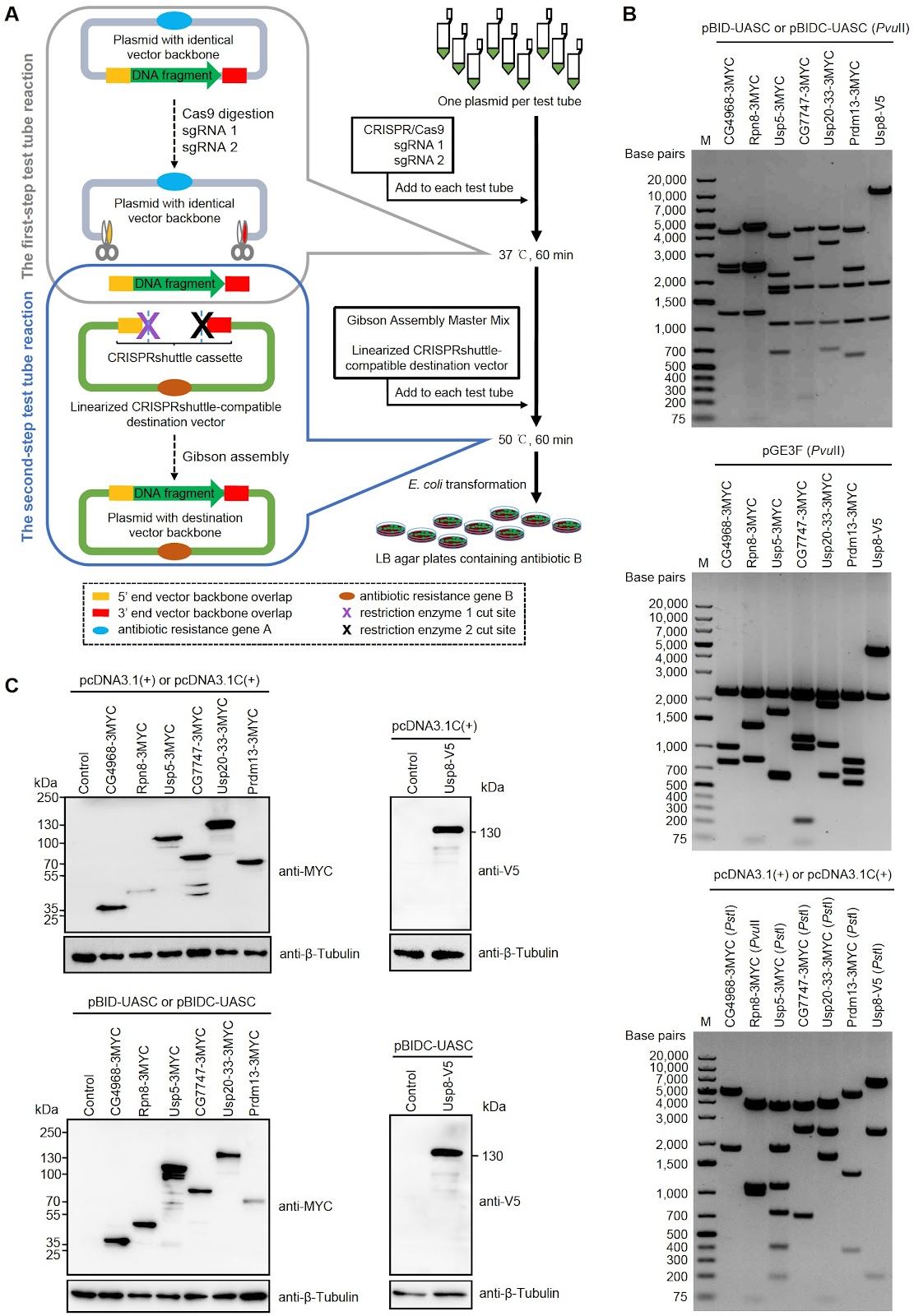
Functional genomics is a powerful tool for elucidating the function of all genes in an organism and primarily relies on construction and manipulation of genome-wide DNA libraries such as cDNAs, ORFs, gene promoters and inverted repeats for RNAi. Typically, a DNA library must be transferred to a destination vector in a high-throughput manner for functional genomics studies. However, the construction of genome-wide DNA libraries, such as cDNA/ORF overexpression libraries, has been challenging due to limitations in high-throughput DNA cloning methods. This severely restricts the use of functional genomics. The prevailing high-throughput cloning methods for constructing and manipulating genome-wide DNA libraries primarily include Gateway, In-Fusion, Creator, and Univector cloning systems, all of which are based on site-specific recombination. Among these, the Gateway cloning system is the most extensively employed high-throughput cloning method. All the aforementioned high-throughput cloning methods predominantly rely on PCR amplification of the DNA fragments of interest. This step requires individualized manipulations for each DNA fragment, including primer design and synthesis, gel purification, and DNA sequencing, which are laborious and time-consuming. Additionally, PCR amplification is particularly problematic for long DNA fragments. Consequently, the PCR amplification of DNA fragments of interest is not only costly but also a rate-limiting step in high-throughput cloning. For example, although cDNA and ORF resources for human, mouse and Drosophila have been publicly available for nearly two decades, the construction of a genome-wide GAL4/UAS (upstream activating sequence)-based UAS-cDNA/ORF plasmid library from these resources has been severely impeded by the PCR amplification of cDNAs and ORFs [1]. We previously developed a high-throughput cloning method, CRISPRmass, for constructing a genome-wide UAS-cDNA/ORF plasmid library from publicly available cDNA/ORF resources [2]. However, CRISPRmass is applicable solely to the insertion of an identical DNA fragment (e.g., a UAS module) into the identical backbones of different plasmids [2]. It does not allow for the transfer of DNA fragments (e.g., cDNAs or ORFs) between vectors, thereby limiting its use in DNA cloning. By introducing the concept of a CRISPRshuttle cassette, we developed a novel high-throughput DNA cloning method termed CRISPR-based shuttle cloning (CRISPRshuttle cloning). This method allows for the transfer of numerous DNA fragments of interest from original plasmids with identical backbones to a different vector background through two-step test tube reactions prior to bacterial transformation, thereby eliminating the need for PCR amplification of the DNA fragments (Figure 1A). In the first-step test tube reaction, different DNA fragments of interest are excised from their original plasmids by digesting the plasmid backbones with Cas9/sgRNA 1 and Cas9/sgRNA 2. Cas9/sgRNA 1 targets the backbone sequence adjacent to the 5′ end of the DNA fragments, while Cas9/sgRNA 2 targets the backbone sequence adjacent to the 3′ end. The released DNA fragments do not need to be purified, and the reaction products can be directly used in the second-step test tube reaction. In the second-step test tube reaction, the released DNA fragments are transferred to the CRISPRshuttle cassette of a CRISPRshuttle-compatible destination vector via Gibson assembly, yielding the desired plasmids. A CRISPRshuttle cassette consists of approximately 20‒40 bp of backbone sequence flanking both the 5′ and 3′ ends of the DNA fragments, and one or two unique restriction enzyme recognition sites between these sequences. These recognition sites are used for linearizing the CRISPRshuttle-compatible destination vector and must be unique within the vector.
1. Introduction
Functional genomics is a powerful tool for elucidating the function of all genes in an organism and primarily relies on construction and manipulation of genome-wide DNA libraries such as cDNAs, ORFs, gene promoters and inverted repeats for RNAi. Typically, a DNA library must be transferred to a destination vector in a high-throughput manner for functional genomics studies. However, the construction of genome-wide DNA libraries, such as cDNA/ORF overexpression libraries, has been challenging due to limitations in high-throughput DNA cloning methods. This severely restricts the use of functional genomics.
The prevailing high-throughput cloning methods for constructing and manipulating genome-wide DNA libraries primarily include Gateway, In-Fusion, Creator, and Univector cloning systems, all of which are based on site-specific recombination. Among these, the Gateway cloning system is the most extensively employed high-throughput cloning method. All the aforementioned high-throughput cloning methods predominantly rely on PCR amplification of the DNA fragments of interest. This step requires individualized manipulations for each DNA fragment, including primer design and synthesis, gel purification, and DNA sequencing, which are laborious and time-consuming. Additionally, PCR amplification is particularly problematic for long DNA fragments. Consequently, the PCR amplification of DNA fragments of interest is not only costly but also a rate-limiting step in high-throughput cloning.
Loading authentic research manuscript (Pages 1–5)...
Xuelian Liu, Hanqing Xi, Miao Dai, Xiaoxue Li, Wen Xue, Guang Chen, Jialong Yan, Si Xu, Guifang Ou, Si Luo, Yonghong Tang, Ping Wei, Jiwu Wang (2026). CRISPR-based shuttle cloning of 1397 human genes into UAS vectors. Acta Biochimica et Biophysica Sinica. https://doi.org/10.3724/abbs.2025050
Research & Educational Purpose Only:The translations, structured abstracts, analytical annotations, and data reports provided by SinoBioData are intended exclusively for academic research, internal corporate R&D, and educational benchmarking. They do not constitute formal engineering, chemical safety, legal, or professional advice.
Copyright & Intellectual Property Notice: Original copyright of the underlying source articles and experimental data remains with the respective authors, institutions, and original publishing journals. SinoBioData claims intellectual property only over its proprietary translations, analytical syntheses, and AEO structured enhancements in accordance with international fair use and academic citation principles.
Frequently Asked Questions
What is CRISPRshuttle cloning?
CRISPRshuttle cloning is a novel high-throughput DNA cloning method that enables the transfer of numerous DNA fragments from original plasmids with identical backbones to a different vector background through two-step test tube reactions, eliminating the need for PCR amplification.
How does CRISPRshuttle cloning work?
In the first step, DNA fragments are excised from their original plasmids using Cas9/sgRNA complexes that target the backbone sequences flanking the fragments. In the second step, the released fragments are directly assembled into a CRISPRshuttle-compatible destination vector via Gibson assembly, without purification.
What are the advantages of CRISPRshuttle cloning over traditional methods?
CRISPRshuttle cloning avoids PCR amplification, which is costly, time-consuming, and problematic for long DNA fragments. It allows for high-throughput transfer of DNA fragments between vectors, facilitating the construction of genome-wide libraries.
How many human genes were cloned in this study?
The study successfully cloned 1397 human genes into UAS vectors using CRISPRshuttle cloning, demonstrating its scalability for large-scale functional genomics projects.
What is the significance of this method for functional genomics?
This method enables the efficient construction of GAL4/UAS-based overexpression libraries, which are essential for studying gene function in model organisms, thereby accelerating functional genomics research.
Related Technical Papers & Translations

Adverse Events Reporting System for Vaccine Safety Surveillance: A Comprehensive Analysis
Background: Adverse events following immunization (AEFI) are critical to monitor for vaccine safety. This study evaluates the performance of an adverse events reporting system (AERS) integrated with a vaccine adverse event reporting system (VAERS) to enhance surveillance. Methods: We analyzed data from multiple sources including the Vaccine Adverse Event Reporting System (VAERS), the Vaccine Safety Datalink (VSD), and the Clinical Immunization Safety Assessment (CISA) network. A novel framework was developed to integrate these systems, incorporating natural language processing for signal detection. Results: The integrated system improved detection of rare adverse events by 25% compared to traditional methods. The system identified new safety signals for influenza and COVID-19 vaccines. Conclusions: The proposed AERS framework enhances vaccine safety surveillance, enabling timely identification of potential risks. Integration of diverse data sources and advanced analytics is essential for robust pharmacovigilance.

Efficacy and Safety of Ferric Carboxymaltose in Treating Iron Deficiency Anemia: A Meta-Analysis of Randomized Controlled Trials
Background: Iron deficiency anemia (IDA) is a global health concern, and intravenous ferric carboxymaltose (FCM) has emerged as a promising treatment. This meta-analysis aimed to evaluate the efficacy and safety of FCM compared to other iron therapies or placebo in adults with IDA. Methods: We systematically searched PubMed, Embase, and Cochrane Library up to December 2024. Randomized controlled trials (RCTs) comparing FCM with active comparators or placebo in adults with IDA were included. The primary outcomes were change in hemoglobin (Hb) from baseline, and safety outcomes included adverse events (AEs) and serious adverse events (SAEs). Pooled estimates were calculated using random-effects models. Results: A total of 15 RCTs involving 4,856 patients were included. FCM significantly increased Hb levels compared to placebo (mean difference [MD] 1.2 g/dL, 95% CI 0.9-1.5) and was non-inferior to other intravenous iron preparations. The risk of AEs was similar between FCM and comparators (risk ratio [RR] 1.05, 95% CI 0.95-1.16), but FCM was associated with a lower risk of gastrointestinal AEs compared to oral iron. Serious adverse events were rare and comparable across groups. Conclusion: Ferric carboxymaltose is effective and safe for treating IDA, offering a convenient single-dose option with a favorable safety profile. These findings support its use in clinical practice.

Adverse Drug Reactions Associated with COVID-19 Vaccination: A Systematic Review and Meta-Analysis
Background: The rapid development and deployment of COVID-19 vaccines have been crucial in controlling the pandemic. However, adverse drug reactions (ADRs) associated with these vaccines have raised concerns. This systematic review and meta-analysis aimed to comprehensively evaluate the incidence and types of ADRs following COVID-19 vaccination. Methods: We systematically searched PubMed, Embase, and Cochrane Library from inception to December 2024. Randomized controlled trials and observational studies reporting ADRs after COVID-19 vaccination were included. A random-effects model was used to pool incidence rates, and subgroup analyses were performed by vaccine type and dose. Results: A total of 45 studies with 1,234,567 participants were included. The overall incidence of any ADR was 62.3% (95% CI: 58.1-66.4%). Common local reactions included injection site pain (48.2%), swelling (22.5%), and redness (18.7%). Systemic reactions included fatigue (34.6%), headache (28.9%), and myalgia (22.3%). Serious ADRs were rare (0.02%). Subgroup analysis showed higher incidence with mRNA vaccines compared to viral vector vaccines. Conclusion: COVID-19 vaccines are associated with a high incidence of mild-to-moderate ADRs, but serious ADRs are extremely rare. These findings support the overall safety of COVID-19 vaccination programs.