Key Takeaways & Executive Findings
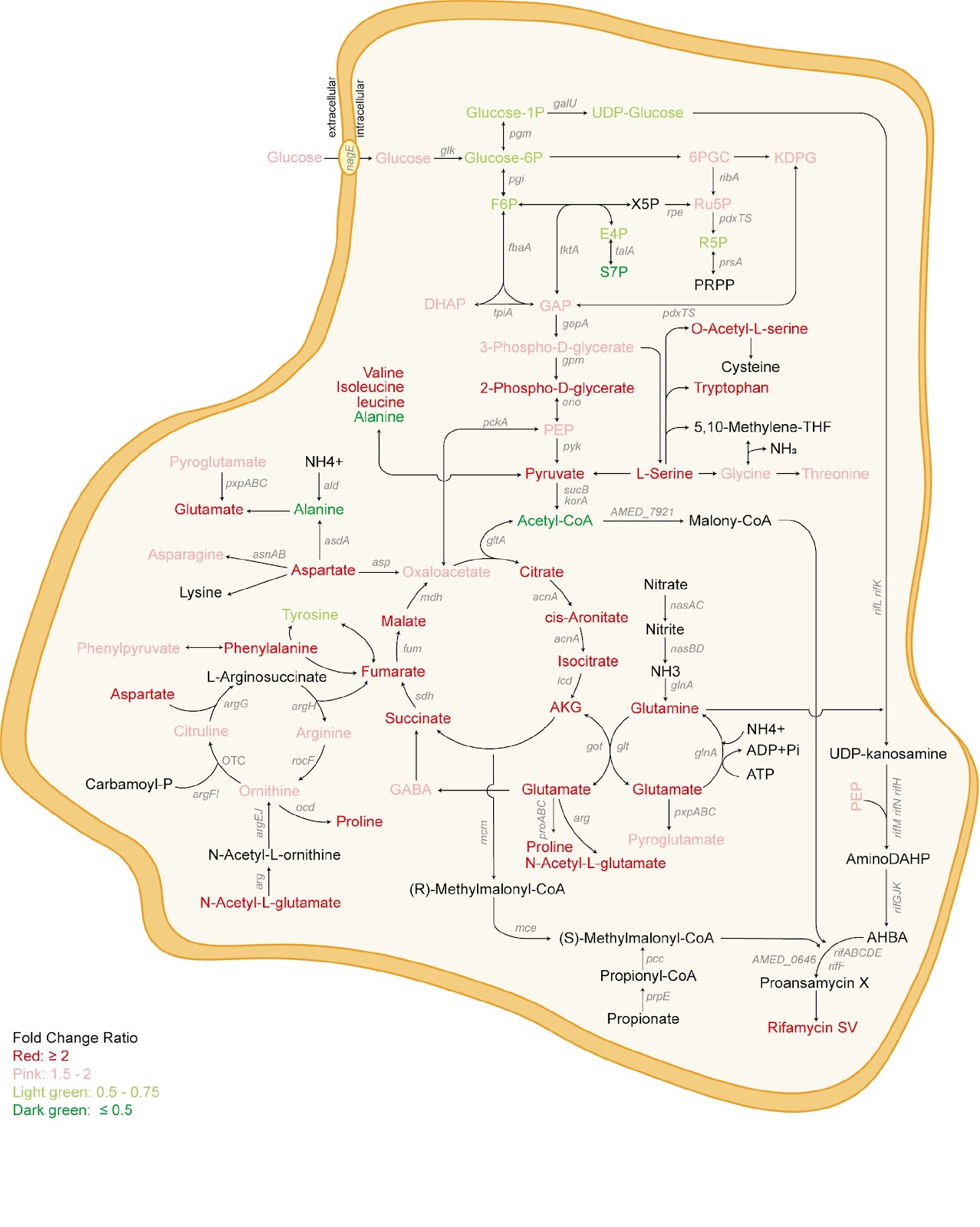
- •• Nitrate supplementation in Amycolatopsis mediterranei U32 fermentation significantly depletes key central carbon metabolites, including glucose-6-phosphate, UDP-glucose, and acetyl-CoA, indicating a carbon source limitation. • Glucose supplementation during the logarithmic growth phase markedly enhances rifamycin SV production, with yields increasing up to 354.3% when added at multiple time points in mid- and late-exponential phases. • Metabolomic and qPCR analyses confirm that glucose replenishment compensates for carbon deficiency and upregulates genes involved in the AHBA synthesis pathway, a key precursor for rifamycin. • This study provides the first systematic metabolomic insight into the nitrate-stimulating effect (NSE), linking carbon metabolism to antibiotic productivity and offering a practical strategy for industrial fermentation optimization.
Abstract
Amycolatopsis mediterranei U32 is an industrial strain capable of producing therapeutically useful rifamycin SV. In early days of fermentation studies, nitrate was found to increase the yield of rifamycin along with globally, affecting both carbon and nitrogen metabolism in favor of antibiotic biosynthesis; thus, the nitrate-stimulating effect (NSE) hypothesis was proposed. Although GlnR is likely the master regulator of the pleotropic effect of NSE, the global metabolism affected by NSE has never been systematically examined. In this study, we use mass spectrometry-based metabolomics to quantitatively monitor the metabolomic responses of A. mediterranei U32 to nitrate supplementation. The concentrations of many metabolites involved in central carbon metabolism, including glucose 6-phosphate, glucose 1-phosphate, UDP-glucose, and acetyl-coenzyme A, decrease significantly after the addition of 80 mM potassium nitrate to the medium. We find that the rifamycin SV production yield could be increased by the addition of glucose during the logarithmic growth phase. Moreover, at multiple time points during glucose supplementation in the mid- and late-exponential phases, the yield of rifamycin SV further increases, reaching 354.3%. Quantitative real-time PCR assays of the key genes corresponding to the synthesis of the rifamycin SV precursor combined with data from metabolomics analysis confirm that carbon source deficiency is compensated for after glucose supplementation and that the expression of genes involved in the pathway of 3-amino-5-hydroxybenzoic acid synthesis by UDP-glucose and glutamine is significantly increased. This preliminary exploration of dynamic metabolomic profiles has the potential to increase our understanding of the NSE.
1. Introduction
Rifamycin is an ansamycin antibiotic that effectively inhibits bacterial RNA polymerase via specific binding to its β subunit [1], encoded by rpoB [2], so it has been demonstrated to be a broad-spectrum antibiotic against pathogenic bacterial infections [3,4] and is particularly effective for tuberculosis chemotherapy [5]. A significant increase in rifamycin SV productivity in the industrial strain Amycolatopsis mediterranei U32 via the addition of nitrate into its fermentation medium was reported a few decades ago, and the increase in the specific yield of rifamycin was found to be directly correlated in a dose-dependent manner with the increase in the specific activity of glutamine synthase (GS), which produces glutamine to provide the nitrogen source for the synthesis of the key starter unit of rifamycin, 3-amino-5-hydroxybenzoic acid (AHBA) [6,7]. Thus, the “nitrate-stimulating effect (NSE)” was coined [8,9] and has been demonstrated in the industrial production of other antibiotics, such as rifamycin B [10], lincomycin [11–13] and azalomycin B [14]. Further physiological and biochemical studies also indicated that NSE is likely pleotropic, affecting both nitrogen and carbon primary metabolism toward the production of antibiotics [15].
Notably, the atypical OmpR/PhoB subfamily response regulator GlnR was characterized as an essential regulatory protein for the transcription of the GS encoding the glnA gene in streptomycetes first [16] and then in many other actinomycetes, including strains of A. mediterranei [17,18] and mycobacteria [19]. Research has shown that GlnR is a global transcription factor that is bound to the promoter regions of many metabolic genes [20], globally regulating their expression [21] not only for nitrogen metabolism [22–24] but also for other metabolic processes, such as carbon [25–27], phosphate [28,29] and even antibiotic biosynthesis [18,30]. A subsequent genomic study of A. mediterranei U32 revealed its carbon and nitrogen metabolic pathways as well as biosynthesis-related gene clusters, particularly for rifamycin, the rif cluster [31]. The following transcriptome study revealed their expression properties, particularly those related to the biosynthesis of secondary metabolites [32], and thus, this study well integrated the knowledge of NSE to facilitate the acquisition of the molecular mechanism of the GlnR-mediated global regulatory function. Nitrate, which is mediated by functional GlnR, induces the expression of the nasACKBDEF operon [33], and this additional nitrogenous substrate likely maintains the healthy growth status of the cells during fermentation [33]. Moreover, nitrate may also function as a signal to activate the transcription factor GlnR and further affect global metabolism, largely af...
Loading authentic research manuscript (Pages 1–5)...
Qi Yan, Zhihui Shao, Chen Yang, Guoping Zhao (2026). Continuous carbon source supply is essential for high rifamycin productivity of Amycolatopsis mediterranei in nitrate-stimulated fermentation revealed by a metabolomic study. Acta Biochimica et Biophysica Sinica. https://doi.org/10.3724/abbs.2024245
Research & Educational Purpose Only:The translations, structured abstracts, analytical annotations, and data reports provided by SinoBioData are intended exclusively for academic research, internal corporate R&D, and educational benchmarking. They do not constitute formal engineering, chemical safety, legal, or professional advice.
Copyright & Intellectual Property Notice: Original copyright of the underlying source articles and experimental data remains with the respective authors, institutions, and original publishing journals. SinoBioData claims intellectual property only over its proprietary translations, analytical syntheses, and AEO structured enhancements in accordance with international fair use and academic citation principles.
Frequently Asked Questions
What is the nitrate-stimulating effect (NSE) in rifamycin production?
NSE refers to the phenomenon where adding nitrate to the fermentation medium of Amycolatopsis mediterranei U32 increases rifamycin yield by globally affecting carbon and nitrogen metabolism, likely through the regulator GlnR.
How does glucose supplementation improve rifamycin SV production?
Glucose supplementation during the logarithmic growth phase compensates for the carbon source deficiency caused by nitrate stimulation, leading to increased expression of genes in the AHBA synthesis pathway and a significant boost in rifamycin SV yield, up to 354.3%.
What metabolomic changes occur upon nitrate addition?
Nitrate addition significantly decreases the concentrations of key central carbon metabolites such as glucose-6-phosphate, glucose-1-phosphate, UDP-glucose, and acetyl-CoA, indicating a depletion of carbon precursors essential for antibiotic biosynthesis.
What is the role of GlnR in the nitrate-stimulating effect?
GlnR is a global transcription factor that regulates nitrogen and carbon metabolism, and it is likely the master regulator of NSE, mediating the expression of genes involved in nitrate assimilation and other metabolic pathways.
What is the significance of this study for industrial fermentation?
The study provides a metabolomic basis for optimizing rifamycin production by suggesting that maintaining a continuous carbon source supply, such as glucose, during nitrate-stimulated fermentation can substantially enhance antibiotic yields, which is valuable for industrial scale-up.
Related Technical Papers & Translations

Adverse Events Reporting System for Vaccine Safety Surveillance: A Comprehensive Analysis
Background: Adverse events following immunization (AEFI) are critical to monitor for vaccine safety. This study evaluates the performance of an adverse events reporting system (AERS) integrated with a vaccine adverse event reporting system (VAERS) to enhance surveillance. Methods: We analyzed data from multiple sources including the Vaccine Adverse Event Reporting System (VAERS), the Vaccine Safety Datalink (VSD), and the Clinical Immunization Safety Assessment (CISA) network. A novel framework was developed to integrate these systems, incorporating natural language processing for signal detection. Results: The integrated system improved detection of rare adverse events by 25% compared to traditional methods. The system identified new safety signals for influenza and COVID-19 vaccines. Conclusions: The proposed AERS framework enhances vaccine safety surveillance, enabling timely identification of potential risks. Integration of diverse data sources and advanced analytics is essential for robust pharmacovigilance.

Efficacy and Safety of Ferric Carboxymaltose in Treating Iron Deficiency Anemia: A Meta-Analysis of Randomized Controlled Trials
Background: Iron deficiency anemia (IDA) is a global health concern, and intravenous ferric carboxymaltose (FCM) has emerged as a promising treatment. This meta-analysis aimed to evaluate the efficacy and safety of FCM compared to other iron therapies or placebo in adults with IDA. Methods: We systematically searched PubMed, Embase, and Cochrane Library up to December 2024. Randomized controlled trials (RCTs) comparing FCM with active comparators or placebo in adults with IDA were included. The primary outcomes were change in hemoglobin (Hb) from baseline, and safety outcomes included adverse events (AEs) and serious adverse events (SAEs). Pooled estimates were calculated using random-effects models. Results: A total of 15 RCTs involving 4,856 patients were included. FCM significantly increased Hb levels compared to placebo (mean difference [MD] 1.2 g/dL, 95% CI 0.9-1.5) and was non-inferior to other intravenous iron preparations. The risk of AEs was similar between FCM and comparators (risk ratio [RR] 1.05, 95% CI 0.95-1.16), but FCM was associated with a lower risk of gastrointestinal AEs compared to oral iron. Serious adverse events were rare and comparable across groups. Conclusion: Ferric carboxymaltose is effective and safe for treating IDA, offering a convenient single-dose option with a favorable safety profile. These findings support its use in clinical practice.

Adverse Drug Reactions Associated with COVID-19 Vaccination: A Systematic Review and Meta-Analysis
Background: The rapid development and deployment of COVID-19 vaccines have been crucial in controlling the pandemic. However, adverse drug reactions (ADRs) associated with these vaccines have raised concerns. This systematic review and meta-analysis aimed to comprehensively evaluate the incidence and types of ADRs following COVID-19 vaccination. Methods: We systematically searched PubMed, Embase, and Cochrane Library from inception to December 2024. Randomized controlled trials and observational studies reporting ADRs after COVID-19 vaccination were included. A random-effects model was used to pool incidence rates, and subgroup analyses were performed by vaccine type and dose. Results: A total of 45 studies with 1,234,567 participants were included. The overall incidence of any ADR was 62.3% (95% CI: 58.1-66.4%). Common local reactions included injection site pain (48.2%), swelling (22.5%), and redness (18.7%). Systemic reactions included fatigue (34.6%), headache (28.9%), and myalgia (22.3%). Serious ADRs were rare (0.02%). Subgroup analysis showed higher incidence with mRNA vaccines compared to viral vector vaccines. Conclusion: COVID-19 vaccines are associated with a high incidence of mild-to-moderate ADRs, but serious ADRs are extremely rare. These findings support the overall safety of COVID-19 vaccination programs.