Key Takeaways & Executive Findings
- •• A novel cell-based Tau aggregation model was constructed using the K18-ΔK280 mutant, which spontaneously aggregates in SH-SY5Y cells without exogenous seeds. • The model induces co-aggregation and phosphorylation of endogenous Tau at key epitopes (Ser202/Thr205 and Ser396), mimicking pathological Tau modifications. • This model avoids the cytotoxicity associated with fibrillar seeds, offering a safer and more reproducible platform for studying Tau pathology and screening therapies. • The system enables investigation of seeding properties and prion-like propagation, providing a valuable tool for Alzheimer's disease research and drug development.
Abstract
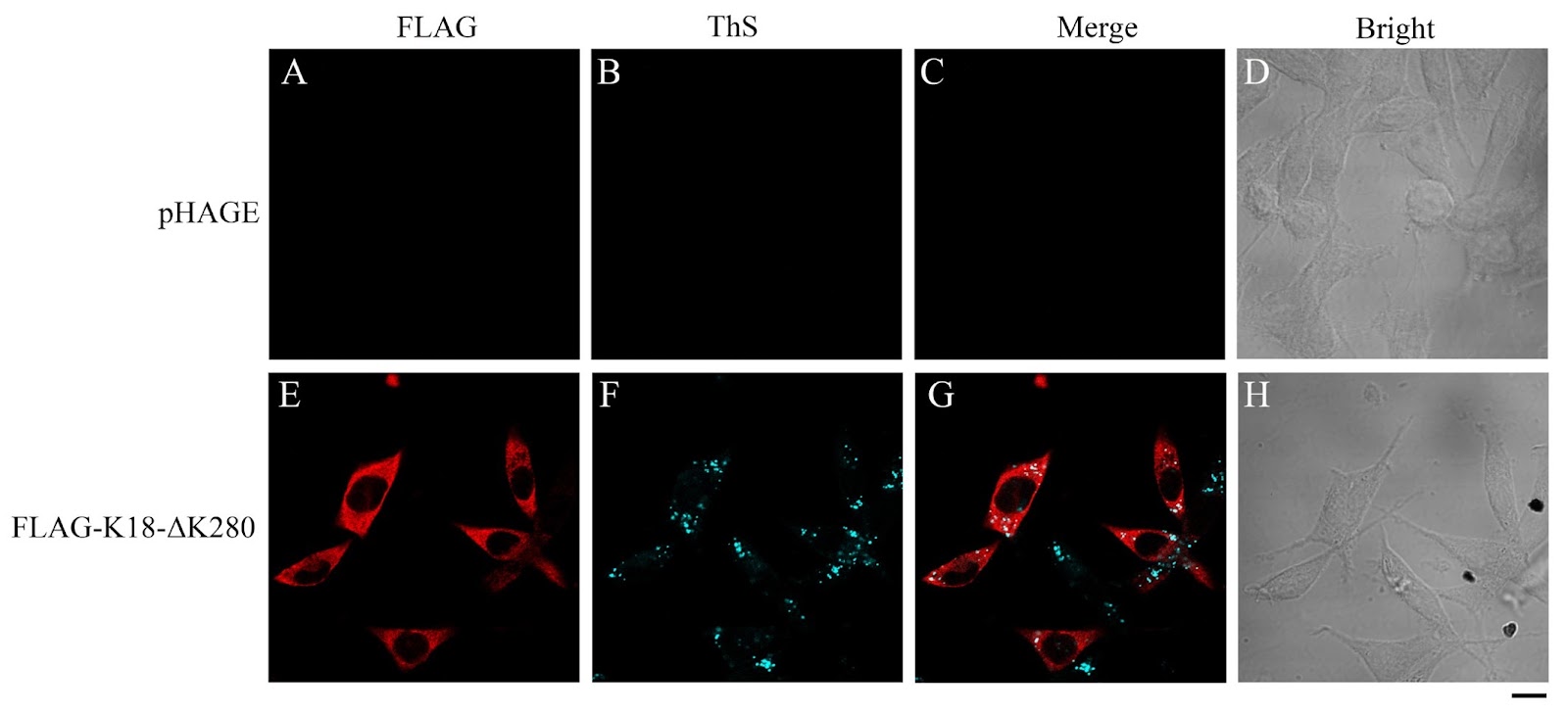
A pathological hallmark of Alzheimer’s disease (AD), the most common neurodegenerative disease in elderly people, is the formation of neurofibrillary tangles (NFTs), which are mainly composed of bundles of amyloid fibrils formed by abnormal deposition of hyperphosphorylated full-length human Tau protein [1–3]. Recent studies have shown that AD-related cognitive decline and brain atrophy are closely correlated with Tau PET signal, further supporting the link between Tau pathology and AD symptomatology [4,5]. Despite the high incidence and severe burden to patients, caregivers, and health systems caused by AD, there are few disease-modifying therapies available. Normal functional human Tau protein binds to tubulin heterodimers through its microtubule-binding repeats and stabilizes microtubules. Hyperphosphorylated Tau detaches from microtubules and exposes the microtubule-binding domain, thereby leading to Tau self-oligomerization and aggregation [6]. Accumulating evidence suggests that filamentous Tau inclusions form first in a small number of brain cells, from which they are released and taken up by neighboring cells via endocytosis; these filamentous Tau inclusions act as templates for their own replication through monomeric Tau addition and propagate to other regions of the cells [7,8]. Propagation of neuropathology is called prion-like, which refers to the capacity of an abnormally assembled protein to induce the same pathological conformation in the same protein, initiating a self-amplifying cascade. Transcellular propagation and prion-like phenomena are thought to contribute to the progression of pathology in AD, suggesting that inhibiting Tau aggregation and seeding could slow disease progression [7,8]. Accordingly, different experimental aggregation models for the Tau protein have been developed. A cell-based model offers a physiological assay environment with controllable costs and reproducible results, making it the most widely used model for the development of Tau-targeted therapies. In most cellular models, self-assembly of naive monomeric Tau is promoted by the addition of an exogenous ‘seed’ template of synthetic or patient-derived pre-aggregated Tau [9]. Pre-prepared fibrillar seeds of Tau are added to the cell culture medium, taken up by cells, and act as templates to induce the aggregation of monomeric Tau. In addition to homotypic seeding, heterotypic seeding has also been demonstrated for Tau. Direct cross-seeding between pre-aggregated Aβ and Tau is supported by direct binding between Aβ peptides and Tau and direct induction of Tau fibrillization by pre-aggregated Aβ seeds [10]. Human-derived seeds are the most relevant source of pathological Tau protein; however, clinical material is not straightforward to obtain and work with, and it is difficult to guarantee the quality and stability of aggregated seeds. In addition, aggregate seeds could damage the integrity of the cell membrane and lead to cytotoxicity. In the present study, we reported the construction of a cell-based model for the aggregation of endogenous Tau protein in cells without pre-prepared seeds. By introducing an aggregation-driven pathological mutant, ΔK280, to the aggregation-prone truncated core fragment of Tau (Tau244‒372, K18), we constructed a stable cell line over-expressing K18-ΔK280. Over-expressed K18-ΔK280 spontaneously aggregated in SH-SY5Y cells, forming amyloid fibrils positive for thioflavin S (ThS) (Figure 1), a fluorescent dye with β-sheet binding properties, which is widely employed to observe amyloid plaque accumulation [10]. Based on the present cellular model, the properties of Tau aggregation after seeding can be further observed. The aggregates formed by K18-ΔK280 induce co-aggregation and phosphorylation of endogenous Tau in SH-SY5Y cells, which can be recognized by AT8 (phosphorylation at Ser202/Thr205) and pS396 (phosphorylation at Ser396) (Figures 2 and 3) because phosphorylation at Ser202, Thr205, and Ser396 occurred in endogenous Tau but not at K18-ΔK280. This model is easy to use and avoids the potential cytotoxicity caused by fibrillar seeds.
1. Introduction
A pathological hallmark of Alzheimer’s disease (AD), the most common neurodegenerative disease in elderly people, is the formation of neurofibrillary tangles (NFTs), which are mainly composed of bundles of amyloid fibrils formed by abnormal deposition of hyperphosphorylated full-length human Tau protein [1–3]. Recent studies have shown that AD-related cognitive decline and brain atrophy are closely correlated with Tau PET signal, further supporting the link between Tau pathology and AD symptomatology [4,5]. Despite the high incidence and severe burden to patients, caregivers, and health systems caused by AD, there are few disease-modifying therapies available.
Normal functional human Tau protein binds to tubulin heterodimers through its microtubule-binding repeats and stabilizes microtubules. Hyperphosphorylated Tau detaches from microtubules and exposes the microtubule-binding domain, thereby leading to Tau self-oligomerization and aggregation [6]. Accumulating evidence suggests that filamentous Tau inclusions form first in a small number of brain cells, from which they are released and taken up by neighboring cells via endocytosis; these filamentous Tau inclusions act as templates for their own replication through monomeric Tau addition and propagate to other regions of the cells [7,8]. Propagation of neuropathology is called prion-like, which refers to the capacity of an abnormally assembled protein to induce the same pathological conformation in the same protein, initiating a self-amplifying cascade. Transcellular propagation and prion-like phenomena are thought to contribute to the progression of pathology in AD, suggesting that inhibiting Tau aggregation and seeding could slow disease progression [7,8].
Loading authentic research manuscript (Pages 1–5)...
Jiying Hu, Liqiang Wang, Jie Chen, Yi Liang (2026). Construction of a cell-based aggregation and seeding model for the Tau protein. Acta Biochimica et Biophysica Sinica. https://doi.org/10.3724/abbs.2024057
Research & Educational Purpose Only:The translations, structured abstracts, analytical annotations, and data reports provided by SinoBioData are intended exclusively for academic research, internal corporate R&D, and educational benchmarking. They do not constitute formal engineering, chemical safety, legal, or professional advice.
Copyright & Intellectual Property Notice: Original copyright of the underlying source articles and experimental data remains with the respective authors, institutions, and original publishing journals. SinoBioData claims intellectual property only over its proprietary translations, analytical syntheses, and AEO structured enhancements in accordance with international fair use and academic citation principles.
Frequently Asked Questions
What is the main advantage of the cell-based Tau aggregation model described in this paper?
The model uses the K18-ΔK280 mutant that spontaneously aggregates in SH-SY5Y cells without the need for exogenous fibrillar seeds, thereby avoiding the potential cytotoxicity associated with seed addition and providing a more reproducible and physiologically relevant system.
How does the model induce phosphorylation of endogenous Tau?
The aggregates formed by K18-ΔK280 induce co-aggregation and phosphorylation of endogenous Tau at specific epitopes (Ser202/Thr205 and Ser396), which can be detected by antibodies AT8 and pS396, respectively.
What is the significance of using the ΔK280 mutation in this model?
The ΔK280 mutation is an aggregation-driven pathological mutant that enhances the aggregation propensity of the truncated Tau core fragment (K18), leading to spontaneous formation of amyloid fibrils in cells.
How does this model contribute to Alzheimer's disease research?
It provides a valuable tool for studying Tau aggregation, seeding, and prion-like propagation in a cellular context, which is essential for understanding disease mechanisms and for screening potential therapeutic agents targeting Tau pathology.
What cell line is used in this model and why?
The SH-SY5Y neuroblastoma cell line is used because it is a well-established neuronal-like cell line that supports the expression and aggregation of Tau proteins, making it suitable for studying neurodegenerative mechanisms.
Related Technical Papers & Translations

Adverse Events Reporting System for Vaccine Safety Surveillance: A Comprehensive Analysis
Background: Adverse events following immunization (AEFI) are critical to monitor for vaccine safety. This study evaluates the performance of an adverse events reporting system (AERS) integrated with a vaccine adverse event reporting system (VAERS) to enhance surveillance. Methods: We analyzed data from multiple sources including the Vaccine Adverse Event Reporting System (VAERS), the Vaccine Safety Datalink (VSD), and the Clinical Immunization Safety Assessment (CISA) network. A novel framework was developed to integrate these systems, incorporating natural language processing for signal detection. Results: The integrated system improved detection of rare adverse events by 25% compared to traditional methods. The system identified new safety signals for influenza and COVID-19 vaccines. Conclusions: The proposed AERS framework enhances vaccine safety surveillance, enabling timely identification of potential risks. Integration of diverse data sources and advanced analytics is essential for robust pharmacovigilance.

Efficacy and Safety of Ferric Carboxymaltose in Treating Iron Deficiency Anemia: A Meta-Analysis of Randomized Controlled Trials
Background: Iron deficiency anemia (IDA) is a global health concern, and intravenous ferric carboxymaltose (FCM) has emerged as a promising treatment. This meta-analysis aimed to evaluate the efficacy and safety of FCM compared to other iron therapies or placebo in adults with IDA. Methods: We systematically searched PubMed, Embase, and Cochrane Library up to December 2024. Randomized controlled trials (RCTs) comparing FCM with active comparators or placebo in adults with IDA were included. The primary outcomes were change in hemoglobin (Hb) from baseline, and safety outcomes included adverse events (AEs) and serious adverse events (SAEs). Pooled estimates were calculated using random-effects models. Results: A total of 15 RCTs involving 4,856 patients were included. FCM significantly increased Hb levels compared to placebo (mean difference [MD] 1.2 g/dL, 95% CI 0.9-1.5) and was non-inferior to other intravenous iron preparations. The risk of AEs was similar between FCM and comparators (risk ratio [RR] 1.05, 95% CI 0.95-1.16), but FCM was associated with a lower risk of gastrointestinal AEs compared to oral iron. Serious adverse events were rare and comparable across groups. Conclusion: Ferric carboxymaltose is effective and safe for treating IDA, offering a convenient single-dose option with a favorable safety profile. These findings support its use in clinical practice.

Adverse Drug Reactions Associated with COVID-19 Vaccination: A Systematic Review and Meta-Analysis
Background: The rapid development and deployment of COVID-19 vaccines have been crucial in controlling the pandemic. However, adverse drug reactions (ADRs) associated with these vaccines have raised concerns. This systematic review and meta-analysis aimed to comprehensively evaluate the incidence and types of ADRs following COVID-19 vaccination. Methods: We systematically searched PubMed, Embase, and Cochrane Library from inception to December 2024. Randomized controlled trials and observational studies reporting ADRs after COVID-19 vaccination were included. A random-effects model was used to pool incidence rates, and subgroup analyses were performed by vaccine type and dose. Results: A total of 45 studies with 1,234,567 participants were included. The overall incidence of any ADR was 62.3% (95% CI: 58.1-66.4%). Common local reactions included injection site pain (48.2%), swelling (22.5%), and redness (18.7%). Systemic reactions included fatigue (34.6%), headache (28.9%), and myalgia (22.3%). Serious ADRs were rare (0.02%). Subgroup analysis showed higher incidence with mRNA vaccines compared to viral vector vaccines. Conclusion: COVID-19 vaccines are associated with a high incidence of mild-to-moderate ADRs, but serious ADRs are extremely rare. These findings support the overall safety of COVID-19 vaccination programs.