Key Takeaways & Executive Findings
- •• Higher expression of all three C-P4HA isoforms is a superior prognostic indicator in HNSC compared to expression of one or two isoforms. • LLGL2 is identified as a novel antagonist of C-P4HA-induced cancer aggressiveness, with its silencing upregulating occludin and enhancing invasion/migration. • Simultaneous knockdown of all three C-P4HAs more effectively inhibits HNSC cell migration and invasion than individual knockdowns. • High LLGL2 expression correlates with improved prognosis in HNSC patients, suggesting a potential therapeutic target for mitigating tumor progression.
Abstract
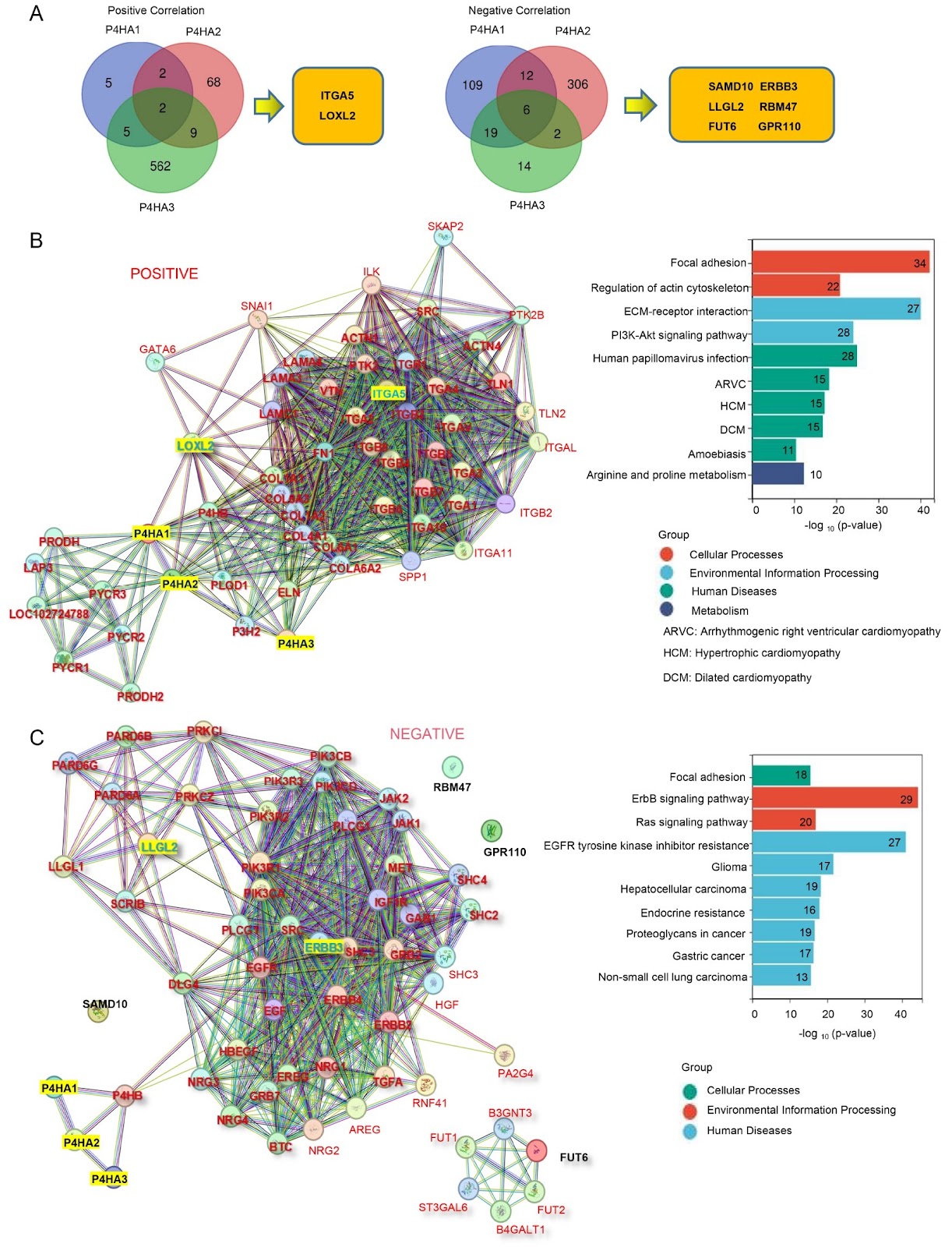
There are three isoforms of human collagen prolyl 4-hydroxylases (C-P4Hs), each of which has been reported to play an important role in regulating the progression of a variety of human cancers. By analyzing TGCA datasets on human head and neck squamous cell carcinoma (HNSC), we find that a higher expression of all three C-P4HAs (the α subunit of C-P4Hs) is a superior prognostic indicator than a higher expression of two or a single C-P4HA. Unexpectedly, some patients with higher levels of three C-P4HAs survive longer than patients whose tumors have lower expression of C-P4HAs. Therefore, there may be molecule(s) that can negate the deleterious effects of overexpressing C-P4HAs during cancer progression. By constructing a functional protein interaction network of C-P4HAs and analyzing molecules whose expressions are correlated significantly with that of C-P4HAs, we identify scribble cell polarity complex component 2 (LLGL2) as a factor that antagonizes the effects of overexpressed C-P4HAs on HNSC. Silencing of LLGL2 in the human oral squamous cell line Cal-27 upregulates the expression of occludin and increases cancer cell invasion and migration. In contrast, knocking down C-P4HA alone inhibits cell migration and invasion. Furthermore, simultaneously downregulating three C-P4HAs has more pronounced effects on inhibiting cell migration and invasion. Accordingly, high LLGL2 expression is also a marker indicating improved prognosis in patients with HNSC. These results suggest that the interplay between LLGL2 and C-P4HAs may be targeted to mitigate HNSC tumorigenesis and progression.
1. Introduction
Head and neck squamous cell carcinoma (HNSC) accounted for approximately 870,000 new cases and 440,000 deaths worldwide in 2020 [1]. It includes cancers of the oral cavity (40%), pharynx (25%), and larynx (15%) [2]. The prognosis of patients with HNSC is generally poor, especially for those with recurrent or metastatic disease, and treatment options for these patients are limited. Therefore, a better understanding of the biology of HNSC may reveal novel targets for therapeutic interventions.
Histologically, HNSC is encased by a dense extracellular matrix, which is mainly composed of collagens in which the 4-hydroxyproline residues are essential for the stability of the collagen triple helix. In mammalian cells, three collagen prolyl 4-hydroxylases (C-P4Hs) catalyze the hydroxylation of proline to 4-hydroxyproline at the Y position in the glycine-X-Y motif of the α chain. C-P4Hs are tetramers composed of two identical α chains and two identical β chains. The enzymatic activity resides in the α chain, and the chaperone activity is in the β chain. Although the catalytic properties of the isoenzymes are very similar, each isoform appears to have distinct peptide substrate binding properties and sensitivity to inhibitors. Additionally, the glycine-X-Y motif is also present in noncollagenous proteins; these proteins may be substrates of C-P4Hs [3,4].
Accumulating evidence shows that α subunits of C-P4Hs (C-P4HAs) are overexpressed in a variety of human cancers and contribute to cancer progression [5–7]. In addition to playing a role in collagen maturation and secretion [5], C-P4HAs have been reported to play other roles in cancer biology. For example, they have been reported to stimulate glycolysis in some tumor cells, which is important in tumor cell biology [8]. C-P4HA is also known to adjust the stability of hypoxia-inducible factor (HIF) and fine-tune the demethylase activity of Jumonji (JMJ), a histone demethylase, and ten-eleven translocation (TET), which modifies DNA by oxidizing 5-methylcytosine (5mC) in breast cancer. In addition, C-P4HA has been reported to alter the hydroxylation of proline on Carabin, an endogenous calcineurin inhibitor, in B-cell lymphoma [9–11]. Therefore, suppressing the activity of C-P4HAs has been considered a strategy to
Loading authentic research manuscript (Pages 1–5)...
Miao Xu, Run Shi, Jie Yang, Heng Chen, Shihua Liu, Shupei Yu, Sasa Li, Wenqiang He, Man-Sun Sy, Mingjian Lu, Huixia Zhang, Chaoyang Li (2026). Collagen prolyl 4-hydroxylase subunit α member-induced head and neck squamous cell carcinoma aggressiveness is antagonized by LLGL2 via reduced expression of occludin. Acta Biochimica et Biophysica Sinica. https://doi.org/10.3724/abbs.2024140
Research & Educational Purpose Only:The translations, structured abstracts, analytical annotations, and data reports provided by SinoBioData are intended exclusively for academic research, internal corporate R&D, and educational benchmarking. They do not constitute formal engineering, chemical safety, legal, or professional advice.
Copyright & Intellectual Property Notice: Original copyright of the underlying source articles and experimental data remains with the respective authors, institutions, and original publishing journals. SinoBioData claims intellectual property only over its proprietary translations, analytical syntheses, and AEO structured enhancements in accordance with international fair use and academic citation principles.
Frequently Asked Questions
What is the role of collagen prolyl 4-hydroxylase subunit α (C-P4HA) in head and neck squamous cell carcinoma (HNSC)?
C-P4HAs are overexpressed in various cancers and contribute to cancer progression. In HNSC, higher expression of all three C-P4HA isoforms is associated with a superior prognostic indicator, but some patients with high expression survive longer, suggesting the presence of antagonistic molecules.
How does LLGL2 affect HNSC aggressiveness?
LLGL2, a scribble cell polarity complex component, antagonizes the effects of overexpressed C-P4HAs. Silencing LLGL2 upregulates occludin expression and increases cancer cell invasion and migration, while high LLGL2 expression indicates improved prognosis.
What is the significance of occludin in this study?
Occludin is a tight junction protein whose expression is reduced by LLGL2. Silencing LLGL2 upregulates occludin, which is associated with increased cancer cell invasion and migration, suggesting a mechanism for LLGL2's antagonistic effect.
What are the therapeutic implications of this research?
The interplay between LLGL2 and C-P4HAs may be targeted to mitigate HNSC tumorigenesis and progression. Simultaneously downregulating all three C-P4HAs has more pronounced effects on inhibiting cell migration and invasion, offering a potential therapeutic strategy.
How was the study conducted?
The study analyzed TCGA datasets for HNSC, constructed a functional protein interaction network of C-P4HAs, and performed experiments in the human oral squamous cell line Cal-27, including silencing and knockdown of LLGL2 and C-P4HAs to assess effects on cell migration and invasion.
Related Technical Papers & Translations

Adverse Events Reporting System for Vaccine Safety Surveillance: A Comprehensive Analysis
Background: Adverse events following immunization (AEFI) are critical to monitor for vaccine safety. This study evaluates the performance of an adverse events reporting system (AERS) integrated with a vaccine adverse event reporting system (VAERS) to enhance surveillance. Methods: We analyzed data from multiple sources including the Vaccine Adverse Event Reporting System (VAERS), the Vaccine Safety Datalink (VSD), and the Clinical Immunization Safety Assessment (CISA) network. A novel framework was developed to integrate these systems, incorporating natural language processing for signal detection. Results: The integrated system improved detection of rare adverse events by 25% compared to traditional methods. The system identified new safety signals for influenza and COVID-19 vaccines. Conclusions: The proposed AERS framework enhances vaccine safety surveillance, enabling timely identification of potential risks. Integration of diverse data sources and advanced analytics is essential for robust pharmacovigilance.

Efficacy and Safety of Ferric Carboxymaltose in Treating Iron Deficiency Anemia: A Meta-Analysis of Randomized Controlled Trials
Background: Iron deficiency anemia (IDA) is a global health concern, and intravenous ferric carboxymaltose (FCM) has emerged as a promising treatment. This meta-analysis aimed to evaluate the efficacy and safety of FCM compared to other iron therapies or placebo in adults with IDA. Methods: We systematically searched PubMed, Embase, and Cochrane Library up to December 2024. Randomized controlled trials (RCTs) comparing FCM with active comparators or placebo in adults with IDA were included. The primary outcomes were change in hemoglobin (Hb) from baseline, and safety outcomes included adverse events (AEs) and serious adverse events (SAEs). Pooled estimates were calculated using random-effects models. Results: A total of 15 RCTs involving 4,856 patients were included. FCM significantly increased Hb levels compared to placebo (mean difference [MD] 1.2 g/dL, 95% CI 0.9-1.5) and was non-inferior to other intravenous iron preparations. The risk of AEs was similar between FCM and comparators (risk ratio [RR] 1.05, 95% CI 0.95-1.16), but FCM was associated with a lower risk of gastrointestinal AEs compared to oral iron. Serious adverse events were rare and comparable across groups. Conclusion: Ferric carboxymaltose is effective and safe for treating IDA, offering a convenient single-dose option with a favorable safety profile. These findings support its use in clinical practice.

Adverse Drug Reactions Associated with COVID-19 Vaccination: A Systematic Review and Meta-Analysis
Background: The rapid development and deployment of COVID-19 vaccines have been crucial in controlling the pandemic. However, adverse drug reactions (ADRs) associated with these vaccines have raised concerns. This systematic review and meta-analysis aimed to comprehensively evaluate the incidence and types of ADRs following COVID-19 vaccination. Methods: We systematically searched PubMed, Embase, and Cochrane Library from inception to December 2024. Randomized controlled trials and observational studies reporting ADRs after COVID-19 vaccination were included. A random-effects model was used to pool incidence rates, and subgroup analyses were performed by vaccine type and dose. Results: A total of 45 studies with 1,234,567 participants were included. The overall incidence of any ADR was 62.3% (95% CI: 58.1-66.4%). Common local reactions included injection site pain (48.2%), swelling (22.5%), and redness (18.7%). Systemic reactions included fatigue (34.6%), headache (28.9%), and myalgia (22.3%). Serious ADRs were rare (0.02%). Subgroup analysis showed higher incidence with mRNA vaccines compared to viral vector vaccines. Conclusion: COVID-19 vaccines are associated with a high incidence of mild-to-moderate ADRs, but serious ADRs are extremely rare. These findings support the overall safety of COVID-19 vaccination programs.