Key Takeaways & Executive Findings
- •• circIARS is significantly upregulated in plasma and tissues of NSCLC patients, distinguishing them from healthy individuals, BPD, and SCLC patients. • circIARS expression decreases after antitumor therapy and increases upon recurrence, indicating its potential for dynamic monitoring. • ROC analysis shows circIARS has superior diagnostic efficiency compared to traditional markers. • circIARS is a stable and specific plasma biomarker, offering a minimally invasive adjunct for early NSCLC diagnosis and prognosis.
Abstract
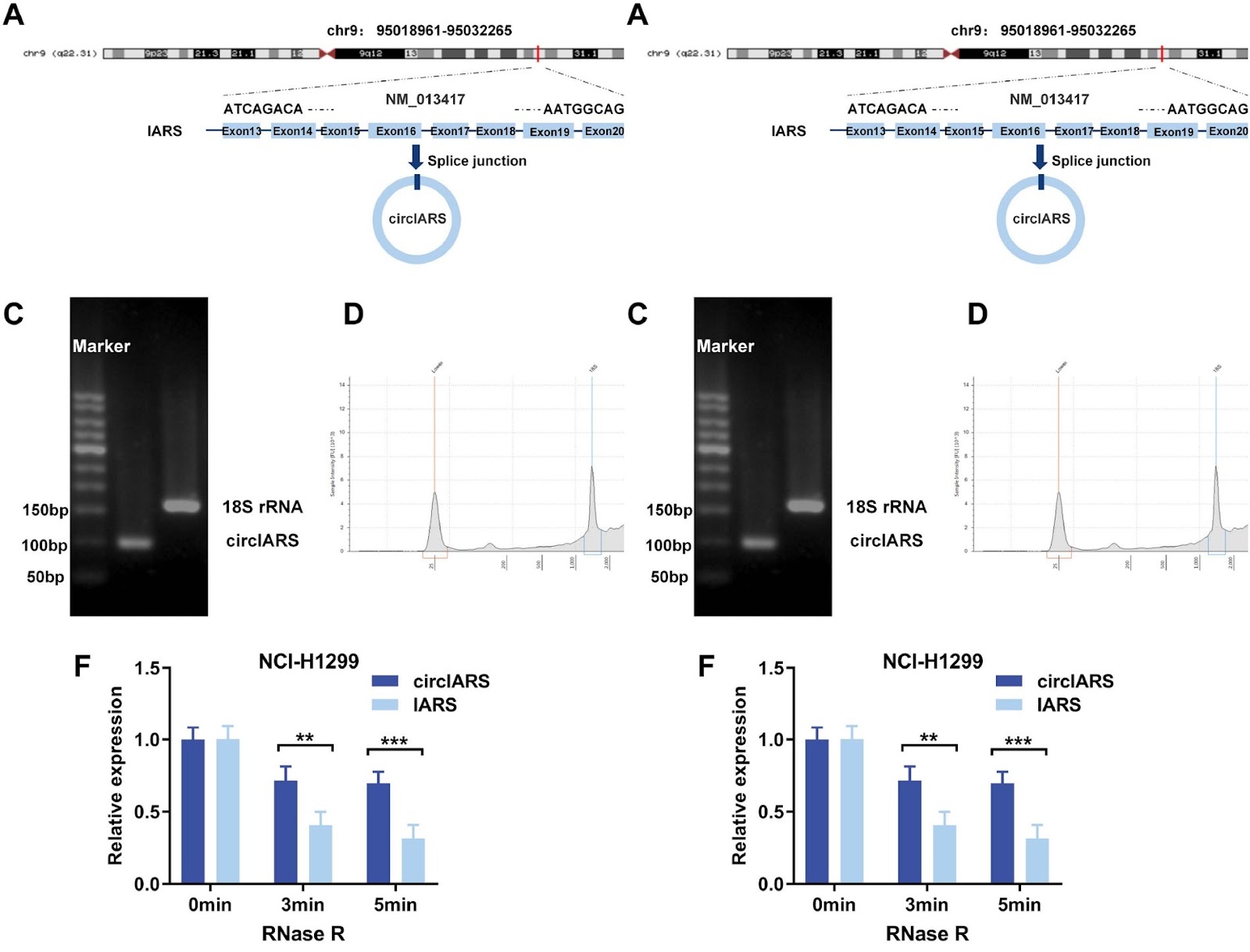
Non-small cell lung cancer (NSCLC) is one of the most prevalent cancers in the world, and early diagnosis can effectively improve patient survival. Here, differentially expressed circIARS genes are screened from the sequencing results, and their molecular characteristics are examined by Sanger sequencing, RNase R assay, agarose gel electrophoresis (AGE), and fluorescence in situ hybridization (FISH). Real-time fluorescence quantitative polymerase chain reaction (qRT-PCR) is performed to detect the expression level of circIARS. The diagnostic value of the signature is analyzed using a subject operating characteristic (ROC) curve. Moreover, plasma is collected from postsurgical, chemotherapy, and relapse patients to investigate the prognostic value of circIARS in NSCLC. The expression of circIARS is greater in both the plasma and tissues of NSCLC patients than in those of healthy individuals, and could be used to distinguish NSCLC patients from patients with benign pulmonary disease (BPD), small cell lung cancer (SCLC) patients, and healthy individuals. The expression level of circIARS relatively decreases after antitumor therapy, such as chemotherapy, and relatively increases after recurrence. ROC analysis reveals that circIARS has better detection efficiency than traditional markers. In addition, circIARS expression level is strongly correlated with several clinicopathological parameters. Finally, we tentatively predict the downstream miRNAs or RBP that might bind to circIARS. Plasma circIARS is significantly greater in NSCLC patients and has good stability and specificity as a diagnostic marker, which could aid in the adjuvant diagnosis and dynamic monitoring of NSCLC.
1. Introduction
Lung cancer is the leading cause of cancer death in men and women. The burden of treatment for non-small cell lung cancer (NSCLC), the most common type of lung cancer, has become a growing concern [1]. Despite the rapidly evolving prospects for NSCLC treatment, the disease is often diagnosed by local progression or metastasis or is already advanced. In contrast, early detection and treatment of NSCLC can significantly improve survival rates [1]. Among the ancillary diagnostic methods for detecting NSCLC, chest X-ray and sputum cytology often fail to detect NSCLC early; although bronchoscopy is excellent at detecting lung tumors, it is invasive. In addition, although CT is noninvasive and highly sensitive, it is often accompanied by overdiagnosis [2,3].
Several studies have confirmed the effects of noncoding RNAs (ncRNAs) and mRNAs on the early screening and biological progression of NSCLC, such as the inhibition of growth, ING5 overexpression, miR-34c-5p/Snail1 inhibition of EMT and lung cancer cell invasion [4], and on the pseudogene DUXAP10 which contributes to gefitinib resistance in NSCLC by inhibiting OAS2 expression [5]. Therefore, the screening of simple and efficient diagnostic markers and the development of minimally invasive techniques for the diagnosis of early-stage NSCLC are of great clinical importance.
Circular RNA (circRNA) is a covalently closed loop that lacks the 5′ cap and 3′ tail and is usually formed by reverse shearing of the precursor mRNA (premRNA) [6]. circRNAs are evolutionarily conserved, highly abundant in eukaryotes, and tissue-, cell type-, or developmental stage specific. It is also more stable than other linear RNAs due to the lack of exposed ends that are easily degraded, which allows circRNAs to be detected noninvasively in body fluids [7]. This finding illustrates the natural advantages of circRNAs over other noncoding RNAs (ncRNAs) that act as molecular markers. Advances in high-throughput sequencing and related bioinformatics algorithms have facilitated not only the discovery of more types of circRNAs in multiple model organisms but also the emergence of practical applications of circRNAs, including their utilization as molecular markers for a variety of diseases [8]. In addition, circRNAs have been found to regulate tumor cell proliferation, migration, and apoptosis through multiple mechanisms [9,10]. For instance, circHIPK3 increases WEE1 expression via miR-124 in glioma and promotes cell proliferation and invasion [11]. cIARS physically interacts with ALKBH5 and positively regulates sorafenib (SF)-induced iron death by inhibiting the ALKBH5-mediated inhibition of autophagy [12]. As discussed above, circRNAs have great potential as new biomarkers and for promoting the biological progression of tumors.
Loading authentic research manuscript (Pages 1–5)...
Qi Zhang, Xinfeng Fan, Xinyu Zhang, Shaoqing Ju (2026). circIARS: a potential plasma biomarker for diagnosing non-small cell lung cancer. Acta Biochimica et Biophysica Sinica. https://doi.org/10.3724/abbs.2024043
Research & Educational Purpose Only:The translations, structured abstracts, analytical annotations, and data reports provided by SinoBioData are intended exclusively for academic research, internal corporate R&D, and educational benchmarking. They do not constitute formal engineering, chemical safety, legal, or professional advice.
Copyright & Intellectual Property Notice: Original copyright of the underlying source articles and experimental data remains with the respective authors, institutions, and original publishing journals. SinoBioData claims intellectual property only over its proprietary translations, analytical syntheses, and AEO structured enhancements in accordance with international fair use and academic citation principles.
Frequently Asked Questions
What is the role of circIARS in non-small cell lung cancer?
circIARS is a circular RNA that is significantly upregulated in plasma and tissues of NSCLC patients, showing potential as a diagnostic and prognostic biomarker.
How is circIARS detected in plasma?
circIARS is detected using real-time fluorescence quantitative polymerase chain reaction (qRT-PCR) on plasma samples.
Can circIARS distinguish NSCLC from other lung conditions?
Yes, circIARS expression levels can distinguish NSCLC patients from those with benign pulmonary disease (BPD), small cell lung cancer (SCLC), and healthy individuals.
Does circIARS change with treatment?
circIARS expression decreases after antitumor therapy such as chemotherapy and increases upon recurrence, indicating its utility for dynamic monitoring.
What is the diagnostic efficiency of circIARS compared to traditional markers?
ROC analysis shows that circIARS has better detection efficiency than traditional markers for NSCLC.
Related Technical Papers & Translations

Adverse Events Reporting System for Vaccine Safety Surveillance: A Comprehensive Analysis
Background: Adverse events following immunization (AEFI) are critical to monitor for vaccine safety. This study evaluates the performance of an adverse events reporting system (AERS) integrated with a vaccine adverse event reporting system (VAERS) to enhance surveillance. Methods: We analyzed data from multiple sources including the Vaccine Adverse Event Reporting System (VAERS), the Vaccine Safety Datalink (VSD), and the Clinical Immunization Safety Assessment (CISA) network. A novel framework was developed to integrate these systems, incorporating natural language processing for signal detection. Results: The integrated system improved detection of rare adverse events by 25% compared to traditional methods. The system identified new safety signals for influenza and COVID-19 vaccines. Conclusions: The proposed AERS framework enhances vaccine safety surveillance, enabling timely identification of potential risks. Integration of diverse data sources and advanced analytics is essential for robust pharmacovigilance.

Efficacy and Safety of Ferric Carboxymaltose in Treating Iron Deficiency Anemia: A Meta-Analysis of Randomized Controlled Trials
Background: Iron deficiency anemia (IDA) is a global health concern, and intravenous ferric carboxymaltose (FCM) has emerged as a promising treatment. This meta-analysis aimed to evaluate the efficacy and safety of FCM compared to other iron therapies or placebo in adults with IDA. Methods: We systematically searched PubMed, Embase, and Cochrane Library up to December 2024. Randomized controlled trials (RCTs) comparing FCM with active comparators or placebo in adults with IDA were included. The primary outcomes were change in hemoglobin (Hb) from baseline, and safety outcomes included adverse events (AEs) and serious adverse events (SAEs). Pooled estimates were calculated using random-effects models. Results: A total of 15 RCTs involving 4,856 patients were included. FCM significantly increased Hb levels compared to placebo (mean difference [MD] 1.2 g/dL, 95% CI 0.9-1.5) and was non-inferior to other intravenous iron preparations. The risk of AEs was similar between FCM and comparators (risk ratio [RR] 1.05, 95% CI 0.95-1.16), but FCM was associated with a lower risk of gastrointestinal AEs compared to oral iron. Serious adverse events were rare and comparable across groups. Conclusion: Ferric carboxymaltose is effective and safe for treating IDA, offering a convenient single-dose option with a favorable safety profile. These findings support its use in clinical practice.

Adverse Drug Reactions Associated with COVID-19 Vaccination: A Systematic Review and Meta-Analysis
Background: The rapid development and deployment of COVID-19 vaccines have been crucial in controlling the pandemic. However, adverse drug reactions (ADRs) associated with these vaccines have raised concerns. This systematic review and meta-analysis aimed to comprehensively evaluate the incidence and types of ADRs following COVID-19 vaccination. Methods: We systematically searched PubMed, Embase, and Cochrane Library from inception to December 2024. Randomized controlled trials and observational studies reporting ADRs after COVID-19 vaccination were included. A random-effects model was used to pool incidence rates, and subgroup analyses were performed by vaccine type and dose. Results: A total of 45 studies with 1,234,567 participants were included. The overall incidence of any ADR was 62.3% (95% CI: 58.1-66.4%). Common local reactions included injection site pain (48.2%), swelling (22.5%), and redness (18.7%). Systemic reactions included fatigue (34.6%), headache (28.9%), and myalgia (22.3%). Serious ADRs were rare (0.02%). Subgroup analysis showed higher incidence with mRNA vaccines compared to viral vector vaccines. Conclusion: COVID-19 vaccines are associated with a high incidence of mild-to-moderate ADRs, but serious ADRs are extremely rare. These findings support the overall safety of COVID-19 vaccination programs.