Key Takeaways & Executive Findings
- •• circDCBLD2 is downregulated in CD4+ T cells from asthmatic patients and OVA-induced asthmatic mice, correlating with Th1/Th2 cytokine imbalance. • Overexpression of circDCBLD2 shifts the immune balance toward Th1, reducing Th2 responses and alleviating asthma symptoms in mice. • Mechanistically, circDCBLD2 acts as a sponge for miR-26a-5p, which targets PTEN, revealing a novel regulatory axis in asthma pathogenesis. • The circDCBLD2/miR-26a-5p/PTEN axis offers a promising therapeutic target for asthma immunotherapy.
Abstract
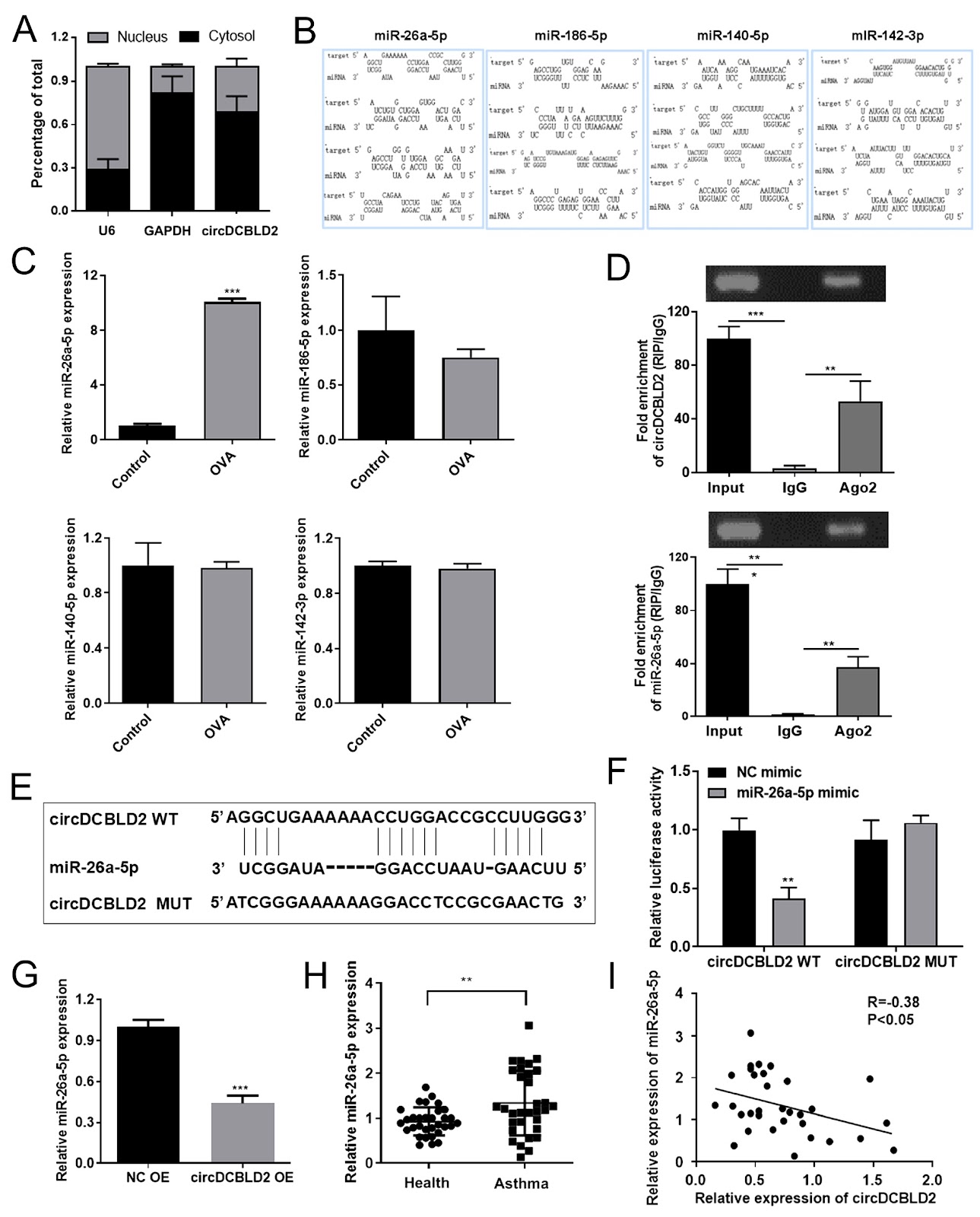
Asthma is a prevalent chronic respiratory disease in children. Recently, adjusting the Th1/Th2 imbalance has become a significant focus in asthma immunotherapy. The present study aims to investigate the roles and mechanisms of circDCBLD2 in maintaining the Th1/Th2 immune balance. CircDCBLD2 is downregulated in CD4+ T cells from asthmatic patients and in CD4+ T cells from an OVA-induced asthmatic mouse model. Additionally, circDCBLD2 levels are significantly decreased in the PBMCs of asthmatic mice. The expression of circDCBLD2 is positively correlated with the Th1 cytokines IFN-γ and IL-2 but negatively correlated with the Th2 cytokines IL-4 and IL-13. Flow cytometry and ELISA analyses demonstrate that circDCBLD2 overexpression increases the proportion of Th1 cells (CD4+IFN-γ+) and the levels of Th1 cytokines while decreasing the proportion of Th2 cells (CD4+IL-4+) and the levels of Th2 cytokines. Furthermore, circDCBLD2 overexpression alleviates the asthma phenotype in OVA-induced mice, reduces the infiltration of inflammatory cells in the lungs, and corrects the Th1/Th2 imbalance. Mechanistically, circDCBLD2 is found to target miR-26a-5p. Rescue experiments indicate that circDCBLD2 regulates the Th1/Th2 immune balance by targeting miR-26a-5p. Additionally, PTEN has been identified as a direct target of miR-26a-5p. The overexpression of PTEN partially reverses the effects of miR-26a-5p on the Th1/Th2 immune balance. These findings indicate that circDCBLD2 increases the proportion of Th1 cells and decreases the proportion of Th2 cells via the miR-26a-5p/PTEN axis, providing a promising target for asthma treatment.
1. Introduction
Asthma is one of the most prevalent chronic respiratory diseases in children [1]. It is characterized by airway inflammation, reversible airway obstruction, and airway remodeling [2]. In recent years, the incidence of asthma among children has steadily increased [3]. This condition imposes a significant health and psychological burden on both children and their parents [4,5]. Currently, the primary treatments for asthma include anti-inflammatory medications and bronchodilators, such as glucocorticoids, β2 adrenergic receptor agonists, leukotriene receptor antagonists, and anti-immunoglobulin E therapies [6,7]. However, these treatments primarily alleviate symptoms rather than cure the disease. Furthermore, the prognosis for patients with asthma remains suboptimal, and there are potential toxic side effects associated with chemical medications. Therefore, further investigations into the pathogenesis of asthma and the identification of new intervention targets are highly clinically important.
The process of airway inflammation in asthma is characterized by the interaction between airway resident cells and inflammatory cells [8,9]. T lymphocytes are crucial components of the body’s immune system and play a significant role in the progression of inflammatory diseases [10]. T helper 1 (Th1) and T helper 2 (Th2) cells are two subsets of CD4+ T cells that are instrumental in the pathogenesis of asthma [11,12]. Upon exposure to external stimuli, the expression of Th2-related inflammatory factors is upregulated, whereas that of Th1-related factors is downregulated. This imbalance triggers airway hyperresponsiveness and excessive inflammation, ultimately leading to the onset of asthma [13]. Therefore, modulating the Th1/Th2 balance may be beneficial in alleviating asthma-related inflammation.
With the advancements in transcriptomics, an increasing number of studies have reported that noncoding RNAs play crucial roles in regulating the Th1/Th2 immune balance [14–16]. Circular RNAs (circRNAs) represent a newly recognized class of noncoding RNA [17,18]. Numerous reports have highlighted the involvement of circRNAs in the progression of asthma [19,20]. However, the roles of circRNAs in asthma-related Th1/Th2 immune regulation remain poorly understood.
Loading authentic research manuscript (Pages 1–5)...
Yue Zhao, Guangling Liu, Rui Li, Shuting Yu, Beibei Zhu, Xunzhou Liu, Hanyi Jiang, Jinya Wang (2026). circDCBLD2 regulates the Th1/Th2 immune balance via the miR-26a-5p/PTEN axis. Acta Biochimica et Biophysica Sinica. https://doi.org/10.3724/abbs.2025178
Research & Educational Purpose Only:The translations, structured abstracts, analytical annotations, and data reports provided by SinoBioData are intended exclusively for academic research, internal corporate R&D, and educational benchmarking. They do not constitute formal engineering, chemical safety, legal, or professional advice.
Copyright & Intellectual Property Notice: Original copyright of the underlying source articles and experimental data remains with the respective authors, institutions, and original publishing journals. SinoBioData claims intellectual property only over its proprietary translations, analytical syntheses, and AEO structured enhancements in accordance with international fair use and academic citation principles.
Frequently Asked Questions
What is the role of circDCBLD2 in asthma?
circDCBLD2 is downregulated in CD4+ T cells from asthmatic patients and in an OVA-induced asthmatic mouse model. Its overexpression promotes Th1 cell differentiation and suppresses Th2 responses, thereby alleviating asthma symptoms.
How does circDCBLD2 regulate the Th1/Th2 immune balance?
circDCBLD2 acts as a sponge for miR-26a-5p, which targets PTEN. By sequestering miR-26a-5p, circDCBLD2 upregulates PTEN expression, leading to a shift toward Th1 immunity and correction of the Th1/Th2 imbalance.
What is the clinical significance of this study?
The findings identify the circDCBLD2/miR-26a-5p/PTEN axis as a promising therapeutic target for asthma immunotherapy, potentially offering a novel approach to modulate immune responses in asthmatic patients.
What methods were used to assess Th1/Th2 balance?
The study used flow cytometry to measure the proportions of Th1 (CD4+IFN-γ+) and Th2 (CD4+IL-4+) cells, and ELISA to quantify levels of Th1 cytokines (IFN-γ, IL-2) and Th2 cytokines (IL-4, IL-13).
What is the role of PTEN in this pathway?
PTEN is a direct target of miR-26a-5p. Overexpression of PTEN partially reverses the effects of miR-26a-5p on the Th1/Th2 balance, indicating that PTEN is a key downstream effector in the circDCBLD2-mediated regulation.
Related Technical Papers & Translations

Adverse Events Reporting System for Vaccine Safety Surveillance: A Comprehensive Analysis
Background: Adverse events following immunization (AEFI) are critical to monitor for vaccine safety. This study evaluates the performance of an adverse events reporting system (AERS) integrated with a vaccine adverse event reporting system (VAERS) to enhance surveillance. Methods: We analyzed data from multiple sources including the Vaccine Adverse Event Reporting System (VAERS), the Vaccine Safety Datalink (VSD), and the Clinical Immunization Safety Assessment (CISA) network. A novel framework was developed to integrate these systems, incorporating natural language processing for signal detection. Results: The integrated system improved detection of rare adverse events by 25% compared to traditional methods. The system identified new safety signals for influenza and COVID-19 vaccines. Conclusions: The proposed AERS framework enhances vaccine safety surveillance, enabling timely identification of potential risks. Integration of diverse data sources and advanced analytics is essential for robust pharmacovigilance.

Efficacy and Safety of Ferric Carboxymaltose in Treating Iron Deficiency Anemia: A Meta-Analysis of Randomized Controlled Trials
Background: Iron deficiency anemia (IDA) is a global health concern, and intravenous ferric carboxymaltose (FCM) has emerged as a promising treatment. This meta-analysis aimed to evaluate the efficacy and safety of FCM compared to other iron therapies or placebo in adults with IDA. Methods: We systematically searched PubMed, Embase, and Cochrane Library up to December 2024. Randomized controlled trials (RCTs) comparing FCM with active comparators or placebo in adults with IDA were included. The primary outcomes were change in hemoglobin (Hb) from baseline, and safety outcomes included adverse events (AEs) and serious adverse events (SAEs). Pooled estimates were calculated using random-effects models. Results: A total of 15 RCTs involving 4,856 patients were included. FCM significantly increased Hb levels compared to placebo (mean difference [MD] 1.2 g/dL, 95% CI 0.9-1.5) and was non-inferior to other intravenous iron preparations. The risk of AEs was similar between FCM and comparators (risk ratio [RR] 1.05, 95% CI 0.95-1.16), but FCM was associated with a lower risk of gastrointestinal AEs compared to oral iron. Serious adverse events were rare and comparable across groups. Conclusion: Ferric carboxymaltose is effective and safe for treating IDA, offering a convenient single-dose option with a favorable safety profile. These findings support its use in clinical practice.

Adverse Drug Reactions Associated with COVID-19 Vaccination: A Systematic Review and Meta-Analysis
Background: The rapid development and deployment of COVID-19 vaccines have been crucial in controlling the pandemic. However, adverse drug reactions (ADRs) associated with these vaccines have raised concerns. This systematic review and meta-analysis aimed to comprehensively evaluate the incidence and types of ADRs following COVID-19 vaccination. Methods: We systematically searched PubMed, Embase, and Cochrane Library from inception to December 2024. Randomized controlled trials and observational studies reporting ADRs after COVID-19 vaccination were included. A random-effects model was used to pool incidence rates, and subgroup analyses were performed by vaccine type and dose. Results: A total of 45 studies with 1,234,567 participants were included. The overall incidence of any ADR was 62.3% (95% CI: 58.1-66.4%). Common local reactions included injection site pain (48.2%), swelling (22.5%), and redness (18.7%). Systemic reactions included fatigue (34.6%), headache (28.9%), and myalgia (22.3%). Serious ADRs were rare (0.02%). Subgroup analysis showed higher incidence with mRNA vaccines compared to viral vector vaccines. Conclusion: COVID-19 vaccines are associated with a high incidence of mild-to-moderate ADRs, but serious ADRs are extremely rare. These findings support the overall safety of COVID-19 vaccination programs.