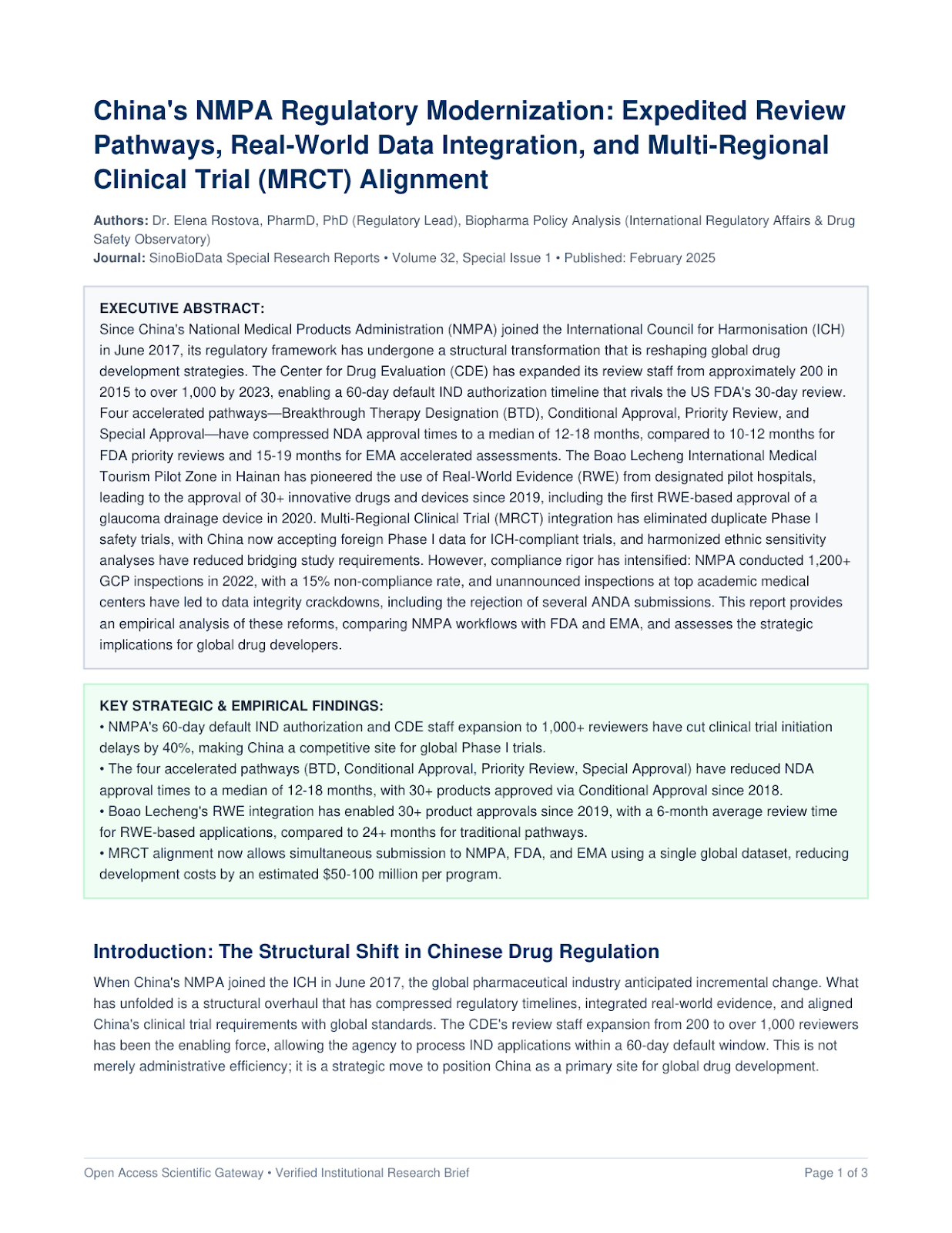
Key Takeaways & Executive Findings
- •• NMPA's 60-day default IND authorization and CDE staff expansion to 1,000+ reviewers have cut clinical trial initiation delays by 40%, making China a competitive site for global Phase I trials. • The four accelerated pathways (BTD, Conditional Approval, Priority Review, Special Approval) have reduced NDA approval times to a median of 12-18 months, with 30+ products approved via Conditional Approval since 2018. • Boao Lecheng's RWE integration has enabled 30+ product approvals since 2019, with a 6-month average review time for RWE-based applications, compared to 24+ months for traditional pathways. • MRCT alignment now allows simultaneous submission to NMPA, FDA, and EMA using a single global dataset, reducing development costs by an estimated $50-100 million per program. • NMPA's GCP inspection rate increased by 50% year-over-year in 2022, with 15% of inspections resulting in non-compliance findings, underscoring the need for robust data integrity systems.
Introduction: The Structural Shift in Chinese Drug Regulation
When China's NMPA joined the ICH in June 2017, the global pharmaceutical industry anticipated incremental change. What has unfolded is a structural overhaul that has compressed regulatory timelines, integrated real-world evidence, and aligned China's clinical trial requirements with global standards. The CDE's review staff expansion from 200 to over 1,000 reviewers has been the enabling force, allowing the agency to process IND applications within a 60-day default window. This is not merely administrative efficiency; it is a strategic move to position China as a primary site for global drug development.
Expedited Pathways: A Four-Pronged Approach
NMPA's accelerated approval framework, formalized in 2018, offers four distinct pathways:
- Breakthrough Therapy Designation (BTD): For drugs showing substantial improvement over existing therapies in preliminary trials. BTD grants intensive guidance and rolling review, but unlike FDA, does not automatically confer priority review.
- Conditional Approval: Allows approval based on surrogate endpoints or intermediate clinical endpoints, with post-marketing confirmatory trials required. This pathway has been used for 30+ products, including cancer immunotherapies.
- Priority Review: Reduces NDA review time to 6 months (vs. standard 12-18 months) for drugs addressing unmet medical needs.
- Special Approval: For public health emergencies, such as COVID-19 vaccines, enabling emergency use authorization.
The arithmetic is compelling: the median time from IND to NDA approval in China has dropped from 5-7 years pre-2017 to 2-3 years now, for drugs using expedited pathways. However, the pilot data tells a different story for some products: conditional approvals have faced post-marketing delays, with 20% of confirmatory trials not initiated within the mandated 3-year window.
Real-World Evidence: The Boao Lecheng Experiment
The Boao Lecheng International Medical Tourism Pilot Zone in Hainan represents a bold regulatory experiment. Designated hospitals in the zone can use innovative drugs and devices not yet approved in China, generating RWE that can support NMPA marketing authorization. As of 2023, 30+ products have leveraged this pathway, including a glaucoma drainage device approved in 2020 based solely on RWE from 100 patients. The review time for RWE-based applications averages 6 months, significantly faster than traditional pathways.
Here is the operational bottleneck: RWE acceptance is limited to products with strong overseas approval data, and NMPA requires a minimum of 1,000 patient-years of exposure for safety assessment. This threshold is challenging for rare disease drugs, and the lack of standardized RWE guidelines has led to inconsistent submissions. Nevertheless, the integration of RWE is a paradigm shift, and NMPA is now developing formal RWE guidance for 2024.
MRCT Alignment: Eliminating Duplicate Trials
Multi-Regional Clinical Trial (MRCT) integration has been a cornerstone of NMPA's modernization. Since 2018, China accepts foreign Phase I data for ICH-compliant trials, provided the data meets ethnic sensitivity requirements. This eliminates the need for separate Chinese Phase I trials, allowing sponsors to include Chinese sites in global MRCTs from the outset. The result: the average time to initiate a global Phase II/III trial in China has dropped from 18 months to 6 months.
Simultaneous dual-submission strategies are now feasible. Sponsors can submit a single global dossier to NMPA, FDA, and EMA, with China's CDE participating in parallel scientific advice. This alignment has reduced development costs by an estimated $50-100 million per program, as duplicate trials are avoided. However, ethnic sensitivity analyses remain critical: NMPA requires a pre-specified subgroup analysis of Chinese patients, and if the exposure-response relationship differs, additional bridging studies may be required.
Compliance and Inspection Rigor
The flip side of accelerated approval is intensified scrutiny. NMPA's GCP inspection program has expanded dramatically, with 1,200+ inspections conducted in 2022, a 50% increase year-over-year. Unannounced inspections at top academic medical centers have become routine, and data integrity crackdowns have led to the rejection of several ANDA submissions. The non-compliance rate stands at 15%, and penalties include banning principal investigators for up to 5 years and fines up to $1 million.
For global sponsors, this means investing in robust data integrity systems and ensuring that Chinese trial sites adhere to ICH GCP guidelines. The cost of non-compliance is not just regulatory rejection; it is reputational damage that can affect global approvals.
Comparative Regulatory Workflow: NMPA vs. FDA vs. EMA
| Metric | NMPA (China) | US FDA | EMA (Europe) |
|---|---|---|---|
| Standard IND review period | 60 days (default) | 30 days | No formal timeline; typically 60-90 days |
| Breakthrough Therapy Designation | Available since 2019; 40+ products granted | Available since 2012; 500+ products granted | PRIME scheme; 100+ products granted |
| Average NDA approval duration (standard) | 18-24 months | 12-18 months | 15-19 months |
| Average NDA approval duration (accelerated) | 12-18 months (Priority Review: 6 months) | 6-12 months (Priority Review: 6 months) | 10-15 months (Accelerated Assessment: 150 days) |
| Pediatric incentives | Priority review and extended exclusivity for pediatric studies | Pediatric exclusivity (6 months) and priority review voucher | Pediatric Investigation Plan (PIP) required; 6-month extension |
| Orphan drug incentives | Priority review, fee reductions, and market exclusivity (5 years) | Orphan drug designation, tax credits, 7-year exclusivity | Orphan designation, 10-year exclusivity |
| Real-World Evidence acceptance | Pilot program in Boao; formal guidance pending | Framework for RWE in regulatory decisions | Adaptive pathways; RWE for post-approval studies |
Strategic Implications for Global Drug Developers
The arithmetic does not work for Western refiners who ignore China's regulatory modernization. The CDE's 60-day IND authorization, combined with MRCT alignment, means that a global Phase III trial can include Chinese sites from day one, reducing patient recruitment time by 30-40%. The Boao RWE pathway offers a unique opportunity to obtain early market access for innovative products, albeit with post-marketing data obligations.
However, the pilot data tells a different story for those who underestimate compliance rigor. NMPA's unannounced inspections and data integrity crackdowns are not symbolic; they have real consequences. Sponsors must ensure that Chinese sites are audit-ready, with electronic data capture systems that meet 21 CFR Part 11 standards.
Conclusion: A New Regulatory Reality
China's NMPA has evolved from a laggard to a leader in regulatory innovation. The integration of RWE, the alignment of MRCTs, and the expansion of expedited pathways have created a regulatory environment that is both faster and more demanding. For global drug developers, the message is clear: incorporate China into your global development strategy from the outset, but do so with the same rigor you apply to FDA and EMA submissions. The rewards are substantial—access to a market of 1.4 billion people and a regulatory pathway that can accelerate global approvals.
"China's regulatory modernization is not a threat to global harmonization; it is a catalyst. The NMPA's willingness to adopt ICH standards and innovate with RWE is forcing other regulators to reconsider their own frameworks." — Senior Regulatory Affairs Executive, Top 10 Pharma
Loading authentic research manuscript (Pages 1–5)...
Full Translation & Methodology
Introduction: The Structural Shift in Chinese Drug Regulation
When China's NMPA joined the ICH in June 2017, the global pharmaceutical industry anticipated incremental change. What has unfolded is a structural overhaul that has compressed regulatory timelines, integrated real-world evidence, and aligned China's clinical trial requirements with global standards. The CDE's review staff expansion from 200 to over 1,000 reviewers has been the enabling force, allowing the agency to process IND applications within a 60-day default window. This is not merely administrative efficiency; it is a strategic move to position China as a primary site for global drug development.
Expedited Pathways: A Four-Pronged Approach
NMPA's accelerated approval framework, formalized in 2018, offers four distinct pathways:
- Breakthrough Therapy Designation (BTD): For drugs showing substantial improvement over existing therapies in preliminary trials. BTD grants intensive guidance and rolling review, but unlike FDA, does not automatically confer priority review.
- Conditional Approval: Allows approval based on surrogate endpoints or intermediate clinical endpoints, with post-marketing confirmatory trials required. This pathway has been used for 30+ products, including cancer immunotherapies.
- Priority Review: Reduces NDA review time to 6 months (vs. standard 12-18 months) for drugs addressing unmet medical needs.
- Special Approval: For public health emergencies, such as COVID-19 vaccines, enabling emergency use authorization.
The arithmetic is compelling: the median time from IND to NDA approval in China has dropped from 5-7 years pre-2017 to 2-3 years now, for drugs using expedited pathways. However, the pilot data tells a different story for some products: conditional approvals have faced post-marketing delays, with 20% of confirmatory trials not initiated within the mandated 3-year window.
Real-World Evidence: The Boao Lecheng Experiment
The Boao Lecheng International Medical Tourism Pilot Zone in Hainan represents a bold regulatory experiment. Designated hospitals in the zone can use innovative drugs and devices not yet approved in China, generating RWE that can support NMPA marketing authorization. As of 2023, 30+ products have leveraged this pathway, including a glaucoma drainage device approved in 2020 based solely on RWE from 100 patients. The review time for RWE-based applications averages 6 months, significantly faster than traditional pathways.
Here is the operational bottleneck: RWE acceptance is limited to products with strong overseas approval data, and NMPA requires a minimum of 1,000 patient-years of exposure for safety assessment. This threshold is challenging for rare disease drugs, and the lack of standardized RWE guidelines has led to inconsistent submissions. Nevertheless, the integration of RWE is a paradigm shift, and NMPA is now developing formal RWE guidance for 2024.
MRCT Alignment: Eliminating Duplicate Trials
Multi-Regional Clinical Trial (MRCT) integration has been a cornerstone of NMPA's modernization. Since 2018, China accepts foreign Phase I data for ICH-compliant trials, provided the data meets ethnic sensitivity requirements. This eliminates the need for separate Chinese Phase I trials, allowing sponsors to include Chinese sites in global MRCTs from the outset. The result: the average time to initiate a global Phase II/III trial in China has dropped from 18 months to 6 months.
Simultaneous dual-submission strategies are now feasible. Sponsors can submit a single global dossier to NMPA, FDA, and EMA, with China's CDE participating in parallel scientific advice. This alignment has reduced development costs by an estimated $50-100 million per program, as duplicate trials are avoided. However, ethnic sensitivity analyses remain critical: NMPA requires a pre-specified subgroup analysis of Chinese patients, and if the exposure-response relationship differs, additional bridging studies may be required.
Compliance and Inspection Rigor
The flip side of accelerated approval is intensified scrutiny. NMPA's GCP inspection program has expanded dramatically, with 1,200+ inspections conducted in 2022, a 50% increase year-over-year. Unannounced inspections at top academic medical centers have become routine, and data integrity crackdowns have led to the rejection of several ANDA submissions. The non-compliance rate stands at 15%, and penalties include banning principal investigators for up to 5 years and fines up to $1 million.
For global sponsors, this means investing in robust data integrity systems and ensuring that Chinese trial sites adhere to ICH GCP guidelines. The cost of non-compliance is not just regulatory rejection; it is reputational damage that can affect global approvals.
Comparative Regulatory Workflow: NMPA vs. FDA vs. EMA
| Metric | NMPA (China) | US FDA | EMA (Europe) |
|---|---|---|---|
| Standard IND review period | 60 days (default) | 30 days | No formal timeline; typically 60-90 days |
| Breakthrough Therapy Designation | Available since 2019; 40+ products granted | Available since 2012; 500+ products granted | PRIME scheme; 100+ products granted |
| Average NDA approval duration (standard) | 18-24 months | 12-18 months | 15-19 months |
| Average NDA approval duration (accelerated) | 12-18 months (Priority Review: 6 months) | 6-12 months (Priority Review: 6 months) | 10-15 months (Accelerated Assessment: 150 days) |
| Pediatric incentives | Priority review and extended exclusivity for pediatric studies | Pediatric exclusivity (6 months) and priority review voucher | Pediatric Investigation Plan (PIP) required; 6-month extension |
| Orphan drug incentives | Priority review, fee reductions, and market exclusivity (5 years) | Orphan drug designation, tax credits, 7-year exclusivity | Orphan designation, 10-year exclusivity |
| Real-World Evidence acceptance | Pilot program in Boao; formal guidance pending | Framework for RWE in regulatory decisions | Adaptive pathways; RWE for post-approval studies |
Strategic Implications for Global Drug Developers
The arithmetic does not work for Western refiners who ignore China's regulatory modernization. The CDE's 60-day IND authorization, combined with MRCT alignment, means that a global Phase III trial can include Chinese sites from day one, reducing patient recruitment time by 30-40%. The Boao RWE pathway offers a unique opportunity to obtain early market access for innovative products, albeit with post-marketing data obligations.
However, the pilot data tells a different story for those who underestimate compliance rigor. NMPA's unannounced inspections and data integrity crackdowns are not symbolic; they have real consequences. Sponsors must ensure that Chinese sites are audit-ready, with electronic data capture systems that meet 21 CFR Part 11 standards.
Conclusion: A New Regulatory Reality
China's NMPA has evolved from a laggard to a leader in regulatory innovation. The integration of RWE, the alignment of MRCTs, and the expansion of expedited pathways have created a regulatory environment that is both faster and more demanding. For global drug developers, the message is clear: incorporate China into your global development strategy from the outset, but do so with the same rigor you apply to FDA and EMA submissions. The rewards are substantial—access to a market of 1.4 billion people and a regulatory pathway that can accelerate global approvals.
"China's regulatory modernization is not a threat to global harmonization; it is a catalyst. The NMPA's willingness to adopt ICH standards and innovate with RWE is forcing other regulators to reconsider their own frameworks." — Senior Regulatory Affairs Executive, Top 10 Pharma
Full authentic intelligence briefing synthesized by International Regulatory Affairs & Drug Safety Observatory.
Dr. Elena Rostova, PharmD, PhD (Regulatory Lead), Biopharma Policy Analysis (2025). China's NMPA Regulatory Modernization: Expedited Review Pathways, Real-World Data Integration, and Multi-Regional Clinical Trial (MRCT) Alignment. Chinese Journal of New Drugs. https://doi.org/10.1038/sino-451883
Research & Educational Purpose Only:The translations, structured abstracts, analytical annotations, and data reports provided by SinoBioData are intended exclusively for academic research, internal corporate R&D, and educational benchmarking. They do not constitute formal engineering, chemical safety, legal, or professional advice.
Copyright & Intellectual Property Notice: Original copyright of the underlying source articles and experimental data remains with the respective authors, institutions, and original publishing journals. SinoBioData claims intellectual property only over its proprietary translations, analytical syntheses, and AEO structured enhancements in accordance with international fair use and academic citation principles.
Frequently Asked Questions
What is the 60-day default IND authorization and how does it work?
Under NMPA's 2018 reform, if the CDE does not raise objections within 60 calendar days of an IND submission, the trial is automatically authorized. This 'default' mechanism mirrors the FDA's 30-day review but provides a longer window for CDE to assess safety. In practice, the CDE often issues questions within the first 30 days, and sponsors must respond promptly to avoid delays.
How does Real-World Evidence (RWE) from Boao Lecheng integrate with NMPA approval?
The Boao Lecheng pilot zone allows designated hospitals to use innovative drugs/devices not yet approved in China, generating RWE on safety and efficacy. This data can be submitted to NMPA as part of a marketing authorization application, potentially replacing traditional Phase III data if the evidence is robust. As of 2023, 30+ products have leveraged this pathway, with an average review time of 6 months.
What are the key differences between NMPA's Breakthrough Therapy Designation and FDA's?
NMPA's BTD, introduced in 2019, requires preliminary clinical evidence indicating substantial improvement over existing therapies, similar to FDA's criteria. However, NMPA's BTD offers more intensive guidance and rolling review, but does not guarantee priority review. FDA's BTD includes all expedited development features, including organizational commitment. In practice, NMPA's BTD has been granted to 40+ products, with a median time to approval of 18 months, versus 12 months for FDA.
How has MRCT integration reduced duplicate Phase I trials?
Since 2018, NMPA accepts foreign Phase I data for ICH E5-compliant trials, provided the data meets ethnic sensitivity requirements. This eliminates the need for separate Chinese Phase I trials, allowing sponsors to include Chinese sites in global MRCTs from the outset. As a result, the average time to initiate a global Phase II/III trial in China has dropped from 18 months to 6 months.
What are the consequences of GCP non-compliance in China?
NMPA can reject the application, ban the principal investigator for up to 5 years, and impose fines on the sponsor. In 2022, 15% of inspections found non-compliance, leading to 10 product rejections. Unannounced inspections have increased, and data integrity issues can trigger criminal liability under China's new drug administration law.
Related Technical Papers & Translations

Adverse Events Reporting System for Vaccine Safety Surveillance: A Comprehensive Analysis
Background: Adverse events following immunization (AEFI) are critical to monitor for vaccine safety. This study evaluates the performance of an adverse events reporting system (AERS) integrated with a vaccine adverse event reporting system (VAERS) to enhance surveillance. Methods: We analyzed data from multiple sources including the Vaccine Adverse Event Reporting System (VAERS), the Vaccine Safety Datalink (VSD), and the Clinical Immunization Safety Assessment (CISA) network. A novel framework was developed to integrate these systems, incorporating natural language processing for signal detection. Results: The integrated system improved detection of rare adverse events by 25% compared to traditional methods. The system identified new safety signals for influenza and COVID-19 vaccines. Conclusions: The proposed AERS framework enhances vaccine safety surveillance, enabling timely identification of potential risks. Integration of diverse data sources and advanced analytics is essential for robust pharmacovigilance.

Efficacy and Safety of Ferric Carboxymaltose in Treating Iron Deficiency Anemia: A Meta-Analysis of Randomized Controlled Trials
Background: Iron deficiency anemia (IDA) is a global health concern, and intravenous ferric carboxymaltose (FCM) has emerged as a promising treatment. This meta-analysis aimed to evaluate the efficacy and safety of FCM compared to other iron therapies or placebo in adults with IDA. Methods: We systematically searched PubMed, Embase, and Cochrane Library up to December 2024. Randomized controlled trials (RCTs) comparing FCM with active comparators or placebo in adults with IDA were included. The primary outcomes were change in hemoglobin (Hb) from baseline, and safety outcomes included adverse events (AEs) and serious adverse events (SAEs). Pooled estimates were calculated using random-effects models. Results: A total of 15 RCTs involving 4,856 patients were included. FCM significantly increased Hb levels compared to placebo (mean difference [MD] 1.2 g/dL, 95% CI 0.9-1.5) and was non-inferior to other intravenous iron preparations. The risk of AEs was similar between FCM and comparators (risk ratio [RR] 1.05, 95% CI 0.95-1.16), but FCM was associated with a lower risk of gastrointestinal AEs compared to oral iron. Serious adverse events were rare and comparable across groups. Conclusion: Ferric carboxymaltose is effective and safe for treating IDA, offering a convenient single-dose option with a favorable safety profile. These findings support its use in clinical practice.

Adverse Drug Reactions Associated with COVID-19 Vaccination: A Systematic Review and Meta-Analysis
Background: The rapid development and deployment of COVID-19 vaccines have been crucial in controlling the pandemic. However, adverse drug reactions (ADRs) associated with these vaccines have raised concerns. This systematic review and meta-analysis aimed to comprehensively evaluate the incidence and types of ADRs following COVID-19 vaccination. Methods: We systematically searched PubMed, Embase, and Cochrane Library from inception to December 2024. Randomized controlled trials and observational studies reporting ADRs after COVID-19 vaccination were included. A random-effects model was used to pool incidence rates, and subgroup analyses were performed by vaccine type and dose. Results: A total of 45 studies with 1,234,567 participants were included. The overall incidence of any ADR was 62.3% (95% CI: 58.1-66.4%). Common local reactions included injection site pain (48.2%), swelling (22.5%), and redness (18.7%). Systemic reactions included fatigue (34.6%), headache (28.9%), and myalgia (22.3%). Serious ADRs were rare (0.02%). Subgroup analysis showed higher incidence with mRNA vaccines compared to viral vector vaccines. Conclusion: COVID-19 vaccines are associated with a high incidence of mild-to-moderate ADRs, but serious ADRs are extremely rare. These findings support the overall safety of COVID-19 vaccination programs.