Key Takeaways & Executive Findings
- •• CDC5L is upregulated in post-ischemia-reperfusion myocardium and its overexpression enhances cardiomyocyte proliferation, reduces apoptosis, and improves cardiac function. • Transcriptomic analysis identifies FGF10 as a key downstream effector of CDC5L, and FGF10 knockdown reverses CDC5L's proliferative and anti-apoptotic effects. • The cardioprotective effect of CDC5L is mediated through the FGF10-YAP axis, as CDC5L reduces YAP phosphorylation in an FGF10-dependent manner. • The CDC5L-FGF10-YAP axis offers a promising therapeutic target for promoting myocardial regeneration and recovery after myocardial infarction.
Abstract
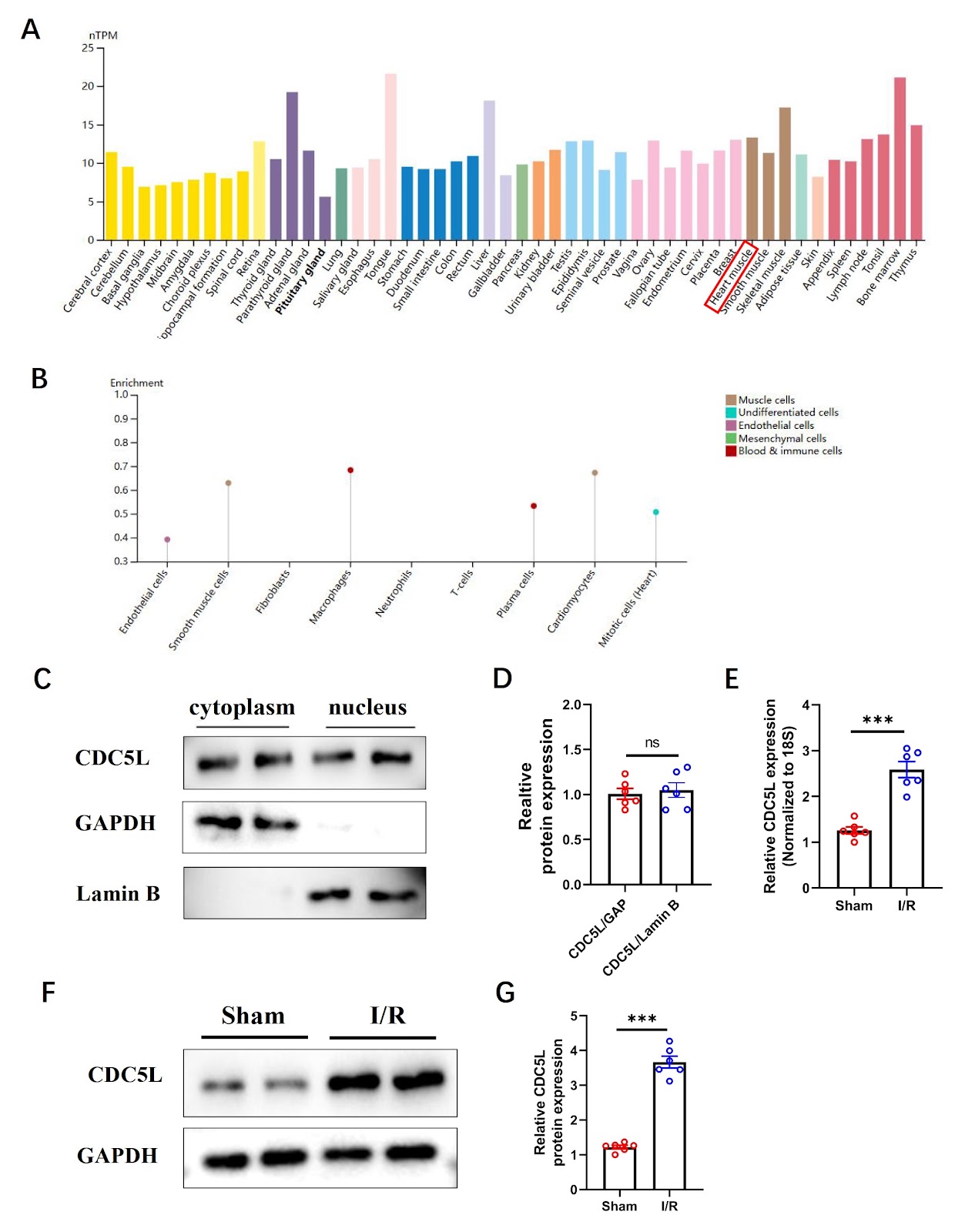
Myocardial infarction (MI) causes irreversible cardiomyocyte loss, creating a need for cardiac repair therapies. The role of cell division cycle 5-like (CDC5L), a cell cycle regulator, in cardiac repair is unknown. This study aims to define the role of CDC5L in mitigating ischemia-reperfusion (I/R) injury by assessing its impact on cardiomyocyte proliferation and apoptosis and to determine the mechanism involving the FGF10-YAP axis. We model cardiac injury using in vitro oxygen-glucose deprivation/reoxygenation (OGD/R) in neonatal mouse cardiomyocytes and in vivo I/R in adult mice. To investigate CDC5L function, we modulate its expression via adenoviral or AAV9-mediated overexpression or knockdown. Proliferation markers (EdU+, Ki67+, pH3+), apoptosis (TUNEL staining, Bax/Bcl-2 ratio), and cardiac function (echocardiography) are assessed. Through transcriptomic screening, we identify CDC5L downstream targets and validate their functional roles using FGF10 knockdown rescue assays. We find that CDC5L is upregulated in the post-I/R murine myocardium. Its overexpression enhances cardiomyocyte proliferation, preserves cardiac function, reduces apoptosis, and diminishes infarct size. Transcriptomic analysis identifies FGF10 as a key downstream effector, and we confirm that CDC5L upregulates FGF10 expression. Notably, FGF10 knockdown reverses the proliferative and anti-apoptotic effects of CDC5L. Moreover, the CDC5L-mediated reduction in YAP phosphorylation is also dependent on FGF10, as this effect is abolished upon FGF10 knockdown. In conclusion, CDC5L attenuates cardiac I/R injury by promoting cardiomyocyte proliferation and inhibiting apoptosis through the FGF10-YAP pathway. This CDC5L-FGF10-YAP axis represents a promising therapeutic target to improve myocardial regeneration and recovery after myocardial infarction.
1. Introduction
Myocardial infarction (MI), a serious cardiovascular disease caused by sudden interruption of coronary blood flow, directly results in the loss of cardiomyocytes and triggers complex pathological processes, including myocardial remodelling and heart failure, ultimately leading to death [1,2]. At present, the treatment for myocardial infarction focuses mainly on ischemia-reperfusion (I/R) methods, such as percutaneous coronary intervention, coronary artery bypass grafting, and drug thrombolysis [3]. Although these methods improve the blood supply of ischemic myocardial tissue after MI, they do not rescue necrotic myocardial cells or regenerate reduced cardiomyocytes [4]. As the ultimate treatment, heart transplantation completely resolves severe heart failure caused by heart injury, but the lack of donors limits its clinical application [5].
Therefore, elucidating the endogenous mechanisms that reactivate cardiomyocyte proliferation and mitigate apoptosis represents a promising therapeutic avenue for improving cardiac repair after MI. A key characteristic of adult mammalian cardiomyocytes is their exit from the cell cycle and loss of proliferative function. Therefore, when the myocardium is subjected to ischemic injury, necrotic myocardial cells can not be replaced and repaired by newly formed normal myocardial cells, and the tissue in the infarcted area is replaced only by fibrous scars [6]. This fibrous scar tissue does not have normal myocardial function, resulting in severe damage to cardiac function. Numerous studies have shown that the hearts of newborn mice regenerate within 7 days after birth, but this regenerative ability is lost after 7 days, indicating that there is a brief window for effective regeneration of myocardial cells [7]. Scholars have extensively explored and overcome the limitations of the endogenous regeneration of myocardial cells outside the regenerative window from multiple perspectives. (1) Overexpression of the OSKM transcription factor in the adult myocardium for a short period of time induces cardiomyocyte dedifferentiation and reprogramming, allowing cardiomyocytes to re-enter the cell cycle, promote cardiac regeneration and promote repair after myocardial infarction [8]. (2) HMGCS2 overexpression increases the dedifferentiation and proliferation of adult myocardial cells after myocardial infarction to improve cardiac function, and HMGCS2 knockdown worsens cardiac function after myocardial infarction reperfusion. (3) Inhibition of succinate dehydrogenase (SDH) activity prolongs the regeneration window of neonatal mouse hearts and promotes myocardial regeneration and repair after myocardial infarction [9,10]. These findings indicate that expanding the myocardia
Loading authentic research manuscript (Pages 1–5)...
Tianwen Wei, Tangjiang Wan, Yuxiao Sun, Yucheng Liang, Zhihao Lin, Shitong Shen, Qi Zhang, Mengli Chen, Yafei Li (2026). CDC5L facilitates cardiomyocyte proliferation and ameliorates myocardial ischemia-reperfusion injury via modulation of the FGF10-YAP axis. Acta Biochimica et Biophysica Sinica. https://doi.org/10.3724/abbs.2025213
Research & Educational Purpose Only:The translations, structured abstracts, analytical annotations, and data reports provided by SinoBioData are intended exclusively for academic research, internal corporate R&D, and educational benchmarking. They do not constitute formal engineering, chemical safety, legal, or professional advice.
Copyright & Intellectual Property Notice: Original copyright of the underlying source articles and experimental data remains with the respective authors, institutions, and original publishing journals. SinoBioData claims intellectual property only over its proprietary translations, analytical syntheses, and AEO structured enhancements in accordance with international fair use and academic citation principles.
Frequently Asked Questions
What is the role of CDC5L in myocardial ischemia-reperfusion injury?
CDC5L is upregulated after ischemia-reperfusion injury and its overexpression promotes cardiomyocyte proliferation, reduces apoptosis, and improves cardiac function, thereby attenuating injury.
How does CDC5L exert its cardioprotective effects?
CDC5L upregulates FGF10 expression, which in turn reduces YAP phosphorylation, activating the FGF10-YAP axis to promote proliferation and inhibit apoptosis.
What experimental models were used in this study?
The study used in vitro oxygen-glucose deprivation/reoxygenation (OGD/R) in neonatal mouse cardiomyocytes and in vivo ischemia-reperfusion (I/R) in adult mice.
What is the clinical significance of the CDC5L-FGF10-YAP axis?
This axis represents a promising therapeutic target for improving myocardial regeneration and recovery after myocardial infarction, potentially leading to new treatments for heart failure.
How was FGF10 identified as a downstream effector of CDC5L?
Through transcriptomic screening, FGF10 was identified as a key downstream target, and its functional role was validated using FGF10 knockdown rescue assays.
Related Technical Papers & Translations

Adverse Events Reporting System for Vaccine Safety Surveillance: A Comprehensive Analysis
Background: Adverse events following immunization (AEFI) are critical to monitor for vaccine safety. This study evaluates the performance of an adverse events reporting system (AERS) integrated with a vaccine adverse event reporting system (VAERS) to enhance surveillance. Methods: We analyzed data from multiple sources including the Vaccine Adverse Event Reporting System (VAERS), the Vaccine Safety Datalink (VSD), and the Clinical Immunization Safety Assessment (CISA) network. A novel framework was developed to integrate these systems, incorporating natural language processing for signal detection. Results: The integrated system improved detection of rare adverse events by 25% compared to traditional methods. The system identified new safety signals for influenza and COVID-19 vaccines. Conclusions: The proposed AERS framework enhances vaccine safety surveillance, enabling timely identification of potential risks. Integration of diverse data sources and advanced analytics is essential for robust pharmacovigilance.

Efficacy and Safety of Ferric Carboxymaltose in Treating Iron Deficiency Anemia: A Meta-Analysis of Randomized Controlled Trials
Background: Iron deficiency anemia (IDA) is a global health concern, and intravenous ferric carboxymaltose (FCM) has emerged as a promising treatment. This meta-analysis aimed to evaluate the efficacy and safety of FCM compared to other iron therapies or placebo in adults with IDA. Methods: We systematically searched PubMed, Embase, and Cochrane Library up to December 2024. Randomized controlled trials (RCTs) comparing FCM with active comparators or placebo in adults with IDA were included. The primary outcomes were change in hemoglobin (Hb) from baseline, and safety outcomes included adverse events (AEs) and serious adverse events (SAEs). Pooled estimates were calculated using random-effects models. Results: A total of 15 RCTs involving 4,856 patients were included. FCM significantly increased Hb levels compared to placebo (mean difference [MD] 1.2 g/dL, 95% CI 0.9-1.5) and was non-inferior to other intravenous iron preparations. The risk of AEs was similar between FCM and comparators (risk ratio [RR] 1.05, 95% CI 0.95-1.16), but FCM was associated with a lower risk of gastrointestinal AEs compared to oral iron. Serious adverse events were rare and comparable across groups. Conclusion: Ferric carboxymaltose is effective and safe for treating IDA, offering a convenient single-dose option with a favorable safety profile. These findings support its use in clinical practice.

Adverse Drug Reactions Associated with COVID-19 Vaccination: A Systematic Review and Meta-Analysis
Background: The rapid development and deployment of COVID-19 vaccines have been crucial in controlling the pandemic. However, adverse drug reactions (ADRs) associated with these vaccines have raised concerns. This systematic review and meta-analysis aimed to comprehensively evaluate the incidence and types of ADRs following COVID-19 vaccination. Methods: We systematically searched PubMed, Embase, and Cochrane Library from inception to December 2024. Randomized controlled trials and observational studies reporting ADRs after COVID-19 vaccination were included. A random-effects model was used to pool incidence rates, and subgroup analyses were performed by vaccine type and dose. Results: A total of 45 studies with 1,234,567 participants were included. The overall incidence of any ADR was 62.3% (95% CI: 58.1-66.4%). Common local reactions included injection site pain (48.2%), swelling (22.5%), and redness (18.7%). Systemic reactions included fatigue (34.6%), headache (28.9%), and myalgia (22.3%). Serious ADRs were rare (0.02%). Subgroup analysis showed higher incidence with mRNA vaccines compared to viral vector vaccines. Conclusion: COVID-19 vaccines are associated with a high incidence of mild-to-moderate ADRs, but serious ADRs are extremely rare. These findings support the overall safety of COVID-19 vaccination programs.