Key Takeaways & Executive Findings
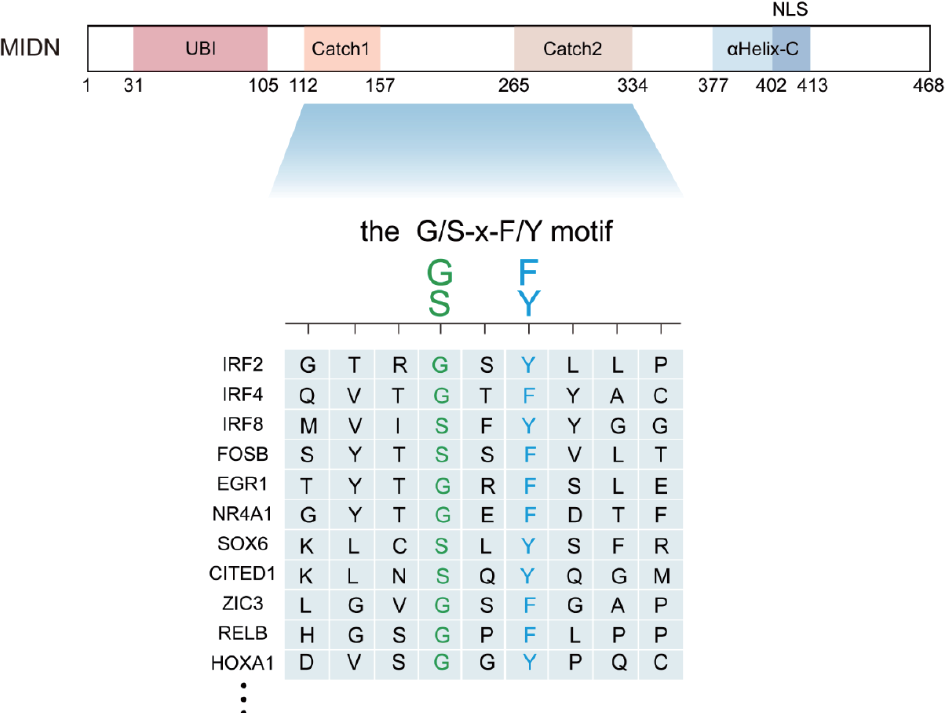
- •• MIDN recognizes substrates via a conserved β-strand insertion mechanism at the Catch1/Catch2 interface. • An 'F-G zipper' interaction between substrate and Catch2 is the dominant energetic determinant for binding. • Flanking residues tolerate substitution due to large, plastic hydrophobic pockets, enabling broad substrate specificity. • A consensus recognition motif (G/S-x-F/Y) is derived, providing a predictive framework for identifying MIDN targets.
Abstract
Protein homeostasis is fundamental to cellular decisions, and its dysregulation drives numerous pathologies. The ubiquitin-independent proteasomal degradation pathway mediated by midnolin (MIDN) has emerged as a distinct mechanism for regulating nuclear protein turnover. In the current study, Zhong et al. provide a comprehensive structural and biochemical analysis of the MIDN Catch domain bound to IRF4-derived peptides, substantially advancing our understanding of MIDN substrate recognition. By solving multiple crystal structures of the Catch-IRF4 complex, the authors demonstrate that MIDN recognizes substrates through a conserved β-strand insertion mechanism at the interface of the Catch1 and Catch2 subdomains. A major conceptual advance is the identification of a minimal and generalizable recognition principle centered on two highly conserved positions within the substrate motif, forming an 'F-G zipper' that constitutes the dominant energetic determinant for binding. In contrast, flanking residues display remarkable tolerance to substitution, occupying large and plastic hydrophobic pockets in the Catch domain. This architectural flexibility provides a direct molecular explanation for how MIDN can accommodate a wide spectrum of substrates while preserving selectivity. The authors derive a concise consensus recognition motif (G/S-x-F/Y) embedded within an unstructured or loop region, offering a predictive framework for identifying additional MIDN targets. Importantly, this work bridges a critical gap between previous cryo-EM studies describing MIDN-proteasome engagement and earlier substrate-specific structural analyses. Overall, this study represents a significant advance in the field of proteostasis by revealing how a ubiquitin-independent adaptor achieves broad substrate specificity through a simple yet robust structural principle, with important implications for immune regulation, neurodegeneration, and cancer biology.
1. Introduction
Protein homeostasis serves as the foundation for every cellular decision—division, differentiation, stress adaptation, or death—by precisely balancing the proteome across abundance, quality, spatial distribution, and temporal dynamics; its dysregulation drives numerous human pathologies, including cancers and neurological disorders [1–3]. In the traditional ubiquitin-dependent degradation cascade, target proteins are marked by covalent attachment of polyubiquitin chains, a process requiring E1 activating enzymes, E2 conjugating enzymes, and E3 ligases that confer substrate specificity. This ubiquitin signal is then recognized by the 19S regulatory particle of the proteasome, which unfolds and translocates the tagged protein into the 20S core for proteolytic destruction [3].
The ubiquitin-independent proteasomal degradation pathway mediated by midnolin (MIDN) has recently emerged as a distinct and biologically important mechanism for regulating nuclear protein turnover [4–7]. While earlier genetic, biochemical, and cryo-electron microscopy studies established MIDN as a proteasome-associated adaptor for immediate-early gene (IEG) products, the molecular logic underlying its broad yet selective substrate recognition remains unresolved.
Loading authentic research manuscript (Pages 1–5)...
Chuanyin Li, Ronggui Hu (2026). Caught the ‘Catch’ of midnolin: structural basis for broad substrate specificity in ubiquitin-independent proteasomal degradation. Acta Biochimica et Biophysica Sinica. https://doi.org/10.3724/abbs.2026006
Research & Educational Purpose Only:The translations, structured abstracts, analytical annotations, and data reports provided by SinoBioData are intended exclusively for academic research, internal corporate R&D, and educational benchmarking. They do not constitute formal engineering, chemical safety, legal, or professional advice.
Copyright & Intellectual Property Notice: Original copyright of the underlying source articles and experimental data remains with the respective authors, institutions, and original publishing journals. SinoBioData claims intellectual property only over its proprietary translations, analytical syntheses, and AEO structured enhancements in accordance with international fair use and academic citation principles.
Frequently Asked Questions
What is the main finding of the study on midnolin?
The study reveals the structural basis for midnolin's broad substrate specificity, showing that it recognizes substrates via a conserved β-strand insertion mechanism and an 'F-G zipper' interaction, with flanking residues accommodating diverse sequences.
How does midnolin achieve broad substrate specificity?
Midnolin achieves broad specificity through a minimal recognition motif (G/S-x-F/Y) and plastic hydrophobic pockets that tolerate substitutions in flanking residues, while the core F-G interaction is critical for binding.
What is the consensus recognition motif for midnolin substrates?
The consensus motif is G/S-x-F/Y, embedded within an unstructured or loop region, which serves as a predictive framework for identifying new midnolin targets.
What are the implications of this study?
The findings have implications for understanding protein homeostasis, immune regulation, neurodegeneration, and cancer biology, and provide a paradigm for short-linear-motif-based proteasomal targeting.
How does this study relate to previous research on midnolin?
This work bridges the gap between cryo-EM studies of midnolin-proteasome engagement and earlier substrate-specific analyses, unifying midnolin biology across structural, biochemical, and functional dimensions.
Related Technical Papers & Translations

Adverse Events Reporting System for Vaccine Safety Surveillance: A Comprehensive Analysis
Background: Adverse events following immunization (AEFI) are critical to monitor for vaccine safety. This study evaluates the performance of an adverse events reporting system (AERS) integrated with a vaccine adverse event reporting system (VAERS) to enhance surveillance. Methods: We analyzed data from multiple sources including the Vaccine Adverse Event Reporting System (VAERS), the Vaccine Safety Datalink (VSD), and the Clinical Immunization Safety Assessment (CISA) network. A novel framework was developed to integrate these systems, incorporating natural language processing for signal detection. Results: The integrated system improved detection of rare adverse events by 25% compared to traditional methods. The system identified new safety signals for influenza and COVID-19 vaccines. Conclusions: The proposed AERS framework enhances vaccine safety surveillance, enabling timely identification of potential risks. Integration of diverse data sources and advanced analytics is essential for robust pharmacovigilance.

Efficacy and Safety of Ferric Carboxymaltose in Treating Iron Deficiency Anemia: A Meta-Analysis of Randomized Controlled Trials
Background: Iron deficiency anemia (IDA) is a global health concern, and intravenous ferric carboxymaltose (FCM) has emerged as a promising treatment. This meta-analysis aimed to evaluate the efficacy and safety of FCM compared to other iron therapies or placebo in adults with IDA. Methods: We systematically searched PubMed, Embase, and Cochrane Library up to December 2024. Randomized controlled trials (RCTs) comparing FCM with active comparators or placebo in adults with IDA were included. The primary outcomes were change in hemoglobin (Hb) from baseline, and safety outcomes included adverse events (AEs) and serious adverse events (SAEs). Pooled estimates were calculated using random-effects models. Results: A total of 15 RCTs involving 4,856 patients were included. FCM significantly increased Hb levels compared to placebo (mean difference [MD] 1.2 g/dL, 95% CI 0.9-1.5) and was non-inferior to other intravenous iron preparations. The risk of AEs was similar between FCM and comparators (risk ratio [RR] 1.05, 95% CI 0.95-1.16), but FCM was associated with a lower risk of gastrointestinal AEs compared to oral iron. Serious adverse events were rare and comparable across groups. Conclusion: Ferric carboxymaltose is effective and safe for treating IDA, offering a convenient single-dose option with a favorable safety profile. These findings support its use in clinical practice.

Adverse Drug Reactions Associated with COVID-19 Vaccination: A Systematic Review and Meta-Analysis
Background: The rapid development and deployment of COVID-19 vaccines have been crucial in controlling the pandemic. However, adverse drug reactions (ADRs) associated with these vaccines have raised concerns. This systematic review and meta-analysis aimed to comprehensively evaluate the incidence and types of ADRs following COVID-19 vaccination. Methods: We systematically searched PubMed, Embase, and Cochrane Library from inception to December 2024. Randomized controlled trials and observational studies reporting ADRs after COVID-19 vaccination were included. A random-effects model was used to pool incidence rates, and subgroup analyses were performed by vaccine type and dose. Results: A total of 45 studies with 1,234,567 participants were included. The overall incidence of any ADR was 62.3% (95% CI: 58.1-66.4%). Common local reactions included injection site pain (48.2%), swelling (22.5%), and redness (18.7%). Systemic reactions included fatigue (34.6%), headache (28.9%), and myalgia (22.3%). Serious ADRs were rare (0.02%). Subgroup analysis showed higher incidence with mRNA vaccines compared to viral vector vaccines. Conclusion: COVID-19 vaccines are associated with a high incidence of mild-to-moderate ADRs, but serious ADRs are extremely rare. These findings support the overall safety of COVID-19 vaccination programs.