Key Takeaways & Executive Findings
- •• Butyrate supplementation significantly improves cardiac function and reduces sympathetic activation in rats with chronic heart failure. • The protective effects of butyrate are mediated by enhancing intestinal barrier integrity and reducing systemic inflammation. • Butyrate attenuates microglial inflammation and M1 polarization in the paraventricular nucleus, decreasing NMDA receptor expression. • These findings suggest that gut microbiota-derived butyrate may serve as a potential therapeutic target for heart failure management.
Abstract
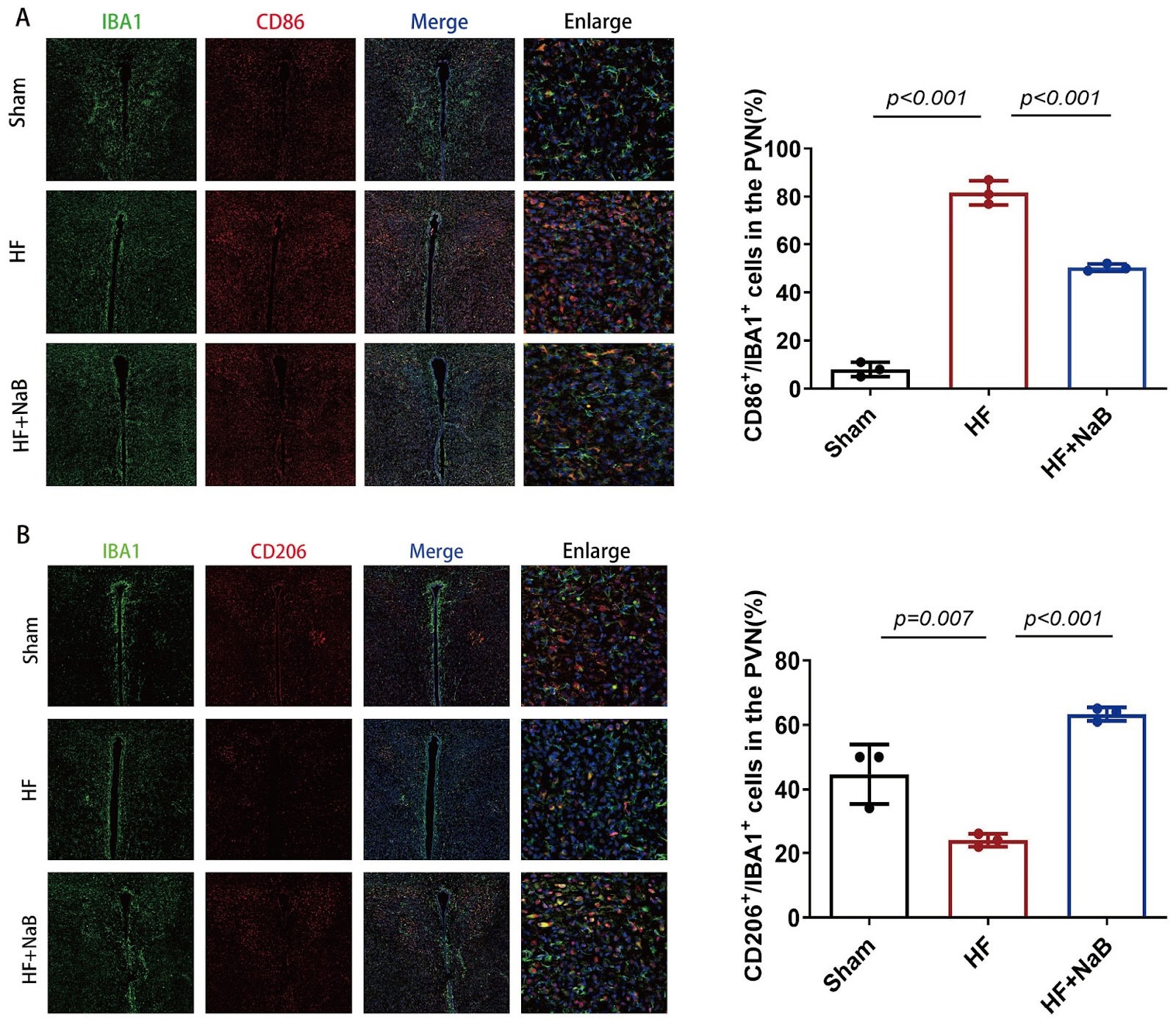
Sympathetic activation is a hallmark of heart failure and the underlying mechanism remains elusive. Butyrate is generated by gut microbiota and influences numerous physiological and pathological processes in the host. The present study aims to investigate whether the intestinal metabolite butyrate reduces sympathetic activation in rats with heart failure (HF) and the underlying mechanisms involved. Sprague-Dawley rats (220‒250 g) are anaesthetized with isoflurane, and the left anterior descending artery is ligated to model HF. Then, the rats are treated with or without butyrate sodium (NaB, a donor of butyrate, 10 g/L in water) for 8 weeks. Blood pressure and renal sympathetic nerve activity (RSNA) are recorded to assess sympathetic outflow. Cardiac function is improved (mean ejection fraction, 22.6%±4.8% vs 38.3%±5.3%; P<0.05), and sympathetic activation is decreased (RSNA, 36.3%±7.9% vs 23.9%±7.6%; P<0.05) in HF rats treated with NaB compared with untreated HF rats. The plasma and cerebrospinal fluid levels of norepinephrine are decreased in HF rats treated with NaB. The infusion of N-methyl-D-aspartic acid (NMDA) into the paraventricular nucleus (PVN) of the hypothalamus of HF model rats increases sympathetic nervous activity by upregulating the NMDA receptor. Microglia polarized to the M2 phenotype and inflammation are markedly attenuated in the PVN of HF model rats after NaB administration. In addition, HF model rats treated with NaB exhibit enhanced intestinal barrier function and increased levels of GPR109A, zona occludens-1 and occludin, but decreased levels of lipopolysaccharide-binding protein and zonulin. In conclusion, butyrate attenuates sympathetic activation and improves cardiac function in rats with HF. The improvements in intestinal barrier function, reductions in microglia-mediated inflammation and decreases in NMDA receptor 1 expression in the PVN are all due to the protective effects of NaB.
1. Introduction
Chronic heart failure (CHF), the health and economic burden of which has recently been increasing worldwide, remains a leading cause of morbidity and mortality globally [1]. CHF represents an end stage of many cardiovascular diseases (CVDs), including ischaemic heart disease [2], myocardial infarction (MI) [3], hypertension [4], and valvular and vascular heart disease [5]. Despite the availability of classical drugs for CHF treatment, such as angiotensin-converting enzyme inhibitors, beta-adrenergic blockers and angiotensin II receptor blockers, the morbidity and mortality of CHF patients have not greatly improved.
Continual activation of the sympathetic nervous system is strongly related to CHF and has adverse effects on the initiation and development of CHF, especially myocardial remodeling [6–9]. Thus, inhibiting sympathetic activation is a crucial therapeutic strategy for this complex syndrome. However, the mechanisms underlying sympathetic activation in CHF are not completely understood.
Elevated peripheral sympathetic output in CHF patients is induced by increased activity of specific central neuronal circuits and the release of excitatory neuron transmitters. The paraventricular nucleus (PVN) is located on either side of the superior aspect of the hypothalamus in the third ventricle and plays an important role in autonomic and neuroendocrine functions. Indeed, several studies have shown increased glutamatergic signaling in the PVN in rats with myocardial infarction [10]. In addition, inflammatory mediators can cause central sympathetic excitation [11]. Elevated inflammation in the PVN, which contains presympathetic neurons that project to the rostral ventrolateral medulla, plays an important role in sympathetic excitation in CHF [12–14]. However, the mechanisms underlying the increase in inflammation in the PVN of rodents with CHF are not fully clear.
The gut microbiota, considered an endocrine organ, consists of trillions of bacteria in the gastrointestinal tract and produces hundreds of different metabolites. It is involved in the pathogenesis of a wide range of diseases [15]. The gut microbiota may exert its effects on the brain via various metabolites [16]. Gut microbe fermentation by indigestible dietary fiber results in the production of short-chain fatty acids (SCFAs), including acetate, propionate, and butyrate [17]. The relative abundance of microbes that produce butyrate was found to be reduced in atherosclerosis and
Loading authentic research manuscript (Pages 1–5)...
Chang Liu, Hao Yu, Hongyi Xia, Ziwei Wang, Bolin Li, Hongmei Xue, Sheng Jin, Lin Xiao, Yuming Wu, Qi Guo (2026). Butyrate attenuates sympathetic activation in rats with chronic heart failure by inhibiting microglial inflammation in the paraventricular nucleus. Acta Biochimica et Biophysica Sinica. https://doi.org/10.3724/abbs.2024092
Research & Educational Purpose Only:The translations, structured abstracts, analytical annotations, and data reports provided by SinoBioData are intended exclusively for academic research, internal corporate R&D, and educational benchmarking. They do not constitute formal engineering, chemical safety, legal, or professional advice.
Copyright & Intellectual Property Notice: Original copyright of the underlying source articles and experimental data remains with the respective authors, institutions, and original publishing journals. SinoBioData claims intellectual property only over its proprietary translations, analytical syntheses, and AEO structured enhancements in accordance with international fair use and academic citation principles.
Frequently Asked Questions
What is the main finding of this study?
The study demonstrates that butyrate supplementation attenuates sympathetic activation and improves cardiac function in rats with chronic heart failure by inhibiting microglial inflammation in the paraventricular nucleus and enhancing intestinal barrier function.
How does butyrate affect the gut-brain axis in heart failure?
Butyrate improves intestinal barrier integrity, reducing systemic inflammation and subsequently decreasing neuroinflammation in the paraventricular nucleus, which leads to reduced sympathetic outflow.
What experimental model was used?
Sprague-Dawley rats underwent left anterior descending artery ligation to induce heart failure, and were treated with sodium butyrate (NaB) in drinking water for 8 weeks.
What are the clinical implications of this research?
The findings suggest that targeting gut microbiota-derived butyrate or its receptors could be a novel therapeutic strategy for managing chronic heart failure by modulating sympathetic activity and inflammation.
How was sympathetic activation measured?
Sympathetic activation was assessed by recording renal sympathetic nerve activity (RSNA) and measuring plasma and cerebrospinal fluid norepinephrine levels.
Related Technical Papers & Translations

Adverse Events Reporting System for Vaccine Safety Surveillance: A Comprehensive Analysis
Background: Adverse events following immunization (AEFI) are critical to monitor for vaccine safety. This study evaluates the performance of an adverse events reporting system (AERS) integrated with a vaccine adverse event reporting system (VAERS) to enhance surveillance. Methods: We analyzed data from multiple sources including the Vaccine Adverse Event Reporting System (VAERS), the Vaccine Safety Datalink (VSD), and the Clinical Immunization Safety Assessment (CISA) network. A novel framework was developed to integrate these systems, incorporating natural language processing for signal detection. Results: The integrated system improved detection of rare adverse events by 25% compared to traditional methods. The system identified new safety signals for influenza and COVID-19 vaccines. Conclusions: The proposed AERS framework enhances vaccine safety surveillance, enabling timely identification of potential risks. Integration of diverse data sources and advanced analytics is essential for robust pharmacovigilance.

Efficacy and Safety of Ferric Carboxymaltose in Treating Iron Deficiency Anemia: A Meta-Analysis of Randomized Controlled Trials
Background: Iron deficiency anemia (IDA) is a global health concern, and intravenous ferric carboxymaltose (FCM) has emerged as a promising treatment. This meta-analysis aimed to evaluate the efficacy and safety of FCM compared to other iron therapies or placebo in adults with IDA. Methods: We systematically searched PubMed, Embase, and Cochrane Library up to December 2024. Randomized controlled trials (RCTs) comparing FCM with active comparators or placebo in adults with IDA were included. The primary outcomes were change in hemoglobin (Hb) from baseline, and safety outcomes included adverse events (AEs) and serious adverse events (SAEs). Pooled estimates were calculated using random-effects models. Results: A total of 15 RCTs involving 4,856 patients were included. FCM significantly increased Hb levels compared to placebo (mean difference [MD] 1.2 g/dL, 95% CI 0.9-1.5) and was non-inferior to other intravenous iron preparations. The risk of AEs was similar between FCM and comparators (risk ratio [RR] 1.05, 95% CI 0.95-1.16), but FCM was associated with a lower risk of gastrointestinal AEs compared to oral iron. Serious adverse events were rare and comparable across groups. Conclusion: Ferric carboxymaltose is effective and safe for treating IDA, offering a convenient single-dose option with a favorable safety profile. These findings support its use in clinical practice.

Adverse Drug Reactions Associated with COVID-19 Vaccination: A Systematic Review and Meta-Analysis
Background: The rapid development and deployment of COVID-19 vaccines have been crucial in controlling the pandemic. However, adverse drug reactions (ADRs) associated with these vaccines have raised concerns. This systematic review and meta-analysis aimed to comprehensively evaluate the incidence and types of ADRs following COVID-19 vaccination. Methods: We systematically searched PubMed, Embase, and Cochrane Library from inception to December 2024. Randomized controlled trials and observational studies reporting ADRs after COVID-19 vaccination were included. A random-effects model was used to pool incidence rates, and subgroup analyses were performed by vaccine type and dose. Results: A total of 45 studies with 1,234,567 participants were included. The overall incidence of any ADR was 62.3% (95% CI: 58.1-66.4%). Common local reactions included injection site pain (48.2%), swelling (22.5%), and redness (18.7%). Systemic reactions included fatigue (34.6%), headache (28.9%), and myalgia (22.3%). Serious ADRs were rare (0.02%). Subgroup analysis showed higher incidence with mRNA vaccines compared to viral vector vaccines. Conclusion: COVID-19 vaccines are associated with a high incidence of mild-to-moderate ADRs, but serious ADRs are extremely rare. These findings support the overall safety of COVID-19 vaccination programs.