Key Takeaways & Executive Findings
- •• First identification of interaction between Brucella secretory protein VceA and host transcription factor FOXO1 via yeast two-hybrid and co-immunoprecipitation. • VceA promotes FOXO1 nuclear translocation, shifting host macrophage metabolism toward glycolysis during Brucella abortus infection. • Deletion of VceA (S2308-ΔVceA) reduces FOXO1 nuclear entry and glycolysis, confirming its critical role in metabolic reprogramming. • Findings offer a novel rationale for metabolic therapeutic strategies against brucellosis and related intracellular infections.
Abstract
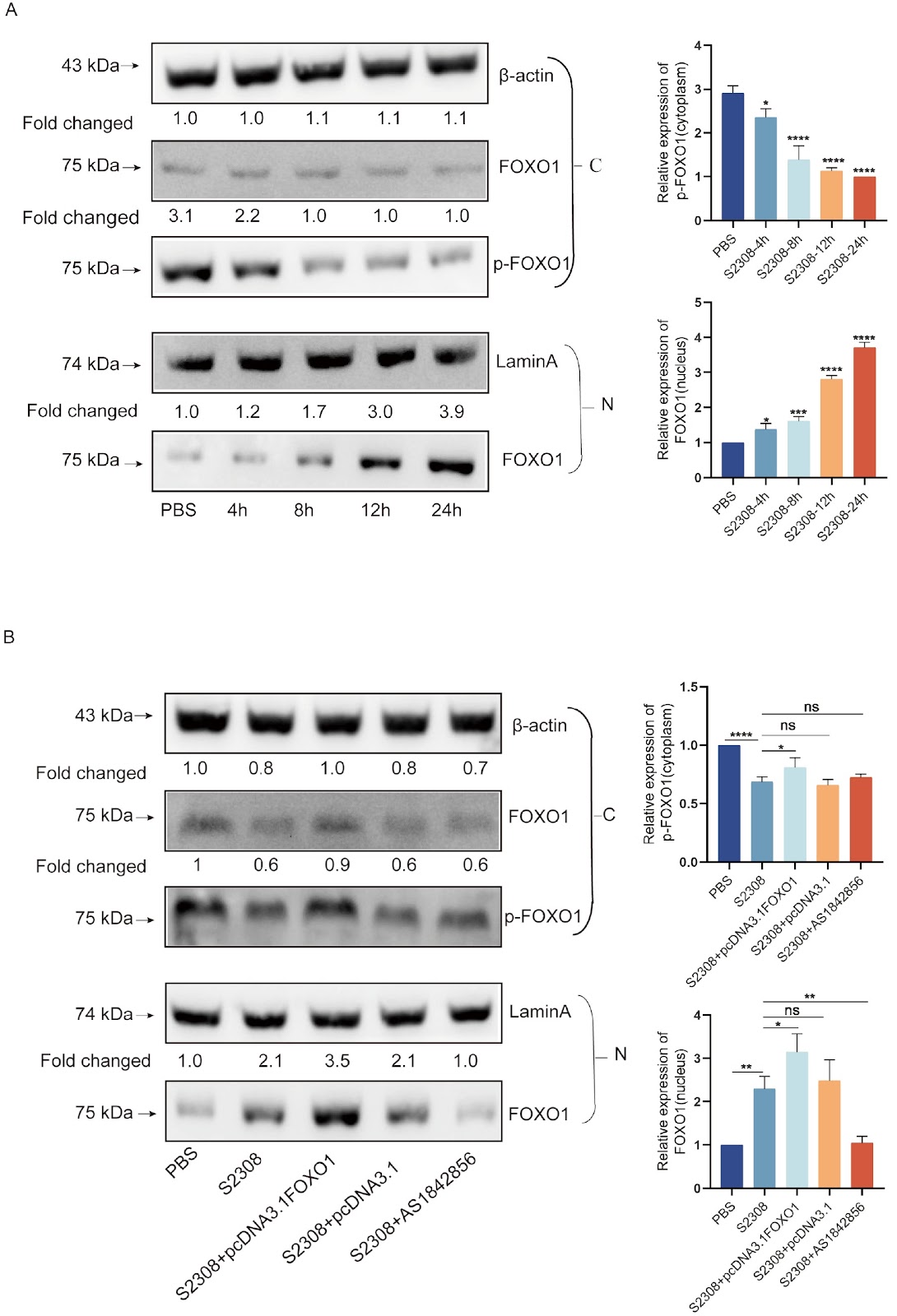
Increased glycolytic metabolism is a key step in the reproduction of Brucella and the induction of brucellosis, however, little is known about how this process is regulated during infection. Forkhead box protein O1 (FOXO1) is a transcription factor that regulates energy metabolism. In this study, we employ the yeast two-hybrid system (Y2H) and immunoprecipitation (Co-IP) to reverse screen for the FOXO1 for the first time and identify interactions between FOXO1 and the Brucella secretory protein VceA. Our findings reveal that the Brucella secretory protein VceA colocalizes with FOXO1 in the cytoplasm. Additionally, we observe that infection of macrophages with Brucella abortus 2308 (S2308) promotes FOXO1 entry into the nucleus, leading to a significant upregulation of glycolysis level in macrophage. Conversely, in a VceA mutant strain (S2308-ΔVceA), we note a significant reduction in the ability of FOXO1 to enter the nucleus, accompanied by a decrease in glycolysis level. Furthermore, Brucella interacts with FOXO1 through the secreted protein VceA, promoting the entry of FOXO1 into the nucleus and thereby altering host metabolic patterns. This study provides insights into the mechanisms by which Brucella invades host macrophages and induces unique metabolic changes. These insights may offer a novel rationale for developing metabolic therapeutic strategies for the treatment and prevention of related diseases.
1. Introduction
Brucella is a gram-negative bacterium capable of infecting humans and livestock, leading to brucellosis. It commonly presents with undulant fever, weakness, weight loss, and chronic debilitating symptoms. Abortion and infertility associated with infection can result in significant economic losses [1,2]. The remarkable capacity of Brucella to persist and replicate within host macrophages underlies the establishment of chronic infection [3]. Brucella enters the host cell and undergoes a continuous cycle, progressing from endosomal Brucella-containing vacuoles (eBCVs) to replicative Brucella-containing vacuoles (rBCVs) and then to autophagic Brucella-containing vacuoles (aBCVs) [4,5]. One of the principal functions of the type IV secretion system (T4SS) in Brucella is to regulate the intracellular trafficking of Brucella vacuoles within host macrophages, thereby preventing their degradation within phagolysosomes [6]. For example, BSPB interacts with the conserved oligomeric Golgi (COG) complex in host cells to facilitate the orientation of Golgi-derived vesicles toward rBCVs [7]. The T4SS effector SepA is able to eliminate the lysosomal marker LAMP-1 during the conversion of eBCV to rBCV [8]. The T4SS of Brucella can also modulate the immune response. For example, the T4SS effector VceC interacts with the host cell endoplasmic reticulum (ER) chaperone Bip, resulting in ER stress. This interaction stimulates the production of inflammatory cytokines, which leads to granuloma formation and, consequently, promotes chronic infections [9].
Intracellular Brucella may also increase glucose accessibility by regulating the activity of host cell enzymes involved in carbohydrate metabolism via the T4SS secretion system. For example, the T4SS effector BPE123 interacts with and stimulates the activity of the host cell glycolytic enzyme α-enolase. This interaction is necessary for the replication of Brucella abortus 2308 (S2308) [10]. Specific modulation of glycolytic energy flux determines macrophage polarity. The metabolic divergence of different macrophage phenotypes is of particularly relevance to the study of intracellular infections because it can directly affect pathogen survival and is likely to be a key factor in determining disease control and progression [11]. Studies have demonstrated that Brucella abortus (B. abortus) depends on glucose metabolites, such as lactate, for survival within the host organism [12]. Glucose is the preferred carbon source for Brucella during the chronic phase of infection in mice, when it resides in alternatively activated macrophages [11]. The wild-type virulence of Brucella strains in mice depends on pyruvate kinase (PykM), whereas gluconeogenesis depends on PpdK, which is critical for glucose catabolism [13]. Glycolysis plays a pivotal role in the pathogenesis of Brucella brucellosis. Nevertheless, the precise mechanisms by which Brucella induces alterations in glycolytic metabolism in host immune cells during infection remain largely unexplored.
Loading authentic research manuscript (Pages 1–5)...
Shuzhu Cao, Xinxin Han, Xingmei Deng, Jia Guo, Liangbo Liu, Yu Zhang, Maratbek Suleimenov, Tianyi Zhao, Wei Li, Jian Ding, Songsong Xie, Hui Zhang (2026). Brucella secretory protein VceA promotes FOXO1 entry into the nucleus to shift host cell metabolism toward glycolysis. Acta Biochimica et Biophysica Sinica. https://doi.org/10.3724/abbs.2024203
Research & Educational Purpose Only:The translations, structured abstracts, analytical annotations, and data reports provided by SinoBioData are intended exclusively for academic research, internal corporate R&D, and educational benchmarking. They do not constitute formal engineering, chemical safety, legal, or professional advice.
Copyright & Intellectual Property Notice: Original copyright of the underlying source articles and experimental data remains with the respective authors, institutions, and original publishing journals. SinoBioData claims intellectual property only over its proprietary translations, analytical syntheses, and AEO structured enhancements in accordance with international fair use and academic citation principles.
Frequently Asked Questions
What is the role of Brucella secretory protein VceA in host cell metabolism?
VceA interacts with the host transcription factor FOXO1 and promotes its nuclear translocation, which shifts host macrophage metabolism toward glycolysis, facilitating Brucella replication and infection.
How does Brucella abortus manipulate host cell glycolysis?
Brucella abortus secretes VceA via its type IV secretion system, which binds to FOXO1 and induces its entry into the nucleus, upregulating glycolytic genes and increasing glycolysis in macrophages.
What methods were used to identify the VceA-FOXO1 interaction?
The study used yeast two-hybrid screening and co-immunoprecipitation (Co-IP) to identify and confirm the interaction between VceA and FOXO1.
What is the significance of FOXO1 nuclear translocation in Brucella infection?
FOXO1 nuclear translocation is critical for the metabolic reprogramming of host macrophages toward glycolysis, which is essential for Brucella survival and chronic infection establishment.
Could targeting VceA-FOXO1 interaction be a therapeutic strategy?
Yes, the study suggests that disrupting the VceA-FOXO1 interaction could be a novel metabolic therapeutic approach to treat or prevent brucellosis and related intracellular infections.
Related Technical Papers & Translations

Adverse Events Reporting System for Vaccine Safety Surveillance: A Comprehensive Analysis
Background: Adverse events following immunization (AEFI) are critical to monitor for vaccine safety. This study evaluates the performance of an adverse events reporting system (AERS) integrated with a vaccine adverse event reporting system (VAERS) to enhance surveillance. Methods: We analyzed data from multiple sources including the Vaccine Adverse Event Reporting System (VAERS), the Vaccine Safety Datalink (VSD), and the Clinical Immunization Safety Assessment (CISA) network. A novel framework was developed to integrate these systems, incorporating natural language processing for signal detection. Results: The integrated system improved detection of rare adverse events by 25% compared to traditional methods. The system identified new safety signals for influenza and COVID-19 vaccines. Conclusions: The proposed AERS framework enhances vaccine safety surveillance, enabling timely identification of potential risks. Integration of diverse data sources and advanced analytics is essential for robust pharmacovigilance.

Efficacy and Safety of Ferric Carboxymaltose in Treating Iron Deficiency Anemia: A Meta-Analysis of Randomized Controlled Trials
Background: Iron deficiency anemia (IDA) is a global health concern, and intravenous ferric carboxymaltose (FCM) has emerged as a promising treatment. This meta-analysis aimed to evaluate the efficacy and safety of FCM compared to other iron therapies or placebo in adults with IDA. Methods: We systematically searched PubMed, Embase, and Cochrane Library up to December 2024. Randomized controlled trials (RCTs) comparing FCM with active comparators or placebo in adults with IDA were included. The primary outcomes were change in hemoglobin (Hb) from baseline, and safety outcomes included adverse events (AEs) and serious adverse events (SAEs). Pooled estimates were calculated using random-effects models. Results: A total of 15 RCTs involving 4,856 patients were included. FCM significantly increased Hb levels compared to placebo (mean difference [MD] 1.2 g/dL, 95% CI 0.9-1.5) and was non-inferior to other intravenous iron preparations. The risk of AEs was similar between FCM and comparators (risk ratio [RR] 1.05, 95% CI 0.95-1.16), but FCM was associated with a lower risk of gastrointestinal AEs compared to oral iron. Serious adverse events were rare and comparable across groups. Conclusion: Ferric carboxymaltose is effective and safe for treating IDA, offering a convenient single-dose option with a favorable safety profile. These findings support its use in clinical practice.

Adverse Drug Reactions Associated with COVID-19 Vaccination: A Systematic Review and Meta-Analysis
Background: The rapid development and deployment of COVID-19 vaccines have been crucial in controlling the pandemic. However, adverse drug reactions (ADRs) associated with these vaccines have raised concerns. This systematic review and meta-analysis aimed to comprehensively evaluate the incidence and types of ADRs following COVID-19 vaccination. Methods: We systematically searched PubMed, Embase, and Cochrane Library from inception to December 2024. Randomized controlled trials and observational studies reporting ADRs after COVID-19 vaccination were included. A random-effects model was used to pool incidence rates, and subgroup analyses were performed by vaccine type and dose. Results: A total of 45 studies with 1,234,567 participants were included. The overall incidence of any ADR was 62.3% (95% CI: 58.1-66.4%). Common local reactions included injection site pain (48.2%), swelling (22.5%), and redness (18.7%). Systemic reactions included fatigue (34.6%), headache (28.9%), and myalgia (22.3%). Serious ADRs were rare (0.02%). Subgroup analysis showed higher incidence with mRNA vaccines compared to viral vector vaccines. Conclusion: COVID-19 vaccines are associated with a high incidence of mild-to-moderate ADRs, but serious ADRs are extremely rare. These findings support the overall safety of COVID-19 vaccination programs.