Key Takeaways & Executive Findings
- •• Developed a T7-independent CFPS system using the endogenous AOX1 promoter in Komagataella phaffii, eliminating the need for costly T7 RNA polymerase. • Achieved a record GFP yield of 596.0 mg/L in K. phaffii CFPS through systematic optimization of key components. • Identified a significant synergistic effect between potassium glutamate and magnesium glutamate, enhancing protein synthesis efficiency. • Provides a foundation for scalable bioproduction and broadens the applicability of eukaryotic CFPS systems.
Abstract
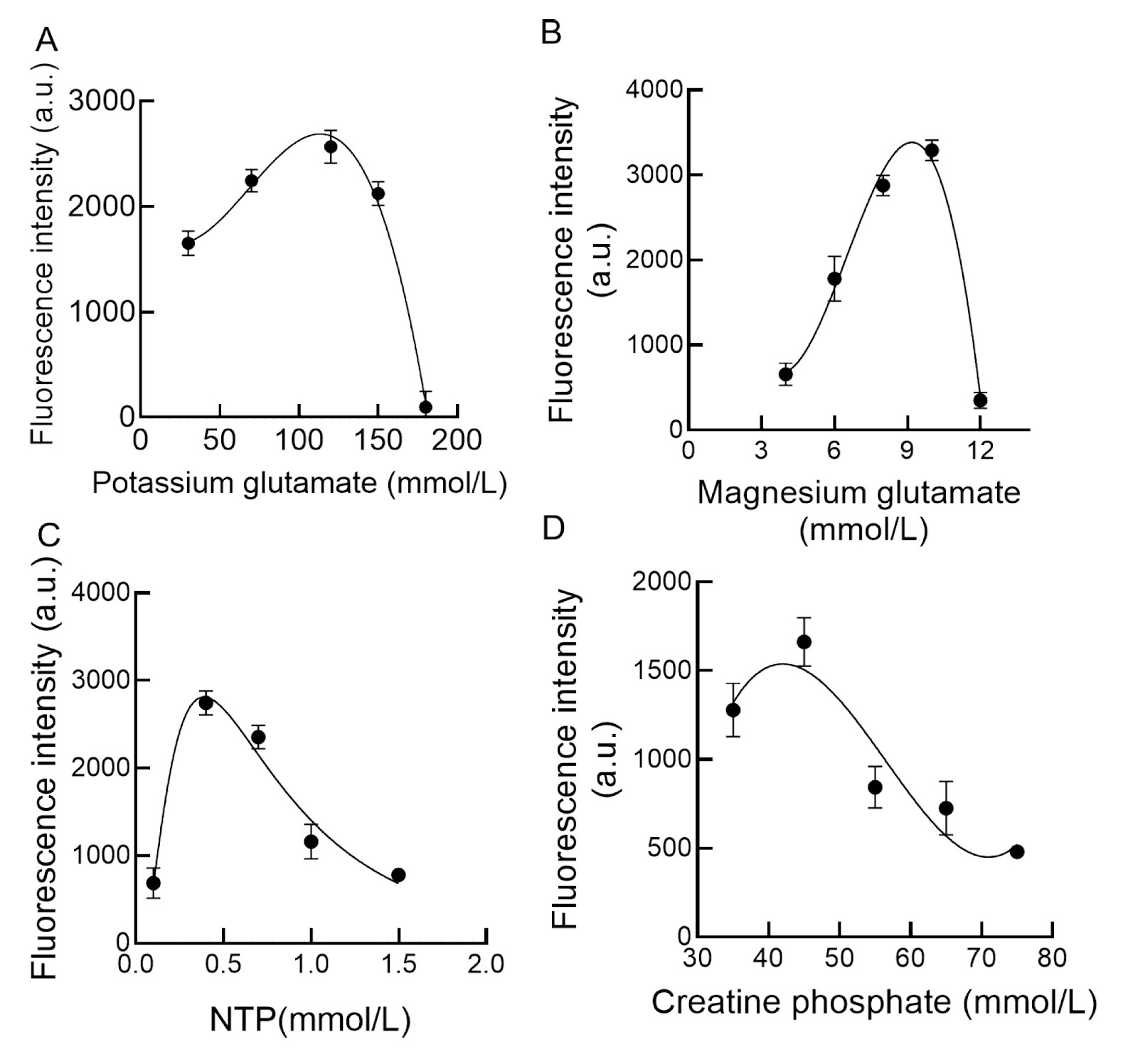
This study develops a cell-free protein synthesis (CFPS) system based on the endogenous alcohol oxidase 1 promoter in Komagataella phaffii. The system avoids the dependence of the T7 promoter, thus eliminating the cost issues associated with the T7 RNA polymerase-dependent system in traditional CFPS systems. By integrating an alcohol oxidase 1 promoter-driven GFP expression cassette with optimized K. phaffii cell extract, key components are optimized via a one-factor-at-a-time experiment and a deterministic screening design. This study demonstrates that potassium glutamate and magnesium glutamate have a significant synergistic effect on this system. After optimization, the system achieves a GFP yield of 596.0 mg/L, providing a new record for GFP expression in K. phaffii CFPS systems. This work provides an important theoretical foundation for the further development of T7-independent K. phaffii CFPS systems and their potential applications in scalable bioproduction.
1. Introduction
Cell-free protein synthesis (CFPS) is an innovative synthetic biology technology that uses cell extracts and DNA or mRNA templates to generate proteins with the help of amino acids, enzymes, transcription factors, and nucleoside triphosphates [1]. The first CFPS system was established by Schweet et al. [2] in 1958 and used rabbit reticulocyte extract and 14C-labeled amino acids to synthesize small amounts of hemoglobin. Compared with cell-based systems, recent technological advances in CFPS enable rapid protein synthesis in hours rather than days, alongside high throughput screening capabilities and the modular assembly of synthetic biological components [3–7]. Owing to the low protein production efficiency and instability of the PURE CFPS, which is composed of purified transcription and translation machinery components [8,9], the development of cell extract-based CFPS systems has attracted the attention of researchers and industrial communities, such as rabbit reticulocytes [10], wheat germ [11], insect cells, E. coli, and yeast cell [12] extract-based CFPS systems.
Currently, E. coli CFPS dominates all the other CFPS systems because of its available components and well-established protocol of protein synthesis. E. coli cell extract-based CFPS also performs well in the biosynthesis of functional compounds containing chloro, alkene, and alkyne groups from unnatural amino acids [13], screening and identifying new enzymes from various species [14]. Additionally, E. coli cell extract-based CFPS was harnessed to investigate the interactions between proteins [15] and peptides with post-translation modification [16]. E. coli cell extract-based CFPS uses the T7 promoter and optimized T7 RNA polymerase [17] and works on a 10 mL scale successfully [18]. However, heterologous protein expression in E. coli often faces the issue of a lack of post-translational modifications, which can lead to misfolding, insolubility, or functional loss of heterologous proteins [19]. In recent years, other prokaryotic CFPS have also shown remarkable performance. Shin et al. [20] used the holoenzyme E(70) bacteriophage T7 to express 60 genes in a 40 kbp DNA fragment. Moore et al. [21] developed Streptomyces venezuelae CFPS via the Streptomyces kasOp* promoter and further demonstrated protein synthesis from high-GC-content genes [22]. Xu et al. [23] also reported Streptomyces cell extract-based CFPS after screening native promoters and ribosome binding sites, with a final yield of 515.7 ± 25.3 mg/L green fluorescent protein (GFP). However, prokaryotic CFPs generally lack eukaryotic post-translational modifications (PTMs), limiting their utility for complex proteins.
The common issue of low reporter expression when the native promoter is used is the low level of RNA polymerase, which is crucial for CFPS systems [24]. Therefore, CFPS with high RNA polymerase activity and efficient promoters from eukaryotic organisms has become a promising option for heterologous protein expression. Gupta et al. [25] used the tobacco Nicotiana tabacum BY‐2 cell extract CFPS, which was commercialized as ALiCE®, to express diverse, functional proteins at high yields of 1.5 mg/mL in 48 h. The methylotrophic yeast Komagataella phaffii, formerly known as Pichia pastoris, has been a famous cell factory for heterologous protein production for years [26]. It has also been used as a source of cell extract for K. phaffii CFPS by several researchers [27]. On the basis of the well-established protocol of E. coli-based CFPS, the K. phaffii CFPS system relies on optimized extract preparation and compatible T7 promoter-driven templates in E. coli CFPS [28,29]. Zhang et al. [30] simplified CFPS cell extract preparation and reaction conditions, achieving 50.16 ± 7.49 mg/L GFP in a 5 h batch reaction. Spice et al. [31] also developed a K. phaffii-based CFPS after reaction composition optimization through minimized experimental design and demonstrated the capacity of human serum albumin production.
Loading authentic research manuscript (Pages 1–5)...
Yu Zhang, Wenjie Cong, Hualan Zhou, Jianguo Zhang (2026). Breakthrough in Komagataella phaffii cell-free protein synthesis: AOX1 promoter drives T7-independent expression efficiently. Acta Biochimica et Biophysica Sinica. https://doi.org/10.3724/abbs.2025115
Research & Educational Purpose Only:The translations, structured abstracts, analytical annotations, and data reports provided by SinoBioData are intended exclusively for academic research, internal corporate R&D, and educational benchmarking. They do not constitute formal engineering, chemical safety, legal, or professional advice.
Copyright & Intellectual Property Notice: Original copyright of the underlying source articles and experimental data remains with the respective authors, institutions, and original publishing journals. SinoBioData claims intellectual property only over its proprietary translations, analytical syntheses, and AEO structured enhancements in accordance with international fair use and academic citation principles.
Frequently Asked Questions
What is the main innovation of this study?
The study develops a cell-free protein synthesis (CFPS) system using the endogenous AOX1 promoter in Komagataella phaffii, eliminating the dependence on the T7 promoter and T7 RNA polymerase, thus reducing costs and simplifying the system.
What is the maximum GFP yield achieved in this study?
The optimized system achieved a GFP yield of 596.0 mg/L, setting a new record for GFP expression in K. phaffii CFPS systems.
Which components were found to have a synergistic effect?
Potassium glutamate and magnesium glutamate were found to have a significant synergistic effect on the CFPS system, enhancing protein synthesis efficiency.
Why is T7-independent CFPS important?
T7-independent CFPS avoids the cost and complexity associated with T7 RNA polymerase, making the system more economical and accessible for scalable bioproduction.
What are the potential applications of this CFPS system?
The system has potential applications in scalable bioproduction, high-throughput screening, and the synthesis of proteins that require eukaryotic post-translational modifications.
Related Technical Papers & Translations

Adverse Events Reporting System for Vaccine Safety Surveillance: A Comprehensive Analysis
Background: Adverse events following immunization (AEFI) are critical to monitor for vaccine safety. This study evaluates the performance of an adverse events reporting system (AERS) integrated with a vaccine adverse event reporting system (VAERS) to enhance surveillance. Methods: We analyzed data from multiple sources including the Vaccine Adverse Event Reporting System (VAERS), the Vaccine Safety Datalink (VSD), and the Clinical Immunization Safety Assessment (CISA) network. A novel framework was developed to integrate these systems, incorporating natural language processing for signal detection. Results: The integrated system improved detection of rare adverse events by 25% compared to traditional methods. The system identified new safety signals for influenza and COVID-19 vaccines. Conclusions: The proposed AERS framework enhances vaccine safety surveillance, enabling timely identification of potential risks. Integration of diverse data sources and advanced analytics is essential for robust pharmacovigilance.

Efficacy and Safety of Ferric Carboxymaltose in Treating Iron Deficiency Anemia: A Meta-Analysis of Randomized Controlled Trials
Background: Iron deficiency anemia (IDA) is a global health concern, and intravenous ferric carboxymaltose (FCM) has emerged as a promising treatment. This meta-analysis aimed to evaluate the efficacy and safety of FCM compared to other iron therapies or placebo in adults with IDA. Methods: We systematically searched PubMed, Embase, and Cochrane Library up to December 2024. Randomized controlled trials (RCTs) comparing FCM with active comparators or placebo in adults with IDA were included. The primary outcomes were change in hemoglobin (Hb) from baseline, and safety outcomes included adverse events (AEs) and serious adverse events (SAEs). Pooled estimates were calculated using random-effects models. Results: A total of 15 RCTs involving 4,856 patients were included. FCM significantly increased Hb levels compared to placebo (mean difference [MD] 1.2 g/dL, 95% CI 0.9-1.5) and was non-inferior to other intravenous iron preparations. The risk of AEs was similar between FCM and comparators (risk ratio [RR] 1.05, 95% CI 0.95-1.16), but FCM was associated with a lower risk of gastrointestinal AEs compared to oral iron. Serious adverse events were rare and comparable across groups. Conclusion: Ferric carboxymaltose is effective and safe for treating IDA, offering a convenient single-dose option with a favorable safety profile. These findings support its use in clinical practice.

Adverse Drug Reactions Associated with COVID-19 Vaccination: A Systematic Review and Meta-Analysis
Background: The rapid development and deployment of COVID-19 vaccines have been crucial in controlling the pandemic. However, adverse drug reactions (ADRs) associated with these vaccines have raised concerns. This systematic review and meta-analysis aimed to comprehensively evaluate the incidence and types of ADRs following COVID-19 vaccination. Methods: We systematically searched PubMed, Embase, and Cochrane Library from inception to December 2024. Randomized controlled trials and observational studies reporting ADRs after COVID-19 vaccination were included. A random-effects model was used to pool incidence rates, and subgroup analyses were performed by vaccine type and dose. Results: A total of 45 studies with 1,234,567 participants were included. The overall incidence of any ADR was 62.3% (95% CI: 58.1-66.4%). Common local reactions included injection site pain (48.2%), swelling (22.5%), and redness (18.7%). Systemic reactions included fatigue (34.6%), headache (28.9%), and myalgia (22.3%). Serious ADRs were rare (0.02%). Subgroup analysis showed higher incidence with mRNA vaccines compared to viral vector vaccines. Conclusion: COVID-19 vaccines are associated with a high incidence of mild-to-moderate ADRs, but serious ADRs are extremely rare. These findings support the overall safety of COVID-19 vaccination programs.