Key Takeaways & Executive Findings
- •• Identified a novel 'mini-N type' subclass of MgtE channels lacking canonical N and CBS domains, expanding the known diversity of the MgtE family. • Demonstrated that de novo-designed protein fusions can stabilize and purify otherwise unstable membrane proteins, enabling structural studies. • Determined crystal structures of de novo-designed proteins and achieved preliminary cryo-EM imaging of a mini-N-type MgtE fusion. • Provides a promising strategy for structural and functional analysis of challenging membrane proteins, with potential implications for drug development and understanding Mg2+ homeostasis.
Abstract
MgtE channels play crucial roles in Mg2+ homeostasis and are implicated in bacterial survival under antibiotic exposure. Previous structural and biophysical studies have focused predominantly on Thermus thermophilus MgtE, leaving the structural and mechanistic diversity of MgtE family proteins largely unexplored. In this study, via a genome mining approach, we identify diverse MgtE homologs, including a novel subclass termed the “mini-N type”, which lacks the canonical cytoplasmic N and CBS domains but possesses a unique small N-like domain. Despite extensive expression screening, mini-N-type homologs cannot be stably purified. To address this issue, we design a series of de novo proteins and determine their crystal structures. A selected de novo protein is fused to a mini-N-type MgtE, enabling successful purification and preliminary cryo-EM imaging. Our findings demonstrate that de novo-designed protein fusions serve as powerful tools for stabilizing and purifying otherwise unstable membrane proteins, opening new avenues for structural and functional studies of otherwise inaccessible membrane proteins.
1. Introduction
MgtE represents a widely conserved Mg2+ channel in bacteria that plays a critical role in Mg2+ homeostasis [1–4] and contributes to bacterial survival under antibiotic exposure by counteracting hyperpolarization [5]. In Pseudomonas aeruginosa, MgtE inhibits the transcription of the type III secretion system, a critical virulence factor, by promoting the expression of the translation-inhibiting sRNAs RsmY and RsmZ [6,7]. In humans, MgtE homologs are referred to as SLC41A1 to SLC41A3 and have been implicated in various physiological functions and diseases, including Parkinson’s disease [8–11]. Accordingly, the MgtE/SLC41 family of proteins has attracted considerable interest as potential therapeutic targets.
To date, extensive structural and mechanistic studies have been conducted on MgtE [12–14]. These studies revealed that MgtE functions as a “Mg2+-gated Mg2+ channel” where the binding of Mg2+ to the cytoplasmic domain leads to channel inactivation [3,15–17]. High-resolution structural analyses of the MgtE transmembrane (TM) domain have elucidated the mechanism of Mg2+ selectivity [18,19], whereas the cryo-EM structure of MgtE in the absence of the Mg2+ domain has provided insights into the gating mechanism [20]. However, these studies have focused predominantly on Thermus thermophilus MgtE (TtMgtE), and structural and biochemical data for MgtE homologs from other species are extremely limited [21–23]. As a result, the structural and functional diversity of the broadly conserved MgtE family remains largely unexplored. In parallel, the recent explosion in genomic data has made it increasingly feasible to investigate the diversity of specific protein families via genome mining approaches [24,25].
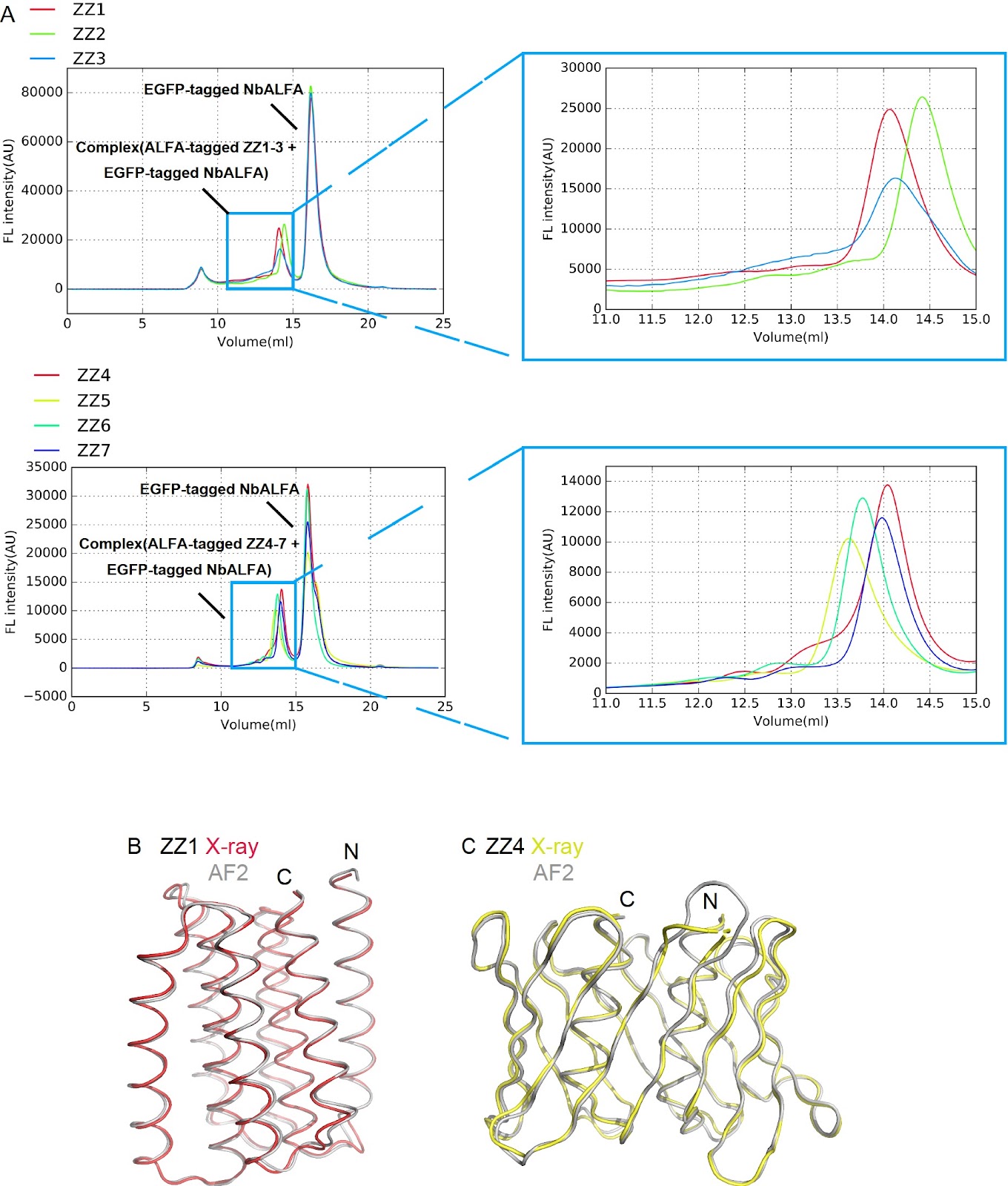
One major challenge in studying membrane proteins such as MgtE lies in their generally low expression levels and poor stability in detergents [26], which significantly hinders structural and functional analyses. Recently, AI-based de novo protein design technologies, such as ProteinMPNN [27] and RF diffusion [28], have rapidly advanced [29] and are expected to facilitate research on membrane proteins [30]. De novo-designed proteins typically exhibit high stability, and fusing them to target membrane proteins may increase their expression and stability, potentially enabling the preparation of large quantities of stable membrane protein samples. In this study, we conducted a bioinformatics analysis of the MgtE family and identified a novel subclass of MgtE proteins with unique domain architectures. Despite extensive expression screening, these proteins could not be stably purified. To overcome this challenge, we designed de novo proteins and successfully determined the crystal structures of several designed proteins. Furthermore, by generating fusion constructs with the de novo-designed protein and the novel MgtE subclass, we achieved successful expression and purification. Overall, this study highlights a promising strategy for stabilizing and purifying membrane proteins via a de novo-designed protein fusion approach.
Loading authentic research manuscript (Pages 1–5)...
Zhixuan Zhao, Kimiho Omae, Wataru Iwasaki, Ziyi Zhang, Fazhi Pan, Eun-Jin Lee, Koichi Ito, Motoyuki Hattori (2026). Bioinformatics classification of the MgtE Mg2+ channel and de novo protein design for the stabilization of its novel subclass. Acta Biochimica et Biophysica Sinica. https://doi.org/10.3724/abbs.2025224
Research & Educational Purpose Only:The translations, structured abstracts, analytical annotations, and data reports provided by SinoBioData are intended exclusively for academic research, internal corporate R&D, and educational benchmarking. They do not constitute formal engineering, chemical safety, legal, or professional advice.
Copyright & Intellectual Property Notice: Original copyright of the underlying source articles and experimental data remains with the respective authors, institutions, and original publishing journals. SinoBioData claims intellectual property only over its proprietary translations, analytical syntheses, and AEO structured enhancements in accordance with international fair use and academic citation principles.
Frequently Asked Questions
What is the novel subclass of MgtE channels identified in this study?
The study identifies a novel subclass termed 'mini-N type' MgtE, which lacks the canonical cytoplasmic N and CBS domains but possesses a unique small N-like domain.
How did the authors overcome the instability of mini-N-type MgtE proteins?
They designed de novo proteins and fused one to a mini-N-type MgtE, which enabled successful purification and preliminary cryo-EM imaging.
What is the significance of using de novo-designed protein fusions?
De novo-designed protein fusions serve as powerful tools for stabilizing and purifying otherwise unstable membrane proteins, opening new avenues for structural and functional studies.
What methods were used in the bioinformatics analysis?
The study used genome mining approaches to identify diverse MgtE homologs and classify them based on domain architecture.
What are the potential applications of this research?
The findings could facilitate structural and functional studies of challenging membrane proteins, potentially aiding in drug development targeting MgtE/SLC41 family proteins.
Related Technical Papers & Translations

Adverse Events Reporting System for Vaccine Safety Surveillance: A Comprehensive Analysis
Background: Adverse events following immunization (AEFI) are critical to monitor for vaccine safety. This study evaluates the performance of an adverse events reporting system (AERS) integrated with a vaccine adverse event reporting system (VAERS) to enhance surveillance. Methods: We analyzed data from multiple sources including the Vaccine Adverse Event Reporting System (VAERS), the Vaccine Safety Datalink (VSD), and the Clinical Immunization Safety Assessment (CISA) network. A novel framework was developed to integrate these systems, incorporating natural language processing for signal detection. Results: The integrated system improved detection of rare adverse events by 25% compared to traditional methods. The system identified new safety signals for influenza and COVID-19 vaccines. Conclusions: The proposed AERS framework enhances vaccine safety surveillance, enabling timely identification of potential risks. Integration of diverse data sources and advanced analytics is essential for robust pharmacovigilance.

Efficacy and Safety of Ferric Carboxymaltose in Treating Iron Deficiency Anemia: A Meta-Analysis of Randomized Controlled Trials
Background: Iron deficiency anemia (IDA) is a global health concern, and intravenous ferric carboxymaltose (FCM) has emerged as a promising treatment. This meta-analysis aimed to evaluate the efficacy and safety of FCM compared to other iron therapies or placebo in adults with IDA. Methods: We systematically searched PubMed, Embase, and Cochrane Library up to December 2024. Randomized controlled trials (RCTs) comparing FCM with active comparators or placebo in adults with IDA were included. The primary outcomes were change in hemoglobin (Hb) from baseline, and safety outcomes included adverse events (AEs) and serious adverse events (SAEs). Pooled estimates were calculated using random-effects models. Results: A total of 15 RCTs involving 4,856 patients were included. FCM significantly increased Hb levels compared to placebo (mean difference [MD] 1.2 g/dL, 95% CI 0.9-1.5) and was non-inferior to other intravenous iron preparations. The risk of AEs was similar between FCM and comparators (risk ratio [RR] 1.05, 95% CI 0.95-1.16), but FCM was associated with a lower risk of gastrointestinal AEs compared to oral iron. Serious adverse events were rare and comparable across groups. Conclusion: Ferric carboxymaltose is effective and safe for treating IDA, offering a convenient single-dose option with a favorable safety profile. These findings support its use in clinical practice.

Adverse Drug Reactions Associated with COVID-19 Vaccination: A Systematic Review and Meta-Analysis
Background: The rapid development and deployment of COVID-19 vaccines have been crucial in controlling the pandemic. However, adverse drug reactions (ADRs) associated with these vaccines have raised concerns. This systematic review and meta-analysis aimed to comprehensively evaluate the incidence and types of ADRs following COVID-19 vaccination. Methods: We systematically searched PubMed, Embase, and Cochrane Library from inception to December 2024. Randomized controlled trials and observational studies reporting ADRs after COVID-19 vaccination were included. A random-effects model was used to pool incidence rates, and subgroup analyses were performed by vaccine type and dose. Results: A total of 45 studies with 1,234,567 participants were included. The overall incidence of any ADR was 62.3% (95% CI: 58.1-66.4%). Common local reactions included injection site pain (48.2%), swelling (22.5%), and redness (18.7%). Systemic reactions included fatigue (34.6%), headache (28.9%), and myalgia (22.3%). Serious ADRs were rare (0.02%). Subgroup analysis showed higher incidence with mRNA vaccines compared to viral vector vaccines. Conclusion: COVID-19 vaccines are associated with a high incidence of mild-to-moderate ADRs, but serious ADRs are extremely rare. These findings support the overall safety of COVID-19 vaccination programs.