Key Takeaways & Executive Findings
- •• First crystal structures of NFI-DNA complexes reveal a conserved dimerization mechanism and dyad-symmetric TGGCA(N3)TGCCA recognition. • NFI dimerization enhances both DNA-binding affinity and specificity, critical for transcriptional regulation. • Systematic evaluation of neurodevelopmental disorder-associated NFI mutations identifies potential pathogenic variants affecting DNA binding. • Provides a structural framework for understanding NFI-related disorders and guiding therapeutic development.
Abstract
Nuclear factor I (NFI) transcription factors play essential roles in multiple aspects of nervous system development, including radial glia maturation, neurogenesis, gliogenesis, and brain morphogenesis. Numerous NFI variants have been identified in individuals with neurodevelopmental disorders, yet the molecular basis of their pathogenicity remains unclear. The absence of resolved NFI-DNA complex structures continues to impede mechanistic insights and therapeutic exploration. Here, we define the oligomeric states of NFIA and NFIC, and determine the crystal structures of the NFIC homodimer, as well as the NFIA and NFIC monomers lacking their dimerization region, in complexes with double-stranded DNAs. Structural analysis reveals the molecular mechanism underlying NFI dimerization and recognition of a dyad-symmetric TGGCA(N3)TGCCA sequence motif, and demonstrates that dimerization enhances both DNA-binding affinity and specificity of NFI proteins. The functional importance of key NFI residues and DNA bases involved in the protein-DNA interaction is further validated by mutagenesis and binding assays. Additionally, we systematically evaluate the effects of the neurodevelopmental disorders-associated NFI mutations on DNA binding of NFIA, providing insights into their potential pathogenic mechanisms. Together, our findings elucidate the structural basis of NFI dimerization and dyad-symmetric DNA recognition and highlight pathogenic variants for further mechanistic studies in neurodevelopmental disorders.
1. Introduction
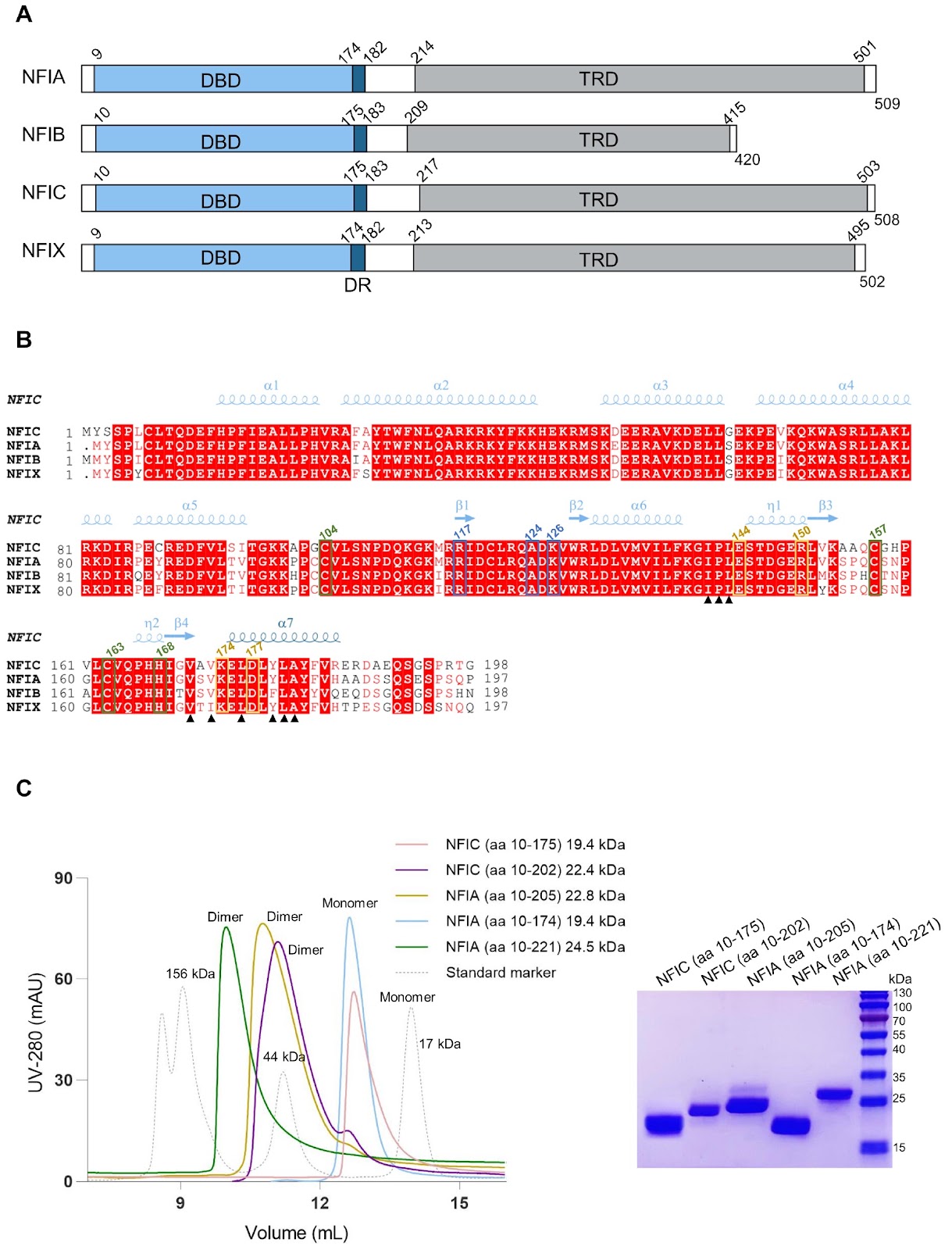
The human nuclear factor I (NFI) family comprises four members: NFIA, NFIB, NFIC, and NFIX. All proteins share a highly conserved N-terminal DNA-binding domain (DBD), whereas their C-terminal transcriptional regulatory domains (TRDs) exhibit much lower sequence conservation (Figure 1A,B, and Supplementary Figure S1). In addition, alternative mRNA splicing of some NFI members generates multiple isoforms [1].
NFI proteins orchestrate cell proliferation and differentiation across multiple organ systems, and are therefore indispensable for normal tissue development. NFIA and NFIX are particularly important for the development and functional maturation of the brain, skeletal muscle, and hematopoietic systems [2–6]. NFIB plays essential roles in the formation of the brain, lung, and mammary gland [3,7,8]. NFIC primarily regulates mammary gland differentiation and tooth development [8,9]. Beyond organ development, NFI proteins also exert key regulatory functions in stem cell biology, where they govern self-renewal and lineage commitment in pluripotent, hematopoietic, and neural stem cells [10,11].
NFIA, NFIB, and NFIX are broadly expressed in the developing and adult nervous system, with particularly high levels in the dorsal telencephalon, where they function as key transcriptional regulators that drive the maturation of radial glia and their progression into neuronal and astrocytic lineages [12]. Mechanistically, NFIA expression in neural progenitors is induced by Notch signaling, directly activating glial fibrillary acidic protein (GFAP) and S100 calcium-binding protein B (S100β) transcription to promote astrocyte differentiation [4]. Fibroblast growth factor 8 (FGF8)-MAPK signaling also induces NFIA and NFIB expression, promoting the maturation of midline zipper glia and facilitating midline remodeling and corpus callosum formation [13]. Additionally, NFIA cooperates with LIM homeobox 2 (LHX2) to regulate γ-aminobutyric acid (GABA) ty
Loading authentic research manuscript (Pages 1–5)...
Shuli Pan, Wenjie Pei, Jin Zhang, Jinrong Min, Ke Liu (2026). Biochemical and structural studies of NFIA and NFIC reveal a conserved mechanism for specific DNA recognition and provide insight into potential pathogenicity of disease-associated mutations. Acta Biochimica et Biophysica Sinica. https://doi.org/10.3724/abbs.2025236
Research & Educational Purpose Only:The translations, structured abstracts, analytical annotations, and data reports provided by SinoBioData are intended exclusively for academic research, internal corporate R&D, and educational benchmarking. They do not constitute formal engineering, chemical safety, legal, or professional advice.
Copyright & Intellectual Property Notice: Original copyright of the underlying source articles and experimental data remains with the respective authors, institutions, and original publishing journals. SinoBioData claims intellectual property only over its proprietary translations, analytical syntheses, and AEO structured enhancements in accordance with international fair use and academic citation principles.
Frequently Asked Questions
What is the main finding of this study?
The study reveals the crystal structures of NFI-DNA complexes, showing a conserved dimerization mechanism and specific recognition of a dyad-symmetric DNA motif, and demonstrates that dimerization enhances DNA-binding affinity and specificity.
How do NFI mutations relate to neurodevelopmental disorders?
The study systematically evaluates disease-associated NFI mutations and identifies those that impair DNA binding, providing insights into their potential pathogenic mechanisms.
What techniques were used in this research?
The researchers used size-exclusion chromatography, X-ray crystallography, mutagenesis, and binding assays to characterize NFI oligomeric states, structures, and DNA-binding properties.
Why is the NFI dimerization important?
Dimerization enhances both the affinity and specificity of NFI proteins for their DNA targets, which is critical for their transcriptional regulatory functions.
What are the implications of this study for therapeutic development?
By elucidating the structural basis of NFI-DNA recognition and identifying pathogenic mutations, this study provides a framework for developing targeted therapies for NFI-related neurodevelopmental disorders.
Related Technical Papers & Translations

Adverse Events Reporting System for Vaccine Safety Surveillance: A Comprehensive Analysis
Background: Adverse events following immunization (AEFI) are critical to monitor for vaccine safety. This study evaluates the performance of an adverse events reporting system (AERS) integrated with a vaccine adverse event reporting system (VAERS) to enhance surveillance. Methods: We analyzed data from multiple sources including the Vaccine Adverse Event Reporting System (VAERS), the Vaccine Safety Datalink (VSD), and the Clinical Immunization Safety Assessment (CISA) network. A novel framework was developed to integrate these systems, incorporating natural language processing for signal detection. Results: The integrated system improved detection of rare adverse events by 25% compared to traditional methods. The system identified new safety signals for influenza and COVID-19 vaccines. Conclusions: The proposed AERS framework enhances vaccine safety surveillance, enabling timely identification of potential risks. Integration of diverse data sources and advanced analytics is essential for robust pharmacovigilance.

Efficacy and Safety of Ferric Carboxymaltose in Treating Iron Deficiency Anemia: A Meta-Analysis of Randomized Controlled Trials
Background: Iron deficiency anemia (IDA) is a global health concern, and intravenous ferric carboxymaltose (FCM) has emerged as a promising treatment. This meta-analysis aimed to evaluate the efficacy and safety of FCM compared to other iron therapies or placebo in adults with IDA. Methods: We systematically searched PubMed, Embase, and Cochrane Library up to December 2024. Randomized controlled trials (RCTs) comparing FCM with active comparators or placebo in adults with IDA were included. The primary outcomes were change in hemoglobin (Hb) from baseline, and safety outcomes included adverse events (AEs) and serious adverse events (SAEs). Pooled estimates were calculated using random-effects models. Results: A total of 15 RCTs involving 4,856 patients were included. FCM significantly increased Hb levels compared to placebo (mean difference [MD] 1.2 g/dL, 95% CI 0.9-1.5) and was non-inferior to other intravenous iron preparations. The risk of AEs was similar between FCM and comparators (risk ratio [RR] 1.05, 95% CI 0.95-1.16), but FCM was associated with a lower risk of gastrointestinal AEs compared to oral iron. Serious adverse events were rare and comparable across groups. Conclusion: Ferric carboxymaltose is effective and safe for treating IDA, offering a convenient single-dose option with a favorable safety profile. These findings support its use in clinical practice.

Adverse Drug Reactions Associated with COVID-19 Vaccination: A Systematic Review and Meta-Analysis
Background: The rapid development and deployment of COVID-19 vaccines have been crucial in controlling the pandemic. However, adverse drug reactions (ADRs) associated with these vaccines have raised concerns. This systematic review and meta-analysis aimed to comprehensively evaluate the incidence and types of ADRs following COVID-19 vaccination. Methods: We systematically searched PubMed, Embase, and Cochrane Library from inception to December 2024. Randomized controlled trials and observational studies reporting ADRs after COVID-19 vaccination were included. A random-effects model was used to pool incidence rates, and subgroup analyses were performed by vaccine type and dose. Results: A total of 45 studies with 1,234,567 participants were included. The overall incidence of any ADR was 62.3% (95% CI: 58.1-66.4%). Common local reactions included injection site pain (48.2%), swelling (22.5%), and redness (18.7%). Systemic reactions included fatigue (34.6%), headache (28.9%), and myalgia (22.3%). Serious ADRs were rare (0.02%). Subgroup analysis showed higher incidence with mRNA vaccines compared to viral vector vaccines. Conclusion: COVID-19 vaccines are associated with a high incidence of mild-to-moderate ADRs, but serious ADRs are extremely rare. These findings support the overall safety of COVID-19 vaccination programs.