Key Takeaways & Executive Findings
- •• Berberine (BBR) disrupts male reproductive function by reducing serum testosterone, sperm concentration, mating rate, and fecundity in mice. • The gut microbiota, specifically Muribaculaceae, is essential for spermatogenesis; BBR-induced reduction in Muribaculaceae abundance is a primary cause of impaired spermatogenesis. • Muribaculaceae regulates ornithine metabolism, which in turn modulates LDLR-mediated testosterone synthesis in Leydig cells. • Fecal microbiota transplantation or Muribaculaceae supplementation may offer a therapeutic strategy for infertility associated with gut microbiota dysbiosis.
Abstract
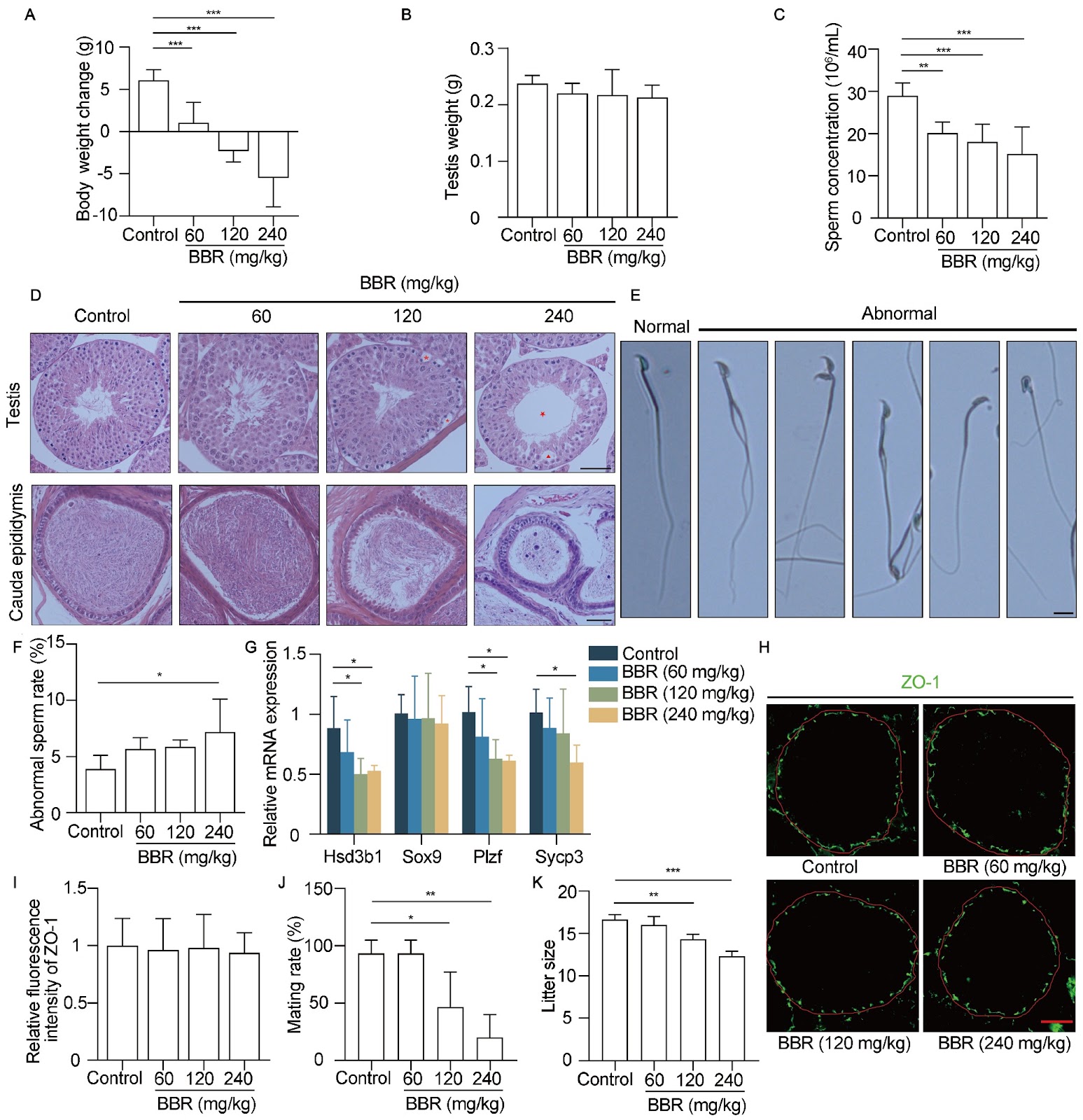
Berberine (BBR) is used to treat diarrhea clinically. However, its reproductive toxicity is unclear. This study aims to investigate the impact of BBR on the male reproductive system. Intragastric BBR administration for 14 consecutive days results in a significant decrease in the serum testosterone concentration, epididymal sperm concentration, mating rate and fecundity of male mice. Testicular treatment with testosterone propionate (TP) partially reverses the damage caused by BBR to the male reproductive system. Mechanistically, the decrease in Muribaculaceae abundance in the gut microbiota of mice is the principal cause of the BBR-induced decrease in the sperm concentration. Both fecal microbiota transplantation (FMT) and polyethylene glycol (PEG) treatment demonstrate that Muribaculaceae is necessary for spermatogenesis. The intragastric administration of Muribaculaceae intestinale to BBR-treated mice restores the sperm concentration and testosterone levels. Metabolomic analysis reveals that BBR affects arginine and proline metabolism, of which ornithine level is downregulated. Combined analysis via 16S rRNA metagenomics sequencing and metabolomics shows that Muribaculaceae regulates ornithine level. The transcriptomic results of the testes indicate that the expressions of genes related to the low-density lipoprotein receptor (LDLR)-mediated testosterone synthesis pathway decrease after BBR administration. The transcriptional activity of the Ldlr gene in TM3 cells is increased with increased ornithine supplementation in the culture media, leading to increased testosterone synthesis. Overall, this study reveals an association between a BBR-induced decrease in Muribaculaceae abundance and defective spermatogenesis, providing a prospective therapeutic approach for addressing infertility-related decreases in serum testosterone triggered by changes in the gut microbiota composition.
1. Introduction
The infertility rate in couples of reproductive age is as high as 15%, of which male infertility accounts for approximately 50% [1]. Over the past 40 years, the seminal sperm concentration of adult males has decreased by more than 50% in Western countries due to multiple factors, such as unhealthy diet and lifestyle, exposure to toxic chemicals, and the abuse of medications [2]. For example, accumulating evidence shows that traditional Chinese medicine (TCM) might cause reproductive dysfunction. Triptonide, a TCM-derived drug for the treatment of immune-related diseases, was reported to induce sperm malformation and decrease motility [3]. Gossypol, a toxic crystalline compound present in cotton seed oil, has also been shown to repress intercellular communication via gap junctions among Sertoli cells and steroidogenesis of Leydig cells in mouse testes [4,5]. In addition, gossypol has been reported to disrupt spermatogenesis by inhibiting testis-specific lactate dehydrogenase C4 in mice [6]. Aristolochic acid induces testicular injury by inhibiting amino acid metabolism, glucose metabolism, β-oxidation of fatty acids and the tricarboxylic acid cycle in male mice [7]. Recently, berberine (BBR) has been used to treat diarrhea [8], inflammatory diseases [9], and colon cancer [10]. The daily oral administration of 0.9 g of BBR to patients receiving chemotherapy relieves chemotherapy-induced radiation intestinal syndrome [11]. A daily dose of 0.6 g BBR is effective in reducing the risk of recurrence of colorectal adenoma [12]. However, the effect of BBR on the male reproductive system remains to be elucidated.
The gut microbiota is involved in many important physiological processes of the host, including the regulation of immunity and maintaining metabolic homeostasis and cognitive functions [13,14]. Many intestinal diseases can cause imbalances in the gut microbiota, including inflammatory bowel disease, irritable bowel syndrome, chronic constipation and osmotic diarrhea [15]. Diarrhea is often accompanied by changes in the osmotic pressure of the gut, leading to changes in the abundance of osmolality-sensitive microbiota. It has been reported that the osmotic laxative PEG changes the composition of the gut microbiota, resulting in a significant decrease in Muribaculaceae abundance [16,17]. Numerous herbal ingredients have low bioavailability and have been shown to function in regulating the gut microbiota. Saponins were reported to facilitate the growth of beneficial bacteria and suppress cachexia-like symptoms in mice [18]. Rhein, one of the main components of rhubarb, increases the abundance of Lactobacillus and
Loading authentic research manuscript (Pages 1–5)...
Wei Qu, Yumin Xu, Jing Yang, Hanqing Shi, Junli Wang, Xinnai Yu, Jiemin Chen, Binyi Wang, Deqing Zhuoga, Mengcheng Luo, Rong Liu (2026). Berberine alters the gut microbiota metabolism and impairs spermatogenesis. Acta Biochimica et Biophysica Sinica. https://doi.org/10.3724/abbs.2024174
Research & Educational Purpose Only:The translations, structured abstracts, analytical annotations, and data reports provided by SinoBioData are intended exclusively for academic research, internal corporate R&D, and educational benchmarking. They do not constitute formal engineering, chemical safety, legal, or professional advice.
Copyright & Intellectual Property Notice: Original copyright of the underlying source articles and experimental data remains with the respective authors, institutions, and original publishing journals. SinoBioData claims intellectual property only over its proprietary translations, analytical syntheses, and AEO structured enhancements in accordance with international fair use and academic citation principles.
Frequently Asked Questions
What is the effect of berberine on male reproductive function?
Berberine administration in mice significantly reduces serum testosterone, sperm concentration, mating rate, and fecundity, indicating reproductive toxicity.
How does berberine affect the gut microbiota?
Berberine reduces the abundance of Muribaculaceae in the gut microbiota, which is essential for spermatogenesis.
What is the mechanism linking gut microbiota to spermatogenesis?
Muribaculaceae regulates ornithine levels, which in turn modulates LDLR-mediated testosterone synthesis in Leydig cells, affecting spermatogenesis.
Can the effects of berberine on spermatogenesis be reversed?
Yes, treatment with testosterone propionate partially reverses the damage, and supplementation with Muribaculaceae or fecal microbiota transplantation restores sperm concentration and testosterone levels.
What are the clinical implications of this study?
The study suggests that modulating gut microbiota, particularly Muribaculaceae, could be a therapeutic approach for infertility related to gut microbiota dysbiosis.
Related Technical Papers & Translations

Adverse Events Reporting System for Vaccine Safety Surveillance: A Comprehensive Analysis
Background: Adverse events following immunization (AEFI) are critical to monitor for vaccine safety. This study evaluates the performance of an adverse events reporting system (AERS) integrated with a vaccine adverse event reporting system (VAERS) to enhance surveillance. Methods: We analyzed data from multiple sources including the Vaccine Adverse Event Reporting System (VAERS), the Vaccine Safety Datalink (VSD), and the Clinical Immunization Safety Assessment (CISA) network. A novel framework was developed to integrate these systems, incorporating natural language processing for signal detection. Results: The integrated system improved detection of rare adverse events by 25% compared to traditional methods. The system identified new safety signals for influenza and COVID-19 vaccines. Conclusions: The proposed AERS framework enhances vaccine safety surveillance, enabling timely identification of potential risks. Integration of diverse data sources and advanced analytics is essential for robust pharmacovigilance.

Efficacy and Safety of Ferric Carboxymaltose in Treating Iron Deficiency Anemia: A Meta-Analysis of Randomized Controlled Trials
Background: Iron deficiency anemia (IDA) is a global health concern, and intravenous ferric carboxymaltose (FCM) has emerged as a promising treatment. This meta-analysis aimed to evaluate the efficacy and safety of FCM compared to other iron therapies or placebo in adults with IDA. Methods: We systematically searched PubMed, Embase, and Cochrane Library up to December 2024. Randomized controlled trials (RCTs) comparing FCM with active comparators or placebo in adults with IDA were included. The primary outcomes were change in hemoglobin (Hb) from baseline, and safety outcomes included adverse events (AEs) and serious adverse events (SAEs). Pooled estimates were calculated using random-effects models. Results: A total of 15 RCTs involving 4,856 patients were included. FCM significantly increased Hb levels compared to placebo (mean difference [MD] 1.2 g/dL, 95% CI 0.9-1.5) and was non-inferior to other intravenous iron preparations. The risk of AEs was similar between FCM and comparators (risk ratio [RR] 1.05, 95% CI 0.95-1.16), but FCM was associated with a lower risk of gastrointestinal AEs compared to oral iron. Serious adverse events were rare and comparable across groups. Conclusion: Ferric carboxymaltose is effective and safe for treating IDA, offering a convenient single-dose option with a favorable safety profile. These findings support its use in clinical practice.

Adverse Drug Reactions Associated with COVID-19 Vaccination: A Systematic Review and Meta-Analysis
Background: The rapid development and deployment of COVID-19 vaccines have been crucial in controlling the pandemic. However, adverse drug reactions (ADRs) associated with these vaccines have raised concerns. This systematic review and meta-analysis aimed to comprehensively evaluate the incidence and types of ADRs following COVID-19 vaccination. Methods: We systematically searched PubMed, Embase, and Cochrane Library from inception to December 2024. Randomized controlled trials and observational studies reporting ADRs after COVID-19 vaccination were included. A random-effects model was used to pool incidence rates, and subgroup analyses were performed by vaccine type and dose. Results: A total of 45 studies with 1,234,567 participants were included. The overall incidence of any ADR was 62.3% (95% CI: 58.1-66.4%). Common local reactions included injection site pain (48.2%), swelling (22.5%), and redness (18.7%). Systemic reactions included fatigue (34.6%), headache (28.9%), and myalgia (22.3%). Serious ADRs were rare (0.02%). Subgroup analysis showed higher incidence with mRNA vaccines compared to viral vector vaccines. Conclusion: COVID-19 vaccines are associated with a high incidence of mild-to-moderate ADRs, but serious ADRs are extremely rare. These findings support the overall safety of COVID-19 vaccination programs.