Key Takeaways & Executive Findings
- •• ATRX ADD domain specifically binds macroH2A histone-fold domain, not canonical H2A, via a D/E-rich loop and L12 loop interaction. • ATRXADD uses a conserved interface to recognize both macroH2A and H3, leading to competitive binding between these histones. • NuRD complex components are identified as potential ATRXADD-associating proteins, with CDH4 directly interacting with ATRXADD by mimicking H3. • These findings reveal the versatility of ATRXADD in recognizing diverse chromatin regulators, providing insights into ATRX's roles in epigenetic regulation and pathogenesis.
Abstract
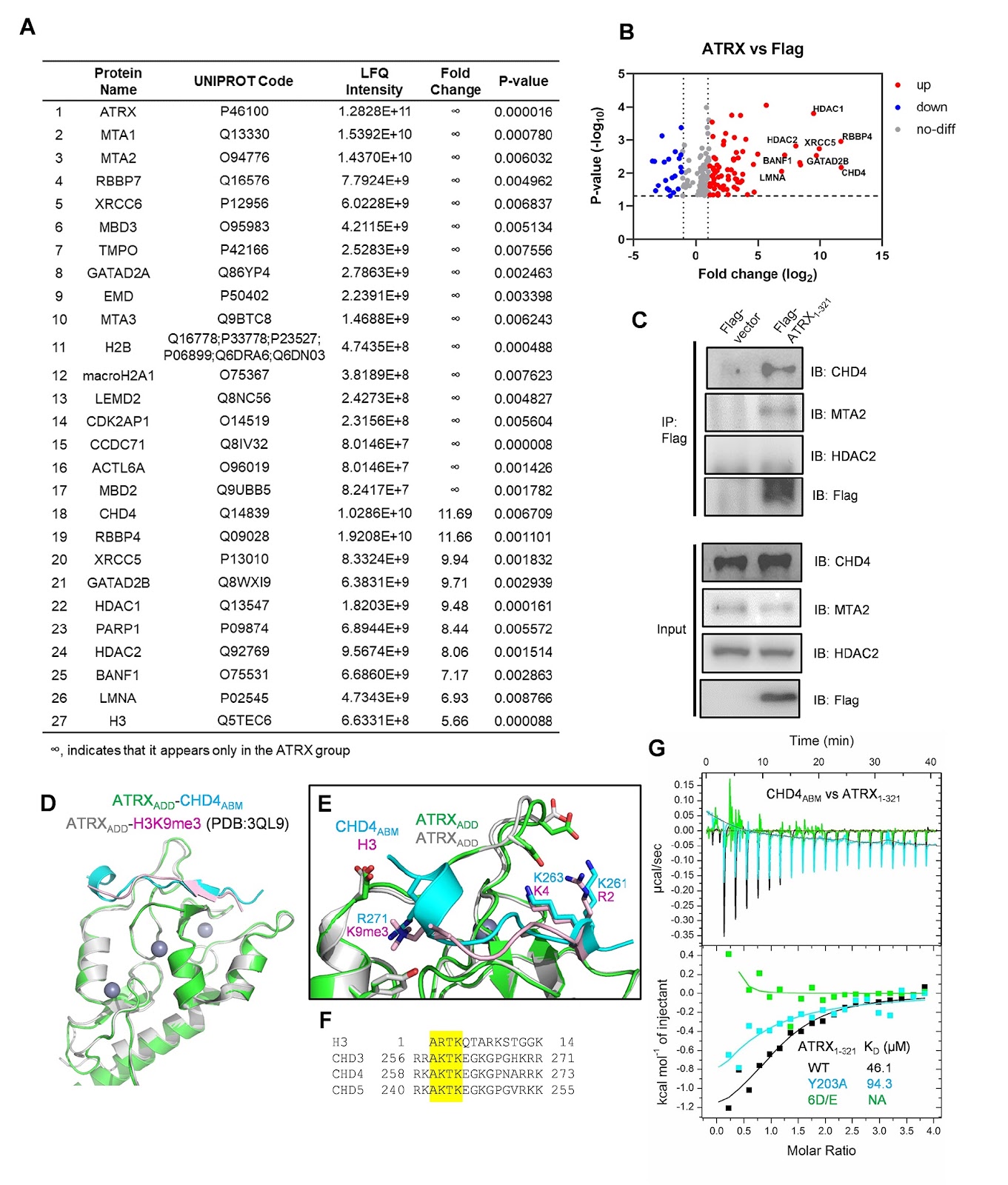
Alpha Thalassemia/Mental developmental retardation, X-linked (ATRX) is an important heterochromatin regulator, frequent mutated in ATR-X syndrome and various cancers. ATRX binds a histone variant macroH2A, forming a functional axis crucial for transcription regulation and genome stability. However, the molecular mechanism underlying the ATRX-macroH2A interaction remains obscure. Here we demonstrate that the ADD domain of ATRX (ATRXADD) specifically binds the histone-fold domain of macroH2A, but not the canonical H2A. The binding specificity is mediated by a D/E-rich loop of ATRXADD and the L12 loop of macroH2A. A swapping mutation in the L12 loop of macroH2A disrupts ATRX binding, whereas the reverse mutation in H2A confers binding capacity with ATRX. Notably, ATRXADD employs a conserved interface to recognize both macroH2A and H3, leading to competition between macroH2A and H3 for ATRX binding. Furthermore, affinity purification and mass spectrometry identify NuRD components as the potential ATRXADD-associating proteins, with CDH4 mimicking H3 in its direct interaction with ATRXADD. These findings elucidate the molecular basis of ATRX's interaction with macroH2A and NuRD, and also demonstrate the versatility of ATRXADD in recognizing diverse chromatin regulators, providing insights into ATRX's multifaceted roles in epigenetic regulation and pathogenesis.
1. Introduction
ATRX (Alpha Thalassemia/Mental Retardation Syndrome X-linked) is a critical chromatin remodeling protein initially identified in connection with alpha-thalassemia and intellectual disability (ATR-X syndrome) [1]. ATRX plays central roles in transcription regulation, telomere maintenance, heterochromatin organization, and the DNA damage response [2]. In mouse models, complete ATRX knockout results in early embryonic lethality [3], while its conditional deletion in the central nervous system causes postnatal death [4,5]. Mutations in ATRX are the primary cause of ATR-X syndrome [6,7] and are frequently observed in various cancers, particularly pediatric gliomas and pancreatic neuroendocrine tumors [8].
Disease-causing mutations in ATRX are frequently clustered in two structural domains with distinct functions: the ATPase domain and the ADD (ATRX-DNMT3-DNMT3L) domain [4,9]. The ATPase domain, a SNF2 (Sucrose Non-Fermenting)-type chromatin remodeling domain, exhibits an ATP hydrolysis-dependent DNA translocase activity [10,11]. By leveraging this translocase activity, the ATRX complex can mobilize nucleosomes, facilitating chromatin remodeling and the transcription of specific genes, especially the α-globin gene [11,12]. Additionally, the remodeling activity of ATRX resolves G-quadruplex structures, preventing replication fork stalling and maintaining genome stability [13‒15].
The ADD domain of ATRX (ATRXADD) is a specialized zinc finger domain that recognizes histone modifications. ATRXADD specifically binds a dual marker consisting of unmodified lysine 4 (H3K4me0) and trimethylated lysine 9 (H3K9me3) on histone H3 [16‒18]. This selective interaction enables ATRX to localize to heterochromatin regions [18]. To date, histone H3 remains the only well-characterized binding partner of ATRXADD. The limited interaction spectrum of ATRXADD stands in sharp contrast to its vital role in heterochromatin organization and its frequent mutations in ATR-X syndrome. Whether ATRXADD engages with other proteins beyond histone H3 to fulfil additional regulatory roles remains an open question.
Loading authentic research manuscript (Pages 1–5)...
Shukun Yan, Xiaoman Wang, Kexue Ge, Duo Wang, Yong Chen (2026). ATRX ADD domain is a versatile module for recognizing macroH2A, H3, and beyond. Acta Biochimica et Biophysica Sinica. https://doi.org/10.3724/abbs.2025085
Research & Educational Purpose Only:The translations, structured abstracts, analytical annotations, and data reports provided by SinoBioData are intended exclusively for academic research, internal corporate R&D, and educational benchmarking. They do not constitute formal engineering, chemical safety, legal, or professional advice.
Copyright & Intellectual Property Notice: Original copyright of the underlying source articles and experimental data remains with the respective authors, institutions, and original publishing journals. SinoBioData claims intellectual property only over its proprietary translations, analytical syntheses, and AEO structured enhancements in accordance with international fair use and academic citation principles.
Frequently Asked Questions
What is the main finding of this study?
The study reveals that the ADD domain of ATRX specifically binds macroH2A, a histone variant, and also interacts with NuRD complex components, demonstrating its versatility in recognizing diverse chromatin regulators.
How does ATRXADD recognize macroH2A?
ATRXADD binds the histone-fold domain of macroH2A through a D/E-rich loop and the L12 loop of macroH2A, with specificity determined by these structural elements.
Does ATRXADD compete with H3 for binding?
Yes, ATRXADD uses a conserved interface to recognize both macroH2A and H3, leading to competition between these histones for ATRX binding.
What is the significance of the ATRX-macroH2A interaction?
The interaction is crucial for transcription regulation and genome stability, and its disruption may contribute to ATR-X syndrome and cancer pathogenesis.
What are the potential clinical implications?
Understanding the molecular basis of ATRX interactions could aid in developing targeted therapies for cancers with ATRX mutations and ATR-X syndrome.
Related Technical Papers & Translations

Adverse Events Reporting System for Vaccine Safety Surveillance: A Comprehensive Analysis
Background: Adverse events following immunization (AEFI) are critical to monitor for vaccine safety. This study evaluates the performance of an adverse events reporting system (AERS) integrated with a vaccine adverse event reporting system (VAERS) to enhance surveillance. Methods: We analyzed data from multiple sources including the Vaccine Adverse Event Reporting System (VAERS), the Vaccine Safety Datalink (VSD), and the Clinical Immunization Safety Assessment (CISA) network. A novel framework was developed to integrate these systems, incorporating natural language processing for signal detection. Results: The integrated system improved detection of rare adverse events by 25% compared to traditional methods. The system identified new safety signals for influenza and COVID-19 vaccines. Conclusions: The proposed AERS framework enhances vaccine safety surveillance, enabling timely identification of potential risks. Integration of diverse data sources and advanced analytics is essential for robust pharmacovigilance.

Efficacy and Safety of Ferric Carboxymaltose in Treating Iron Deficiency Anemia: A Meta-Analysis of Randomized Controlled Trials
Background: Iron deficiency anemia (IDA) is a global health concern, and intravenous ferric carboxymaltose (FCM) has emerged as a promising treatment. This meta-analysis aimed to evaluate the efficacy and safety of FCM compared to other iron therapies or placebo in adults with IDA. Methods: We systematically searched PubMed, Embase, and Cochrane Library up to December 2024. Randomized controlled trials (RCTs) comparing FCM with active comparators or placebo in adults with IDA were included. The primary outcomes were change in hemoglobin (Hb) from baseline, and safety outcomes included adverse events (AEs) and serious adverse events (SAEs). Pooled estimates were calculated using random-effects models. Results: A total of 15 RCTs involving 4,856 patients were included. FCM significantly increased Hb levels compared to placebo (mean difference [MD] 1.2 g/dL, 95% CI 0.9-1.5) and was non-inferior to other intravenous iron preparations. The risk of AEs was similar between FCM and comparators (risk ratio [RR] 1.05, 95% CI 0.95-1.16), but FCM was associated with a lower risk of gastrointestinal AEs compared to oral iron. Serious adverse events were rare and comparable across groups. Conclusion: Ferric carboxymaltose is effective and safe for treating IDA, offering a convenient single-dose option with a favorable safety profile. These findings support its use in clinical practice.

Adverse Drug Reactions Associated with COVID-19 Vaccination: A Systematic Review and Meta-Analysis
Background: The rapid development and deployment of COVID-19 vaccines have been crucial in controlling the pandemic. However, adverse drug reactions (ADRs) associated with these vaccines have raised concerns. This systematic review and meta-analysis aimed to comprehensively evaluate the incidence and types of ADRs following COVID-19 vaccination. Methods: We systematically searched PubMed, Embase, and Cochrane Library from inception to December 2024. Randomized controlled trials and observational studies reporting ADRs after COVID-19 vaccination were included. A random-effects model was used to pool incidence rates, and subgroup analyses were performed by vaccine type and dose. Results: A total of 45 studies with 1,234,567 participants were included. The overall incidence of any ADR was 62.3% (95% CI: 58.1-66.4%). Common local reactions included injection site pain (48.2%), swelling (22.5%), and redness (18.7%). Systemic reactions included fatigue (34.6%), headache (28.9%), and myalgia (22.3%). Serious ADRs were rare (0.02%). Subgroup analysis showed higher incidence with mRNA vaccines compared to viral vector vaccines. Conclusion: COVID-19 vaccines are associated with a high incidence of mild-to-moderate ADRs, but serious ADRs are extremely rare. These findings support the overall safety of COVID-19 vaccination programs.