Key Takeaways & Executive Findings
- •• ACLY is a key enzyme linking glucose and lipid metabolism, and its overexpression promotes tumorigenesis in multiple cancer types. • ACLY exerts oncogenic effects not only via metabolic reprogramming but also through epigenetic regulation and protein acetylation. • Pharmacological inhibitors of ACLY show antitumor activity in preclinical studies, but clinical translation remains limited. • Targeting ACLY represents a promising therapeutic strategy for cancer treatment, with potential for combination therapies.
Abstract
ATP citrate lyase (ACLY) is involved in acetyl-coenzyme A synthesis and protein acetylation, thereby increasing lipid metabolism and altering protein metabolism to affect cellular metabolism. Additionally, ACLY is associated with various biological and pathological functions, especially regarding tumorigenesis. It facilitates the progression of various cancer types, including liver, lung, breast, prostate, and colorectal cancers. Mechanisms underlying ACLY-mediated carcinogenesis are under investigation and may not be limited to energy metabolism and biosynthesis. Acetylation modification of specific signaling molecules and transcription factors is considered a potential mechanism of ACLY-mediated tumorigenesis and offers novel insights and potential targets for the clinical treatment of tumors. Furthermore, the antitumor effect of pharmacological ACLY-inhibiting agents, including various small molecules or naturally active compounds, has been reported, albeit their practical application in clinical settings remains limited. This study aims to comprehensively review the oncogenic role of ACLY, with a focus on major collaborators and regulatory genes.
1. Introduction
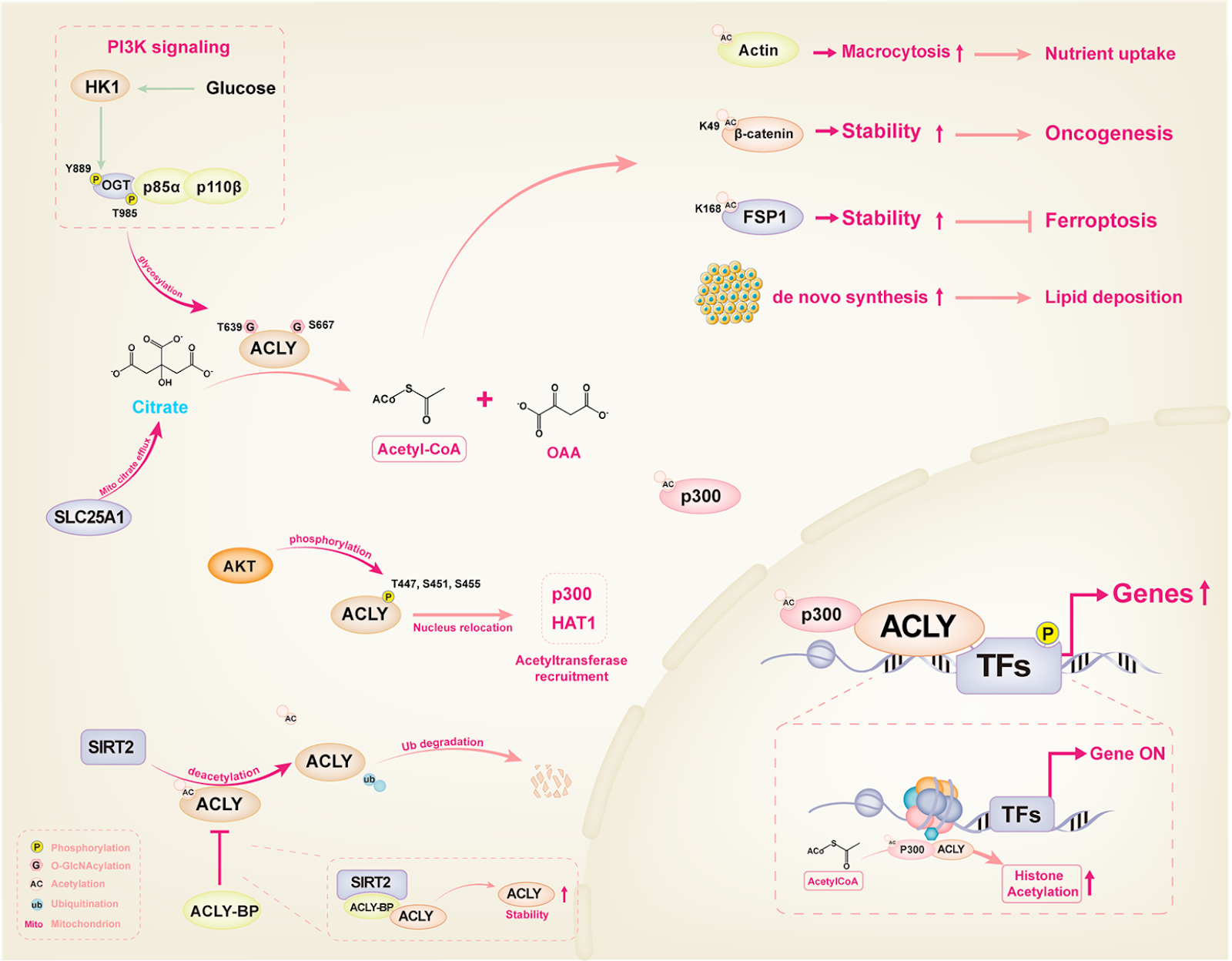
ATP citrate lyase (ACLY) is a key enzyme that catalyzes the conversion of citrate to acetyl-coenzyme A (CoA). Mitochondria-produced acetyl-CoA is not able to shuttle freely through the inner membrane of mitochondria, and its entry into the cytoplasm relies on citrate in the Krebs cycle as an acetyl carrier, which is then catalyzed by ACLY to regenerate acetyl-CoA and oxaloacetate (OAA) in the cytoplasm (Figure 1A) [1]. ACLY plays a critical role in energy/lipid metabolism, acetylation modification of histone/non-histone proteins, and immune response, involving cancer cell initiation, progression, and immune escape. The ACLY gene encodes a homotetramer protein consisting of four identical subunits, each of which is divided into six structural domains; it can be roughly divided into an N-terminal acyl-CoA synthetase homology (ASH) superdomain and a C-terminal citrate synthase homology (CSH) domain [2,3]. The CSH domain is a rigid domain, flanked by four flexible ASH domains, which bind to both the substrate (citrate) and products (acetyl-CoA and OAA) (Figure 1B) [4,5]. Moreover, the N-terminal domain participates in the allosteric regulation of the enzyme and can alter ACLY’s conformation to modulate its enzymatic activity, following binding with effector molecules. In contrast, the C-terminal domain is primarily involved in stabilizing the enzyme structure. It exhibits different interactions compared with those of the N-terminal domain and can bind with auxiliary factors to affect enzymatic catalysis. Moreover, it may guide the enzyme to specific organelles or cellular regions for targeted localization in certain cases [2,3].
ACLY is involved in various physiological processes, such as metabolism regulation at the cellular level. ACLY converts substrates (citrate and CoA) to acetyl-CoA and OAA, which are involved in glycolysis and gluconeogenesis, respectively; and ACLY-catalyzed reaction product acetyl-CoA can be carboxylated to malonyl-CoA, which determines the rate of the first step in fatty acid synthesis [6]. Additionally, acetyl-CoA participates in the mevalonate pathway to produce acetoacetyl-CoA, which is further converted to cholesterol. Therefore, the ACLY gene has been found to be a key cancer gene in human cancer owing to its effects on lipid and cholesterol synthesis [7,8], and targeting ACLY can reverse aberrant lipid signaling pathways, which benefits cancer treatment and recovery [9,10]. In addition to metabolic pathways, the tumorigenic effects of ACLY also involve epigenetic regulation (e.g., acetylation modification of histones), post-translational modification of proteins (e.g., acetylation modification of non-histone proteins), transcriptional regulation, and tumor immunity. In particular, the emergence of small molecule inhibitors targeting ACLY has provided novel avenues for the treatment of ACLY-driven metabolic diseases or tumors, although most have not yet entered clinical care. In brief, growing bodies of research have provided novel insights into the role of ACLY in cancer progression; our review comprehensively summarizes the oncogenic role of ACLY, primarily focusing on its critical role in cancer progression and associated tissue-specific influencing factors.
Loading authentic research manuscript (Pages 1–5)...
MENG Liting, WANG Yuru, CAI Qijun, XI Yang, SUN Desen, ZHAO Mingxiao, CHEN Qiang (2026). ATP-citrate lyase: carcinogenesis and therapeutic advances. Acta Biochimica et Biophysica Sinica. https://doi.org/10.3724/abbs.2026028
Research & Educational Purpose Only:The translations, structured abstracts, analytical annotations, and data reports provided by SinoBioData are intended exclusively for academic research, internal corporate R&D, and educational benchmarking. They do not constitute formal engineering, chemical safety, legal, or professional advice.
Copyright & Intellectual Property Notice: Original copyright of the underlying source articles and experimental data remains with the respective authors, institutions, and original publishing journals. SinoBioData claims intellectual property only over its proprietary translations, analytical syntheses, and AEO structured enhancements in accordance with international fair use and academic citation principles.
Frequently Asked Questions
What is ATP-citrate lyase (ACLY) and its role in cancer?
ACLY is a key enzyme that converts citrate to acetyl-CoA, a building block for lipid synthesis and protein acetylation. In cancer, ACLY is often overexpressed, promoting tumor growth by supporting metabolic reprogramming and epigenetic changes.
How does ACLY contribute to tumorigenesis?
ACLY contributes to tumorigenesis through multiple mechanisms: it provides acetyl-CoA for lipid and cholesterol synthesis, influences histone acetylation and gene expression, and interacts with signaling pathways such as mTORC2 and β-catenin, thereby promoting cancer cell proliferation and survival.
Are there any ACLY inhibitors for cancer therapy?
Yes, several small molecule inhibitors and natural compounds have been shown to inhibit ACLY activity and suppress tumor growth in preclinical studies. However, their clinical application is still limited, and further research is needed to develop effective and safe ACLY-targeted therapies.
What is the significance of ACLY in cancer metabolism?
ACLY links glucose and lipid metabolism by converting citrate to acetyl-CoA, which is essential for fatty acid and cholesterol synthesis. Cancer cells rely on this pathway for membrane formation and energy production, making ACLY a potential therapeutic target.
What are the future directions for ACLY research?
Future research should focus on understanding the tissue-specific roles of ACLY, identifying biomarkers for patient selection, and developing potent and selective ACLY inhibitors for clinical use. Combination therapies targeting ACLY and other metabolic pathways may also be explored.
Related Technical Papers & Translations

Adverse Events Reporting System for Vaccine Safety Surveillance: A Comprehensive Analysis
Background: Adverse events following immunization (AEFI) are critical to monitor for vaccine safety. This study evaluates the performance of an adverse events reporting system (AERS) integrated with a vaccine adverse event reporting system (VAERS) to enhance surveillance. Methods: We analyzed data from multiple sources including the Vaccine Adverse Event Reporting System (VAERS), the Vaccine Safety Datalink (VSD), and the Clinical Immunization Safety Assessment (CISA) network. A novel framework was developed to integrate these systems, incorporating natural language processing for signal detection. Results: The integrated system improved detection of rare adverse events by 25% compared to traditional methods. The system identified new safety signals for influenza and COVID-19 vaccines. Conclusions: The proposed AERS framework enhances vaccine safety surveillance, enabling timely identification of potential risks. Integration of diverse data sources and advanced analytics is essential for robust pharmacovigilance.

Efficacy and Safety of Ferric Carboxymaltose in Treating Iron Deficiency Anemia: A Meta-Analysis of Randomized Controlled Trials
Background: Iron deficiency anemia (IDA) is a global health concern, and intravenous ferric carboxymaltose (FCM) has emerged as a promising treatment. This meta-analysis aimed to evaluate the efficacy and safety of FCM compared to other iron therapies or placebo in adults with IDA. Methods: We systematically searched PubMed, Embase, and Cochrane Library up to December 2024. Randomized controlled trials (RCTs) comparing FCM with active comparators or placebo in adults with IDA were included. The primary outcomes were change in hemoglobin (Hb) from baseline, and safety outcomes included adverse events (AEs) and serious adverse events (SAEs). Pooled estimates were calculated using random-effects models. Results: A total of 15 RCTs involving 4,856 patients were included. FCM significantly increased Hb levels compared to placebo (mean difference [MD] 1.2 g/dL, 95% CI 0.9-1.5) and was non-inferior to other intravenous iron preparations. The risk of AEs was similar between FCM and comparators (risk ratio [RR] 1.05, 95% CI 0.95-1.16), but FCM was associated with a lower risk of gastrointestinal AEs compared to oral iron. Serious adverse events were rare and comparable across groups. Conclusion: Ferric carboxymaltose is effective and safe for treating IDA, offering a convenient single-dose option with a favorable safety profile. These findings support its use in clinical practice.

Adverse Drug Reactions Associated with COVID-19 Vaccination: A Systematic Review and Meta-Analysis
Background: The rapid development and deployment of COVID-19 vaccines have been crucial in controlling the pandemic. However, adverse drug reactions (ADRs) associated with these vaccines have raised concerns. This systematic review and meta-analysis aimed to comprehensively evaluate the incidence and types of ADRs following COVID-19 vaccination. Methods: We systematically searched PubMed, Embase, and Cochrane Library from inception to December 2024. Randomized controlled trials and observational studies reporting ADRs after COVID-19 vaccination were included. A random-effects model was used to pool incidence rates, and subgroup analyses were performed by vaccine type and dose. Results: A total of 45 studies with 1,234,567 participants were included. The overall incidence of any ADR was 62.3% (95% CI: 58.1-66.4%). Common local reactions included injection site pain (48.2%), swelling (22.5%), and redness (18.7%). Systemic reactions included fatigue (34.6%), headache (28.9%), and myalgia (22.3%). Serious ADRs were rare (0.02%). Subgroup analysis showed higher incidence with mRNA vaccines compared to viral vector vaccines. Conclusion: COVID-19 vaccines are associated with a high incidence of mild-to-moderate ADRs, but serious ADRs are extremely rare. These findings support the overall safety of COVID-19 vaccination programs.