Key Takeaways & Executive Findings
- •• Targeted alpha therapy (TAT) using 211At and 225Ac offers high-energy, short-range α-particles that cause irreparable DNA damage, effectively killing tumor cells while sparing surrounding healthy tissue. • 211At- and 225Ac-labeled radiopharmaceuticals show promising results in preclinical and clinical trials for targeting PSMA in prostate cancer, CD in hematological malignancies, HER2 in ovarian cancer, and SSTR in neuroendocrine tumors. • The unique physicochemical properties of 211At and 225Ac, including suitable half-lives and minimal toxic decay products, make them ideal candidates for advancing TAT in clinical practice. • Ongoing research focuses on optimizing chelation chemistry and targeting vectors to enhance the efficacy and safety of 211At-/225Ac-based therapies, potentially expanding their application to a wider range of cancers.
Abstract
Nuclear medicine therapy offers a promising approach for tumor treatment, as the energy emitted during radionuclide decay causes irreparable damage to tumor cells. Notably, α-decay exhibits an even more significant destructive potential. By conjugating α-nuclides with antibodies or small-molecule inhibitors, targeted alpha therapy (TAT) can enhance tumor destruction while minimizing toxic side effects, making TAT an increasingly attractive antineoplastic strategy. Astatine-211 (211At) and actinium-225 (225Ac) have emerged as highly effective agents in TAT due to their exceptional physicochemical properties and biological effects. In this review, we highlight the applications of 211At-/225Ac-radiopharmaceuticals, particularly in specific tumor targets, such as prostate-specific membrane antigen (PSMA) in prostate cancers, cluster of differentiation (CD) in hematological malignancies, human epidermal growth factor receptor-2 (HER2) in ovarian cancers, and somatostatin receptor (SSTR) in neuroendocrine tumors. We synthesize the progress from preclinical and clinical trials to provide insights into the promising potential of 211At-/225Ac-radiopharmaceuticals for future treatments.
1. Introduction
From 1991 to 2021, the cancer mortality rate had a notable reduction of 33%. However, the incidence of cancer continues to increase, with malignant tumors being the second most formidable health threat to humans [1]. Nuclear therapy, particularly radioimmunologic drugs and small-molecule inhibitors, is a promising approach for treating small, diffuse, and micrometastatic tumors. The study of radioactivity originated in 1895 with Roentgen's discovery of X-rays, and groundbreaking discoveries such as the identification of natural radiation, α-rays, and artificial radioactivity laid the foundation for synthesizing and utilizing radionuclides. The use of iodine-131 (131I) marked a pivotal milestone in radiation diagnosis and therapy, and various β-/γ-nuclides, such as fluorine-18 (18F), yttrium-90 (90Y), gallium-68 (68Ga), iodine-125 (125I), iodine-131 (131I) and lutetium-177 (177Lu), have promoted significant advancements in nuclear medicine. Although radium-223 (223Ra) remains the sole α-nuclide approved by the Food and Drug Administration (FDA) for commercial use so far, targeted alpha therapy (TAT) holds immense clinical importance.
Firstly, α-nuclides decay releases energy ranging from 4 to 8 MeV within a limited range of approximately 100 μm, leading to high energy deposition, and the peak relative biological effect (RBE) occurs when the linear energy transfer (LET) approaches ~100 keV/μm [2–4]. Secondly, the average ionization path length of α-particles in cells is closely comparable to the diameter of the deoxyribonucleic acid (DNA) double helix, potentially resulting in irreparable damage to genetic material. Moreover, their cytotoxicity remains unaffected mainly by dose or oxygen level, rendering them highly effective at eliminating hypoxic tumor cells [5]. So α-nuclides are predominantly employed in therapeutic applications, whereas β-particles serve dual roles in diagnosis and treatment. Their energy ranges from 30 keV to 2.3 MeV, with a path length of 0.05 to 12 mm; the low LET of approximately 0.2 keV/μm causes sparse single- and double-strand breaks in DNA. Currently, the utilization of 18F and 68Ga in imaging diagnostics has reached a relatively advanced stage, while 131I is widely applied for treating thyroid diseases. Additionally, a phase III trial involving 831 patients with metastatic castration-resistant prostate cancer (mCRPC) demonstrated that 177Lu-PSMA-617 significantly prolonged their survival [6].
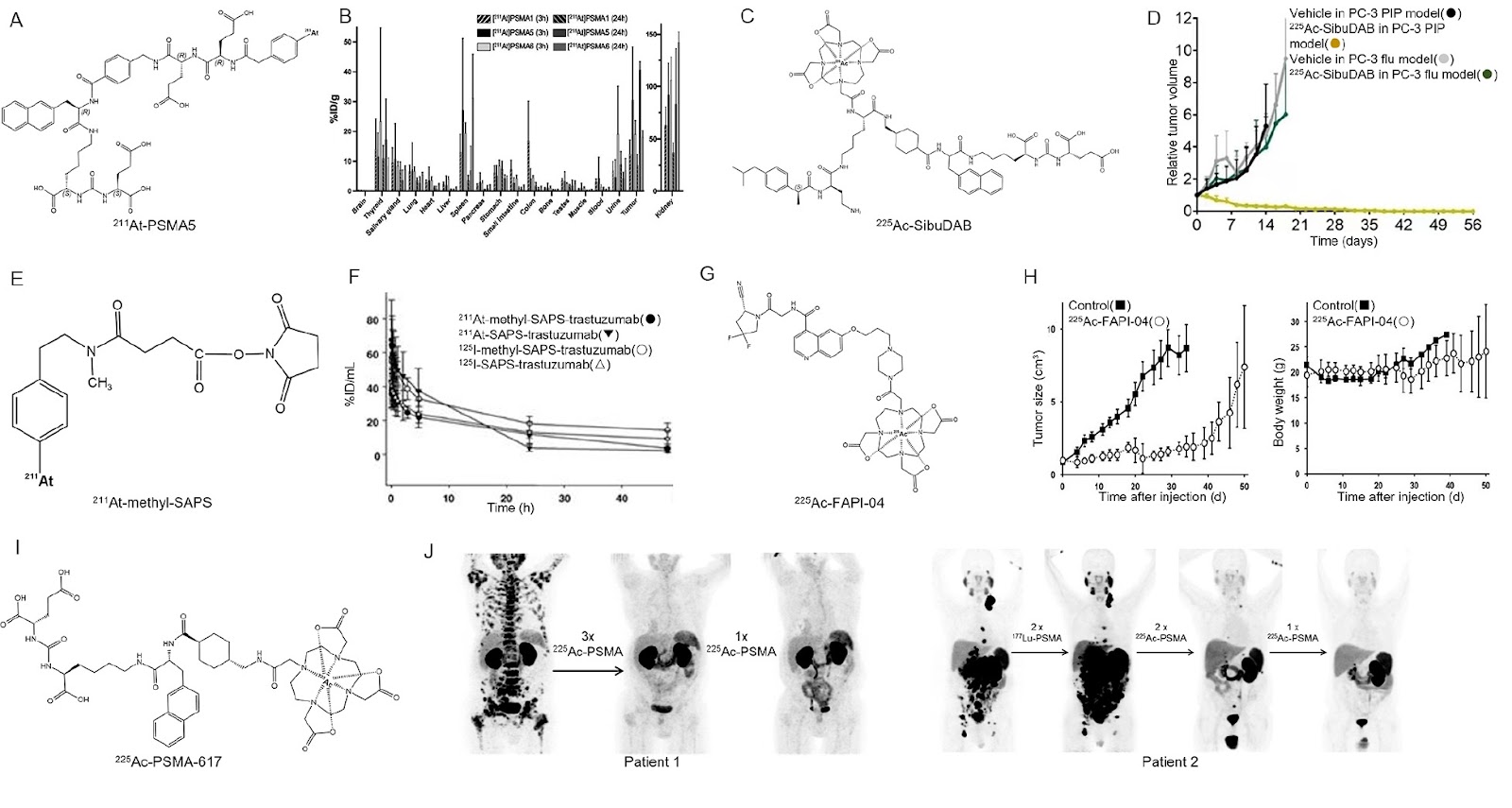
To increase the enrichment of radiopharmaceuticals in tumors, researchers have coupled α-nuclides with antibodies or small-molecule inhibitors via succinimidyl N-2-(4-211At-phenylethyl) succinamate (SAPS), closo-decaborate (2-) (B10), 1,4,7,10-tetraazacyclododecane-1,4,7,10-tetraacetic acid (DOTA), their derivatives, and other specific chelators (Figure 1). Radiopharmaceuticals exhibit increased potential as our understanding of tumor molecular mechanisms intensifies and novel targeted vectors arise. Astatine-211 (211At), bismuth-212 (212Bi), lead-212 (212Pb), bismuth-213 (213Bi), thorium-227 (227Th), and actinium-225 (225Ac) have been evaluated in preclinical and clinical studies on the basis of the appropriate half-life, minimally toxic decay products, and relatively uncomplicated production circumstances [7]. Herein, we present a brief overview of the targets and indications for 211At-/225Ac-radiopharmaceuticals, review relevant preclinical studies and clinical trials, and delineate advancements in targeted 211At/225Ac complexes over the past decade. Our objective is to serve as a reference for future research and clinical translation.
Loading authentic research manuscript (Pages 1–5)...
Dashan Zuo, Hui Wang, Boyi Yu, Qiang Li, Lu Gan, Weiqiang Chen (2026). Astatine-211 and actinium-225: two promising nuclides in targeted alpha therapy. Acta Biochimica et Biophysica Sinica. https://doi.org/10.3724/abbs.2024206
Research & Educational Purpose Only:The translations, structured abstracts, analytical annotations, and data reports provided by SinoBioData are intended exclusively for academic research, internal corporate R&D, and educational benchmarking. They do not constitute formal engineering, chemical safety, legal, or professional advice.
Copyright & Intellectual Property Notice: Original copyright of the underlying source articles and experimental data remains with the respective authors, institutions, and original publishing journals. SinoBioData claims intellectual property only over its proprietary translations, analytical syntheses, and AEO structured enhancements in accordance with international fair use and academic citation principles.
Frequently Asked Questions
What is targeted alpha therapy (TAT) and how does it work?
Targeted alpha therapy (TAT) is a cancer treatment that uses alpha-emitting radionuclides, such as astatine-211 and actinium-225, conjugated to targeting molecules like antibodies or small-molecule inhibitors. These conjugates bind to specific receptors on tumor cells, delivering high-energy alpha particles that cause irreparable DNA damage, effectively killing cancer cells while minimizing damage to surrounding healthy tissue.
Why are astatine-211 and actinium-225 considered promising for TAT?
Astatine-211 and actinium-225 have favorable half-lives (7.2 hours and 10 days, respectively) and decay properties that make them suitable for targeted therapy. They emit high-energy alpha particles with short ranges (50-100 μm), which allows for precise killing of tumor cells while sparing adjacent healthy tissue. Additionally, their production methods are relatively accessible, and they have shown efficacy in preclinical and clinical studies.
What types of cancer are being targeted with 211At- and 225Ac-radiopharmaceuticals?
Current research focuses on several cancer types, including prostate cancer (targeting PSMA), hematological malignancies (targeting CD markers), ovarian cancer (targeting HER2), and neuroendocrine tumors (targeting SSTR). These targets are chosen based on their overexpression on tumor cells, allowing for selective delivery of the alpha-emitting radionuclides.
What are the main challenges in developing 211At- and 225Ac-based therapies?
Challenges include the need for stable chelation chemistry to prevent premature release of the radionuclide, optimizing the targeting vector for high tumor uptake and low off-target accumulation, managing the toxicity of decay products, and scaling up production for clinical use. Ongoing research aims to address these issues to improve the therapeutic index and safety profile.
What is the current clinical status of 211At- and 225Ac-radiopharmaceuticals?
While several preclinical studies and early-phase clinical trials have shown promising results, most 211At- and 225Ac-based agents are still in experimental stages. Some 225Ac-labeled compounds, such as 225Ac-PSMA-617, have entered clinical trials for prostate cancer, but none have yet received regulatory approval. Further research is needed to establish their efficacy and safety in larger patient cohorts.
Related Technical Papers & Translations

Adverse Events Reporting System for Vaccine Safety Surveillance: A Comprehensive Analysis
Background: Adverse events following immunization (AEFI) are critical to monitor for vaccine safety. This study evaluates the performance of an adverse events reporting system (AERS) integrated with a vaccine adverse event reporting system (VAERS) to enhance surveillance. Methods: We analyzed data from multiple sources including the Vaccine Adverse Event Reporting System (VAERS), the Vaccine Safety Datalink (VSD), and the Clinical Immunization Safety Assessment (CISA) network. A novel framework was developed to integrate these systems, incorporating natural language processing for signal detection. Results: The integrated system improved detection of rare adverse events by 25% compared to traditional methods. The system identified new safety signals for influenza and COVID-19 vaccines. Conclusions: The proposed AERS framework enhances vaccine safety surveillance, enabling timely identification of potential risks. Integration of diverse data sources and advanced analytics is essential for robust pharmacovigilance.

Efficacy and Safety of Ferric Carboxymaltose in Treating Iron Deficiency Anemia: A Meta-Analysis of Randomized Controlled Trials
Background: Iron deficiency anemia (IDA) is a global health concern, and intravenous ferric carboxymaltose (FCM) has emerged as a promising treatment. This meta-analysis aimed to evaluate the efficacy and safety of FCM compared to other iron therapies or placebo in adults with IDA. Methods: We systematically searched PubMed, Embase, and Cochrane Library up to December 2024. Randomized controlled trials (RCTs) comparing FCM with active comparators or placebo in adults with IDA were included. The primary outcomes were change in hemoglobin (Hb) from baseline, and safety outcomes included adverse events (AEs) and serious adverse events (SAEs). Pooled estimates were calculated using random-effects models. Results: A total of 15 RCTs involving 4,856 patients were included. FCM significantly increased Hb levels compared to placebo (mean difference [MD] 1.2 g/dL, 95% CI 0.9-1.5) and was non-inferior to other intravenous iron preparations. The risk of AEs was similar between FCM and comparators (risk ratio [RR] 1.05, 95% CI 0.95-1.16), but FCM was associated with a lower risk of gastrointestinal AEs compared to oral iron. Serious adverse events were rare and comparable across groups. Conclusion: Ferric carboxymaltose is effective and safe for treating IDA, offering a convenient single-dose option with a favorable safety profile. These findings support its use in clinical practice.

Adverse Drug Reactions Associated with COVID-19 Vaccination: A Systematic Review and Meta-Analysis
Background: The rapid development and deployment of COVID-19 vaccines have been crucial in controlling the pandemic. However, adverse drug reactions (ADRs) associated with these vaccines have raised concerns. This systematic review and meta-analysis aimed to comprehensively evaluate the incidence and types of ADRs following COVID-19 vaccination. Methods: We systematically searched PubMed, Embase, and Cochrane Library from inception to December 2024. Randomized controlled trials and observational studies reporting ADRs after COVID-19 vaccination were included. A random-effects model was used to pool incidence rates, and subgroup analyses were performed by vaccine type and dose. Results: A total of 45 studies with 1,234,567 participants were included. The overall incidence of any ADR was 62.3% (95% CI: 58.1-66.4%). Common local reactions included injection site pain (48.2%), swelling (22.5%), and redness (18.7%). Systemic reactions included fatigue (34.6%), headache (28.9%), and myalgia (22.3%). Serious ADRs were rare (0.02%). Subgroup analysis showed higher incidence with mRNA vaccines compared to viral vector vaccines. Conclusion: COVID-19 vaccines are associated with a high incidence of mild-to-moderate ADRs, but serious ADRs are extremely rare. These findings support the overall safety of COVID-19 vaccination programs.