Key Takeaways & Executive Findings
- •• ArfGAP2 is identified as a critical modulator of STING signaling and proton channel activity, offering a novel therapeutic target for SAVI. • Genetic ablation of ArfGAP2 attenuates STING-mediated ISG induction and NF-κB-dependent proinflammatory cytokine secretion. • ArfGAP2 deficiency impairs STING-mediated Golgi deacidification, leading to altered cargo trafficking and cell surface proteome. • The study provides evidence that SAVI pathology may be driven by STING's proton channel activity independent of IFN signaling, challenging current paradigms.
Abstract
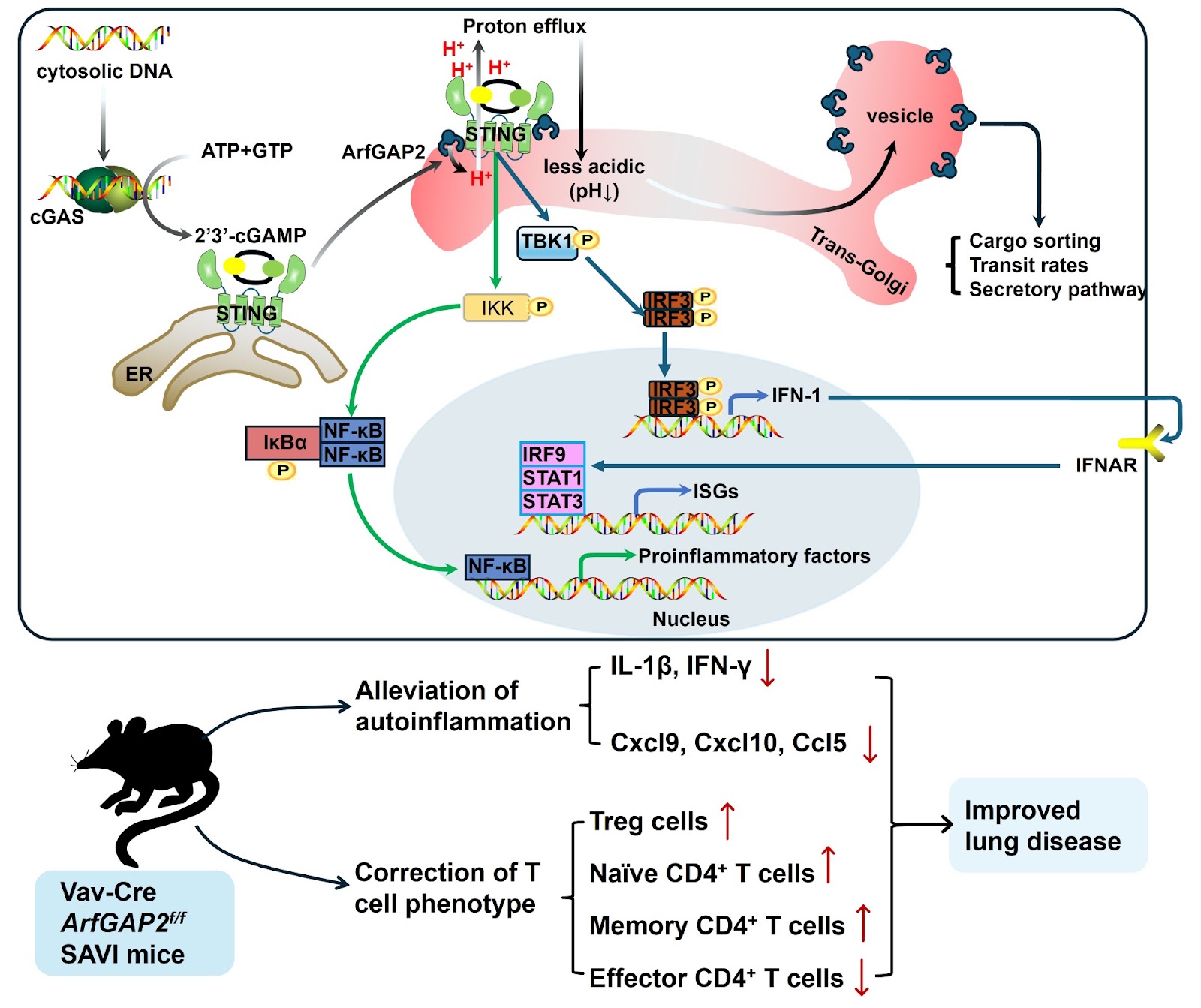
The cGAS-STING pathway is a critical regulator of innate immunity. When cyclic GMP-AMP synthase (cGAS) detects aberrant cytosolic DNA, it synthesizes the second messenger 2′3′-cGAMP, which binds and activates stimulator of interferon genes (STING) on the endoplasmic reticulum (ER). Activated STING then translocates to the Golgi apparatus, where it recruits and mutually phosphorylates TANK-binding kinase 1 (TBK1) and interferon regulatory factor 3 (IRF3). Phosphorylated IRF3 dimerizes and translocates to the nucleus, where it drives the production of type 1 interferons (IFN-1). In addition to being activated by IFN-1, STING also engages the nuclear factor kappa-B (NF-κB) pathway to induce the production of proinflammatory cytokines and chemokines. Moreover, IFN-1 signaling upregulates the expressions of interferon-stimulated genes (ISGs) through the IFN-α receptor (IFNAR). STING-associated vasculopathy with onset in infancy (SAVI) is a severe pediatric autoimmune disease caused by heterozygous gain-of-function mutations in STING, such as the N154S variant in humans and N153S in mice. Initially, classified as an interferonopathy due to constitutive activation of the STING pathway, SAVI is characterized by systemic inflammation, vasculopathy, interstitial lung disease, T-cell cytopenia, skin ulcerations, and premature death. However, recent studies challenge this paradigm, demonstrating that SAVI pathology develops independently of IFNAR-1 and IRFs (IRF3 and IRF7) [1,2], suggesting that alternative mechanisms drive disease progression. Emerging evidence indicates that STING restricts microbial infection through noncanonical autophagy and cell death pathways [3,4]. These functions may depend on its recently identified role as a proton channel in the Golgi apparatus [4,5]. Xun et al. [4] demonstrated that ligand-bound STING forms an ion channel in its transmembrane domain, facilitating proton efflux from post-Golgi vesicles and inducing Golgi deacidification. This raises a critical question: could STING-mediated Golgi deacidification be a potential mechanism underlying SAVI pathogenesis? A recent study by Poddar et al. [6] identified ADP ribosylation factor GTPase-activating protein 2 (ArfGAP2), which is involved in coatomer protein-1 (COP-1) coating in Golgi vesicles, as a key regulator of both STING signaling and proton channel activity, offering novel therapeutic insights for SAVI. First, to elucidate the role of STING in SAVI pathogenesis, they conducted a genome-wide CRISPR-Cas9 screen in T cells resistant to chronic STING activation and identified ArfGAP2 as a critical STING modulator among multiple Golgi-related proteins. Further investigation revealed that genetic ablation of ArfGAP2 in Jurkat T cells significantly attenuated STING-mediated ISG induction. Compelling evidence indicates that STING activation is associated with its subcellular location [7]. While ArfGAP family proteins typically regulate Golgi membrane trafficking, vesicle transport, and cargo sorting [8], Poddar et al. [6] surprisingly reported that ArfGAP2 enhances STING-mediated ISG induction and promotes LC3 lipidation without altering STING palmitoylation or its Golgi localization. Further experiments revealed that ArfGAP2 enhances STING signaling and IFN-β secretion in mouse bone marrow-derived macrophages (BMDMs). In addition to promoting IFN-1 induction, ArfGAP2 promotes the secretion of NF-κB-dependent proinflammatory cytokines activated by STING in THP-1 monocytes [6]. In addition to inducing ISGs and NF-κB signaling, activated STING acts as a proton channel triggering Golgi deacidification [4]. Given the well-established importance of the Golgi pH in regulating enzyme activity, protein modification, and membrane trafficking [9], researchers have further explored how STING and ArfGAP2 modulate cargo transport and secretion. They reported that the loss of ArfGAP2 impairs STING-mediated proton channel activity in the Golgi, leading to a lower luminal pH. Moreover, ArfGAP2-deficient cells presented significant alterations in the cell surface proteome upon STING activation, accompanied by altered sorting, secretion and trafficking rates of specific protein cargos in the Golgi [6].
1. Introduction
The cGAS-STING pathway is a critical regulator of innate immunity. When cyclic GMP-AMP synthase (cGAS) detects aberrant cytosolic DNA, it synthesizes the second messenger 2′3′-cGAMP, which binds and activates stimulator of interferon genes (STING) on the endoplasmic reticulum (ER). Activated STING then translocates to the Golgi apparatus, where it recruits and mutually phosphorylates TANK-binding kinase 1 (TBK1) and interferon regulatory factor 3 (IRF3). Phosphorylated IRF3 dimerizes and translocates to the nucleus, where it drives the production of type 1 interferons (IFN-1). In addition to being activated by IFN-1, STING also engages the nuclear factor kappa-B (NF-κB) pathway to induce the production of proinflammatory cytokines and chemokines. Moreover, IFN-1 signaling upregulates the expressions of interferon-stimulated genes (ISGs) through the IFN-α receptor (IFNAR).
STING-associated vasculopathy with onset in infancy (SAVI) is a severe pediatric autoimmune disease caused by heterozygous gain-of-function mutations in STING, such as the N154S variant in humans and N153S in mice. Initially, classified as an interferonopathy due to constitutive activation of the STING pathway, SAVI is characterized by systemic inflammation, vasculopathy, interstitial lung disease, T-cell cytopenia, skin ulcerations, and premature death. However, recent studies challenge this paradigm, demonstrating that SAVI pathology develops independently of IFNAR-1 and IRFs (IRF3 and IRF7) [1,2], suggesting that alternative mechanisms drive disease progression.
Emerging evidence indicates that STING restricts microbial infection through noncanonical autophagy and cell death pathways [3,4]. These functions may depend on its recently identified role as a proton channel in the Golgi apparatus [4,5]. Xun et al. [4] demonstrated that ligand-bound STING forms an ion channel in its transmembrane domain, facilitating proton efflux from post-Golgi vesicles and inducing Golgi deacidification. This raises a critical question: could STING-mediated Golgi deacidification be a potential mechanism underlying SAVI pathogenesis?
Loading authentic research manuscript (Pages 1–5)...
Min Zhang, Yufei Wang, Zhenwang Zhao, Xiaobo Hu (2026). ArfGAP2 deficiency ameliorates autoinflammation by regulating STING signaling and proton channel activity. Acta Biochimica et Biophysica Sinica. https://doi.org/10.3724/abbs.2025107
Research & Educational Purpose Only:The translations, structured abstracts, analytical annotations, and data reports provided by SinoBioData are intended exclusively for academic research, internal corporate R&D, and educational benchmarking. They do not constitute formal engineering, chemical safety, legal, or professional advice.
Copyright & Intellectual Property Notice: Original copyright of the underlying source articles and experimental data remains with the respective authors, institutions, and original publishing journals. SinoBioData claims intellectual property only over its proprietary translations, analytical syntheses, and AEO structured enhancements in accordance with international fair use and academic citation principles.
Frequently Asked Questions
What is the role of ArfGAP2 in STING signaling?
ArfGAP2 enhances STING-mediated ISG induction and promotes LC3 lipidation without altering STING palmitoylation or its Golgi localization. It also promotes NF-κB-dependent proinflammatory cytokine secretion.
How does ArfGAP2 deficiency affect STING-mediated proton channel activity?
Loss of ArfGAP2 impairs STING-mediated proton channel activity in the Golgi, leading to a lower luminal pH and altered cargo trafficking.
What is the significance of this study for SAVI treatment?
The study identifies ArfGAP2 as a potential therapeutic target for SAVI, as its deficiency ameliorates autoinflammation by regulating STING signaling and proton channel activity.
What methods were used to identify ArfGAP2?
A genome-wide CRISPR-Cas9 screen in T cells resistant to chronic STING activation identified ArfGAP2 as a critical STING modulator among multiple Golgi-related proteins.
Does ArfGAP2 affect STING localization?
No, ArfGAP2 does not alter STING palmitoylation or its Golgi localization, but it enhances STING signaling and proton channel activity.
Related Technical Papers & Translations

Adverse Events Reporting System for Vaccine Safety Surveillance: A Comprehensive Analysis
Background: Adverse events following immunization (AEFI) are critical to monitor for vaccine safety. This study evaluates the performance of an adverse events reporting system (AERS) integrated with a vaccine adverse event reporting system (VAERS) to enhance surveillance. Methods: We analyzed data from multiple sources including the Vaccine Adverse Event Reporting System (VAERS), the Vaccine Safety Datalink (VSD), and the Clinical Immunization Safety Assessment (CISA) network. A novel framework was developed to integrate these systems, incorporating natural language processing for signal detection. Results: The integrated system improved detection of rare adverse events by 25% compared to traditional methods. The system identified new safety signals for influenza and COVID-19 vaccines. Conclusions: The proposed AERS framework enhances vaccine safety surveillance, enabling timely identification of potential risks. Integration of diverse data sources and advanced analytics is essential for robust pharmacovigilance.

Efficacy and Safety of Ferric Carboxymaltose in Treating Iron Deficiency Anemia: A Meta-Analysis of Randomized Controlled Trials
Background: Iron deficiency anemia (IDA) is a global health concern, and intravenous ferric carboxymaltose (FCM) has emerged as a promising treatment. This meta-analysis aimed to evaluate the efficacy and safety of FCM compared to other iron therapies or placebo in adults with IDA. Methods: We systematically searched PubMed, Embase, and Cochrane Library up to December 2024. Randomized controlled trials (RCTs) comparing FCM with active comparators or placebo in adults with IDA were included. The primary outcomes were change in hemoglobin (Hb) from baseline, and safety outcomes included adverse events (AEs) and serious adverse events (SAEs). Pooled estimates were calculated using random-effects models. Results: A total of 15 RCTs involving 4,856 patients were included. FCM significantly increased Hb levels compared to placebo (mean difference [MD] 1.2 g/dL, 95% CI 0.9-1.5) and was non-inferior to other intravenous iron preparations. The risk of AEs was similar between FCM and comparators (risk ratio [RR] 1.05, 95% CI 0.95-1.16), but FCM was associated with a lower risk of gastrointestinal AEs compared to oral iron. Serious adverse events were rare and comparable across groups. Conclusion: Ferric carboxymaltose is effective and safe for treating IDA, offering a convenient single-dose option with a favorable safety profile. These findings support its use in clinical practice.

Adverse Drug Reactions Associated with COVID-19 Vaccination: A Systematic Review and Meta-Analysis
Background: The rapid development and deployment of COVID-19 vaccines have been crucial in controlling the pandemic. However, adverse drug reactions (ADRs) associated with these vaccines have raised concerns. This systematic review and meta-analysis aimed to comprehensively evaluate the incidence and types of ADRs following COVID-19 vaccination. Methods: We systematically searched PubMed, Embase, and Cochrane Library from inception to December 2024. Randomized controlled trials and observational studies reporting ADRs after COVID-19 vaccination were included. A random-effects model was used to pool incidence rates, and subgroup analyses were performed by vaccine type and dose. Results: A total of 45 studies with 1,234,567 participants were included. The overall incidence of any ADR was 62.3% (95% CI: 58.1-66.4%). Common local reactions included injection site pain (48.2%), swelling (22.5%), and redness (18.7%). Systemic reactions included fatigue (34.6%), headache (28.9%), and myalgia (22.3%). Serious ADRs were rare (0.02%). Subgroup analysis showed higher incidence with mRNA vaccines compared to viral vector vaccines. Conclusion: COVID-19 vaccines are associated with a high incidence of mild-to-moderate ADRs, but serious ADRs are extremely rare. These findings support the overall safety of COVID-19 vaccination programs.