Key Takeaways & Executive Findings
- •• Angelicin significantly alleviates sepsis-associated acute liver injury (SALI) by improving liver function and reducing pathological damage in a CLP-induced mouse model. • ANG suppresses inflammation by downregulating pro-inflammatory cytokines (IL-1β, IL-6, TNF-α) and upregulating anti-inflammatory IL-10, via inhibition of NF-κB and p38 MAPK pathways. • ANG exerts antioxidant effects by reducing MDA and ROS levels while increasing GSH, CAT, and SOD activities, through activation of the Nrf2/Keap1 pathway. • Mechanistically, ANG-induced Nrf2/Keap1 activation is dependent on NF-κB inhibition, highlighting a novel crosstalk and positioning ANG as a promising therapeutic candidate for SALI.
Abstract
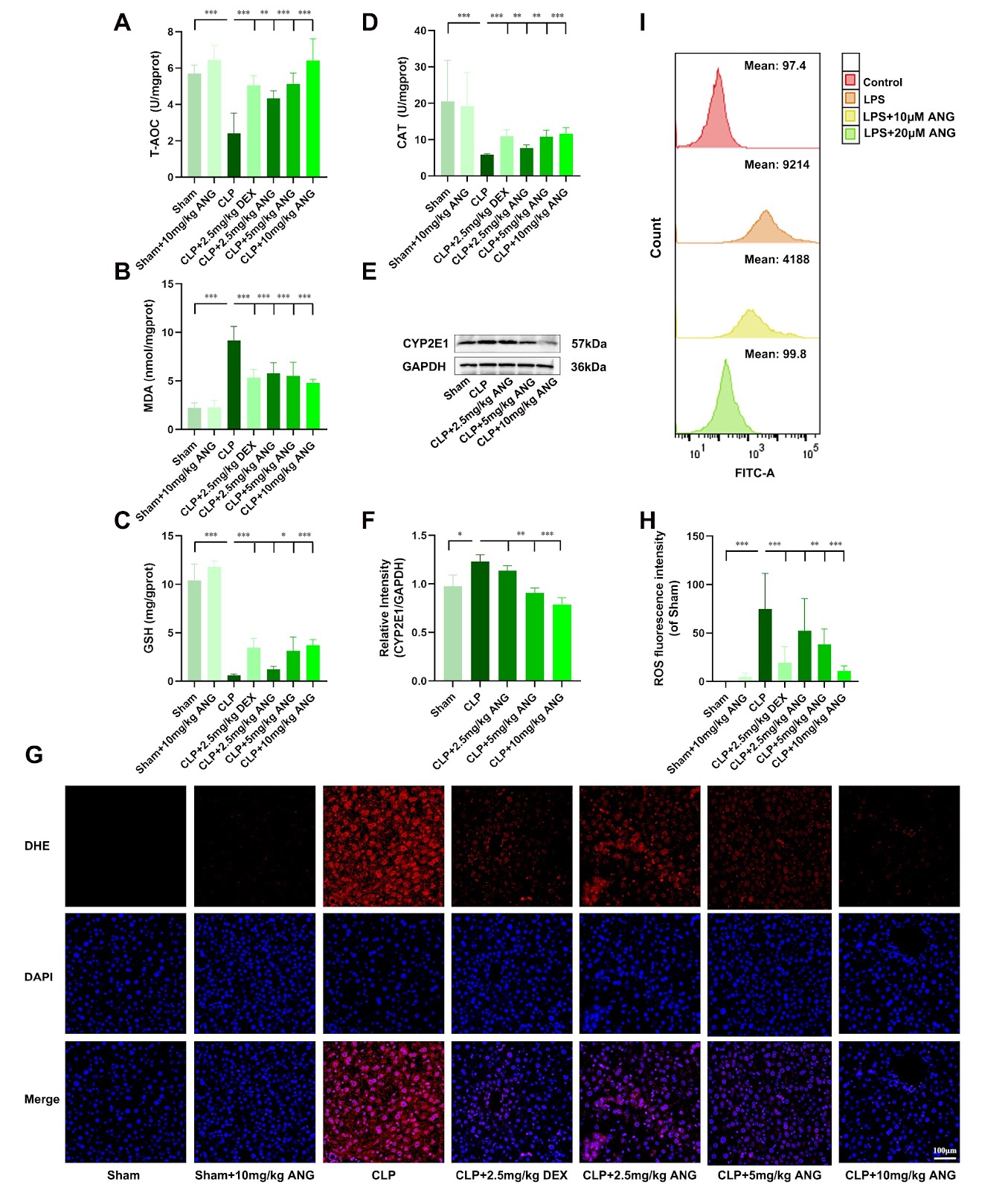
Sepsis-associated acute liver injury (SALI) is a frequent and clinically severe complication of sepsis, in which inflammatory responses and oxidative stress are involved. Angelicin (ANG), one of the main active components in the traditional Chinese medicine Psoralea corylifolia Linn., has anti-inflammatory and antioxidant bioactivities. In this study, the protective effect of ANG on SALI and its specific mechanism are investigated by establishing a mouse model of caecal ligation and puncture (CLP)-induced SALI and an in vitro sepsis model in LPS-stimulated AML12 cells. These results show that ANG can alleviate liver injury and improve liver function in SALI mice. ANG decreases the mRNA expression levels of the pro-inflammatory factors Il-1β, Il-6, and Tnf-α and increases the mRNA expression level of the anti-inflammatory factor Il-10, which suggests its anti-inflammatory effects. The results of the biochemical kit assay and DHE staining show that ANG can decrease the levels of MDA and ROS and increase the level of GSH and the activities of CAT and SOD, which suggests that ANG has antioxidant effects. Mechanistically, ANG exerts anti-inflammatory effects by inhibiting the NF-κB and p38 MAPK pathways and exerting antioxidant effects by activating the Nrf2/Keap1 pathway. Additionally, cell transfection experiments indicate that activation of the Nrf2/Keap1 pathway by ANG may depend on the inhibition of the NF-κB pathway. In conclusion, ANG attenuates SALI by inhibiting the NF-κB and p38 MAPK pathways, thereby activating the Nrf2/Keap1 pathway and making it a promising therapeutic intervention for SALI.
1. Introduction
Sepsis is a systemic inflammatory response caused by infection, and when this inflammatory response is out of control, it may lead to damage to multiple organ systems [1]. The liver is a key effector in sepsis pathogenesis, orchestrating host defense via microbial antigen clearance, immune cell recruitment, and inflammation-associated metabolic shifts, thereby frequently becoming a major affected organ [2]. Sepsis not only causes acute liver injury, leading to liver failure but also may lead to serious complications, such as biliary obstruction, hepatic encephalopathy, and multiple organ dysfunction syndrome (MODS) [2]. However, few studies have investigated sepsis-associated acute liver injury (SALI).
Recent investigations revealed that physiological responses, including oxidative stress, inflammatory signaling, and programmed cell death (apoptosis), play essential protective roles against SALI [3]. However, excessive activation of these pathways paradoxically aggravates tissue damage in vivo [4]. As heterologous phagocytes in innate immunity, macrophages detect pathogen-associated molecular patterns (PAMPs) and damage-associated molecular patterns (DAMPs) by expressing pattern-recognition receptors [5]. During sepsis pathogenesis, hepatic non-parenchymal cells, including Kupffer cells, hepatic sinusoidal endothelial cells, and stellate cells, serve as the primary defense mechanism by capturing and eliminating invading pathogenic microorganisms and their byproducts, thereby providing systemic protection while maintaining hepatic homeostasis [6]. Moreover, liver-resident and recruited immune cells produce multiple proinflammatory cytokines and chemokines that lead to liver injury and dysfunction during sepsis [7]. Liver dysfunction has been demonstrated to be a distinct and independent predictor of adverse outcomes in critically ill patients [8], whereas pre-existing hepatic impairment predisposes individuals to sepsis, subsequent multi-organ failure, and increased mortality. Therefore, anti-inflammatory interventions that mitigate liver injury and restore hepatic function could improve outcomes in sepsis patients [9].
Extensive evidence indicates that various signaling pathways, particularly the mitogen-activated protein kinase (MAPK) and nuclear factor-κB (NF-κB) pathways, critically regulate inflammatory responses during sepsis pathogenesis [10]. The MAPK family, which comprises extracellular signal-regulated kinases 1/2 (ERK1/2), p38 mitogen-activated protein kinase (p38 MAPK), and c-Jun N-terminal kinase (JNK), modulates the transcriptional regulation of proinflammatory mediators, including inducible nitric oxide synthase (iNOS) and cyclooxygenase-2 (COX-2). Moreover, NF-κB, a heterodimer of p50/p65 subunits that complex with inhibitory κB (IκB) proteins, plays a bidirectional role in both host defense and inflammation.
Loading authentic research manuscript (Pages 1–5)...
Enzhuang Pan, Huilin Sun, Shasha Zhang, Jun Wang, Yedan Liu, Feibiao Wang, Jing Xia, Yingjia Qian, Xiaolong Xu, Jingquan Dong (2026). Angelicin attenuates sepsis-associated acute liver injury via p38 MAPK inhibition and NF-κB-mediated Nrf2/Keap1 activation to suppress inflammation and oxidative stress. Acta Biochimica et Biophysica Sinica. https://doi.org/10.3724/abbs.2025139
Research & Educational Purpose Only:The translations, structured abstracts, analytical annotations, and data reports provided by SinoBioData are intended exclusively for academic research, internal corporate R&D, and educational benchmarking. They do not constitute formal engineering, chemical safety, legal, or professional advice.
Copyright & Intellectual Property Notice: Original copyright of the underlying source articles and experimental data remains with the respective authors, institutions, and original publishing journals. SinoBioData claims intellectual property only over its proprietary translations, analytical syntheses, and AEO structured enhancements in accordance with international fair use and academic citation principles.
Frequently Asked Questions
What is sepsis-associated acute liver injury (SALI)?
SALI is a frequent and clinically severe complication of sepsis, characterized by inflammatory responses and oxidative stress leading to liver dysfunction and potential failure.
How does Angelicin protect against SALI?
Angelicin attenuates SALI by inhibiting the NF-κB and p38 MAPK pathways to suppress inflammation, and by activating the Nrf2/Keap1 pathway to reduce oxidative stress, thereby improving liver function.
What experimental models were used in this study?
The study used a mouse model of caecal ligation and puncture (CLP)-induced SALI and an in vitro sepsis model in LPS-stimulated AML12 cells.
What are the key molecular mechanisms of Angelicin's action?
Angelicin inhibits pro-inflammatory cytokines (IL-1β, IL-6, TNF-α) and increases anti-inflammatory IL-10, while reducing oxidative stress markers (MDA, ROS) and enhancing antioxidants (GSH, CAT, SOD). Mechanistically, it inhibits NF-κB and p38 MAPK, and activates Nrf2/Keap1, with Nrf2 activation dependent on NF-κB inhibition.
Is Angelicin a promising therapeutic for SALI?
Yes, the findings suggest that Angelicin is a promising therapeutic intervention for sepsis-associated acute liver injury due to its dual anti-inflammatory and antioxidant effects.
Related Technical Papers & Translations

Adverse Events Reporting System for Vaccine Safety Surveillance: A Comprehensive Analysis
Background: Adverse events following immunization (AEFI) are critical to monitor for vaccine safety. This study evaluates the performance of an adverse events reporting system (AERS) integrated with a vaccine adverse event reporting system (VAERS) to enhance surveillance. Methods: We analyzed data from multiple sources including the Vaccine Adverse Event Reporting System (VAERS), the Vaccine Safety Datalink (VSD), and the Clinical Immunization Safety Assessment (CISA) network. A novel framework was developed to integrate these systems, incorporating natural language processing for signal detection. Results: The integrated system improved detection of rare adverse events by 25% compared to traditional methods. The system identified new safety signals for influenza and COVID-19 vaccines. Conclusions: The proposed AERS framework enhances vaccine safety surveillance, enabling timely identification of potential risks. Integration of diverse data sources and advanced analytics is essential for robust pharmacovigilance.

Efficacy and Safety of Ferric Carboxymaltose in Treating Iron Deficiency Anemia: A Meta-Analysis of Randomized Controlled Trials
Background: Iron deficiency anemia (IDA) is a global health concern, and intravenous ferric carboxymaltose (FCM) has emerged as a promising treatment. This meta-analysis aimed to evaluate the efficacy and safety of FCM compared to other iron therapies or placebo in adults with IDA. Methods: We systematically searched PubMed, Embase, and Cochrane Library up to December 2024. Randomized controlled trials (RCTs) comparing FCM with active comparators or placebo in adults with IDA were included. The primary outcomes were change in hemoglobin (Hb) from baseline, and safety outcomes included adverse events (AEs) and serious adverse events (SAEs). Pooled estimates were calculated using random-effects models. Results: A total of 15 RCTs involving 4,856 patients were included. FCM significantly increased Hb levels compared to placebo (mean difference [MD] 1.2 g/dL, 95% CI 0.9-1.5) and was non-inferior to other intravenous iron preparations. The risk of AEs was similar between FCM and comparators (risk ratio [RR] 1.05, 95% CI 0.95-1.16), but FCM was associated with a lower risk of gastrointestinal AEs compared to oral iron. Serious adverse events were rare and comparable across groups. Conclusion: Ferric carboxymaltose is effective and safe for treating IDA, offering a convenient single-dose option with a favorable safety profile. These findings support its use in clinical practice.

Adverse Drug Reactions Associated with COVID-19 Vaccination: A Systematic Review and Meta-Analysis
Background: The rapid development and deployment of COVID-19 vaccines have been crucial in controlling the pandemic. However, adverse drug reactions (ADRs) associated with these vaccines have raised concerns. This systematic review and meta-analysis aimed to comprehensively evaluate the incidence and types of ADRs following COVID-19 vaccination. Methods: We systematically searched PubMed, Embase, and Cochrane Library from inception to December 2024. Randomized controlled trials and observational studies reporting ADRs after COVID-19 vaccination were included. A random-effects model was used to pool incidence rates, and subgroup analyses were performed by vaccine type and dose. Results: A total of 45 studies with 1,234,567 participants were included. The overall incidence of any ADR was 62.3% (95% CI: 58.1-66.4%). Common local reactions included injection site pain (48.2%), swelling (22.5%), and redness (18.7%). Systemic reactions included fatigue (34.6%), headache (28.9%), and myalgia (22.3%). Serious ADRs were rare (0.02%). Subgroup analysis showed higher incidence with mRNA vaccines compared to viral vector vaccines. Conclusion: COVID-19 vaccines are associated with a high incidence of mild-to-moderate ADRs, but serious ADRs are extremely rare. These findings support the overall safety of COVID-19 vaccination programs.