Key Takeaways & Executive Findings
- •• Chronic hypobaric hypoxia induces significant shifts in gut microbiota and metabolites, with carnosine levels and Ruminococcus bromii abundance decreasing over 28 days. • Carnosine inversely correlates with pulmonary arteriole media thickness, suggesting a protective role against vascular remodeling. • Therapeutic carnosine supplementation restores antioxidant defenses and attenuates vascular remodeling without affecting right ventricular pressures. • In vitro, carnosine inhibits hypoxia-induced PASMC proliferation and migration, partly via suppression of Nrf2 accumulation, highlighting its potential as a metabolite-based therapy.
Abstract
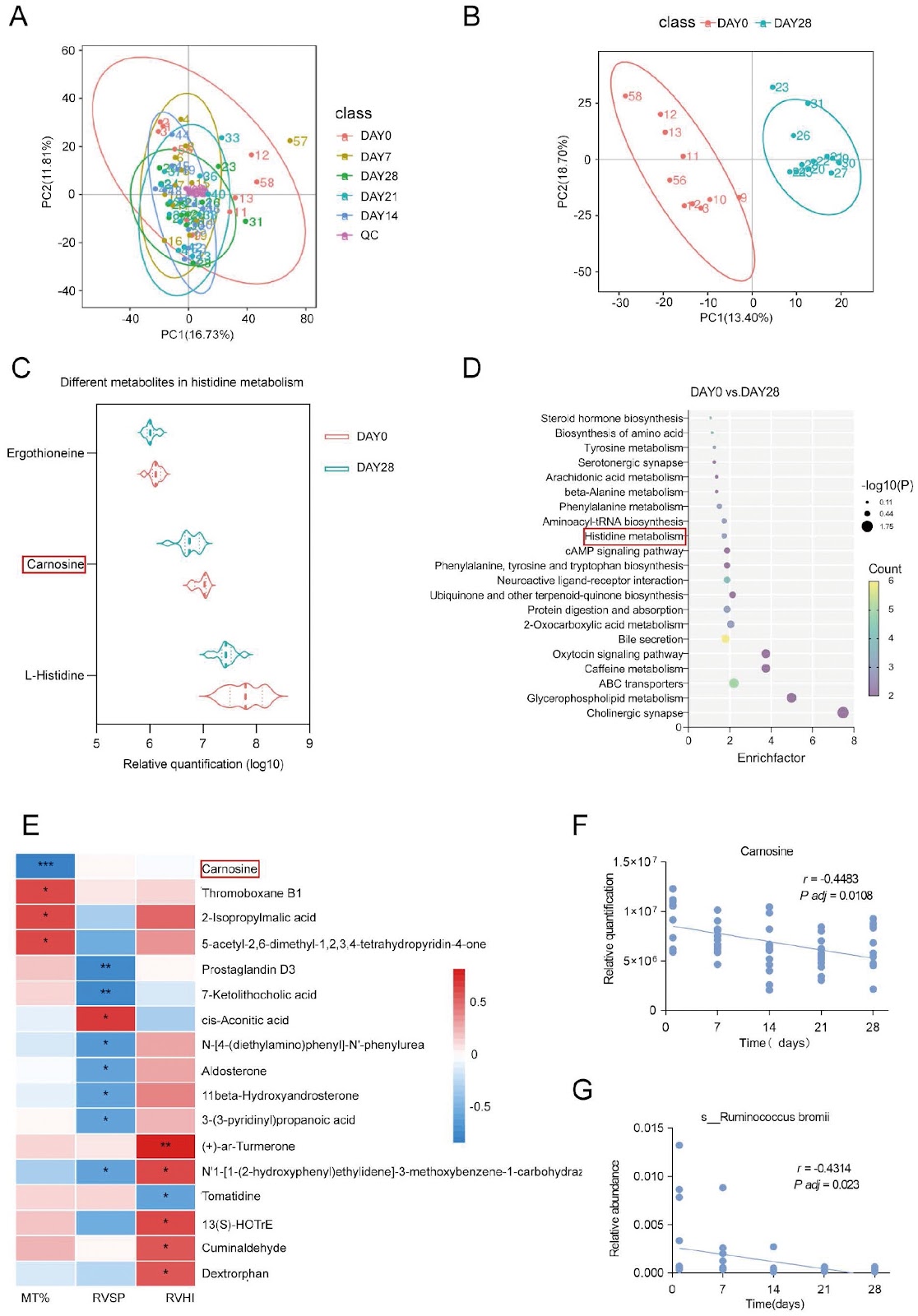
Exposure to chronic hypobaric hypoxia provokes marked alterations in the gut microbiota and its metabolome, yet the functional significance of histidine-derived metabolites in hypobaric hypoxic pulmonary hypertension (PH) remains underexplored. Here, we employ 16S rDNA, metagenomic, and untargeted metabolomic sequencing to characterize longitudinal shifts in the fecal microbiota and metabolites during hypobaric hypoxic PH development in Sprague-Dawley rats. Fecal carnosine levels and the abundance of its producer, Ruminococcus bromii, both decrease significantly over 28 days of hypobaric hypoxia (P < 0.05). Spearman correlation shows that carnosine is inversely correlated with the percentage of pulmonary arteriole media thickness (MT%; r = –0.8741, P < 0.001). Therapeutic supplementation with carnosine restores systemic and pulmonary antioxidant defenses and attenuates vascular remodeling without altering right ventricular pressures. In vitro, carnosine inhibits hypoxia-induced pulmonary artery smooth muscle cell (PASMC) proliferation and migration and suppresses nuclear factor erythroid 2-related factor 2 (Nrf2) accumulation. These findings reveal dynamic gut-lung crosstalk in hypobaric hypoxic PH and nominate carnosine as a metabolite-based intervention to mitigate hypoxia-driven pulmonary vascular remodeling.
1. Introduction
The high-altitude environment is characterized by hypobaric hypoxic conditions that profoundly impact multiple organ systems [1]. Chronic exposure to high altitude can induce hypobaric hypoxic pulmonary hypertension (PH) [2], which is classified as Group 3 pulmonary hypertension [3]. Hypobaric hypoxic PH is characterized by abnormal pulmonary vasoconstriction, vascular cell proliferation, and inflammatory infiltration, culminating in pathological remodeling of the pulmonary vasculature, which is driven by endothelial cell dysfunction and excessive proliferative migration of smooth muscle cells [4].
High-altitude exposure also perturbs gut homeostasis by altering the composition of the gut microbiota [5]. Such microbial shifts are recognized to correlate with both physiological adaptations and disease pathogenesis. Prior studies have highlighted gut microbiota dysbiosis in PH [6] and demonstrated that targeted modulation of the microbiome can influence PH progression [7]. Gut-derived metabolites, such as short-chain fatty acids (SCFAs) and trimethylamine-N-oxide (TMAO), play important roles in PH pathophysiology, although specific microbial signatures vary according to the underlying etiology of PH [8]. Moreover, hypobaric hypoxic PH has been shown to disrupt amino acid metabolism, with notable alterations in the histidine, arginine, and ornithine metabolism pathways observed in PH [9]. Carnosine, a dipeptide product of the histidine metabolic pathway, exerts anti-inflammatory and antioxidant effects [10], protects endothelial integrity, and inhibits angiogenesis [11]. Exogenous carnosine supplementation has demonstrated efficacy in preventing atherosclerotic disease [12]. In vitro studies have revealed its antiproliferative effect on vascular smooth muscle cells [13].
Accordingly, our study aimed to characterize the dynamic alterations in the gut microbiota and metabolites during the development of hypobaric hypoxic PH, identify gut metabolites associated with pulmonary vascular remodeling, and validate the potential therapeutic role of carnosine in hypobaric hypoxic PH.
Loading authentic research manuscript (Pages 1–5)...
Huaying Wei, Shikun Guo, Wenjing Ding, Yifan Yang, Xinyu Hu, Ailifeila Aili, Xiaolan Chen, Xinying Xue, Lei Pan (2026). Altered gut microbial dynamics and the antivascular remodeling effect of carnosine in hypobaric hypoxic pulmonary hypertension rats. Acta Biochimica et Biophysica Sinica. https://doi.org/10.3724/abbs.2025237
Research & Educational Purpose Only:The translations, structured abstracts, analytical annotations, and data reports provided by SinoBioData are intended exclusively for academic research, internal corporate R&D, and educational benchmarking. They do not constitute formal engineering, chemical safety, legal, or professional advice.
Copyright & Intellectual Property Notice: Original copyright of the underlying source articles and experimental data remains with the respective authors, institutions, and original publishing journals. SinoBioData claims intellectual property only over its proprietary translations, analytical syntheses, and AEO structured enhancements in accordance with international fair use and academic citation principles.
Frequently Asked Questions
What is the role of carnosine in hypobaric hypoxic pulmonary hypertension?
Carnosine, a histidine-derived dipeptide, exhibits protective effects by restoring antioxidant defenses and attenuating pulmonary vascular remodeling in hypobaric hypoxic PH. It inhibits hypoxia-induced PASMC proliferation and migration, partly through suppression of Nrf2 accumulation.
Chronic hypobaric hypoxia induces significant alterations in gut microbiota composition and metabolome, including a decrease in carnosine levels and the abundance of its producer Ruminococcus bromii over 28 days.
What is the correlation between carnosine and pulmonary vascular remodeling?
Carnosine levels are inversely correlated with the percentage of pulmonary arteriole media thickness (MT%; r = –0.8741, P < 0.001), indicating that lower carnosine levels are associated with more severe vascular remodeling.
What are the key findings of this study?
The study reveals dynamic gut-lung crosstalk in hypobaric hypoxic PH, identifies carnosine as a potential metabolite-based intervention, and demonstrates that carnosine supplementation mitigates hypoxia-driven pulmonary vascular remodeling without affecting right ventricular pressures.
What methods were used in this study?
The study employed 16S rDNA, metagenomic, and untargeted metabolomic sequencing to characterize fecal microbiota and metabolites in a rat model of hypobaric hypoxic PH. In vitro experiments on PASMCs were also conducted to assess carnosine's effects.
Related Technical Papers & Translations

Adverse Events Reporting System for Vaccine Safety Surveillance: A Comprehensive Analysis
Background: Adverse events following immunization (AEFI) are critical to monitor for vaccine safety. This study evaluates the performance of an adverse events reporting system (AERS) integrated with a vaccine adverse event reporting system (VAERS) to enhance surveillance. Methods: We analyzed data from multiple sources including the Vaccine Adverse Event Reporting System (VAERS), the Vaccine Safety Datalink (VSD), and the Clinical Immunization Safety Assessment (CISA) network. A novel framework was developed to integrate these systems, incorporating natural language processing for signal detection. Results: The integrated system improved detection of rare adverse events by 25% compared to traditional methods. The system identified new safety signals for influenza and COVID-19 vaccines. Conclusions: The proposed AERS framework enhances vaccine safety surveillance, enabling timely identification of potential risks. Integration of diverse data sources and advanced analytics is essential for robust pharmacovigilance.

Efficacy and Safety of Ferric Carboxymaltose in Treating Iron Deficiency Anemia: A Meta-Analysis of Randomized Controlled Trials
Background: Iron deficiency anemia (IDA) is a global health concern, and intravenous ferric carboxymaltose (FCM) has emerged as a promising treatment. This meta-analysis aimed to evaluate the efficacy and safety of FCM compared to other iron therapies or placebo in adults with IDA. Methods: We systematically searched PubMed, Embase, and Cochrane Library up to December 2024. Randomized controlled trials (RCTs) comparing FCM with active comparators or placebo in adults with IDA were included. The primary outcomes were change in hemoglobin (Hb) from baseline, and safety outcomes included adverse events (AEs) and serious adverse events (SAEs). Pooled estimates were calculated using random-effects models. Results: A total of 15 RCTs involving 4,856 patients were included. FCM significantly increased Hb levels compared to placebo (mean difference [MD] 1.2 g/dL, 95% CI 0.9-1.5) and was non-inferior to other intravenous iron preparations. The risk of AEs was similar between FCM and comparators (risk ratio [RR] 1.05, 95% CI 0.95-1.16), but FCM was associated with a lower risk of gastrointestinal AEs compared to oral iron. Serious adverse events were rare and comparable across groups. Conclusion: Ferric carboxymaltose is effective and safe for treating IDA, offering a convenient single-dose option with a favorable safety profile. These findings support its use in clinical practice.

Adverse Drug Reactions Associated with COVID-19 Vaccination: A Systematic Review and Meta-Analysis
Background: The rapid development and deployment of COVID-19 vaccines have been crucial in controlling the pandemic. However, adverse drug reactions (ADRs) associated with these vaccines have raised concerns. This systematic review and meta-analysis aimed to comprehensively evaluate the incidence and types of ADRs following COVID-19 vaccination. Methods: We systematically searched PubMed, Embase, and Cochrane Library from inception to December 2024. Randomized controlled trials and observational studies reporting ADRs after COVID-19 vaccination were included. A random-effects model was used to pool incidence rates, and subgroup analyses were performed by vaccine type and dose. Results: A total of 45 studies with 1,234,567 participants were included. The overall incidence of any ADR was 62.3% (95% CI: 58.1-66.4%). Common local reactions included injection site pain (48.2%), swelling (22.5%), and redness (18.7%). Systemic reactions included fatigue (34.6%), headache (28.9%), and myalgia (22.3%). Serious ADRs were rare (0.02%). Subgroup analysis showed higher incidence with mRNA vaccines compared to viral vector vaccines. Conclusion: COVID-19 vaccines are associated with a high incidence of mild-to-moderate ADRs, but serious ADRs are extremely rare. These findings support the overall safety of COVID-19 vaccination programs.