Key Takeaways & Executive Findings
- •• AlphaFold2 predictions reveal that the LTM motif modulates the HOIP-UBA structure, affecting LUBAC stability. • GeoPPI analysis shows that the LTM motif reduces binding affinity between UBL domains and HOIP, decreasing complex stability. • HOIP (629‒695) and HOIP-UBA cooperatively bind to HOIL-1L-UBL, forming a stable elongated domain (HOIP 466‒695). • Molecular dynamics, SPR, and ITC confirm the structural and functional significance of the HOIP-HOIL-1L interaction in LUBAC.
Abstract
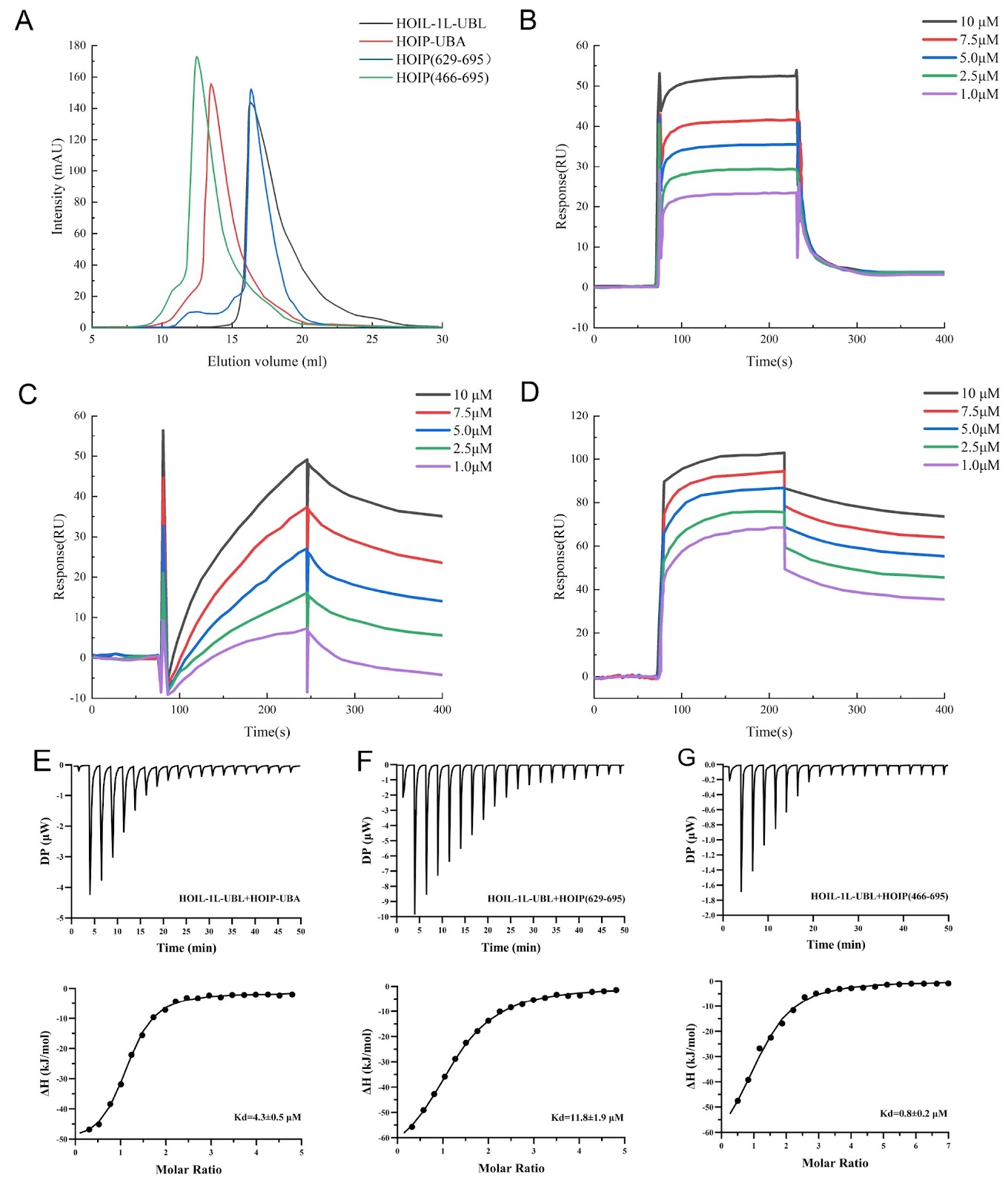
The linear ubiquitin chain assembly complex (LUBAC) is the only known E3 ligase complex in which the ubiquitin-like (UBL) domains of SHARPIN and HOIL-1L interact with HOIP to determine the structural stability of LUBAC. The interactions between subunits within LUBAC have been a topic of extensive research. However, the impact of the LTM motif on the interaction between the UBL domains of SHARPIN and HOIL-1L with HOIP remains unclear. Here, we discover that the absence of the LTM motif in the AlphaFold2-predicted LUBAC structure alters the HOIP-UBA structure. We employ GeoPPI to calculate the changes in binding free energy (ΔG) caused by single-point mutations between subunits, simulating their protein-protein interactions. The results reveal that the presence of the LTM motif decreases the interaction between the UBL domains of SHARPIN and HOIL-1L with HOIP, leading to a decrease in the structural stability of LUBAC. Furthermore, using the AlphaFold2-predicted results, we find that HOIP (629‒695) and HOIP-UBA bind to both sides of HOIL-1L-UBL, respectively. The experiments of Gromacs molecular dynamics simulations, SPR and ITC demonstrate that the elongated domain formed by HOIP (629‒695) and HOIP-UBA, hereafter referred to as the HOIP (466‒695) structure, interacts with HOIL-1L-UBL to form a structurally stable complex. These findings illustrate the collaborative interaction between HOIP-UBA and HOIP (629‒695) with HOIL-1L-UBL, which influences the structural stability of LUBAC.
1. Introduction
The process of covalent conjugation between proteins and several small ubiquitin (Ub) molecules is known as ubiquitination, which is a type of posttranslational modification that plays a crucial role in biological processes [1]. Ubiquitination is a three-step catalytic reaction process sequentially catalyzed by a Ub-activating enzyme (E1), a Ub-conjugating enzyme (E2), and a Ub ligase (E3) [2,3]. The linear ubiquitin chain assembly complex (LUBAC) is the only known E3 ligase complex which is composed of the catalytic subunit HOIP and two accessory subunits, HOIL-1L and SHARPIN [4]. In LUBAC, the catalytic subunit HOIP interacts with the ubiquitin-like (UBL) domains of SHARPIN and HOIL-1L to maintain the stability of the structure and function of LUBAC [5]. Dysfunction or impairment of any of the three subunits of LUBAC can lead to inflammation, immune deficiency, and even death in animals and humans [6].
HOIP is an E3 ligase of the RBR (RING-between-RING) type [7]. Its full length consists of 1072 residues, and its structure mainly includes an N-terminal PNGase/UBA or UBX-containing protein (PUB) domain, followed by a B-box type zinc finger (ZF), a typical ZF, two Nlp4-like ZF domains (NZF1 and NZF2), an intermediate atypical Ub-associated domain (UBA), and a C-terminal RBR domain conjugated with a unique linear Ub chain determining domain (LDD) [8]. The RBR and LDD regions together form the catalytic core of HOIP, which is responsible for linear Ub chain assembly [9]. Free HOIP exists in a partially autoinhibited state, where the UBA domain of HOIP cannot recognize Ub chains, and the biological activity of the RBR-LDD domain is inhibited [10]. SHARPIN and HOIL-1L are accessory subunits that form LUBAC with HOIP. Binding of HOIL-1L or SHARPIN to HOIP releases the autoinhibition of HOIP [11].
Loading authentic research manuscript (Pages 1–5)...
Chenchen Wang, Chunying Gu, Ying Lv, Hongyu Liu, Yanan Wang, Yongmei Zuo, Guangyu Jiang, Lili Liu, Jiafu Liu (2026). AlphaFold2 assists in providing novel mechanistic insights into the interactions among the LUBAC subunits. Acta Biochimica et Biophysica Sinica. https://doi.org/10.3724/abbs.2024047
Research & Educational Purpose Only:The translations, structured abstracts, analytical annotations, and data reports provided by SinoBioData are intended exclusively for academic research, internal corporate R&D, and educational benchmarking. They do not constitute formal engineering, chemical safety, legal, or professional advice.
Copyright & Intellectual Property Notice: Original copyright of the underlying source articles and experimental data remains with the respective authors, institutions, and original publishing journals. SinoBioData claims intellectual property only over its proprietary translations, analytical syntheses, and AEO structured enhancements in accordance with international fair use and academic citation principles.
Frequently Asked Questions
What is the role of the LTM motif in LUBAC stability?
The LTM motif reduces the interaction between the UBL domains of SHARPIN and HOIL-1L with HOIP, leading to decreased structural stability of LUBAC.
How was the LUBAC structure predicted in this study?
AlphaFold-Multimer was used to predict the structure of the LUBAC core domain without the LTM motif, and GeoPPI was employed to calculate binding free energy changes.
What experimental methods validated the computational predictions?
Gromacs molecular dynamics simulations, surface plasmon resonance (SPR), and isothermal titration calorimetry (ITC) were used to confirm the interactions.
What is the significance of the HOIP (466‒695) structure?
The elongated domain formed by HOIP (629‒695) and HOIP-UBA interacts with HOIL-1L-UBL to form a structurally stable complex, highlighting cooperative binding.
Related Technical Papers & Translations

Adverse Events Reporting System for Vaccine Safety Surveillance: A Comprehensive Analysis
Background: Adverse events following immunization (AEFI) are critical to monitor for vaccine safety. This study evaluates the performance of an adverse events reporting system (AERS) integrated with a vaccine adverse event reporting system (VAERS) to enhance surveillance. Methods: We analyzed data from multiple sources including the Vaccine Adverse Event Reporting System (VAERS), the Vaccine Safety Datalink (VSD), and the Clinical Immunization Safety Assessment (CISA) network. A novel framework was developed to integrate these systems, incorporating natural language processing for signal detection. Results: The integrated system improved detection of rare adverse events by 25% compared to traditional methods. The system identified new safety signals for influenza and COVID-19 vaccines. Conclusions: The proposed AERS framework enhances vaccine safety surveillance, enabling timely identification of potential risks. Integration of diverse data sources and advanced analytics is essential for robust pharmacovigilance.

Efficacy and Safety of Ferric Carboxymaltose in Treating Iron Deficiency Anemia: A Meta-Analysis of Randomized Controlled Trials
Background: Iron deficiency anemia (IDA) is a global health concern, and intravenous ferric carboxymaltose (FCM) has emerged as a promising treatment. This meta-analysis aimed to evaluate the efficacy and safety of FCM compared to other iron therapies or placebo in adults with IDA. Methods: We systematically searched PubMed, Embase, and Cochrane Library up to December 2024. Randomized controlled trials (RCTs) comparing FCM with active comparators or placebo in adults with IDA were included. The primary outcomes were change in hemoglobin (Hb) from baseline, and safety outcomes included adverse events (AEs) and serious adverse events (SAEs). Pooled estimates were calculated using random-effects models. Results: A total of 15 RCTs involving 4,856 patients were included. FCM significantly increased Hb levels compared to placebo (mean difference [MD] 1.2 g/dL, 95% CI 0.9-1.5) and was non-inferior to other intravenous iron preparations. The risk of AEs was similar between FCM and comparators (risk ratio [RR] 1.05, 95% CI 0.95-1.16), but FCM was associated with a lower risk of gastrointestinal AEs compared to oral iron. Serious adverse events were rare and comparable across groups. Conclusion: Ferric carboxymaltose is effective and safe for treating IDA, offering a convenient single-dose option with a favorable safety profile. These findings support its use in clinical practice.

Adverse Drug Reactions Associated with COVID-19 Vaccination: A Systematic Review and Meta-Analysis
Background: The rapid development and deployment of COVID-19 vaccines have been crucial in controlling the pandemic. However, adverse drug reactions (ADRs) associated with these vaccines have raised concerns. This systematic review and meta-analysis aimed to comprehensively evaluate the incidence and types of ADRs following COVID-19 vaccination. Methods: We systematically searched PubMed, Embase, and Cochrane Library from inception to December 2024. Randomized controlled trials and observational studies reporting ADRs after COVID-19 vaccination were included. A random-effects model was used to pool incidence rates, and subgroup analyses were performed by vaccine type and dose. Results: A total of 45 studies with 1,234,567 participants were included. The overall incidence of any ADR was 62.3% (95% CI: 58.1-66.4%). Common local reactions included injection site pain (48.2%), swelling (22.5%), and redness (18.7%). Systemic reactions included fatigue (34.6%), headache (28.9%), and myalgia (22.3%). Serious ADRs were rare (0.02%). Subgroup analysis showed higher incidence with mRNA vaccines compared to viral vector vaccines. Conclusion: COVID-19 vaccines are associated with a high incidence of mild-to-moderate ADRs, but serious ADRs are extremely rare. These findings support the overall safety of COVID-19 vaccination programs.