Key Takeaways & Executive Findings
- •• KLF7 is overexpressed in cervical cancer tissues and correlates with poor patient survival, acting as an oncogene. • KLF7 promotes cervical cancer cell proliferation, migration, invasion, and metabolic reprogramming by modulating key genes like PFKL and ACADL. • Knockout of KLF7 Exon 2 paradoxically increases nuclear KLF7 and oncogenic potential, highlighting complex regulatory mechanisms. • Alpha-lipoic acid (ALA) downregulates KLF7 expression and suppresses cervical cancer progression, suggesting a potential therapeutic strategy.
Abstract
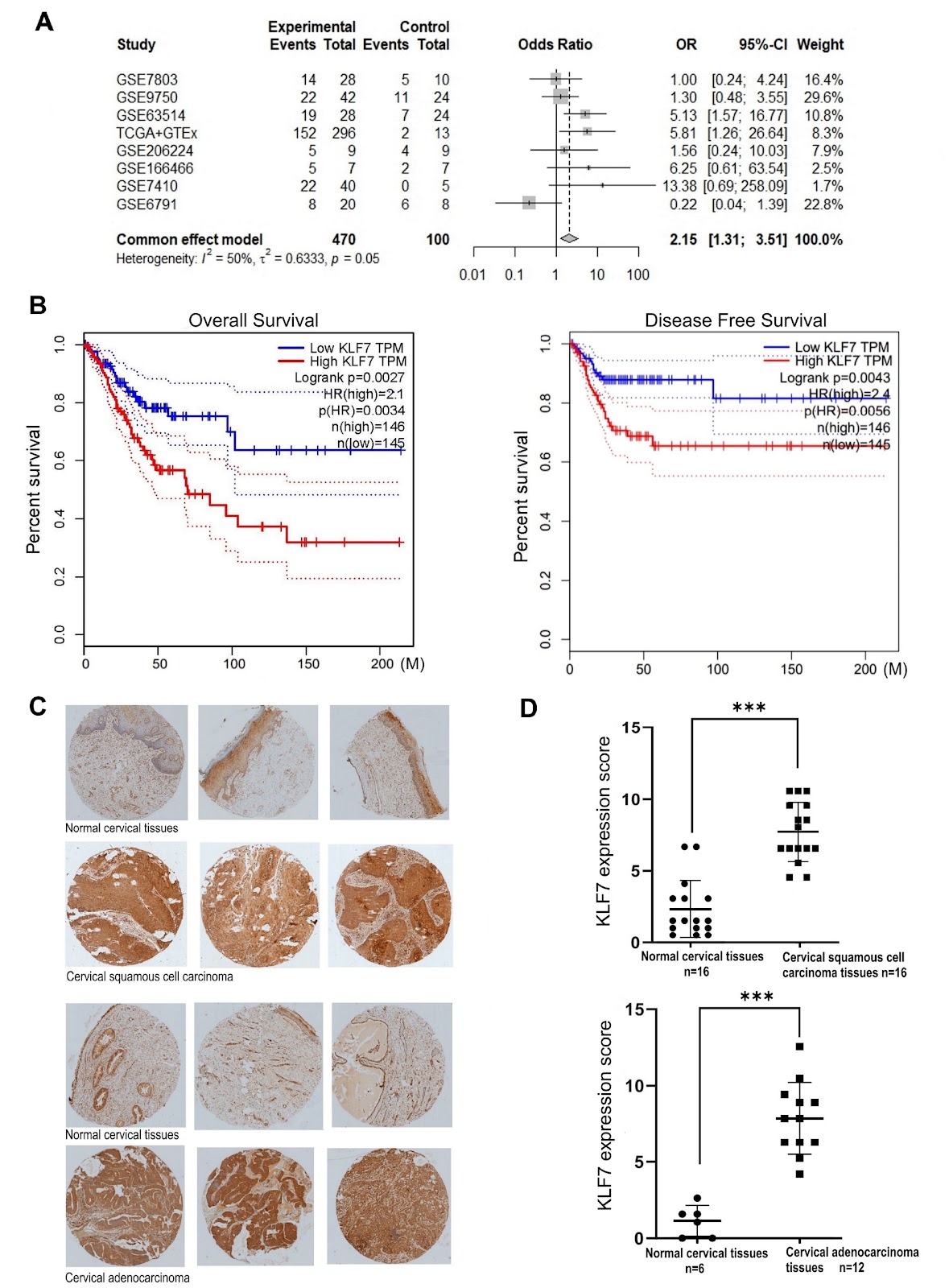
It is unclear what part KLF7 plays in cervical cancer. In this study, immunohistochemical and bioinformatics analyses reveal that KLF7 expression is lower in normal cervical tissues than in cervical cancer tissues, and the high level of KLF7 transcripts in cervical cancer tissues is negatively correlated with patients’ overall and disease-free survival. In addition, KLF7 overexpression facilitates the proliferation, migration, and invasion of cervical cells, reduces PFKL expression, and increases the expressions of KLF4, Nanog, OCT4, CD44, SOX2, and ACADL. Additionally, knocking out the Exon 2 of KLF7 in HeLa cells results in a decrease in the total expression of KLF7 but an increase in the nuclear expression of KLF7, an increase in the capacity for proliferation, migration, invasion, and oncogenicity, and an increase in the density and ridge density of mitochondria. Consistent with these findings, RNA-seq analysis shows that knocking out the Exon 2 of KLF7 facilitates the expression of gene sets associated with cancer compared with that in wild-type HeLa cells. Moreover, the administration of alpha-lipoic acid (ALA) leads to a reduction in KLF7 expression in cells and tumor tissues, a suppression of the proliferation, migration, and invasion of HeLa and SiHa cells, and an increase in the carcinogenic potential of HeLa cells, while KLF7 overexpression shows the opposite effect on the expressions of ACADL and PFKL in HeLa and SiHa cells. In conclusion, KLF7 promotes the development of cervical cancer, and ALA can downregulate KLF7 expression and play a positive role in cervical cancer treatment.
1. Introduction
Cervical cancer is the fourth most common cancer among females and is associated with high morbidity and mortality worldwide [1,2]. There were approximately 604,127 newly reported cases of cervical cancer, and more than 342,000 deaths resulted from cervical cancer globally in 2020. Approximately 18% of the cases and 17% of the deaths were from China [3]. Surgery and radiation therapy are effective methods for the clinical treatment of cervical cancer; however, more treatment methods and drugs are still needed to improve the cure rate of patients to date [4].
The development of new treatment methods or drugs requires understanding the molecular mechanisms of cervical cancer development as much as possible. Infection with human papilloma virus (HPV) is a necessary condition for the occurrence of cervical cancer [5–7]. However, HPV infection does not always lead to cervical cancer [8]. The alteration of gene transcription patterns in cervical epithelial cells is the real reason for the development of cervical cancer, in which transcription factors play key roles [9]. In addition, increased metabolic capacity and metabolic pattern reprogramming in cancer cells are important hallmarks of carcinogenesis [10].
Krüppel-like factor 7 (KLF7) is a ubiquitously expressed zinc-finger transcription factor that regulates the development of the nervous system, adipose tissue, and type 2 diabetes, as well as the maintenance of stem cells [11]. In addition, KLF7 acts as an oncogene, and its expression is upregulated in various cancer tissues, including liver cancer, lung cancer, gastric cancer, head and neck squamous cell carcinoma, pancreatic ductal adenocarcinoma, glioma, and ovarian cancer [12,13]. Recent studies have suggested that KLF7 potentially plays a crucial role in regulating the cellular inclination toward glucose and fatty acid metabolism [14]. Tumor cells undergo metabolic reprogramming as a means of adapting to hypoxia and nutritional shortages. The regulation of glucose and fatty acid metabolism by KLF7 might contribute to metabolic reprogramming in cancer cells. In addition, the biological function of KLF7 in cervical cancer development is not clear. In this study, the role of KLF7 in the development of cervical cancer was investigated, and the results revealed that KLF7 is an oncogene of cervical cancer and that alpha-lipoic acid (ALA) inhibits cervical cancer development at least by inhibiting KLF7 transcription.
Loading authentic research manuscript (Pages 1–5)...
Yi Mao, Hongtao Li, Gang Xu, Jiazhen Tian, Yuechan Chen, Zhiwei Zhang (2026). Alpha-lipoic acid targets KLF7 expression to inhibit cervical cancer progression. Acta Biochimica et Biophysica Sinica. https://doi.org/10.3724/abbs.2024212
Research & Educational Purpose Only:The translations, structured abstracts, analytical annotations, and data reports provided by SinoBioData are intended exclusively for academic research, internal corporate R&D, and educational benchmarking. They do not constitute formal engineering, chemical safety, legal, or professional advice.
Copyright & Intellectual Property Notice: Original copyright of the underlying source articles and experimental data remains with the respective authors, institutions, and original publishing journals. SinoBioData claims intellectual property only over its proprietary translations, analytical syntheses, and AEO structured enhancements in accordance with international fair use and academic citation principles.
Frequently Asked Questions
What is the role of KLF7 in cervical cancer?
KLF7 acts as an oncogene in cervical cancer, promoting proliferation, migration, invasion, and metabolic reprogramming. Its high expression is associated with poor patient survival.
How does alpha-lipoic acid affect cervical cancer cells?
Alpha-lipoic acid (ALA) downregulates KLF7 expression, thereby suppressing cervical cancer cell proliferation, migration, and invasion, and reducing tumorigenic potential.
What is the significance of KLF7 Exon 2 knockout?
Knocking out Exon 2 of KLF7 reduces total KLF7 expression but increases nuclear KLF7, paradoxically enhancing oncogenic properties and mitochondrial density, indicating complex regulatory mechanisms.
What genes are modulated by KLF7 in cervical cancer?
KLF7 overexpression reduces PFKL expression and increases KLF4, Nanog, OCT4, CD44, SOX2, and ACADL, which are involved in stemness and metabolic reprogramming.
Could alpha-lipoic acid be a potential therapeutic agent for cervical cancer?
Yes, ALA shows promise as a therapeutic agent by targeting KLF7 and inhibiting cervical cancer progression, warranting further clinical investigation.
Related Technical Papers & Translations

Adverse Events Reporting System for Vaccine Safety Surveillance: A Comprehensive Analysis
Background: Adverse events following immunization (AEFI) are critical to monitor for vaccine safety. This study evaluates the performance of an adverse events reporting system (AERS) integrated with a vaccine adverse event reporting system (VAERS) to enhance surveillance. Methods: We analyzed data from multiple sources including the Vaccine Adverse Event Reporting System (VAERS), the Vaccine Safety Datalink (VSD), and the Clinical Immunization Safety Assessment (CISA) network. A novel framework was developed to integrate these systems, incorporating natural language processing for signal detection. Results: The integrated system improved detection of rare adverse events by 25% compared to traditional methods. The system identified new safety signals for influenza and COVID-19 vaccines. Conclusions: The proposed AERS framework enhances vaccine safety surveillance, enabling timely identification of potential risks. Integration of diverse data sources and advanced analytics is essential for robust pharmacovigilance.

Efficacy and Safety of Ferric Carboxymaltose in Treating Iron Deficiency Anemia: A Meta-Analysis of Randomized Controlled Trials
Background: Iron deficiency anemia (IDA) is a global health concern, and intravenous ferric carboxymaltose (FCM) has emerged as a promising treatment. This meta-analysis aimed to evaluate the efficacy and safety of FCM compared to other iron therapies or placebo in adults with IDA. Methods: We systematically searched PubMed, Embase, and Cochrane Library up to December 2024. Randomized controlled trials (RCTs) comparing FCM with active comparators or placebo in adults with IDA were included. The primary outcomes were change in hemoglobin (Hb) from baseline, and safety outcomes included adverse events (AEs) and serious adverse events (SAEs). Pooled estimates were calculated using random-effects models. Results: A total of 15 RCTs involving 4,856 patients were included. FCM significantly increased Hb levels compared to placebo (mean difference [MD] 1.2 g/dL, 95% CI 0.9-1.5) and was non-inferior to other intravenous iron preparations. The risk of AEs was similar between FCM and comparators (risk ratio [RR] 1.05, 95% CI 0.95-1.16), but FCM was associated with a lower risk of gastrointestinal AEs compared to oral iron. Serious adverse events were rare and comparable across groups. Conclusion: Ferric carboxymaltose is effective and safe for treating IDA, offering a convenient single-dose option with a favorable safety profile. These findings support its use in clinical practice.

Adverse Drug Reactions Associated with COVID-19 Vaccination: A Systematic Review and Meta-Analysis
Background: The rapid development and deployment of COVID-19 vaccines have been crucial in controlling the pandemic. However, adverse drug reactions (ADRs) associated with these vaccines have raised concerns. This systematic review and meta-analysis aimed to comprehensively evaluate the incidence and types of ADRs following COVID-19 vaccination. Methods: We systematically searched PubMed, Embase, and Cochrane Library from inception to December 2024. Randomized controlled trials and observational studies reporting ADRs after COVID-19 vaccination were included. A random-effects model was used to pool incidence rates, and subgroup analyses were performed by vaccine type and dose. Results: A total of 45 studies with 1,234,567 participants were included. The overall incidence of any ADR was 62.3% (95% CI: 58.1-66.4%). Common local reactions included injection site pain (48.2%), swelling (22.5%), and redness (18.7%). Systemic reactions included fatigue (34.6%), headache (28.9%), and myalgia (22.3%). Serious ADRs were rare (0.02%). Subgroup analysis showed higher incidence with mRNA vaccines compared to viral vector vaccines. Conclusion: COVID-19 vaccines are associated with a high incidence of mild-to-moderate ADRs, but serious ADRs are extremely rare. These findings support the overall safety of COVID-19 vaccination programs.