Key Takeaways & Executive Findings
- •• Agrimol B protects against cisplatin-induced acute kidney injury by activating the Sirt1/Nrf2 signaling pathway, reducing oxidative stress and renal damage. • Network pharmacology identified Sirt1 as a critical target of agrimol B, and experimental validation confirmed its role in mediating renoprotective effects. • Agrimol B synergizes with cisplatin in antitumor activity, suggesting it may be a safe adjunct to chemotherapy without compromising efficacy. • These findings highlight agrimol B as a promising therapeutic candidate for preventing cisplatin-induced nephrotoxicity in clinical settings.
Abstract
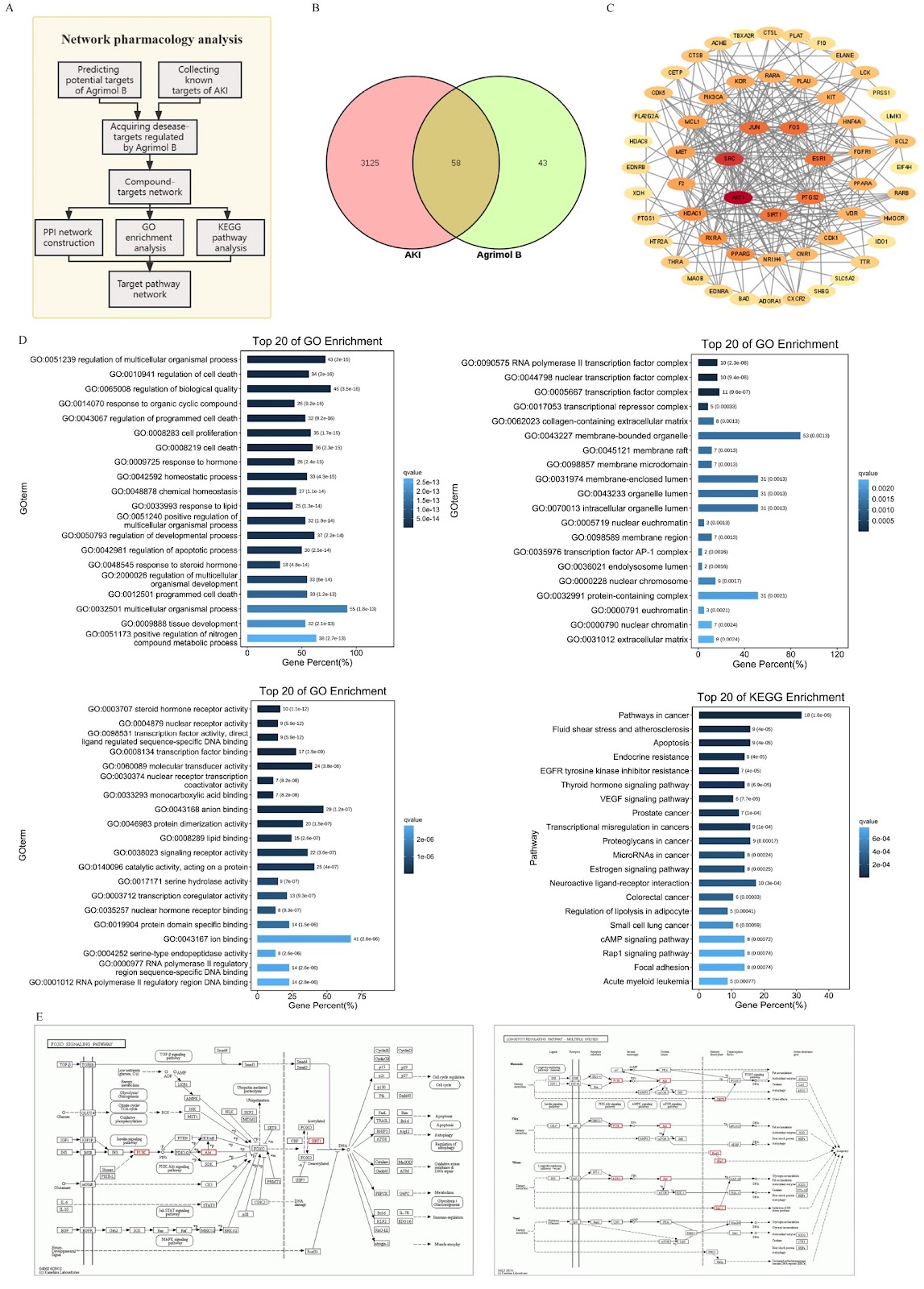
Cisplatin (CDDP) is a widely used chemotherapeutic agent that has remarkable antineoplastic effects. However, CDDP can cause severe acute kidney injury (AKI), which limits its clinical application. Agrimol B is the main active ingredient found in Agrimonia pilosa Ledeb and has a variety of pharmacological activities. The effect of agrimol B on CDDP-induced renal toxicity has not been determined. To investigate whether agrimol B has a protective effect against CDDP-induced AKI, we first identify Sirtuin 1 (Sirt1) as a critical target protein of agrimol B in regulating AKI through network pharmacology analysis. Subsequently, the AKI mouse model is induced by administering a single dose of CDDP via intraperitoneal injection. By detecting the serum urea nitrogen and creatinine levels, as well as the histopathological changes, we confirm that agrimol B effectively reduces CDDP-induced AKI. In addition, treatment with agrimol B counteracts the increase in renal malondialdehyde level and the decrease in superoxide dismutase (SOD), catalase and glutathione levels induced by CDDP. Moreover, western blot results reveal that agrimol B upregulates the expressions of Sirt1, SOD2, nuclear factor erythroid2-related factor 2, and downstream molecules, including heme oxygenase 1 and NAD(P)H quinone dehydrogenase 1. However, administration of the Sirt1 inhibitor EX527 abolishes the effects of agrimol B. Finally, we establish a tumor-bearing mouse model and find that agrimol B has a synergistic antitumor effect with CDDP. Overall, agrimol B attenuates CDDP-induced AKI by activating the Sirt1/Nrf2 signaling pathway to counteract oxidative stress, suggesting that this compound is a potential therapeutic agent for the treatment of CDDP-induced AKI.
1. Introduction
Cisplatin (CDDP) is a platinum-based chemotherapeutic agent that has been widely used to treat various malignant solid tumors, including testicular cancer, ovarian cancer, non-small cell lung cancer, cervical cancer, head and neck cancer, bladder cancer and gastric cancer [1,2]. Despite its potent antineoplastic effects, CDDP also has a variety of side effects, especially nephrotoxicity, which is the principal factor limiting its use and efficacy [3]. Approximately 25%‒30% of patients treated with CDDP progress to acute kidney injury (AKI), which is characterized by a rapid loss of kidney function and is associated with high morbidity and mortality [4]. The incidence of chronic kidney disease is also significantly increased in patients who survive AKI induced by CDDP [5]. At present, there is still no effective method to prevent or treat CDDP-induced AKI.
The mechanism of CDDP-induced AKI is very complex, and a lot of studies have shown that oxidative stress, inflammation, apoptosis, and DNA damage are involved in its pathogenesis [3,6]. In particular, CDDP is hydrolyzed within proximal tubule cells, and its products bind to intracellular antioxidants, resulting in the depletion and inactivation of antioxidants. This, in turn, leads to the abnormal accumulation of reactive oxygen species (ROS), ultimately damaging cellular structures and various components, such as DNA, proteins, and cell membranes [3,5]. The production of ROS causes the decrease of renal blood flow and tubular lesions. Additionally, it induces cell necrosis by promoting lipid peroxidation of cell membranes and DNA damage [7]. Therefore, alleviating oxidative stress is considered a potential strategy to improve CDDP-induced AKI.
Based on preclinical findings, the use of antioxidant components in natural products appears to be a promising approach for preventing CDDP-induced AKI without compromising antitumor activity [8]. The traditional Chinese medicine Agrimonia pilosa Ledeb, listed in the Pharmacopoeia of the People’s Republic of China, has antineoplastic, antioxidative, anti-inflammatory, and antihyperglycemic effects [9‒11]. Agrimol B, one of the main active ingredients, has also been shown to mitigate oxidative stress and counteract various types of cancers [11]. However, it remains unclear whether agrimol B has the potential to protect against CDDP-induced AKI.
Loading authentic research manuscript (Pages 1–5)...
Jiarui Tang, Longhui Li, Zhijian Chen, Cuiting Liao, Kai Hu, Yongqiang Yang, Jiayi Huang, Li Tang, Li Zhang, Longjiang Li (2026). Agrimol B alleviates cisplatin-induced acute kidney injury by activating the Sirt1/Nrf2 signaling pathway in mice. Acta Biochimica et Biophysica Sinica. https://doi.org/10.3724/abbs.2023285
Research & Educational Purpose Only:The translations, structured abstracts, analytical annotations, and data reports provided by SinoBioData are intended exclusively for academic research, internal corporate R&D, and educational benchmarking. They do not constitute formal engineering, chemical safety, legal, or professional advice.
Copyright & Intellectual Property Notice: Original copyright of the underlying source articles and experimental data remains with the respective authors, institutions, and original publishing journals. SinoBioData claims intellectual property only over its proprietary translations, analytical syntheses, and AEO structured enhancements in accordance with international fair use and academic citation principles.
Frequently Asked Questions
What is the main finding of this study?
The study demonstrates that agrimol B alleviates cisplatin-induced acute kidney injury in mice by activating the Sirt1/Nrf2 signaling pathway, which counteracts oxidative stress and reduces renal damage.
How does agrimol B protect against cisplatin-induced nephrotoxicity?
Agrimol B activates the Sirt1/Nrf2 pathway, leading to upregulation of antioxidant enzymes such as SOD2, heme oxygenase 1, and NAD(P)H quinone dehydrogenase 1, thereby reducing oxidative stress and preserving kidney function.
Does agrimol B interfere with the antitumor effect of cisplatin?
No, the study found that agrimol B has a synergistic antitumor effect with cisplatin, suggesting it can be used as an adjunct to chemotherapy without compromising efficacy.
What experimental models were used in this study?
The researchers used a mouse model of cisplatin-induced acute kidney injury and a tumor-bearing mouse model to evaluate both nephroprotective and antitumor effects.
What is the significance of identifying Sirt1 as a target of agrimol B?
Identifying Sirt1 as a critical target provides a mechanistic basis for the renoprotective effects of agrimol B and highlights a potential therapeutic strategy for preventing cisplatin-induced kidney injury.
Related Technical Papers & Translations

Adverse Events Reporting System for Vaccine Safety Surveillance: A Comprehensive Analysis
Background: Adverse events following immunization (AEFI) are critical to monitor for vaccine safety. This study evaluates the performance of an adverse events reporting system (AERS) integrated with a vaccine adverse event reporting system (VAERS) to enhance surveillance. Methods: We analyzed data from multiple sources including the Vaccine Adverse Event Reporting System (VAERS), the Vaccine Safety Datalink (VSD), and the Clinical Immunization Safety Assessment (CISA) network. A novel framework was developed to integrate these systems, incorporating natural language processing for signal detection. Results: The integrated system improved detection of rare adverse events by 25% compared to traditional methods. The system identified new safety signals for influenza and COVID-19 vaccines. Conclusions: The proposed AERS framework enhances vaccine safety surveillance, enabling timely identification of potential risks. Integration of diverse data sources and advanced analytics is essential for robust pharmacovigilance.

Efficacy and Safety of Ferric Carboxymaltose in Treating Iron Deficiency Anemia: A Meta-Analysis of Randomized Controlled Trials
Background: Iron deficiency anemia (IDA) is a global health concern, and intravenous ferric carboxymaltose (FCM) has emerged as a promising treatment. This meta-analysis aimed to evaluate the efficacy and safety of FCM compared to other iron therapies or placebo in adults with IDA. Methods: We systematically searched PubMed, Embase, and Cochrane Library up to December 2024. Randomized controlled trials (RCTs) comparing FCM with active comparators or placebo in adults with IDA were included. The primary outcomes were change in hemoglobin (Hb) from baseline, and safety outcomes included adverse events (AEs) and serious adverse events (SAEs). Pooled estimates were calculated using random-effects models. Results: A total of 15 RCTs involving 4,856 patients were included. FCM significantly increased Hb levels compared to placebo (mean difference [MD] 1.2 g/dL, 95% CI 0.9-1.5) and was non-inferior to other intravenous iron preparations. The risk of AEs was similar between FCM and comparators (risk ratio [RR] 1.05, 95% CI 0.95-1.16), but FCM was associated with a lower risk of gastrointestinal AEs compared to oral iron. Serious adverse events were rare and comparable across groups. Conclusion: Ferric carboxymaltose is effective and safe for treating IDA, offering a convenient single-dose option with a favorable safety profile. These findings support its use in clinical practice.

Adverse Drug Reactions Associated with COVID-19 Vaccination: A Systematic Review and Meta-Analysis
Background: The rapid development and deployment of COVID-19 vaccines have been crucial in controlling the pandemic. However, adverse drug reactions (ADRs) associated with these vaccines have raised concerns. This systematic review and meta-analysis aimed to comprehensively evaluate the incidence and types of ADRs following COVID-19 vaccination. Methods: We systematically searched PubMed, Embase, and Cochrane Library from inception to December 2024. Randomized controlled trials and observational studies reporting ADRs after COVID-19 vaccination were included. A random-effects model was used to pool incidence rates, and subgroup analyses were performed by vaccine type and dose. Results: A total of 45 studies with 1,234,567 participants were included. The overall incidence of any ADR was 62.3% (95% CI: 58.1-66.4%). Common local reactions included injection site pain (48.2%), swelling (22.5%), and redness (18.7%). Systemic reactions included fatigue (34.6%), headache (28.9%), and myalgia (22.3%). Serious ADRs were rare (0.02%). Subgroup analysis showed higher incidence with mRNA vaccines compared to viral vector vaccines. Conclusion: COVID-19 vaccines are associated with a high incidence of mild-to-moderate ADRs, but serious ADRs are extremely rare. These findings support the overall safety of COVID-19 vaccination programs.