Key Takeaways & Executive Findings
- •• Fecal microbiota transplantation from young mice restores cognitive function in aged mice, partially by increasing hippocampal synaptophysin. • Ageing-associated gut dysbiosis is characterized by reduced Lactobacillus abundance, which is reversed by FMT. • FMT elevates serum acetic acid, which upregulates ACSS2 and synaptophysin in senescent neurons, enhancing ATP production. • Gut microbiota transplantation represents a promising therapeutic strategy for ageing-associated cognitive decline.
Abstract
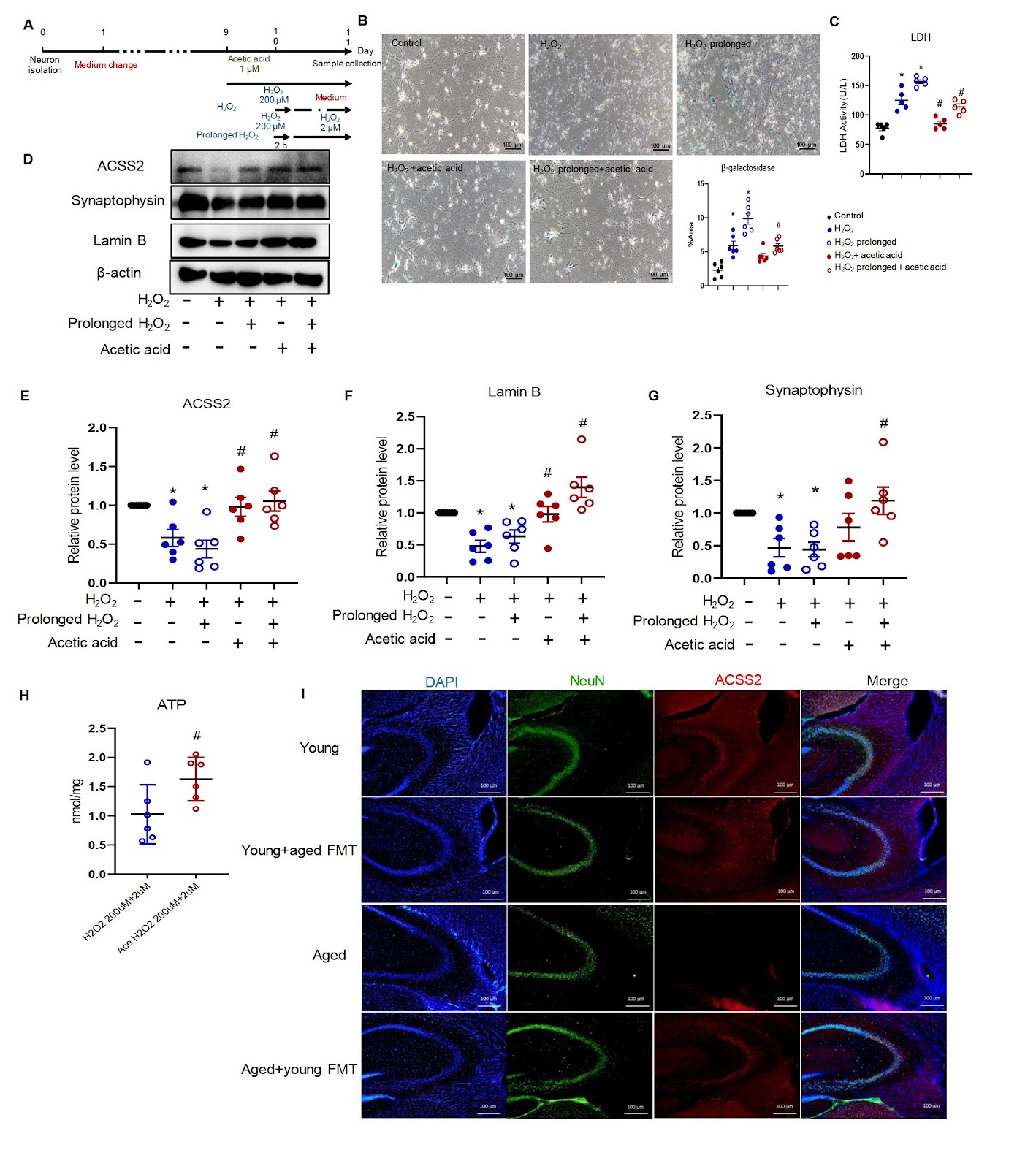
Ageing is an independent factor for cognitive dysfunction. Ageing-associated alterations in the gut microbiota also affect cognition. The present study is designed to investigate changes in the gut microbiota and their participation in ageing-associated cognitive impairment. Both 10-week-old and 18-month-old mice are used. Mouse cognition is examined by novel object recognition and T-maze tests. Mouse feces are collected for sequencing and transplantation. Protein expression in the mouse intestine and hippocampus is studied using immunohistochemistry and immunofluorescence staining. Senescent neurons are induced by hydrogen peroxide in vitro. The cell lysates are used for western blot analysis and adenosine triphosphate (ATP) measurement. Our results show that 18-month-old mice exhibit cognitive dysfunction compared with young mice. In aged mice, transplanting the microbiota of young mice increases the protein presence of synaptophysin in the hippocampus and partially restores cognition. The protein expressions of mucin-2 and E-cadherin in the intestine are reduced in aged mice but are increased by transplantation. Gut microbiota analyses reveal that the reduced abundance of the microbe Bacilli-Lactobacillales-Lactobacillaceae-Lactobacillus in aged mice is restored by transplantation. Fecal microbiota transplantation in young mice increases the serum level of acetic acid in aged mice. Hydrogen peroxide stimulation induces senescence and reduces the protein expression levels of synaptophysin and acetyl-coenzyme A synthetase member 2 (ACSS2) in primary neurons. Incubation with acetic acid upregulates the protein expressions of ACSS2 and synaptophysin and further increases ATP production in senescent neurons. In summary, gut microbiota transplantation increases the abundance of Lactobacillales, elevates serum acetic acid level, and improves cognitive function in aged mice. Gut microbiota transplantation has therapeutic importance for ageing-associated cognitive decline.
1. Introduction
Medical advances and hygiene improvements have significantly extended lifespan in modern society. However, the incidence of ageing-associated diseases, including neurological disorders, cardiovascular disease and malignant cancers, has also increased. It has been reported that more than 50 million senile people worldwide suffer from cognitive impairments, which will reach 130 million by 2050 [1]. Ageing-induced neuron impairment and microglial activation in the central nervous system are critical mechanisms underlying cognitive decline, shown as impaired learning capacity, memory loss, confusion, anxiety, and personality changes.
In addition to the well-studied mechanisms in the central nervous system, the gut microbiota plays a role in neurological disorders through the gut-brain axis [2], probably through the release of metabolites and neurotransmitters [3]. Notably, patients suffering from cognitive decline have altered gut microbiota communities, as shown by decreases in the beneficial bacteria Akkermansia and Bifidobacterium and increases in the detrimental bacteria Ruminococcus and Eggerthella [4–7]. In a rodent model of Alzheimer’s disease, germ-free mice presented reduced cerebral amyloid-β plaques and blunted neurofibrillary tangles compared with their counterparts under specific pathogen-free conditions [8]. Transplanting the gut microbiota from Alzheimer’s disease model mice impaired memory in C57BL/6 mice [9]. Short-chain fatty acids (SCFAs), including acetic acid, pentanoic acid, hexanoic acid, isovaleric acid, and butyric acid, are the primary metabolites of bacteria. SCFAs are involved in regulating neurotransmitters [10], neurotrophic factors [11], myelination [12], and microglial homeostasis [13]. The administration of acetate increases the production of glutamate-glutamine, a regulatory neuropeptide, and suppresses appetite in mice [10]. Sodium butyrate increases mitochondrial biogenesis in astrocytes and ameliorates cognitive impairments in Alzheimer’s disease model mice [14]. Therefore, fecal microbiota transplantation (FMT) has been developed as an alternative treatment for cognitive impairment. Treatment with Bacillus subtilis probiotics inhibits α-synuclein aggregation in C. elegans [15]. In aged mice with cognitive dysfunction, probiotic treatment improved memory by restoring the anatomic structure of the gut and the blood-brain barrier [16].
Thus, the present study was designed to investigate the effects of FMT on ageing-associated cognitive decline and the underlying mechanisms involving gut microbiota and metabolites.
Loading authentic research manuscript (Pages 1–5)...
Huihui Ju, Yile Zhou, Wanting Wei, Yan Hu, Hongwei Fang, Zhouyi Chen, Xia Sun, Yi Shi, Hao Fang (2026). Ageing-associated gut dysbiosis deteriorates mouse cognition. Acta Biochimica et Biophysica Sinica. https://doi.org/10.3724/abbs.2024217
Research & Educational Purpose Only:The translations, structured abstracts, analytical annotations, and data reports provided by SinoBioData are intended exclusively for academic research, internal corporate R&D, and educational benchmarking. They do not constitute formal engineering, chemical safety, legal, or professional advice.
Copyright & Intellectual Property Notice: Original copyright of the underlying source articles and experimental data remains with the respective authors, institutions, and original publishing journals. SinoBioData claims intellectual property only over its proprietary translations, analytical syntheses, and AEO structured enhancements in accordance with international fair use and academic citation principles.
Frequently Asked Questions
What is the main finding of this study?
The study demonstrates that fecal microbiota transplantation from young mice improves cognitive function in aged mice by restoring gut microbiota composition, particularly increasing Lactobacillus abundance, and elevating serum acetic acid levels, which in turn upregulates ACSS2 and synaptophysin in neurons.
How does gut microbiota affect cognition in ageing?
Ageing-associated gut dysbiosis, characterized by reduced beneficial bacteria like Lactobacillus, leads to decreased production of short-chain fatty acids such as acetic acid, which are crucial for neuronal function. This contributes to cognitive decline through the gut-brain axis.
What is the role of acetic acid in this context?
Acetic acid, a short-chain fatty acid produced by gut bacteria, upregulates the expression of ACSS2 and synaptophysin in senescent neurons, enhancing ATP production and potentially improving synaptic function and cognition.
Could fecal microbiota transplantation be a therapeutic approach for cognitive decline?
Yes, the study suggests that FMT has therapeutic potential for ageing-associated cognitive decline by restoring beneficial gut bacteria and metabolite production, thereby improving cognitive function in aged mice.
What are the key mechanisms underlying the cognitive improvement after FMT?
FMT restores gut microbiota diversity, increases Lactobacillales abundance, elevates serum acetic acid, and upregulates hippocampal synaptophysin and intestinal mucin-2 and E-cadherin, collectively improving gut barrier integrity and neuronal health.
Related Technical Papers & Translations

Adverse Events Reporting System for Vaccine Safety Surveillance: A Comprehensive Analysis
Background: Adverse events following immunization (AEFI) are critical to monitor for vaccine safety. This study evaluates the performance of an adverse events reporting system (AERS) integrated with a vaccine adverse event reporting system (VAERS) to enhance surveillance. Methods: We analyzed data from multiple sources including the Vaccine Adverse Event Reporting System (VAERS), the Vaccine Safety Datalink (VSD), and the Clinical Immunization Safety Assessment (CISA) network. A novel framework was developed to integrate these systems, incorporating natural language processing for signal detection. Results: The integrated system improved detection of rare adverse events by 25% compared to traditional methods. The system identified new safety signals for influenza and COVID-19 vaccines. Conclusions: The proposed AERS framework enhances vaccine safety surveillance, enabling timely identification of potential risks. Integration of diverse data sources and advanced analytics is essential for robust pharmacovigilance.

Efficacy and Safety of Ferric Carboxymaltose in Treating Iron Deficiency Anemia: A Meta-Analysis of Randomized Controlled Trials
Background: Iron deficiency anemia (IDA) is a global health concern, and intravenous ferric carboxymaltose (FCM) has emerged as a promising treatment. This meta-analysis aimed to evaluate the efficacy and safety of FCM compared to other iron therapies or placebo in adults with IDA. Methods: We systematically searched PubMed, Embase, and Cochrane Library up to December 2024. Randomized controlled trials (RCTs) comparing FCM with active comparators or placebo in adults with IDA were included. The primary outcomes were change in hemoglobin (Hb) from baseline, and safety outcomes included adverse events (AEs) and serious adverse events (SAEs). Pooled estimates were calculated using random-effects models. Results: A total of 15 RCTs involving 4,856 patients were included. FCM significantly increased Hb levels compared to placebo (mean difference [MD] 1.2 g/dL, 95% CI 0.9-1.5) and was non-inferior to other intravenous iron preparations. The risk of AEs was similar between FCM and comparators (risk ratio [RR] 1.05, 95% CI 0.95-1.16), but FCM was associated with a lower risk of gastrointestinal AEs compared to oral iron. Serious adverse events were rare and comparable across groups. Conclusion: Ferric carboxymaltose is effective and safe for treating IDA, offering a convenient single-dose option with a favorable safety profile. These findings support its use in clinical practice.

Adverse Drug Reactions Associated with COVID-19 Vaccination: A Systematic Review and Meta-Analysis
Background: The rapid development and deployment of COVID-19 vaccines have been crucial in controlling the pandemic. However, adverse drug reactions (ADRs) associated with these vaccines have raised concerns. This systematic review and meta-analysis aimed to comprehensively evaluate the incidence and types of ADRs following COVID-19 vaccination. Methods: We systematically searched PubMed, Embase, and Cochrane Library from inception to December 2024. Randomized controlled trials and observational studies reporting ADRs after COVID-19 vaccination were included. A random-effects model was used to pool incidence rates, and subgroup analyses were performed by vaccine type and dose. Results: A total of 45 studies with 1,234,567 participants were included. The overall incidence of any ADR was 62.3% (95% CI: 58.1-66.4%). Common local reactions included injection site pain (48.2%), swelling (22.5%), and redness (18.7%). Systemic reactions included fatigue (34.6%), headache (28.9%), and myalgia (22.3%). Serious ADRs were rare (0.02%). Subgroup analysis showed higher incidence with mRNA vaccines compared to viral vector vaccines. Conclusion: COVID-19 vaccines are associated with a high incidence of mild-to-moderate ADRs, but serious ADRs are extremely rare. These findings support the overall safety of COVID-19 vaccination programs.