Key Takeaways & Executive Findings
- •• Golden hamster studies reveal that PIWI-piRNA pathway is essential for female fertility, contrary to mouse models where it is dispensable. • piRNAs play critical roles in oogenesis and early embryogenesis by silencing transposable elements and regulating gene expression. • The review highlights species-specific differences in piRNA biology, advocating hamsters as a more representative model for human reproduction. • Emerging research directions include understanding piRNA dynamics and functional redundancies, with implications for diagnosing and treating female infertility.
Abstract
PIWI-interacting RNAs (piRNAs), which associate with PIWI clade Argonaute proteins to form piRNA-induced silencing complexes (piRISCs) in germline cells, are responsible for maintaining genomic integrity and reproductive function through transcriptional or post-transcriptional suppression of transposable elements and regulation of protein-coding genes. Recent discoveries of crucial PIWI-piRNA functions in oogenesis and embryogenesis in golden hamsters suggest an indispensable role in female fertility that has been obscured in the predominant mouse model of PIWI-piRNA pathway regulation. In particular, studies of piRNA expression dynamics, functional redundancies, and compositional variations across mammal species have advanced our understanding of piRNA functions in male and, especially, female reproduction. These findings further support the use of hamsters as a more representative model of piRNA biology in mammals. In addition to discussing these new perspectives, the current review also covers emerging directions for piRNA research, its implications for female fertility, and our fundamental understanding of reproductive mechanisms.
1. Introduction
During gametogenesis and early embryogenesis in animals, transposon elements (TEs) are actively transcribed as a result of epigenetic reprogramming, which can cause severe damage to the host genome [1–4]. In most animals, genome integrity is guided by a conserved adaptive immune system known as the PIWI-interacting RNAs (piRNAs) pathway in the germline [5–7]. piRNAs are an animal-specific class of small non-coding RNAs that are distinct from microRNAs (miRNAs) and small interfering RNAs (siRNAs) [8–12]. piRNAs guide PIWI clade Argonautes (PIWI proteins) rather than AGO clade proteins, which are known to mediate miRNA- and siRNA-dependent regulatory pathways [13]. PIWI-piRNA complexes, namely, piRNA-induced silencing complexes (piRISCs), primarily function in silencing TEs at both the transcriptional and post-transcriptional levels in animal germ cells [5,6]. Moreover, increasing evidence suggests that the PIWI-piRNA machinery can also mediate the regulation of protein-coding genes [14,15]. These critical activities of piRNAs in germ cells are indispensable for fertility in most animals [7].
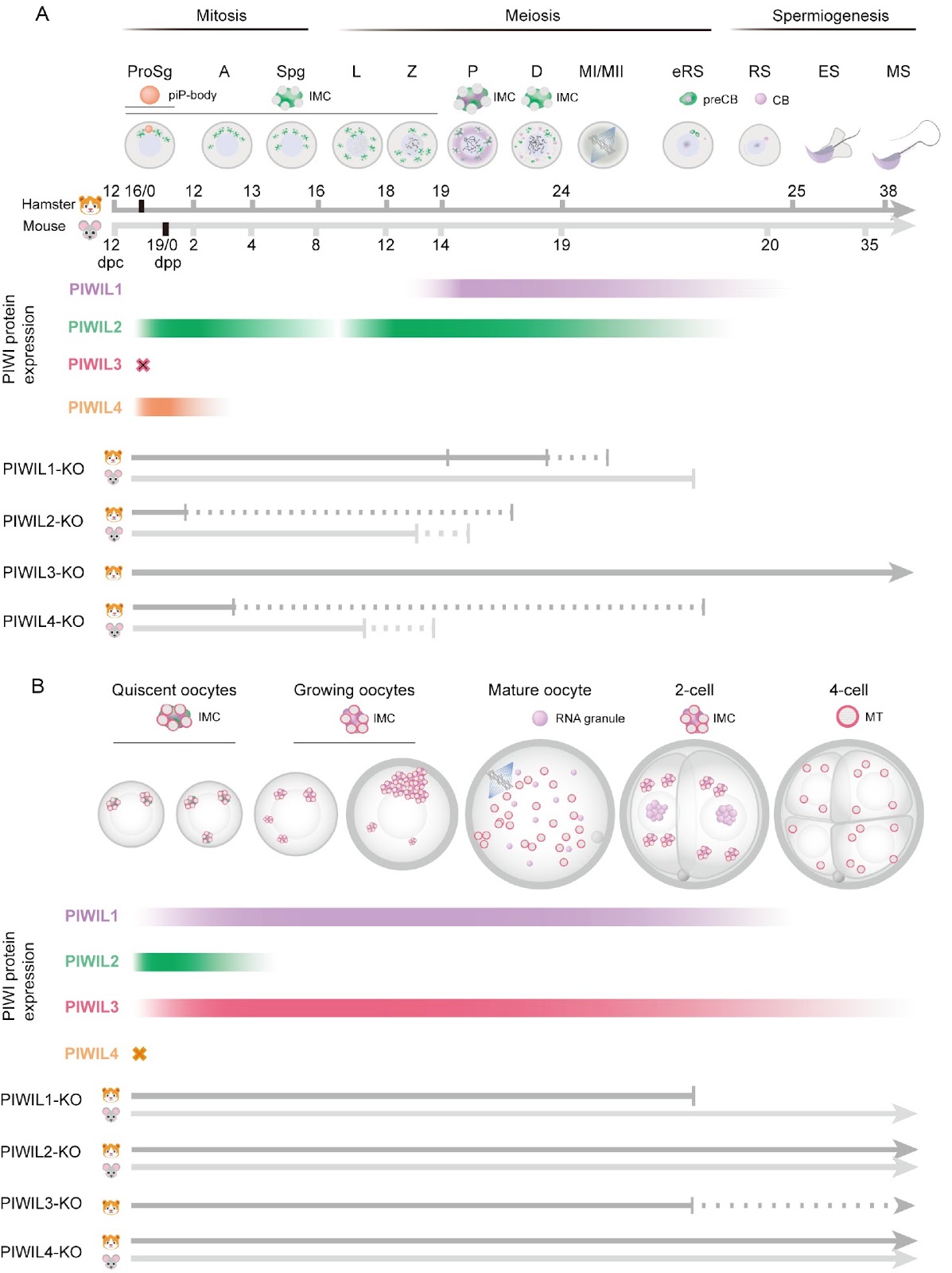
In mice, which have served for decades as a common mammalian model for studying PIWI-piRNAs, the disruption of any Piwi genes or other genes critical for piRNA biogenesis leads to the arrest of spermatogenesis but does not impair oogenesis or female fertility [10,16–20]. However, recent evidence indicates that small non-coding RNAs in mouse oocytes may not be representative of other mammals, including humans [21,22], as previously thought. In particular, recent studies in golden hamsters have shown that piRNAs are essential for female fertility and that the absence of any piRNA population can lead to arrested embryonic development [23–26]. It is thus apparent that the piRNA pathway plays essential roles in female reproduction, which has long been underappreciated and warrants careful examination in other mammals. Here, we discuss recent advances in our understanding of the biological functions of the piRNA pathway in mammalian oocytes and early embryos, especially with a focus on golden hamsters and humans.
Loading authentic research manuscript (Pages 1–5)...
Xiaolong Lv, Hongdao Zhang, Ligang Wu (2026). Advances in PIWI-piRNA function in female reproduction in mammals. Acta Biochimica et Biophysica Sinica. https://doi.org/10.3724/abbs.2024195
Research & Educational Purpose Only:The translations, structured abstracts, analytical annotations, and data reports provided by SinoBioData are intended exclusively for academic research, internal corporate R&D, and educational benchmarking. They do not constitute formal engineering, chemical safety, legal, or professional advice.
Copyright & Intellectual Property Notice: Original copyright of the underlying source articles and experimental data remains with the respective authors, institutions, and original publishing journals. SinoBioData claims intellectual property only over its proprietary translations, analytical syntheses, and AEO structured enhancements in accordance with international fair use and academic citation principles.
Frequently Asked Questions
What are PIWI-interacting RNAs (piRNAs) and their role in female reproduction?
piRNAs are small non-coding RNAs that associate with PIWI proteins to form piRISCs, which silence transposable elements and regulate gene expression. Recent studies in golden hamsters show they are essential for female fertility, impacting oogenesis and early embryogenesis.
Why are golden hamsters considered a better model than mice for studying piRNA function in female reproduction?
Unlike mice, where piRNA pathway disruption does not affect female fertility, golden hamsters exhibit arrested embryonic development when piRNAs are absent, making them a more representative model for human reproductive biology.
What is the significance of the piRNA pathway in maintaining genomic integrity?
The piRNA pathway silences transposable elements during gametogenesis and early embryogenesis, preventing genomic damage caused by their activation, thus ensuring fertility.
What are the emerging research directions in piRNA biology?
Emerging directions include understanding piRNA expression dynamics, functional redundancies, and compositional variations across species, as well as their implications for female infertility and reproductive mechanisms.
How do piRNAs regulate protein-coding genes?
In addition to silencing transposons, PIWI-piRNA complexes can regulate protein-coding genes at transcriptional and post-transcriptional levels, contributing to proper germ cell development.
Related Technical Papers & Translations

Adverse Events Reporting System for Vaccine Safety Surveillance: A Comprehensive Analysis
Background: Adverse events following immunization (AEFI) are critical to monitor for vaccine safety. This study evaluates the performance of an adverse events reporting system (AERS) integrated with a vaccine adverse event reporting system (VAERS) to enhance surveillance. Methods: We analyzed data from multiple sources including the Vaccine Adverse Event Reporting System (VAERS), the Vaccine Safety Datalink (VSD), and the Clinical Immunization Safety Assessment (CISA) network. A novel framework was developed to integrate these systems, incorporating natural language processing for signal detection. Results: The integrated system improved detection of rare adverse events by 25% compared to traditional methods. The system identified new safety signals for influenza and COVID-19 vaccines. Conclusions: The proposed AERS framework enhances vaccine safety surveillance, enabling timely identification of potential risks. Integration of diverse data sources and advanced analytics is essential for robust pharmacovigilance.

Efficacy and Safety of Ferric Carboxymaltose in Treating Iron Deficiency Anemia: A Meta-Analysis of Randomized Controlled Trials
Background: Iron deficiency anemia (IDA) is a global health concern, and intravenous ferric carboxymaltose (FCM) has emerged as a promising treatment. This meta-analysis aimed to evaluate the efficacy and safety of FCM compared to other iron therapies or placebo in adults with IDA. Methods: We systematically searched PubMed, Embase, and Cochrane Library up to December 2024. Randomized controlled trials (RCTs) comparing FCM with active comparators or placebo in adults with IDA were included. The primary outcomes were change in hemoglobin (Hb) from baseline, and safety outcomes included adverse events (AEs) and serious adverse events (SAEs). Pooled estimates were calculated using random-effects models. Results: A total of 15 RCTs involving 4,856 patients were included. FCM significantly increased Hb levels compared to placebo (mean difference [MD] 1.2 g/dL, 95% CI 0.9-1.5) and was non-inferior to other intravenous iron preparations. The risk of AEs was similar between FCM and comparators (risk ratio [RR] 1.05, 95% CI 0.95-1.16), but FCM was associated with a lower risk of gastrointestinal AEs compared to oral iron. Serious adverse events were rare and comparable across groups. Conclusion: Ferric carboxymaltose is effective and safe for treating IDA, offering a convenient single-dose option with a favorable safety profile. These findings support its use in clinical practice.

Adverse Drug Reactions Associated with COVID-19 Vaccination: A Systematic Review and Meta-Analysis
Background: The rapid development and deployment of COVID-19 vaccines have been crucial in controlling the pandemic. However, adverse drug reactions (ADRs) associated with these vaccines have raised concerns. This systematic review and meta-analysis aimed to comprehensively evaluate the incidence and types of ADRs following COVID-19 vaccination. Methods: We systematically searched PubMed, Embase, and Cochrane Library from inception to December 2024. Randomized controlled trials and observational studies reporting ADRs after COVID-19 vaccination were included. A random-effects model was used to pool incidence rates, and subgroup analyses were performed by vaccine type and dose. Results: A total of 45 studies with 1,234,567 participants were included. The overall incidence of any ADR was 62.3% (95% CI: 58.1-66.4%). Common local reactions included injection site pain (48.2%), swelling (22.5%), and redness (18.7%). Systemic reactions included fatigue (34.6%), headache (28.9%), and myalgia (22.3%). Serious ADRs were rare (0.02%). Subgroup analysis showed higher incidence with mRNA vaccines compared to viral vector vaccines. Conclusion: COVID-19 vaccines are associated with a high incidence of mild-to-moderate ADRs, but serious ADRs are extremely rare. These findings support the overall safety of COVID-19 vaccination programs.