Key Takeaways & Executive Findings
- •• First report of a germline SMARCB1 mutation (c.1091A>C, p.Lys364Thr) associated with both adult Coffin-Siris syndrome type 3 (CSS3) and meningioma, expanding the phenotypic spectrum of SMARCB1-related disorders. • The novel missense mutation may abnormally activate the MAPK signaling pathway, linking chromatin remodeling defects to tumor progression and neurodevelopmental phenotypes. • Whole-exome sequencing identified the mutation in two adult siblings with selective verbal learning difficulties and language delays, highlighting the adult presentation of CSS3. • The study underscores the importance of surveillance for tumor development in adult CSS3 patients with SMARCB1 mutations.
Abstract
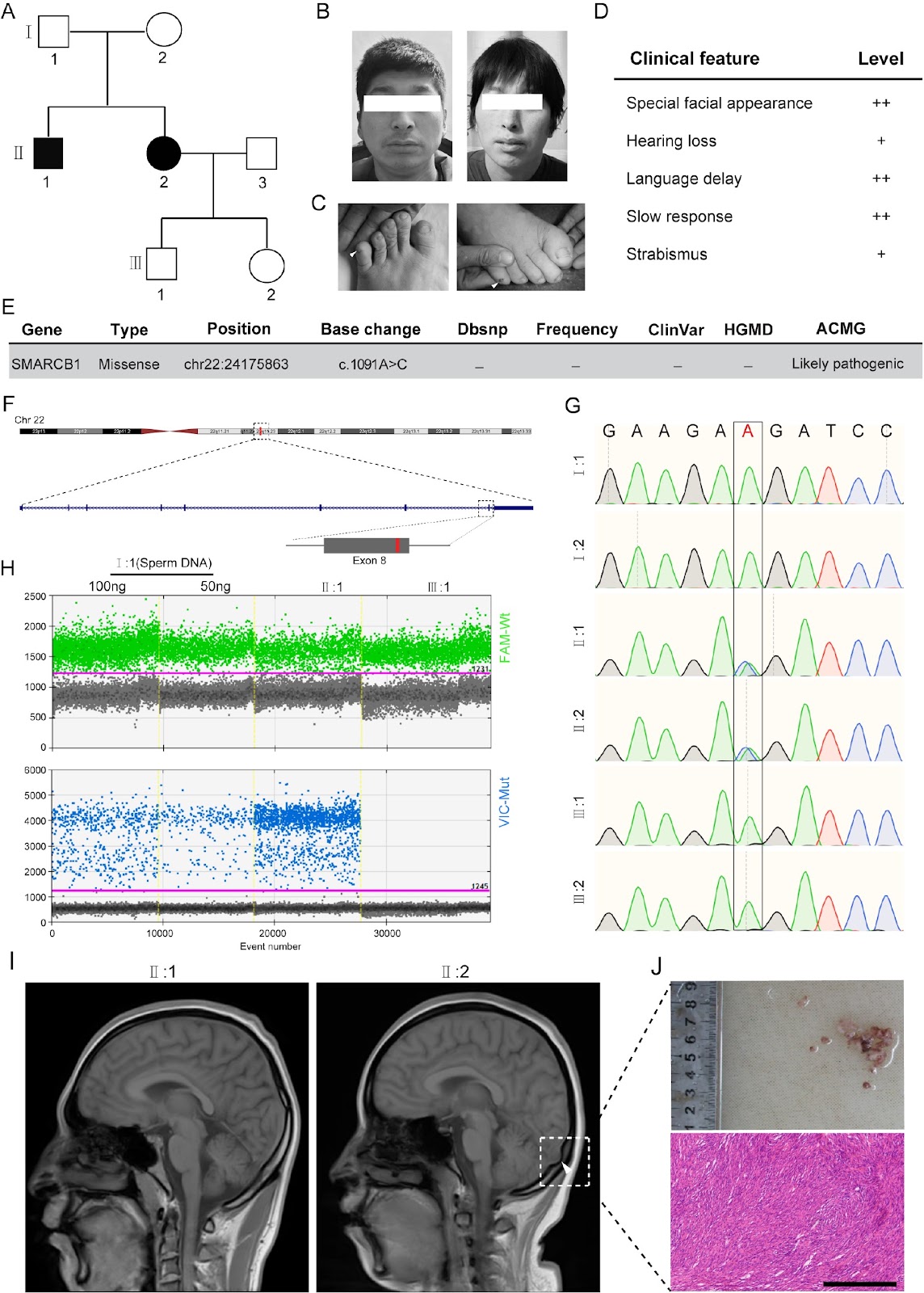
SMARCB1 encodes a core subunit of the SWI/SNF chromatin remodeling complex, which plays a crucial role in the regulation of gene expression. Germline mutations in the SMARCB1 gene have been linked to early childhood Coffin-Siris syndrome type 3 (CSS3), a rare congenital malformation syndrome characterized by severe developmental delay and intellectual disability. In this study, we report a family of two adult CSS3 patients with a novel missense SMARCB1 mutation (c.1091A>C, p.Lys364Thr) identified through whole-exome sequencing (WES). Both patients exhibit selective difficulties in verbal learning and experience language delays. Additionally, the development of meningioma is confirmed in one of the patients. Mechanistic studies suggest that this missense mutation may abnormally activate the MAPK signaling pathway, which is implicated in the pathogenesis of tumor progression and neurodevelopmental disorders. This is the first reported case of a germline mutation in the SMARCB1 gene associated with both CSS3 and meningioma, thereby expanding the phenotypic spectrum of SMARCB1-related disorders.
1. Introduction
The mammalian SWI/SNF (Switch/sucrose non-fermentable) complex is an evolutionarily conserved, ATP-dependent chromatin remodeling complex that functions as an epigenetic modulator in the regulation of gene accessibility and expression [1–3]. Germline variants in genes encoding the core subunits of the SWI/SNF complex, including SMARCB1, SMARCA4, SMARCA2, SMARCE1, ARID1A, and ARID1B, have been implicated in neurodevelopmental disorders [4–8]. One such disorder is Coffin-Siris syndrome (CSS), a rare intellectual disability syndrome characterized by developmental delay, hypotonia, coarse facial features, feeding difficulties in infancy, and fifth digit anomalies [7,9–12]. Notably, mutations in SMARCB1 (also known as SNF5, BAF47, and INI1) are often associated with individuals exhibiting more severe intellectual disability and choroid plexus hyperplasia, a condition referred to as CSS3 (OMIM# 614608) [4,13,14].
In addition, genome-sequencing studies have revealed the extensive role of the SWI/SNF complex in cancer, with approximately 25% of all human tumors displaying aberrations in these genes [15–17]. SMARCB1 is recognized as a tumor suppressor, and its mutations have been linked to malignant rhabdoid tumors, schwannomas, and meningiomas, either individually or concurrently [18,19]. SMARCB1 consists of 385 amino acids, which include the N-terminal winged-helix DNA binding domain [20], two tandem repeat domains, and the highly conserved putative coiled-coil C-terminal domain (CTD) [14]. Notably, single-residue mutations closely associated with CSS and cancer are enriched in the CTD [14,21]. However, it remains unclear whether individuals with CSS3 concurrently develop tumors due to the limited understanding of the adult phenotypes of these patients. In this study, we identified a novel germline missense mutation in two members of a family with CSS3, one of whom developed meningioma. This report expands the phenotypic spectrum associated with SMARCB1-related disorders.
Loading authentic research manuscript (Pages 1–5)...
Zhenglong Guo, Jie Bai, Yang Liu, Xianwei Zhang, Wenke Yang, Jinming Wang, Yuwei Zhang, Hai Xiao, Bingtao Hao, Shixiu Liao (2026). A novel mutation in SMARCB1 associated with adult Coffin-Siris syndrome and meningioma. Acta Biochimica et Biophysica Sinica. https://doi.org/10.3724/abbs.2024204
Research & Educational Purpose Only:The translations, structured abstracts, analytical annotations, and data reports provided by SinoBioData are intended exclusively for academic research, internal corporate R&D, and educational benchmarking. They do not constitute formal engineering, chemical safety, legal, or professional advice.
Copyright & Intellectual Property Notice: Original copyright of the underlying source articles and experimental data remains with the respective authors, institutions, and original publishing journals. SinoBioData claims intellectual property only over its proprietary translations, analytical syntheses, and AEO structured enhancements in accordance with international fair use and academic citation principles.
Frequently Asked Questions
What is the novel mutation reported in this study?
The study identifies a novel missense mutation in the SMARCB1 gene: c.1091A>C, resulting in p.Lys364Thr.
What is Coffin-Siris syndrome type 3 (CSS3)?
CSS3 is a rare congenital malformation syndrome caused by mutations in SMARCB1, characterized by severe developmental delay, intellectual disability, and other features such as hypotonia and coarse facial features.
How was the mutation identified?
The mutation was identified through whole-exome sequencing (WES) of two affected siblings and their parents, and confirmed by Sanger sequencing.
What is the clinical significance of this finding?
This is the first reported case of a germline SMARCB1 mutation associated with both CSS3 and meningioma, expanding the phenotypic spectrum and highlighting the need for tumor surveillance in adult CSS3 patients.
What mechanistic insight does the study provide?
The study suggests that the mutation may abnormally activate the MAPK signaling pathway, which is implicated in tumor progression and neurodevelopmental disorders.
Related Technical Papers & Translations

Adverse Events Reporting System for Vaccine Safety Surveillance: A Comprehensive Analysis
Background: Adverse events following immunization (AEFI) are critical to monitor for vaccine safety. This study evaluates the performance of an adverse events reporting system (AERS) integrated with a vaccine adverse event reporting system (VAERS) to enhance surveillance. Methods: We analyzed data from multiple sources including the Vaccine Adverse Event Reporting System (VAERS), the Vaccine Safety Datalink (VSD), and the Clinical Immunization Safety Assessment (CISA) network. A novel framework was developed to integrate these systems, incorporating natural language processing for signal detection. Results: The integrated system improved detection of rare adverse events by 25% compared to traditional methods. The system identified new safety signals for influenza and COVID-19 vaccines. Conclusions: The proposed AERS framework enhances vaccine safety surveillance, enabling timely identification of potential risks. Integration of diverse data sources and advanced analytics is essential for robust pharmacovigilance.

Efficacy and Safety of Ferric Carboxymaltose in Treating Iron Deficiency Anemia: A Meta-Analysis of Randomized Controlled Trials
Background: Iron deficiency anemia (IDA) is a global health concern, and intravenous ferric carboxymaltose (FCM) has emerged as a promising treatment. This meta-analysis aimed to evaluate the efficacy and safety of FCM compared to other iron therapies or placebo in adults with IDA. Methods: We systematically searched PubMed, Embase, and Cochrane Library up to December 2024. Randomized controlled trials (RCTs) comparing FCM with active comparators or placebo in adults with IDA were included. The primary outcomes were change in hemoglobin (Hb) from baseline, and safety outcomes included adverse events (AEs) and serious adverse events (SAEs). Pooled estimates were calculated using random-effects models. Results: A total of 15 RCTs involving 4,856 patients were included. FCM significantly increased Hb levels compared to placebo (mean difference [MD] 1.2 g/dL, 95% CI 0.9-1.5) and was non-inferior to other intravenous iron preparations. The risk of AEs was similar between FCM and comparators (risk ratio [RR] 1.05, 95% CI 0.95-1.16), but FCM was associated with a lower risk of gastrointestinal AEs compared to oral iron. Serious adverse events were rare and comparable across groups. Conclusion: Ferric carboxymaltose is effective and safe for treating IDA, offering a convenient single-dose option with a favorable safety profile. These findings support its use in clinical practice.

Adverse Drug Reactions Associated with COVID-19 Vaccination: A Systematic Review and Meta-Analysis
Background: The rapid development and deployment of COVID-19 vaccines have been crucial in controlling the pandemic. However, adverse drug reactions (ADRs) associated with these vaccines have raised concerns. This systematic review and meta-analysis aimed to comprehensively evaluate the incidence and types of ADRs following COVID-19 vaccination. Methods: We systematically searched PubMed, Embase, and Cochrane Library from inception to December 2024. Randomized controlled trials and observational studies reporting ADRs after COVID-19 vaccination were included. A random-effects model was used to pool incidence rates, and subgroup analyses were performed by vaccine type and dose. Results: A total of 45 studies with 1,234,567 participants were included. The overall incidence of any ADR was 62.3% (95% CI: 58.1-66.4%). Common local reactions included injection site pain (48.2%), swelling (22.5%), and redness (18.7%). Systemic reactions included fatigue (34.6%), headache (28.9%), and myalgia (22.3%). Serious ADRs were rare (0.02%). Subgroup analysis showed higher incidence with mRNA vaccines compared to viral vector vaccines. Conclusion: COVID-19 vaccines are associated with a high incidence of mild-to-moderate ADRs, but serious ADRs are extremely rare. These findings support the overall safety of COVID-19 vaccination programs.