Key Takeaways & Executive Findings
- •• A novel DNA aptamer (AA2) targeting human ACE2 was identified via SELEX, with high affinity (Kd = 5.41 nM) and ability to block SARS-CoV-2 S protein RBD binding. • The aptamer-siRNA chimera (AsiC) combining AA2 with a siRNA targeting the pseudovirus genome achieves synergistic inhibition of viral entry and replication. • This dual-function approach offers a promising strategy against emerging SARS-CoV-2 variants by targeting a conserved host receptor. • The study provides proof-of-concept for ACE2-targeted AsiCs as a new class of broad-spectrum antiviral therapeutics.
Abstract
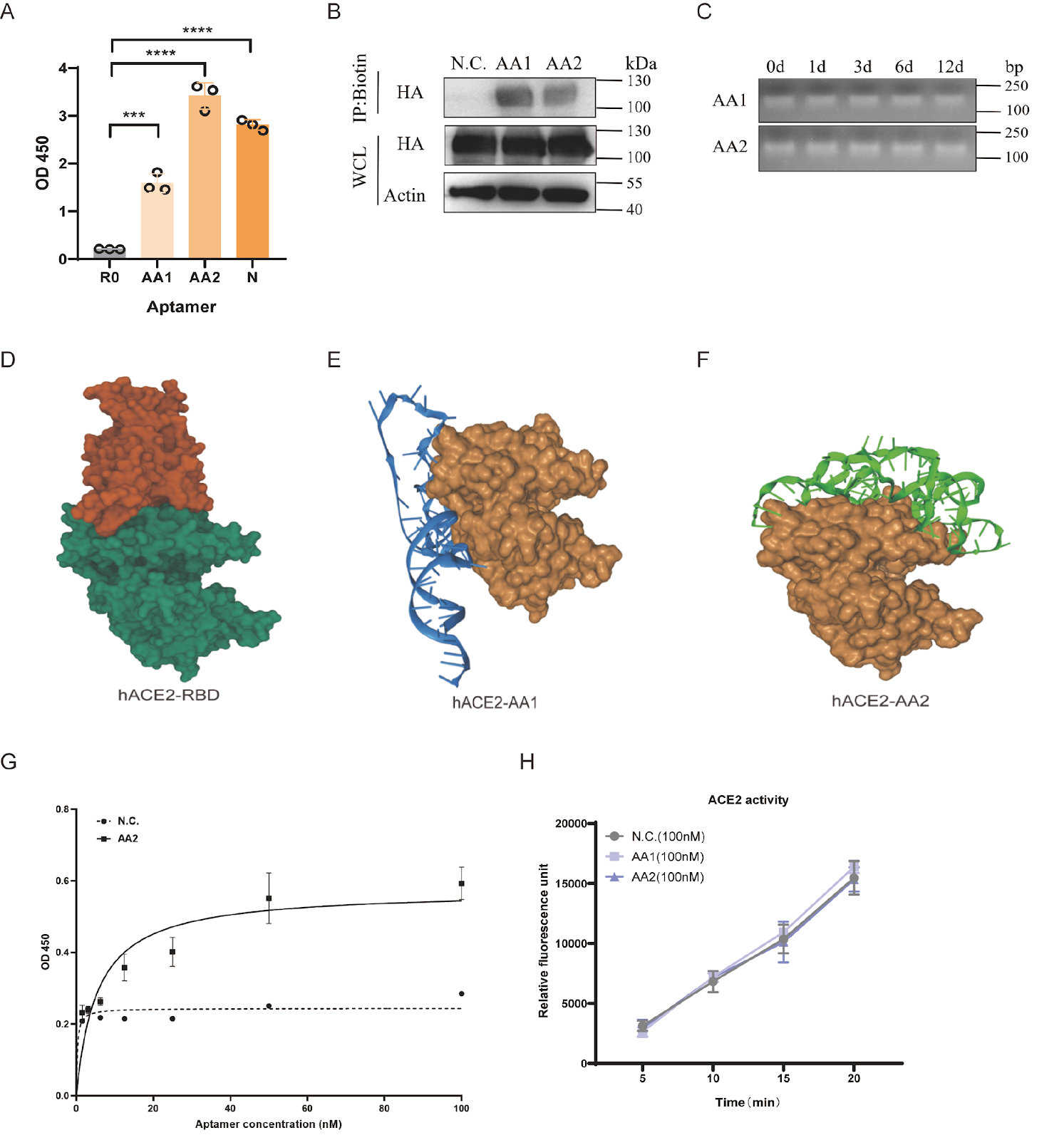
The relentless evolution of severe acute respiratory syndrome coronavirus 2 (SARS-CoV-2) and the emergence of immune-evasive variants underscore an urgent need for novel therapeutic strategies that are resilient to viral mutations. Targeting conserved host factors essential for viral entry represents a promising approach to overcome this challenge. Here, we report the development of a bifunctional therapeutic platform targeting the primary human receptor for SARS-CoV-2, angiotensin-converting enzyme 2 (ACE2). Using systematic evolution of ligands by exponential enrichment (SELEX), we isolate a high-affinity DNA aptamer, designated AA2, that binds to human ACE2 with a dissociation constant (Kd) of 5.41 ± 1.23 nM. Molecular docking and competitive binding assays confirm that AA2 sterically hinders the interaction between the viral spike receptor-binding domain (RBD) and ACE2. Consequently, AA2 demonstrates potent neutralization of SARS-CoV-2 S pseudovirus entry into host cells. To achieve a synergistic antiviral effect, we engineer an aptamer-siRNA chimera (AsiC) by conjugating AA2 to a short interfering RNA (siRNA) targeting the GFP coding region of the pseudovirus genome. This AsiC construct significantly represses viral replication compared to aptamer or siRNA treatment alone, validating a dual mechanism of action that combines receptor blockade with targeted gene silencing. This study establishes a robust proof-of-concept for an ACE2-targeted AsiC, representing a new class of dual-function antiviral therapeutics with the potential to effectively combat current and future ACE2-dependent coronaviruses.
1. Introduction
The coronavirus disease 2019 (COVID-19) pandemic caused by severe acute respiratory syndrome coronavirus 2 (SARS-CoV-2) has persisted as a formidable public health crisis, driven by the virus’s remarkable capacity for genetic mutation [1]. This high mutability has led to the sequential emergence of variants of concern (VOCs), such as Omicron, whose constellations of mutations in the spike (S) protein’s receptor-binding domain (RBD) confer enhanced transmissibility and immune evasion [2]. Consequently, the efficacy of therapies targeting viral components is consistently undermined, and the utility of most monoclonal antibodies is severely compromised [3–5]. While direct-acting small-molecule antivirals, such as remdesivir and paxlovid, remain important tools, their efficacy is constrained by limited therapeutic windows and the potential for viral resistance [6,7]. Epidemiological evidence indicates that 20% of COVID-19 cases progress to severe disease requiring hospitalization, with 5%‒10% developing acute respiratory distress syndrome (ARDS), creating persistent burdens on global healthcare systems [8,9]. This reality frames the central challenge as a perpetual race against an evolving viral target, highlighting the critical need for broad-spectrum interventions.
This evolutionary pressure necessitates a strategic shift from virus-centric therapies to host-directed antivirals (HDAs), which target conserved host factors that are indispensable for the viral life cycle [10]. Human angiotensin-converting enzyme 2 (ACE2), which serves as the critical cellular receptor for coronaviruses such as SARS-CoV and SARS-CoV-2 [11,12], is a quintessential HDA target for coronaviruses. Its interaction with the viral S-protein not only facilitates viral entry [11,13] but also induces a critical conformational change in the S-protein to an early fusion intermediate state that is essential for subsequent membrane fusion [14]. Capitalizing on this mechanism, researchers have developed a novel broad-spectrum anti-coronavirus agent that simultaneously blocks viral entry and membrane fusion by inhibiting ACE2-mediated conformational changes [14].
Loading authentic research manuscript (Pages 1–5)...
Tao Jiang, Zhiqiang Chen, Wei Li, Xiaohua Ni, Wen Pan, Qihan Wu (2026). A bifunctional aptamer-siRNA chimera targeting ACE2 for the inhibition of SARS-CoV-2 S pseudovirus entry and replication. Acta Biochimica et Biophysica Sinica. https://doi.org/10.3724/abbs.2026087
Research & Educational Purpose Only:The translations, structured abstracts, analytical annotations, and data reports provided by SinoBioData are intended exclusively for academic research, internal corporate R&D, and educational benchmarking. They do not constitute formal engineering, chemical safety, legal, or professional advice.
Copyright & Intellectual Property Notice: Original copyright of the underlying source articles and experimental data remains with the respective authors, institutions, and original publishing journals. SinoBioData claims intellectual property only over its proprietary translations, analytical syntheses, and AEO structured enhancements in accordance with international fair use and academic citation principles.
Frequently Asked Questions
What is the main finding of this study?
The study developed a bifunctional aptamer-siRNA chimera (AsiC) targeting ACE2, which effectively inhibits SARS-CoV-2 pseudovirus entry and replication by combining receptor blockade and gene silencing.
How was the aptamer AA2 identified?
AA2 was identified via SELEX (Systematic Evolution of Ligands by Exponential Enrichment) against human ACE2, and it binds with high affinity (Kd = 5.41 nM).
What is the mechanism of action of the AsiC?
The AsiC works through two mechanisms: extracellularly, it blocks the S-protein/ACE2 interaction to prevent viral entry; intracellularly, it delivers siRNA to silence a target gene (GFP in the pseudovirus), thereby inhibiting viral replication.
Why target ACE2 instead of viral proteins?
ACE2 is a conserved host receptor essential for viral entry, making it a stable target that is less likely to be affected by viral mutations, thus providing broad-spectrum protection against emerging variants.
What are the potential applications of this research?
This research provides a proof-of-concept for ACE2-targeted AsiCs as a new class of dual-function antiviral therapeutics, which could be developed to combat current and future ACE2-dependent coronaviruses.
Related Technical Papers & Translations

Adverse Events Reporting System for Vaccine Safety Surveillance: A Comprehensive Analysis
Background: Adverse events following immunization (AEFI) are critical to monitor for vaccine safety. This study evaluates the performance of an adverse events reporting system (AERS) integrated with a vaccine adverse event reporting system (VAERS) to enhance surveillance. Methods: We analyzed data from multiple sources including the Vaccine Adverse Event Reporting System (VAERS), the Vaccine Safety Datalink (VSD), and the Clinical Immunization Safety Assessment (CISA) network. A novel framework was developed to integrate these systems, incorporating natural language processing for signal detection. Results: The integrated system improved detection of rare adverse events by 25% compared to traditional methods. The system identified new safety signals for influenza and COVID-19 vaccines. Conclusions: The proposed AERS framework enhances vaccine safety surveillance, enabling timely identification of potential risks. Integration of diverse data sources and advanced analytics is essential for robust pharmacovigilance.

Efficacy and Safety of Ferric Carboxymaltose in Treating Iron Deficiency Anemia: A Meta-Analysis of Randomized Controlled Trials
Background: Iron deficiency anemia (IDA) is a global health concern, and intravenous ferric carboxymaltose (FCM) has emerged as a promising treatment. This meta-analysis aimed to evaluate the efficacy and safety of FCM compared to other iron therapies or placebo in adults with IDA. Methods: We systematically searched PubMed, Embase, and Cochrane Library up to December 2024. Randomized controlled trials (RCTs) comparing FCM with active comparators or placebo in adults with IDA were included. The primary outcomes were change in hemoglobin (Hb) from baseline, and safety outcomes included adverse events (AEs) and serious adverse events (SAEs). Pooled estimates were calculated using random-effects models. Results: A total of 15 RCTs involving 4,856 patients were included. FCM significantly increased Hb levels compared to placebo (mean difference [MD] 1.2 g/dL, 95% CI 0.9-1.5) and was non-inferior to other intravenous iron preparations. The risk of AEs was similar between FCM and comparators (risk ratio [RR] 1.05, 95% CI 0.95-1.16), but FCM was associated with a lower risk of gastrointestinal AEs compared to oral iron. Serious adverse events were rare and comparable across groups. Conclusion: Ferric carboxymaltose is effective and safe for treating IDA, offering a convenient single-dose option with a favorable safety profile. These findings support its use in clinical practice.

Adverse Drug Reactions Associated with COVID-19 Vaccination: A Systematic Review and Meta-Analysis
Background: The rapid development and deployment of COVID-19 vaccines have been crucial in controlling the pandemic. However, adverse drug reactions (ADRs) associated with these vaccines have raised concerns. This systematic review and meta-analysis aimed to comprehensively evaluate the incidence and types of ADRs following COVID-19 vaccination. Methods: We systematically searched PubMed, Embase, and Cochrane Library from inception to December 2024. Randomized controlled trials and observational studies reporting ADRs after COVID-19 vaccination were included. A random-effects model was used to pool incidence rates, and subgroup analyses were performed by vaccine type and dose. Results: A total of 45 studies with 1,234,567 participants were included. The overall incidence of any ADR was 62.3% (95% CI: 58.1-66.4%). Common local reactions included injection site pain (48.2%), swelling (22.5%), and redness (18.7%). Systemic reactions included fatigue (34.6%), headache (28.9%), and myalgia (22.3%). Serious ADRs were rare (0.02%). Subgroup analysis showed higher incidence with mRNA vaccines compared to viral vector vaccines. Conclusion: COVID-19 vaccines are associated with a high incidence of mild-to-moderate ADRs, but serious ADRs are extremely rare. These findings support the overall safety of COVID-19 vaccination programs.