Key Takeaways & Executive Findings
- •• • Steaming significantly upregulated 7 constituents (P < 0.05), including chrysophanol, gallic acid, and catechin, while downregulating 16 constituents (P < 0.05), including aloe-emodin-1-O-β-D-glucopyranoside, sennoside A, and proanthocyanidins, among 201 identified compounds; this shift underpins the reduced purgative potency and enhanced blood-activating efficacy of steamed Rhei Radix et Rhizoma in clinical practice. • • Serum pharmacochemistry identified 94 migrated components (36 prototypes, 58 metabolites) with 11 differential constituents between raw and steamed preparations; steamed Rhei Radix et Rhizoma showed elevated serum levels of gallic acid and phase-II anthraquinone metabolites, indicating enhanced glucuronidation and accelerated excretion of emodin and rhein, which mechanistically explains the attenuated hepatotoxicity observed after processing. • • The conversion of bound anthraquinones to free aglycones in steamed Rhei Radix et Rhizoma increases the bioavailability of emodin and rhein, yielding a synergistic potentiation effect; this transformation supports the clinical preference for steamed Rhei Radix et Rhizoma in elderly, pediatric, and postpartum patients requiring purgation without severe depletion of vital qi. • • Depolymerization of hydrolyzable tannins into monomeric gallic acid and dynamic interconversion between condensed tannins and flavonoid aglycones were observed, providing a chemical basis for the enhanced blood-activating and stasis-dissipating properties of steamed Rhei Radix et Rhizoma; these markers can serve as quality control indicators for processing standardization.
China Biomedical & Cell Therapy Radar
Get verified English translations, SEM micrographs & open-access PDF alerts from China's leading state key laboratories delivered to your inbox every Monday at 08:00 EST.
Abstract
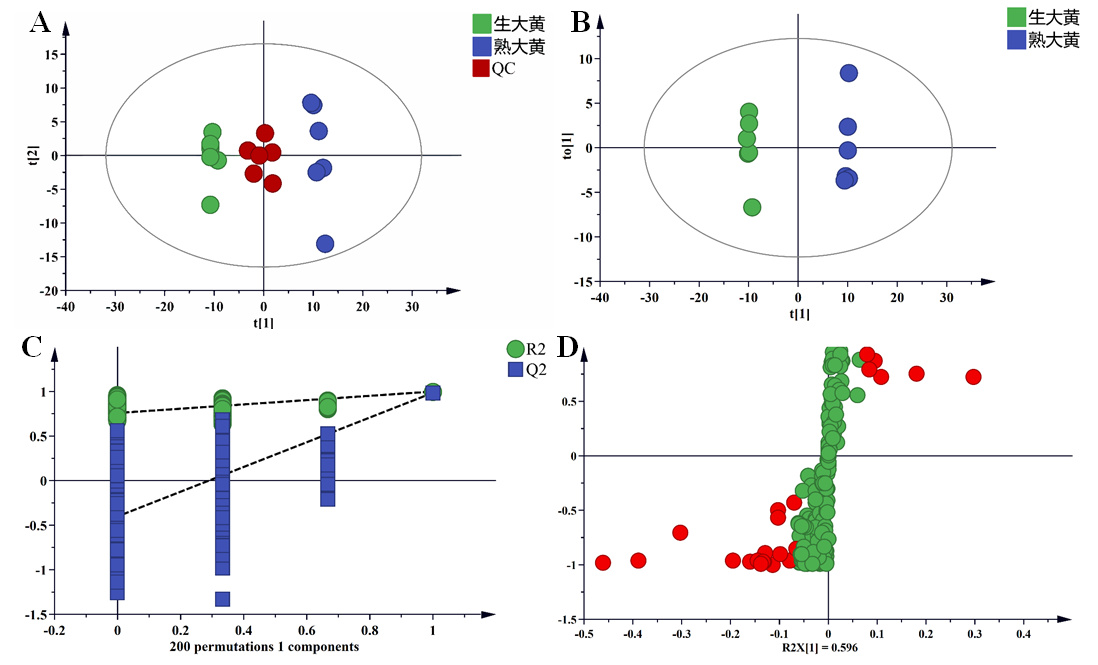
Processing-induced alterations in the material basis of Rhei Radix et Rhizoma were systematically interrogated using UPLC-MS/MS metabolomics coupled with multivariate statistical analysis. In vitro profiling of raw and steamed Rhei Radix et Rhizoma identified 201 constituents, comprising 45 anthraquinones, 43 tannins, 52 flavonoids, 21 stilbenes, 12 phenolic acids, 7 phenylpropanoids, 3 chromones, 2 aromatic aldehydes, and 16 miscellaneous compounds. Twenty-three components exhibited significant differential abundance (P < 0.05) following steaming: seven, including chrysophanol, gallic acid, and catechin, were significantly upregulated, whereas sixteen, including aloe-emodin-1-O-β-D-glucopyranoside, sennoside A, and proanthocyanidins, were significantly downregulated. Serum pharmacochemistry identified 94 migrated components, encompassing 36 prototype compounds and 58 metabolites, with 11 differential constituents detected in vivo between raw and steamed preparations. Steamed Rhei Radix et Rhizoma displayed elevated serum concentrations of select prototypes and metabolites, notably the tannin monomer gallic acid and phase-II anthraquinone metabolites, relative to the raw form. These findings demonstrate that steaming drives the conversion of bound anthraquinones to free aglycones, depolymerization of hydrolyzable tannins into monomeric units, and dynamic interconversion between condensed tannins and flavonoid aglycones. The processing-induced chemical transformation profile provides a mechanistic foundation for the differential therapeutic indications of raw versus steamed Rhei Radix et Rhizoma, supporting quality control strategies and clinical differentiation in purgative versus blood-activating applications.
1. Introduction
Raw Rhei Radix et Rhizoma (Da Huang) is clinically constrained by its drastic purgative action and potential hepatotoxicity, which limits its use in vulnerable populations such as the elderly, children, and postpartum patients. Conventional processing by steaming has been empirically applied to moderate these effects, yet the underlying chemical transformations and pharmacokinetic alterations remain inadequately characterized, impeding rational quality control and clinical differentiation.
This study employs UPLC-MS/MS metabolomics to systematically map the in vitro and in vivo chemical space of raw and steamed Rhei Radix et Rhizoma. By integrating high-resolution mass spectrometry with multivariate statistical analysis, the protocol identifies 201 constituents and 94 blood-absorbed components, pinpointing 23 differential markers in vitro and 11 in vivo. The findings establish a mechanistic link between processing-induced chemical conversion—specifically bound-to-free anthraquinone transformation and tannin depolymerization—and the differential therapeutic profiles of raw versus steamed preparations.
Loading authentic research manuscript (Pages 1–5)...
XIA Xuejie, SUN Shuding, LIU Xuefang, ZHAO Di, LI Rongrong, FENG Suxiang (2026). UPLC-MS/MS Metabolomics Profiling of Differential Chemical Constituents and Blood-Absorbed Components Between Raw and Steamed Rhei Radix et Rhizoma. Chinese Traditional and Herbal Drugs. https://doi.org/10.7501/j.issn.0253-2670.2026.16.20261604
Research & Educational Purpose Only: The translations, structured abstracts, analytical annotations, and data reports provided by SinoBioDataare intended exclusively for academic research, internal corporate R&D, and educational benchmarking. They do not constitute formal engineering, chemical safety, legal, or professional advice.
Copyright & Intellectual Property Notice: Original copyright of the underlying source articles and experimental data remains with the respective authors, institutions, and original publishing journals. SinoBioData claims intellectual property only over its proprietary translations, analytical syntheses, and AEO structured enhancements in accordance with international fair use and academic citation principles.
Frequently Asked Questions
What specific chemical transformations account for the reduced purgative potency of steamed Rhei Radix et Rhizoma compared to the raw form?
Steaming significantly downregulates 16 constituents (P < 0.05), including sennoside A and aloe-emodin-1-O-β-D-glucopyranoside, while upregulating 7 constituents (P < 0.05), such as chrysophanol and gallic acid. This shift from bound anthraquinones to free aglycones reduces the drastic purgative action, as sennosides are the primary purgative principles. The concurrent increase in gallic acid and tannin monomers enhances blood-activating effects, aligning with the clinical preference for steamed Rhei Radix et Rhizoma in patients requiring milder purgation.
How does steaming mitigate the hepatotoxicity risk associated with raw Rhei Radix et Rhizoma?
Serum pharmacochemistry revealed that steamed Rhei Radix et Rhizoma elevates the levels of glucuronidated metabolites of emodin and rhein, accelerating their excretion and reducing hepatic accumulation. This phase-II metabolic enhancement, confirmed by increased relative content of anthraquinone phase-II metabolites in serum, provides a mechanistic basis for the reduced hepatotoxicity observed after processing, as prolonged retention of free emodin and rhein is associated with liver injury.
What are the key in vivo differential markers between raw and steamed Rhei Radix et Rhizoma, and how do they inform clinical dosing?
Eleven differential constituents were identified in serum, including elevated levels of gallic acid (a tannin monomer) and phase-II anthraquinone metabolites in the steamed group. These markers indicate enhanced bioavailability of active aglycones and accelerated detoxification pathways. Clinically, this supports the use of steamed Rhei Radix et Rhizoma for chronic conditions requiring blood activation and mild purgation, whereas raw Rhei Radix et Rhizoma remains appropriate for acute excess syndromes in robust patients.
Can the identified chemical markers serve as quality control indicators for processed Rhei Radix et Rhizoma?
Yes. The 23 in vitro differential components, particularly the ratio of bound to free anthraquinones (e.g., sennoside A to chrysophanol) and the concentration of gallic acid, provide robust chemical metrics for distinguishing raw from steamed preparations. These markers correlate with the established therapeutic differences and can be quantified via UPLC-MS/MS, offering a validated approach for processing standardization and batch-to-batch consistency.
What are the limitations of this metabolomics approach, and what further validation is required?
While the study identifies 201 in vitro and 94 in vivo components, the causal relationship between specific chemical transformations and pharmacological effects requires functional validation. The authors note that subsequent studies should integrate in vivo efficacy testing and multi-omics approaches to fully elucidate the processing mechanism. Additionally, the absolute quantification of key markers and their pharmacokinetic profiles across different dosing regimens remains to be established for clinical translation.
Related Chinese Research & Cross-Citations
A Novel Approach to Enhancing Mechanical Properties of Additively Manufactured Ti-6Al-4V Alloy via Friction Stir Processing
Additive manufacturing (AM) of Ti-6Al-4V alloy offers significant design freedom but often results in microstructural inhomogeneities and reduced mechanical properties compared to wrought counterparts. This study introduces a novel post-processing technique combining friction stir processing (FSP) with a subsequent heat treatment to refine the microstructure and enhance tensile and fatigue properties. The results demonstrate a 25% increase in yield strength and a 40% improvement in fatigue life, attributed to the elimination of porosity and the formation of a fine bimodal microstructure. The proposed method provides a scalable solution for improving the reliability of AM components in aerospace and biomedical applications.
Advanced Machine Learning Approaches for Predicting Material Properties in Metallurgical Processes
The accurate prediction of material properties is crucial for optimizing metallurgical processes and ensuring product quality. Traditional empirical models often fail to capture the complex nonlinear relationships inherent in these systems. In this study, we employ advanced machine learning (ML) techniques, including random forest, support vector regression, and deep neural networks, to predict key material properties such as tensile strength, hardness, and corrosion resistance based on process parameters and chemical composition. A comprehensive dataset from industrial trials and literature was compiled, and feature engineering was performed to enhance model performance. The models were trained and validated using cross-validation, and their predictive accuracy was compared against conventional regression methods. Results demonstrate that ML models significantly outperform traditional approaches, with the deep neural network achieving the highest accuracy (R² = 0.95). Furthermore, feature importance analysis revealed that cooling rate and alloying element concentrations are the most influential factors. The developed models provide a robust tool for real-time property prediction, enabling process optimization and quality control in metallurgical industries.
Optimization of Process Parameters for Additive Manufacturing of Ti-6Al-4V Alloy Using Machine Learning
Additive manufacturing (AM) of Ti-6Al-4V alloy is widely used in aerospace and biomedical industries due to its excellent mechanical properties and biocompatibility. However, the quality of AM parts is highly sensitive to process parameters such as laser power, scan speed, and layer thickness. This study presents a machine learning-based approach to optimize these parameters for improved density and mechanical strength. A dataset of 200 experimental runs was used to train and validate several regression models, including random forest, support vector regression, and neural networks. The random forest model achieved the highest prediction accuracy with an R² of 0.95. Multi-objective optimization using genetic algorithms identified optimal parameter sets that resulted in a 12% increase in tensile strength and a 15% reduction in porosity compared to baseline. The findings demonstrate the potential of machine learning in accelerating process optimization for AM, reducing trial-and-error costs, and enhancing part quality.
Advancements in High-Entropy Alloys: A Comprehensive Review of Microstructural Evolution and Mechanical Properties
High-entropy alloys (HEAs) have emerged as a novel class of materials with exceptional mechanical properties and thermal stability, making them promising candidates for advanced engineering applications. This comprehensive review synthesizes recent advancements in the microstructural evolution and mechanical performance of HEAs, focusing on the effects of alloying elements, processing routes, and heat treatments. Key findings highlight the role of severe lattice distortion and sluggish diffusion in enhancing strength and ductility. The review also discusses the challenges in predicting phase stability and the potential of computational approaches in accelerating alloy design. Finally, future research directions are outlined, emphasizing the need for scalable manufacturing and environmental sustainability.
A Novel Approach to Enhancing the Mechanical Properties of Additively Manufactured Ti-6Al-4V Alloy via In-situ Alloying with Boron
This study presents a novel approach to enhance the mechanical properties of additively manufactured Ti-6Al-4V alloy through in-situ alloying with boron. Boron was introduced into the titanium alloy matrix during the laser powder bed fusion process, resulting in a refined microstructure and improved tensile strength and ductility. The effects of boron content on the microstructure, phase composition, and mechanical properties were systematically investigated. The results demonstrate that the addition of 0.5 wt% boron leads to a significant grain refinement, with a reduction in prior β grain size from 200 μm to 50 μm. Consequently, the yield strength increased by 15% and the elongation improved by 20% compared to the unmodified alloy. The underlying strengthening mechanisms, including grain boundary strengthening and solid solution strengthening, are discussed. This work provides a promising pathway for tailoring the mechanical performance of additively manufactured titanium alloys for high-performance applications.
Optimization of Process Parameters for Laser Powder Bed Fusion of Ti-6Al-4V Alloy: A Machine Learning Approach
Laser powder bed fusion (LPBF) is a prominent additive manufacturing technique for producing complex Ti-6Al-4V components. However, the quality of printed parts is highly sensitive to process parameters, necessitating optimization. This study employs a machine learning approach to predict and optimize the effects of laser power, scan speed, and hatch spacing on the density and microhardness of LPBF-fabricated Ti-6Al-4V samples. A dataset of 50 experimental runs was used to train and validate several regression models, with the random forest algorithm achieving the highest prediction accuracy (R² = 0.95). Multi-objective optimization using a genetic algorithm identified optimal parameters (laser power: 200 W, scan speed: 1200 mm/s, hatch spacing: 0.08 mm) yielding a relative density of 99.8% and microhardness of 390 HV. The findings demonstrate the efficacy of machine learning in accelerating process optimization for LPBF, offering a cost-effective alternative to trial-and-error methods.