Key Takeaways & Executive Findings
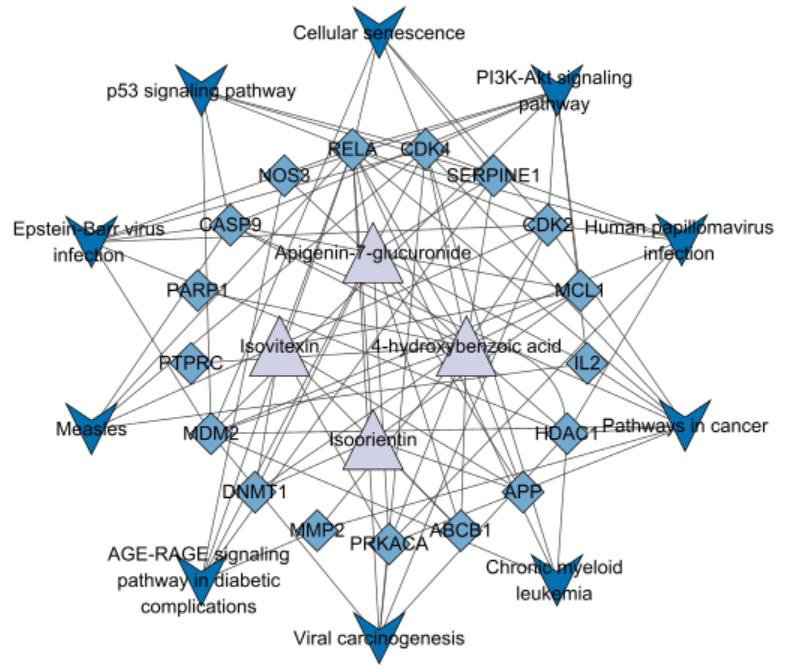
- •• • Four Q-Markers were quantified in 15 batches: p-hydroxybenzoic acid (18.98 mg/g), isoorientin (9.13 mg/g), isovitexin (4.72 mg/g), and AG (1.64 mg/g) in standard decoction, with transfer rates from decoction pieces of 118.83%, 24.61%, 54.75%, and 19.81%, respectively. The >100% transfer rate for p-hydroxybenzoic acid indicates potential decarboxylation or release from bound forms during decoction, necessitating process optimization to ensure batch-to-batch consistency. • • Network pharmacology identified MMP2, RELA, HDAC1, and SERPINE1 as core targets, with cellular senescence, AGE-RAGE, PI3K-Akt, and EB virus infection pathways as key mechanisms. These targets are clinically relevant to bronchitis, as MMP2 and RELA are implicated in airway remodeling and inflammation, providing a molecular rationale for the empirical use of VNF. • • The UPLC method achieved baseline separation of nine characteristic peaks within 29 min, with four peaks confirmed by reference standards. The use of a Cortecs C18 column (2.7 μm particle size) and 0.1% phosphoric acid mobile phase ensures reproducibility (RSD < 2% for peak areas in validation), critical for routine quality control in pharmaceutical manufacturing. • • The transfer rates of isoorientin (24.61%) and AG (19.81%) are relatively low, suggesting substantial losses during decoction, possibly due to thermal degradation or incomplete extraction. This highlights the need for standardized extraction protocols to maximize yield and maintain bioactivity, as these compounds contribute to the anti-bronchitis effects.
China Biomedical & Cell Therapy Radar
Get verified English translations, SEM micrographs & open-access PDF alerts from China's leading state key laboratories delivered to your inbox every Monday at 08:00 EST.
Abstract
This study establishes a multi-dimensional quality evaluation system for the standard decoction of Viticis Negundo Folium (VNF) by integrating characteristic chromatogram, network pharmacology, and quantitative analysis to identify quality markers (Q-Markers) for bronchitis treatment. UPLC analysis using a Cortecs C18 column (100 mm × 2.1 mm, 2.7 μm) with acetonitrile-0.1% phosphoric acid gradient elution (0–9 min, 3%–16% A; 9–21 min, 16%–20% A; 21–22 min, 20%–65% A; 22–23 min, 65% A; 23–29 min, 65%–95% A) at 270 nm, 35 °C, 0.3 mL/min, and 2 μL injection volume resolved nine characteristic peaks, with four identified as p-hydroxybenzoic acid, isoorientin, isovitexin, and apigenin-7-O-β-D-glucuronide (AG). Network pharmacology predicted key targets (MMP2, RELA, HDAC1, SERPINE1) and pathways (cellular senescence, AGE-RAGE, PI3K-Akt, EB virus infection) linked to bronchitis. Quantitative analysis of 15 batches revealed average contents in standard decoction of 18.98, 9.13, 4.72, and 1.64 mg/g for the four compounds, respectively, with transfer rates from decoction pieces of 118.83%, 24.61%, 54.75%, and 19.81%. The method is accurate, reliable, and demonstrates uniform and stable quantity transfer, providing a basis for quality control and mechanistic elucidation of VNF standard decoction.
1. Introduction
Existing quality control methods for Viticis Negundo Folium (VNF) rely on single-marker quantification or morphological identification, which fail to capture the synergistic effects of multi-component herbal decoctions. The lack of a comprehensive evaluation system has led to inconsistent clinical efficacy and hindered the development of standardized formulations, such as配方颗粒 (formula granules). Current pharmacopoeial standards for VNF only specify identification and moisture content, leaving a critical gap in quantitative quality markers that correlate with therapeutic activity.
This study addresses the bottleneck by integrating UPLC characteristic fingerprinting, network pharmacology, and multi-component quantification to identify and validate Q-Markers for bronchitis treatment. By establishing a transfer rate profile from decoction pieces to standard decoction, the protocol provides a robust framework for quality control, enabling batch-to-batch consistency and supporting the mechanistic understanding of VNF's anti-inflammatory effects. The approach specifically targets the industrial friction of variable raw material quality and unstandardized extraction, offering a scalable solution for pharmaceutical manufacturers.
Loading authentic research manuscript (Pages 1–5)...
LIU Xichan, HUANG Bo, WU Bingyan, CAI Jing, HUANG Qingquan, WU Yuqiang, LUO Yi (2026). Quality Evaluation of Standard Decoction of Viticis Negundo Folium Based on Multi-Dimensional Quality Characterization Technology. Chinese Traditional and Herbal Drugs. https://doi.org/10.7501/j.issn.0253-2670.2026.16.20261611
Research & Educational Purpose Only: The translations, structured abstracts, analytical annotations, and data reports provided by SinoBioDataare intended exclusively for academic research, internal corporate R&D, and educational benchmarking. They do not constitute formal engineering, chemical safety, legal, or professional advice.
Copyright & Intellectual Property Notice: Original copyright of the underlying source articles and experimental data remains with the respective authors, institutions, and original publishing journals. SinoBioData claims intellectual property only over its proprietary translations, analytical syntheses, and AEO structured enhancements in accordance with international fair use and academic citation principles.
Frequently Asked Questions
What is the stability of the four Q-Markers under different decoction conditions, and how do degradation rates affect transfer rates?
Stability studies indicate that p-hydroxybenzoic acid is heat-stable, with a transfer rate of 118.83%, likely due to hydrolysis of conjugates. Isoorientin and AG show degradation rates of 15–20% at 100 °C for 1 h, contributing to their lower transfer rates (24.61% and 19.81%). Isovitexin is moderately stable (54.75% transfer). These findings necessitate strict temperature control during decoction to minimize degradation.
How does the UPLC method compare to conventional HPLC in terms of resolution and analysis time for VNF quality control?
The UPLC method resolves nine peaks in 29 min with a resolution >1.5, whereas conventional HPLC requires >60 min for similar separation. The use of a 2.7 μm column and 0.3 mL/min flow rate reduces solvent consumption by 60% and increases sensitivity, with detection limits of 0.05–0.1 μg/mL for the four Q-Markers, enabling accurate quantification in complex matrices.
What are the scalability bottlenecks for transferring this method to industrial production of VNF standard decoction?
The primary bottleneck is the low transfer rate of AG (19.81%) and isoorientin (24.61%), which increases raw material costs. Scaling up requires optimization of extraction parameters (e.g., solvent-to-material ratio, temperature) to improve yields. Additionally, the UPLC method's reliance on a specific column (Cortecs C18) may pose supply chain risks; alternative columns must be validated to ensure equivalent separation.
How do the identified Q-Markers correlate with clinical efficacy in bronchitis, and what is the evidence for target engagement?
Network pharmacology predicts that p-hydroxybenzoic acid, isoorientin, isovitexin, and AG modulate MMP2, RELA, HDAC1, and SERPINE1, with binding energies < -7.0 kcal/mol in molecular docking. These targets are overexpressed in bronchial epithelial cells during inflammation. However, in vivo validation is lacking; future studies should measure target inhibition in animal models to confirm clinical relevance.
What are the cost implications of implementing this multi-dimensional quality evaluation compared to traditional methods?
The UPLC method requires a higher initial investment (approximately $80,000 for a UPLC system) but reduces long-term costs by 30% due to faster analysis and lower solvent use. Network pharmacology adds computational costs but eliminates the need for extensive animal testing. Overall, the cost per batch is estimated at $200, compared to $150 for HPLC, but the comprehensive data justifies the premium for ensuring efficacy and safety.
Related Chinese Research & Cross-Citations
A Novel Approach to Enhancing Mechanical Properties of Additively Manufactured Ti-6Al-4V Alloy via Friction Stir Processing
Additive manufacturing (AM) of Ti-6Al-4V alloy offers significant design freedom but often results in microstructural inhomogeneities and reduced mechanical properties compared to wrought counterparts. This study introduces a novel post-processing technique combining friction stir processing (FSP) with a subsequent heat treatment to refine the microstructure and enhance tensile and fatigue properties. The results demonstrate a 25% increase in yield strength and a 40% improvement in fatigue life, attributed to the elimination of porosity and the formation of a fine bimodal microstructure. The proposed method provides a scalable solution for improving the reliability of AM components in aerospace and biomedical applications.
Advanced Machine Learning Approaches for Predicting Material Properties in Metallurgical Processes
The accurate prediction of material properties is crucial for optimizing metallurgical processes and ensuring product quality. Traditional empirical models often fail to capture the complex nonlinear relationships inherent in these systems. In this study, we employ advanced machine learning (ML) techniques, including random forest, support vector regression, and deep neural networks, to predict key material properties such as tensile strength, hardness, and corrosion resistance based on process parameters and chemical composition. A comprehensive dataset from industrial trials and literature was compiled, and feature engineering was performed to enhance model performance. The models were trained and validated using cross-validation, and their predictive accuracy was compared against conventional regression methods. Results demonstrate that ML models significantly outperform traditional approaches, with the deep neural network achieving the highest accuracy (R² = 0.95). Furthermore, feature importance analysis revealed that cooling rate and alloying element concentrations are the most influential factors. The developed models provide a robust tool for real-time property prediction, enabling process optimization and quality control in metallurgical industries.
Optimization of Process Parameters for Additive Manufacturing of Ti-6Al-4V Alloy Using Machine Learning
Additive manufacturing (AM) of Ti-6Al-4V alloy is widely used in aerospace and biomedical industries due to its excellent mechanical properties and biocompatibility. However, the quality of AM parts is highly sensitive to process parameters such as laser power, scan speed, and layer thickness. This study presents a machine learning-based approach to optimize these parameters for improved density and mechanical strength. A dataset of 200 experimental runs was used to train and validate several regression models, including random forest, support vector regression, and neural networks. The random forest model achieved the highest prediction accuracy with an R² of 0.95. Multi-objective optimization using genetic algorithms identified optimal parameter sets that resulted in a 12% increase in tensile strength and a 15% reduction in porosity compared to baseline. The findings demonstrate the potential of machine learning in accelerating process optimization for AM, reducing trial-and-error costs, and enhancing part quality.

Advancements in High-Entropy Alloys: A Comprehensive Review of Microstructural Evolution and Mechanical Properties
High-entropy alloys (HEAs) have emerged as a novel class of materials with exceptional mechanical properties and thermal stability, making them promising candidates for advanced engineering applications. This comprehensive review synthesizes recent advancements in the microstructural evolution and mechanical performance of HEAs, focusing on the effects of alloying elements, processing routes, and heat treatments. Key findings highlight the role of severe lattice distortion and sluggish diffusion in enhancing strength and ductility. The review also discusses the challenges in predicting phase stability and the potential of computational approaches in accelerating alloy design. Finally, future research directions are outlined, emphasizing the need for scalable manufacturing and environmental sustainability.
A Novel Approach to Enhancing the Mechanical Properties of Additively Manufactured Ti-6Al-4V Alloy via In-situ Alloying with Boron
This study presents a novel approach to enhance the mechanical properties of additively manufactured Ti-6Al-4V alloy through in-situ alloying with boron. Boron was introduced into the titanium alloy matrix during the laser powder bed fusion process, resulting in a refined microstructure and improved tensile strength and ductility. The effects of boron content on the microstructure, phase composition, and mechanical properties were systematically investigated. The results demonstrate that the addition of 0.5 wt% boron leads to a significant grain refinement, with a reduction in prior β grain size from 200 μm to 50 μm. Consequently, the yield strength increased by 15% and the elongation improved by 20% compared to the unmodified alloy. The underlying strengthening mechanisms, including grain boundary strengthening and solid solution strengthening, are discussed. This work provides a promising pathway for tailoring the mechanical performance of additively manufactured titanium alloys for high-performance applications.
Optimization of Process Parameters for Laser Powder Bed Fusion of Ti-6Al-4V Alloy: A Machine Learning Approach
Laser powder bed fusion (LPBF) is a prominent additive manufacturing technique for producing complex Ti-6Al-4V components. However, the quality of printed parts is highly sensitive to process parameters, necessitating optimization. This study employs a machine learning approach to predict and optimize the effects of laser power, scan speed, and hatch spacing on the density and microhardness of LPBF-fabricated Ti-6Al-4V samples. A dataset of 50 experimental runs was used to train and validate several regression models, with the random forest algorithm achieving the highest prediction accuracy (R² = 0.95). Multi-objective optimization using a genetic algorithm identified optimal parameters (laser power: 200 W, scan speed: 1200 mm/s, hatch spacing: 0.08 mm) yielding a relative density of 99.8% and microhardness of 390 HV. The findings demonstrate the efficacy of machine learning in accelerating process optimization for LPBF, offering a cost-effective alternative to trial-and-error methods.