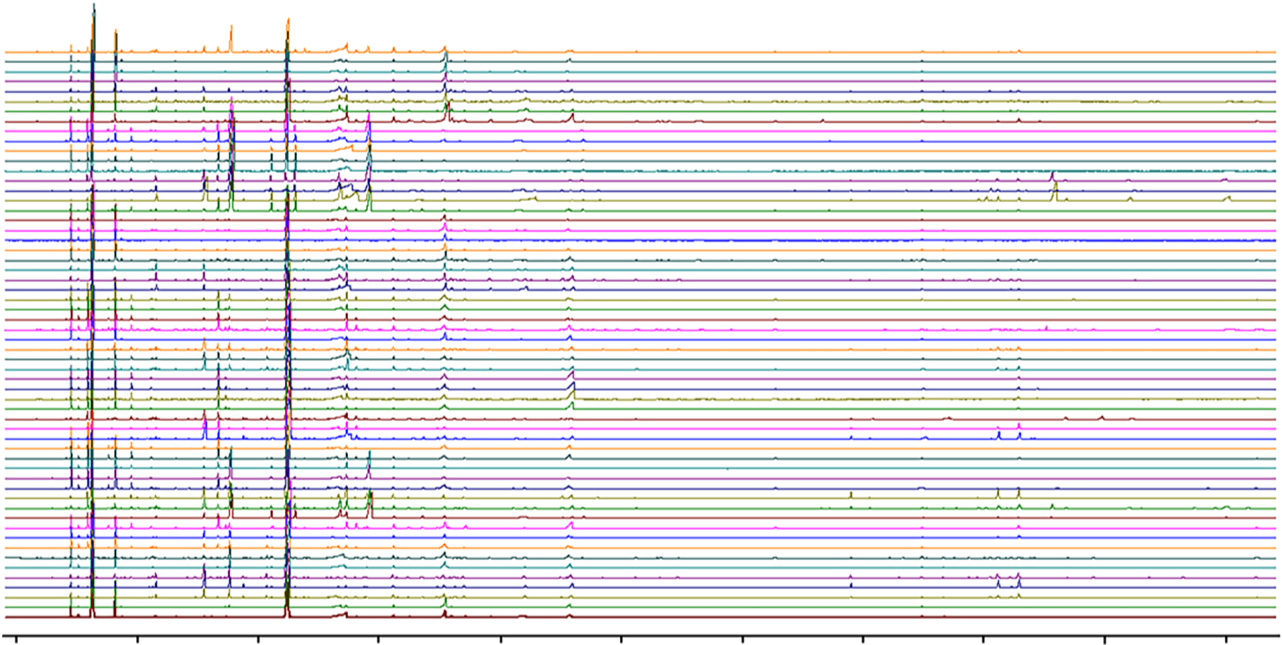
Key Takeaways & Executive Findings
- •• • The matching frequency method compressed 58 GC-MS fingerprints into 34 structural "material units" (A1–A34), reducing average peak count and information entropy at P < 0.01 while preserving total zero-, first-, and second-order moments and information content. This dimensional reduction is industrially critical because it enables batch-to-batch quality control without discarding the statistical moments that encode the overall chemical profile. • • Factor rotation extracted eight common factors, with the top four accounting for the highest variance and enriched in phytol, β-elemene, D-limonene, α-pinene, and caryophyllene. These compounds have documented anti-lung-cancer mechanisms, including PI3K/Akt pathway inhibition and mitochondrial apoptosis induction, providing a mechanistic rationale for prioritizing these factor groups in raw material sourcing. • • Comprehensive quality scores negatively correlated with A549 IC50 values (r = −0.739, P < 0.01) across a 73.6–269.9 nL/mL range. The correlation is strong enough for trend-level screening but not for single-batch potency prediction, as the highest-scoring sample S16 did not exhibit the absolute lowest IC50, exposing a gap between chemical scoring and biological endpoint. • • High-contribution units A34, A31, and A7 were flagged as a potential pharmacodynamic component group, yet they remain statistically derived candidates without isolation, enrichment, or independent in vivo validation. Industrial translation requires preparative-scale fractionation and multi-cell-line testing before these markers can be adopted as pharmacopoeial quality indicators.
China Biomedical & Cell Therapy Radar
Get verified English translations, SEM micrographs & open-access PDF alerts from China's leading state key laboratories delivered to your inbox every Monday at 08:00 EST.
Abstract
This study addresses the pharmacodynamic material basis of Houttuynia cordata volatile oil by integrating supramolecular "imprinting template" theory with matching frequency, total statistical moment, and factor rotation methods, coupled to in vitro antitumor activity. Fifty-eight batches (S1–S58) from different origins were fingerprinted by GC-MS. The matching frequency method reduced the imprinting template to 34 structural "material units" (A1–A34). Integration significantly decreased average peak count and information entropy (P < 0.01), while total zero-, first-, and second-order moments and information content remained unchanged. Factor rotation extracted eight common factors; comprehensive scores ranked S16 and S54 highest and S24 and S27 lowest. CCK-8 assays against human lung adenocarcinoma A549 cells yielded IC50 values from 73.6 to 269.9 nL/mL. Comprehensive scores negatively correlated with IC50 (r = −0.739, P < 0.01). High-contribution units A34, A31, and A7 were preliminarily identified as a potential pharmacodynamic component group. The model demonstrates utility for trend-level quality evaluation but does not provide one-to-one prediction of single-batch efficacy. Limitations include restriction to volatile constituents, single-cell-line validation, and lack of independent isolation and enrichment for the flagged units. The protocol offers a transferable statistical framework for linking chromatographic fingerprints to bioactivity in complex botanical oils.
1. Introduction
Quality control of complex botanical oils such as Houttuynia cordata volatile oil has stalled on a fundamental mismatch: chromatographic fingerprints capture hundreds of peaks, but pharmacopoeial monographs typically quantify only one or two marker compounds. This reductionist approach fails to represent the multi-component synergy that drives clinical efficacy, and it cannot distinguish batches with similar marker content but divergent biological activity. The absence of a statistically defensible link between chemical fingerprints and pharmacodynamic endpoints leaves manufacturers without a rational basis for batch release or sourcing decisions.
The present study addresses this bottleneck by applying supramolecular "imprinting template" theory to partition the volatile oil fingerprint into structural "material units" via a matching frequency algorithm, then extracting functional units through factor rotation. Total statistical moment parameters and information entropy verify that the integration preserves the original chromatographic characteristics. The resulting comprehensive scores are correlated against CCK-8-derived IC50 values against A549 cells, establishing an empirical bridge between chemical profiling and antitumor activity. This protocol does not claim to replace mechanism-level assays, but it provides a transferable statistical framework for flagging high-contribution component groups that merit isolation and independent validation.
Loading authentic research manuscript (Pages 1–5)...
HE Wenjun, WANG Yinan, CHEN Wang, LIU Xia, YUAN Qin, REN Xinning, PAN Xue, HE Fuyuan (2026). Screening and Correlation Analysis of "Material Units" in Houttuynia cordata Volatile Oil Based on Supramolecular "Imprinting Template" Theory Combined with Factor Rotation. Chinese Traditional and Herbal Drugs. https://doi.org/10.7501/j.issn.0253-2670.2026.16.20261607
Research & Educational Purpose Only: The translations, structured abstracts, analytical annotations, and data reports provided by SinoBioDataare intended exclusively for academic research, internal corporate R&D, and educational benchmarking. They do not constitute formal engineering, chemical safety, legal, or professional advice.
Copyright & Intellectual Property Notice: Original copyright of the underlying source articles and experimental data remains with the respective authors, institutions, and original publishing journals. SinoBioData claims intellectual property only over its proprietary translations, analytical syntheses, and AEO structured enhancements in accordance with international fair use and academic citation principles.
Frequently Asked Questions
What is the quantitative relationship between the comprehensive quality score and the in vitro antitumor activity, and what are the limits of its predictive power?
Pearson correlation between the factor-rotation-derived comprehensive score and A549 IC50 values across 58 batches yielded r = −0.739 (P < 0.01), with IC50 ranging from 73.6 to 269.9 nL/mL. This indicates a strong negative trend: higher chemical scores associate with lower IC50 (greater potency). However, the highest-scoring sample S16 did not exhibit the absolute lowest IC50, demonstrating that the model captures overall batch trends rather than one-to-one potency. The discrepancy is attributed to experimental error and the multidimensional nature of chemical scoring versus a single biological endpoint. For industrial release testing, the model is suitable for ranking or flagging batches, not for replacing direct bioassay.
How does the matching frequency method reduce dimensionality without losing critical chromatographic information?
The method collapsed 58 GC-MS fingerprints into 34 structural "material units" (A1–A34). Validation via total statistical moment parameters showed no significant differences in total zero-order moment, first-order moment, second-order moment, or information content after integration. However, average peak count and information entropy decreased significantly (P < 0.01). This means the reduction removes redundant or low-frequency peaks while preserving the statistical moments that describe the overall retention-time distribution and peak-area profile. The trade-off is a loss of fine-grained peak-level detail, which is acceptable for batch-level quality evaluation but may obscure minor constituents with synergistic roles.
Which specific chemical constituents drive the top four common factors, and what mechanistic evidence supports their anti-lung-cancer activity?
Factor 1 is dominated by phytol and β-elemene. Phytol inhibits A549 proliferation and migration via PI3K/Akt pathway suppression in NSCLC; β-elemene induces apoptosis, causes cell-cycle arrest, and enhances chemoradiosensitivity. Factors 2–4 are enriched in D-limonene, α-pinene, and caryophyllene. Caryophyllene exerts selective cytotoxicity against A549 cells through mitochondrial apoptosis; D-limonene and α-pinene inhibit oncogenic signaling, with D-limonene additionally inducing autophagy. These mechanisms are documented in prior pharmacological literature, but the present study did not perform pathway-level validation, so the mechanistic attribution remains correlative rather than causal.
What are the principal limitations that prevent immediate industrial adoption of this quality evaluation model?
Four limitations are explicit. First, the chemical coverage is restricted to volatile oil constituents; flavonoids, alkaloids, and other non-volatile components are excluded, so the model does not represent whole-plant quality. Second, bioactivity validation used only the A549 cell line and CCK-8 viability as the endpoint; no apoptosis, cell-cycle, or normal lung epithelial cell controls were included, leaving selectivity and mechanism unresolved. Third, the score–IC50 relationship is trend-level, not predictive for individual batches, as evidenced by S16. Fourth, the flagged high-contribution units (A34, A31, A7) have not been isolated, enriched, or independently tested in vivo. Adoption as a pharmacopoeial or release specification would require multi-cell-line, in vivo, and preparative-scale validation.
What experimental steps are required to translate the statistically flagged "material units" into validated quality markers?
The study identifies A34, A31, and A7 as high-contribution candidates from the top four factors, but these are statistical constructs, not isolated compounds. Translation requires: (1) preparative-scale fractionation of the volatile oil to enrich each unit; (2) independent CCK-8 and mechanism-level assays (apoptosis, cell-cycle) across multiple lung cancer lines and normal lung epithelial cells; (3) in vivo antitumor efficacy testing in appropriate models; (4) confirmation that the isolated fractions reproduce the predicted potency ranking; and (5) establishment of quantitative thresholds for each marker in raw material specifications. Until these steps are completed, the units serve as hypothesis-generating leads rather than validated quality markers.
Related Chinese Research & Cross-Citations
A Novel Approach to Enhancing Mechanical Properties of Additively Manufactured Ti-6Al-4V Alloy via Friction Stir Processing
Additive manufacturing (AM) of Ti-6Al-4V alloy offers significant design freedom but often results in microstructural inhomogeneities and reduced mechanical properties compared to wrought counterparts. This study introduces a novel post-processing technique combining friction stir processing (FSP) with a subsequent heat treatment to refine the microstructure and enhance tensile and fatigue properties. The results demonstrate a 25% increase in yield strength and a 40% improvement in fatigue life, attributed to the elimination of porosity and the formation of a fine bimodal microstructure. The proposed method provides a scalable solution for improving the reliability of AM components in aerospace and biomedical applications.

Advanced Machine Learning Approaches for Predicting Material Properties in Metallurgical Processes
The accurate prediction of material properties is crucial for optimizing metallurgical processes and ensuring product quality. Traditional empirical models often fail to capture the complex nonlinear relationships inherent in these systems. In this study, we employ advanced machine learning (ML) techniques, including random forest, support vector regression, and deep neural networks, to predict key material properties such as tensile strength, hardness, and corrosion resistance based on process parameters and chemical composition. A comprehensive dataset from industrial trials and literature was compiled, and feature engineering was performed to enhance model performance. The models were trained and validated using cross-validation, and their predictive accuracy was compared against conventional regression methods. Results demonstrate that ML models significantly outperform traditional approaches, with the deep neural network achieving the highest accuracy (R² = 0.95). Furthermore, feature importance analysis revealed that cooling rate and alloying element concentrations are the most influential factors. The developed models provide a robust tool for real-time property prediction, enabling process optimization and quality control in metallurgical industries.
Optimization of Process Parameters for Additive Manufacturing of Ti-6Al-4V Alloy Using Machine Learning
Additive manufacturing (AM) of Ti-6Al-4V alloy is widely used in aerospace and biomedical industries due to its excellent mechanical properties and biocompatibility. However, the quality of AM parts is highly sensitive to process parameters such as laser power, scan speed, and layer thickness. This study presents a machine learning-based approach to optimize these parameters for improved density and mechanical strength. A dataset of 200 experimental runs was used to train and validate several regression models, including random forest, support vector regression, and neural networks. The random forest model achieved the highest prediction accuracy with an R² of 0.95. Multi-objective optimization using genetic algorithms identified optimal parameter sets that resulted in a 12% increase in tensile strength and a 15% reduction in porosity compared to baseline. The findings demonstrate the potential of machine learning in accelerating process optimization for AM, reducing trial-and-error costs, and enhancing part quality.

Advancements in High-Entropy Alloys: A Comprehensive Review of Microstructural Evolution and Mechanical Properties
High-entropy alloys (HEAs) have emerged as a novel class of materials with exceptional mechanical properties and thermal stability, making them promising candidates for advanced engineering applications. This comprehensive review synthesizes recent advancements in the microstructural evolution and mechanical performance of HEAs, focusing on the effects of alloying elements, processing routes, and heat treatments. Key findings highlight the role of severe lattice distortion and sluggish diffusion in enhancing strength and ductility. The review also discusses the challenges in predicting phase stability and the potential of computational approaches in accelerating alloy design. Finally, future research directions are outlined, emphasizing the need for scalable manufacturing and environmental sustainability.
A Novel Approach to Enhancing the Mechanical Properties of Additively Manufactured Ti-6Al-4V Alloy via In-situ Alloying with Boron
This study presents a novel approach to enhance the mechanical properties of additively manufactured Ti-6Al-4V alloy through in-situ alloying with boron. Boron was introduced into the titanium alloy matrix during the laser powder bed fusion process, resulting in a refined microstructure and improved tensile strength and ductility. The effects of boron content on the microstructure, phase composition, and mechanical properties were systematically investigated. The results demonstrate that the addition of 0.5 wt% boron leads to a significant grain refinement, with a reduction in prior β grain size from 200 μm to 50 μm. Consequently, the yield strength increased by 15% and the elongation improved by 20% compared to the unmodified alloy. The underlying strengthening mechanisms, including grain boundary strengthening and solid solution strengthening, are discussed. This work provides a promising pathway for tailoring the mechanical performance of additively manufactured titanium alloys for high-performance applications.

Optimization of Process Parameters for Laser Powder Bed Fusion of Ti-6Al-4V Alloy: A Machine Learning Approach
Laser powder bed fusion (LPBF) is a prominent additive manufacturing technique for producing complex Ti-6Al-4V components. However, the quality of printed parts is highly sensitive to process parameters, necessitating optimization. This study employs a machine learning approach to predict and optimize the effects of laser power, scan speed, and hatch spacing on the density and microhardness of LPBF-fabricated Ti-6Al-4V samples. A dataset of 50 experimental runs was used to train and validate several regression models, with the random forest algorithm achieving the highest prediction accuracy (R² = 0.95). Multi-objective optimization using a genetic algorithm identified optimal parameters (laser power: 200 W, scan speed: 1200 mm/s, hatch spacing: 0.08 mm) yielding a relative density of 99.8% and microhardness of 390 HV. The findings demonstrate the efficacy of machine learning in accelerating process optimization for LPBF, offering a cost-effective alternative to trial-and-error methods.