Key Takeaways & Executive Findings
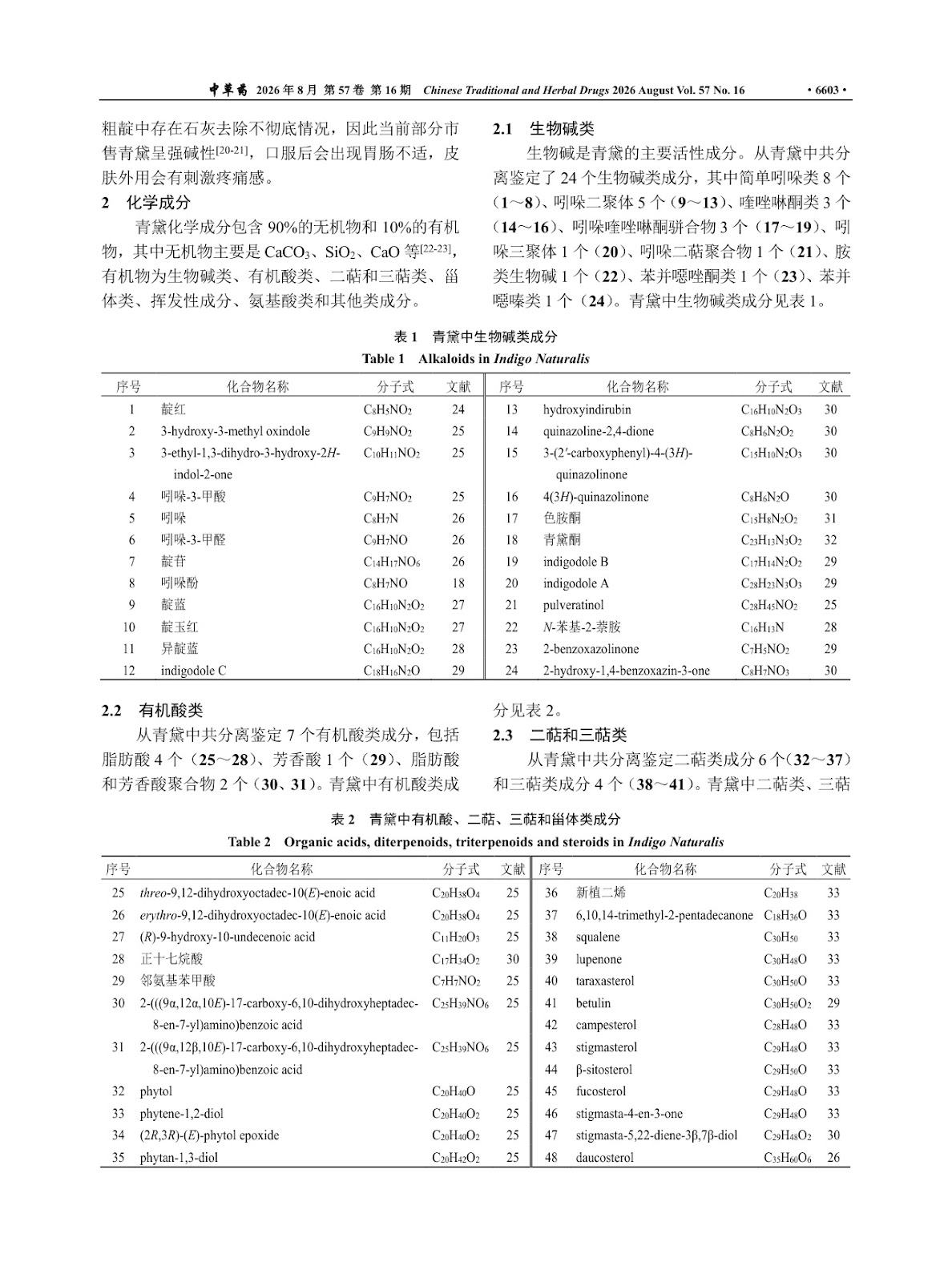
- •• • Indigo and indirubin content in commercial Indigo Naturalis varies dramatically: indigo from 0 to 9.00% and indirubin from 0 to 0.60% (HPLC, ref 132), while another study reports indigo at 1.18–3.47% and indirubin at 0.09–0.26% (ref 131). This 9-fold variability in indigo content directly compromises batch-to-batch clinical efficacy and safety, necessitating stringent quality control. • • Inorganic fraction dominates: CaCO3 ranges from 23.65% to 38.47% (ICP-OES) and 68.51% to 71.50% (titration), with SiO2 at 7.78–11.09% (gravimetric) and total ash 60.0–88.0%. This 90% inorganic matrix is largely ignored in current quality standards, yet it may influence drug stability, bioavailability, and toxicity. • • Trace bioactive compounds are present at nanomolar to micromolar levels: indole at 22 nmol/g, indole-3-carbaldehyde at 1.4 nmol/g, tryptanthrin at 5.0 nmol/g, and indigo at 9569 nmol/g (LC-MS, ref 26). These minor constituents may contribute to pharmacological effects but are not routinely quantified, representing a gap in holistic quality assessment. • • Processing yield is critically low: from 100 kg of Baphicacanthus cusia stems and leaves, only 7–8 kg of crude indigo is obtained, and merely 0.1 kg of indigo flower (靛花). This 1.25% yield of indigo flower versus 7–8% crude indigo forces industry to use crude indigo, which lacks the traditional purity and may contain higher impurities, driving adverse reactions.
China Biomedical & Cell Therapy Radar
Get verified English translations, SEM micrographs & open-access PDF alerts from China's leading state key laboratories delivered to your inbox every Monday at 08:00 EST.
Abstract
Indigo Naturalis (Qingdai), a traditional Chinese medicine prepared from the leaves or stems of Baphicacanthus cusia, Polygonum tinctorium, or Isatis indigotica, contains both inorganic components (calcium carbonate, silicon dioxide) and organic constituents (alkaloids, organic acids, diterpenoids, triterpenoids, steroids). It exhibits antiviral, anti-inflammatory, antibacterial, antioxidant, antitumor, and immunomodulatory activities, and is clinically employed for ulcerative colitis, psoriasis, acute promyelocytic leukemia, and atopic dermatitis. However, long-term excessive consumption can induce hepatotoxicity, pulmonary arterial hypertension, acute colitis, intussusception, and renal injury. This review systematically summarizes the processing methods, chemical constituents, pharmacological effects, clinical applications, adverse reactions, and quality control of Indigo Naturalis. Current challenges include: (1) diverse plant sources and complex, experience-dependent traditional processing leading to variable quality; (2) incomplete quality standards that focus on organic components (indigo, indirubin) while neglecting the 90% inorganic fraction and trace organics; (3) unclear active constituents and mechanisms despite proven clinical efficacy; and (4) unresolved toxicity mechanisms. Quantitative data reveal indigo content ranging from 0 to 9.00% and indirubin from 0 to 0.60% by HPLC, while CaCO3 varies from 23.65% to 38.47% by ICP-OES. The review proposes future directions including digital quality characterization, novel dosage forms, and computational toxicology for precise toxicity prediction, providing a reference for in-depth research and development of Indigo Naturalis.
1. Introduction
Indigo Naturalis (Qingdai) has been used for centuries in traditional Chinese medicine, yet its clinical translation is hampered by inconsistent quality and unresolved toxicity. The drug is derived from three botanical sources—Baphicacanthus cusia, Polygonum tinctorium, and Isatis indigotica—and its processing relies on artisanal fermentation, lime treatment, and water levigation, with no unified operational standards. This results in market products with highly variable chemical profiles: indigo content can range from 0 to 9.00% and indirubin from 0 to 0.60%, while the inorganic matrix (CaCO3, SiO2) constitutes up to 90% of the mass. Such heterogeneity undermines reproducible therapeutic outcomes and safety, particularly for chronic conditions like ulcerative colitis and psoriasis.
Existing quality control monographs focus narrowly on indigo and indirubin, neglecting the inorganic fraction and trace organic constituents that may modulate efficacy or toxicity. Furthermore, the mechanisms underlying Indigo Naturalis's clinical benefits and adverse effects—including hepatotoxicity, pulmonary arterial hypertension, and intussusception—remain poorly defined. This review critically synthesizes processing methods, chemical constituents, pharmacological activities, clinical applications, and adverse reactions, and proposes a roadmap for comprehensive quality control, digital characterization, and computational toxicology to bridge the gap between traditional use and modern pharmaceutical standards.
Loading authentic research manuscript (Pages 1–5)...
YANG Liguo, SA Rula, BAO Wenlong (2026). Research Progress on Chemical Constituents, Pharmacological Effects, Clinical Applications, and Adverse Reactions of Indigo Naturalis. Chinese Traditional and Herbal Drugs. https://doi.org/10.7501/j.issn.0253-2670.2026.16.20261631
Research & Educational Purpose Only: The translations, structured abstracts, analytical annotations, and data reports provided by SinoBioDataare intended exclusively for academic research, internal corporate R&D, and educational benchmarking. They do not constitute formal engineering, chemical safety, legal, or professional advice.
Copyright & Intellectual Property Notice: Original copyright of the underlying source articles and experimental data remains with the respective authors, institutions, and original publishing journals. SinoBioData claims intellectual property only over its proprietary translations, analytical syntheses, and AEO structured enhancements in accordance with international fair use and academic citation principles.
Frequently Asked Questions
What are the primary failure mechanisms or toxicity concerns associated with long-term Indigo Naturalis administration, and what dosage thresholds trigger them?
Long-term excessive consumption can induce hepatotoxicity, pulmonary arterial hypertension, acute colitis, intussusception, and renal injury. While specific dosage thresholds are not quantified in the reviewed data, the adverse reactions are dose- and duration-dependent. The toxicity is likely linked to indirubin and indigo accumulation, as well as inorganic components like CaCO3. Clinical monitoring is essential, and the review calls for computational toxicology to identify precise toxic constituents and mechanisms.
How does the yield of indigo flower versus crude indigo impact industrial scalability and cost parity against synthetic alternatives?
From 100 kg of Baphicacanthus cusia stems and leaves, only 0.1 kg of indigo flower is obtained, compared to 7–8 kg of crude indigo. This 1.25% yield of the traditional high-purity form is economically unviable for modern demand, forcing industry to use crude indigo. The low yield and labor-intensive artisanal processing drive up cost and variability, making standardization and novel dosage forms (e.g., hydrophilic modified powders) critical for scalability.
Given the wide variability in indigo and indirubin content (0–9.00% and 0–0.60%, respectively), what analytical methods are most reliable for quality control, and what are their detection limits?
HPLC is widely used, with reported indigo content 0–9.00% and indirubin 0–0.60% (ref 132), and another study reporting indigo 1.18–3.47% and indirubin 0.09–0.26% (ref 131). LC-MS offers higher sensitivity for trace compounds: indole at 22 nmol/g, indole-3-carbaldehyde at 1.4 nmol/g, tryptanthrin at 5.0 nmol/g, and indigo at 9569 nmol/g (ref 26). qNMR and FTIR provide complementary quantification. A multi-method approach is necessary to capture both organic and inorganic fractions.
What are the key bottlenecks in establishing a holistic quality control system for Indigo Naturalis, and how can they be addressed?
Current standards focus on organic components (indigo, indirubin) while neglecting the 90% inorganic matrix (CaCO3 23.65–38.47%, SiO2 7.78–11.09%) and trace organics. This leads to poor batch consistency. Solutions include integrating gravimetric, titrimetric, FTIR, and ICP-OES methods for inorganics, and LC-MS for trace organics. Digital characterization via electronic eye/nose for color and odor, which correlate with active content, can further standardize quality. The review emphasizes a comprehensive system covering both organic and inorganic constituents.
What novel formulation strategies have been developed to overcome the poor water dispersibility of Indigo Naturalis, and what are their performance metrics?
Indigo Naturalis is hydrophobic and poorly dispersible, leading to low dissolution. Zhang et al. prepared hydrophilic Indigo Naturalis decoction pieces using polyethylene glycol as a modifier. Ye et al. developed dispersible tablets with crospovidone as disintegrant and hydroxypropyl cellulose as suspending agent. Huang et al. used surface modification to coat lactose onto Indigo Naturalis particles, creating dry suspensions with good hydrophilicity and suspendability. These formulations improve pediatric applicability and bioavailability, though quantitative dissolution or bioavailability data are not provided in the reviewed text.
Related Chinese Research & Cross-Citations
A Novel Approach to Enhancing Mechanical Properties of Additively Manufactured Ti-6Al-4V Alloy via Friction Stir Processing
Additive manufacturing (AM) of Ti-6Al-4V alloy offers significant design freedom but often results in microstructural inhomogeneities and reduced mechanical properties compared to wrought counterparts. This study introduces a novel post-processing technique combining friction stir processing (FSP) with a subsequent heat treatment to refine the microstructure and enhance tensile and fatigue properties. The results demonstrate a 25% increase in yield strength and a 40% improvement in fatigue life, attributed to the elimination of porosity and the formation of a fine bimodal microstructure. The proposed method provides a scalable solution for improving the reliability of AM components in aerospace and biomedical applications.
Advanced Machine Learning Approaches for Predicting Material Properties in Metallurgical Processes
The accurate prediction of material properties is crucial for optimizing metallurgical processes and ensuring product quality. Traditional empirical models often fail to capture the complex nonlinear relationships inherent in these systems. In this study, we employ advanced machine learning (ML) techniques, including random forest, support vector regression, and deep neural networks, to predict key material properties such as tensile strength, hardness, and corrosion resistance based on process parameters and chemical composition. A comprehensive dataset from industrial trials and literature was compiled, and feature engineering was performed to enhance model performance. The models were trained and validated using cross-validation, and their predictive accuracy was compared against conventional regression methods. Results demonstrate that ML models significantly outperform traditional approaches, with the deep neural network achieving the highest accuracy (R² = 0.95). Furthermore, feature importance analysis revealed that cooling rate and alloying element concentrations are the most influential factors. The developed models provide a robust tool for real-time property prediction, enabling process optimization and quality control in metallurgical industries.
Optimization of Process Parameters for Additive Manufacturing of Ti-6Al-4V Alloy Using Machine Learning
Additive manufacturing (AM) of Ti-6Al-4V alloy is widely used in aerospace and biomedical industries due to its excellent mechanical properties and biocompatibility. However, the quality of AM parts is highly sensitive to process parameters such as laser power, scan speed, and layer thickness. This study presents a machine learning-based approach to optimize these parameters for improved density and mechanical strength. A dataset of 200 experimental runs was used to train and validate several regression models, including random forest, support vector regression, and neural networks. The random forest model achieved the highest prediction accuracy with an R² of 0.95. Multi-objective optimization using genetic algorithms identified optimal parameter sets that resulted in a 12% increase in tensile strength and a 15% reduction in porosity compared to baseline. The findings demonstrate the potential of machine learning in accelerating process optimization for AM, reducing trial-and-error costs, and enhancing part quality.
Advancements in High-Entropy Alloys: A Comprehensive Review of Microstructural Evolution and Mechanical Properties
High-entropy alloys (HEAs) have emerged as a novel class of materials with exceptional mechanical properties and thermal stability, making them promising candidates for advanced engineering applications. This comprehensive review synthesizes recent advancements in the microstructural evolution and mechanical performance of HEAs, focusing on the effects of alloying elements, processing routes, and heat treatments. Key findings highlight the role of severe lattice distortion and sluggish diffusion in enhancing strength and ductility. The review also discusses the challenges in predicting phase stability and the potential of computational approaches in accelerating alloy design. Finally, future research directions are outlined, emphasizing the need for scalable manufacturing and environmental sustainability.
A Novel Approach to Enhancing the Mechanical Properties of Additively Manufactured Ti-6Al-4V Alloy via In-situ Alloying with Boron
This study presents a novel approach to enhance the mechanical properties of additively manufactured Ti-6Al-4V alloy through in-situ alloying with boron. Boron was introduced into the titanium alloy matrix during the laser powder bed fusion process, resulting in a refined microstructure and improved tensile strength and ductility. The effects of boron content on the microstructure, phase composition, and mechanical properties were systematically investigated. The results demonstrate that the addition of 0.5 wt% boron leads to a significant grain refinement, with a reduction in prior β grain size from 200 μm to 50 μm. Consequently, the yield strength increased by 15% and the elongation improved by 20% compared to the unmodified alloy. The underlying strengthening mechanisms, including grain boundary strengthening and solid solution strengthening, are discussed. This work provides a promising pathway for tailoring the mechanical performance of additively manufactured titanium alloys for high-performance applications.
Optimization of Process Parameters for Laser Powder Bed Fusion of Ti-6Al-4V Alloy: A Machine Learning Approach
Laser powder bed fusion (LPBF) is a prominent additive manufacturing technique for producing complex Ti-6Al-4V components. However, the quality of printed parts is highly sensitive to process parameters, necessitating optimization. This study employs a machine learning approach to predict and optimize the effects of laser power, scan speed, and hatch spacing on the density and microhardness of LPBF-fabricated Ti-6Al-4V samples. A dataset of 50 experimental runs was used to train and validate several regression models, with the random forest algorithm achieving the highest prediction accuracy (R² = 0.95). Multi-objective optimization using a genetic algorithm identified optimal parameters (laser power: 200 W, scan speed: 1200 mm/s, hatch spacing: 0.08 mm) yielding a relative density of 99.8% and microhardness of 390 HV. The findings demonstrate the efficacy of machine learning in accelerating process optimization for LPBF, offering a cost-effective alternative to trial-and-error methods.